Have you ever looked for a favorite crayon and found it broken, lost, or under a chair? Shared things need extra care because many people use them. When you take care of a book, a toy, a table, or a tablet that others use too, you are helping everyone learn, play, and stay safe.
Some things belong to just you. Some things are for everyone. Shared things can be markers your family shares, library books, puzzles, headphones, a learning table, or a computer used for schoolwork. When we care for shared things, they last longer and stay ready for the next person.
Taking care of shared things also shows kindness and responsibility. If you put the scissors back in the right place, someone else can find them. If you wipe up a spill, no one slips. Small habits make a big difference.
Shared materials are things more than one person uses, like crayons, books, blocks, or devices.
Shared spaces are places everyone uses, like a kitchen table for learning, a reading corner, or a play area.
Learning resources are tools that help you learn, like paper, pencils, books, tablets, headphones, and art supplies.
At home and in the community, caring for shared things helps people trust you. Others learn that you will be gentle, careful, and honest.
You may share a chair at the table, a box of markers, a puzzle shelf, or a family tablet. You might also borrow a library book or use supplies at a club, camp, or community center. These are all shared things, so they need safe hands and careful choices.
Sometimes shared learning resources are digital. A family computer, headphones, or a charger can be used by more than one person. If you finish using them and put them back where they belong, the next person can use them too.
When you borrow something, it is important to ask first. Saying, "May I use this?" is part of caring. Returning it in good shape is part of being fair.
As shown in [Figure 1], a routine is something you do the same careful way each time. A good caring routine helps you remember what to do with shared things. You can follow this easy plan: ask, use gently, keep clean, put away.
Step 1: Ask first. Make sure it is okay to use the item. Step 2: Use gentle hands. Open slowly, carry carefully, and do not throw, bend, or yank. Step 3: Keep it clean. Wash your hands if they are sticky. Keep drinks away from books and devices. Step 4: Put it back. Return it to the right place when you are done.
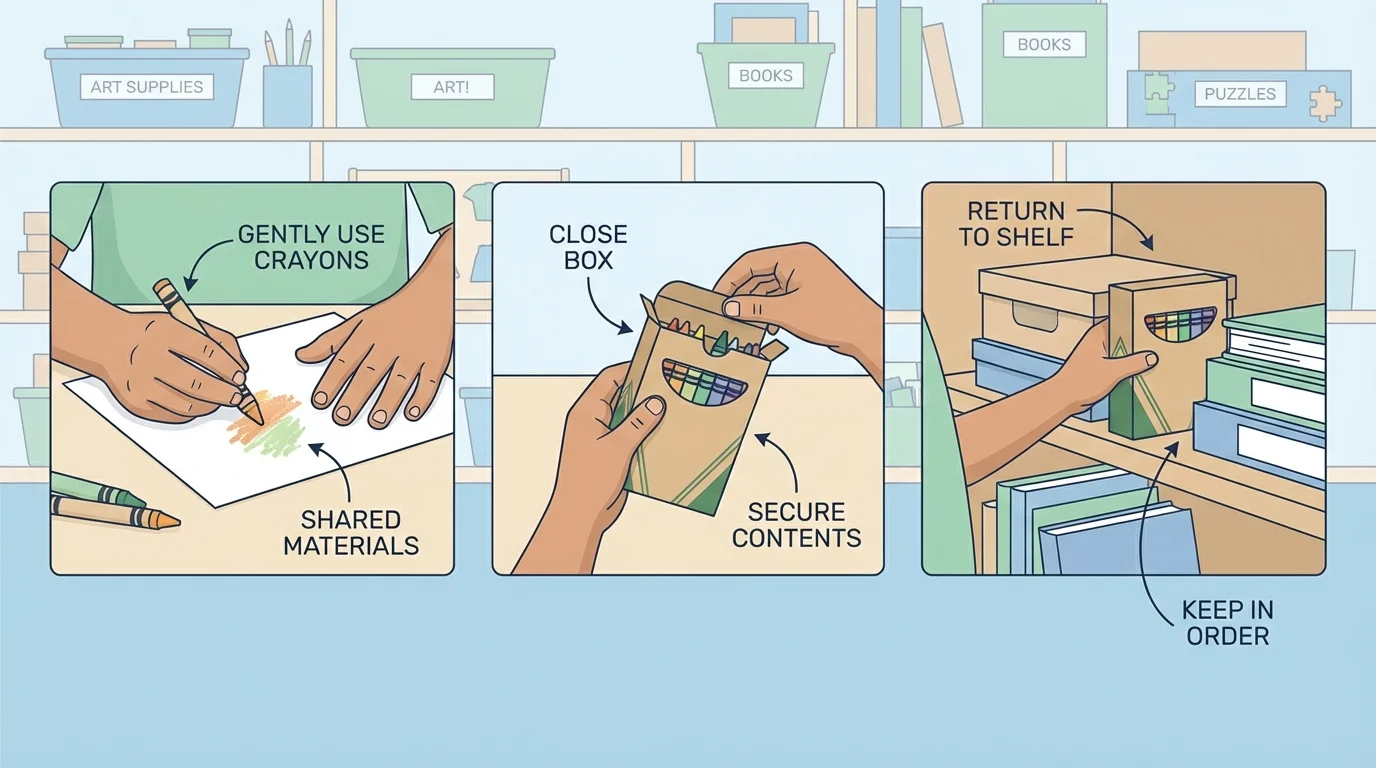
If you use markers or crayons, put the caps on the markers, gather the papers, and place everything back in the box. If you use a tablet, carry it with two hands, keep it away from water, and give it back carefully.
Example: Using shared art supplies
Step 1: Take one box of crayons and open it gently.
Step 2: Color on your paper, not on the table.
Step 3: Pick up all the crayons when you finish.
Step 4: Close the box and return it to the shelf.
This keeps the crayons safe, tidy, and ready for the next person.
Try This: Before you walk away from a shared item, stop and ask yourself, "Is it clean? Is it safe? Is it back where it belongs?"
As shown in [Figure 2], a shared space should be easy to use and safe to walk through. In a tidy space, supplies are in place, the chair is pushed in, and the floor is clear. That helps everyone feel calm and safe.
A messy space can cause problems. A cup near a computer might spill. Paper on the floor can be stepped on. A marker without a cap can dry out. Caring for a space means looking around before you leave and fixing small problems right away.
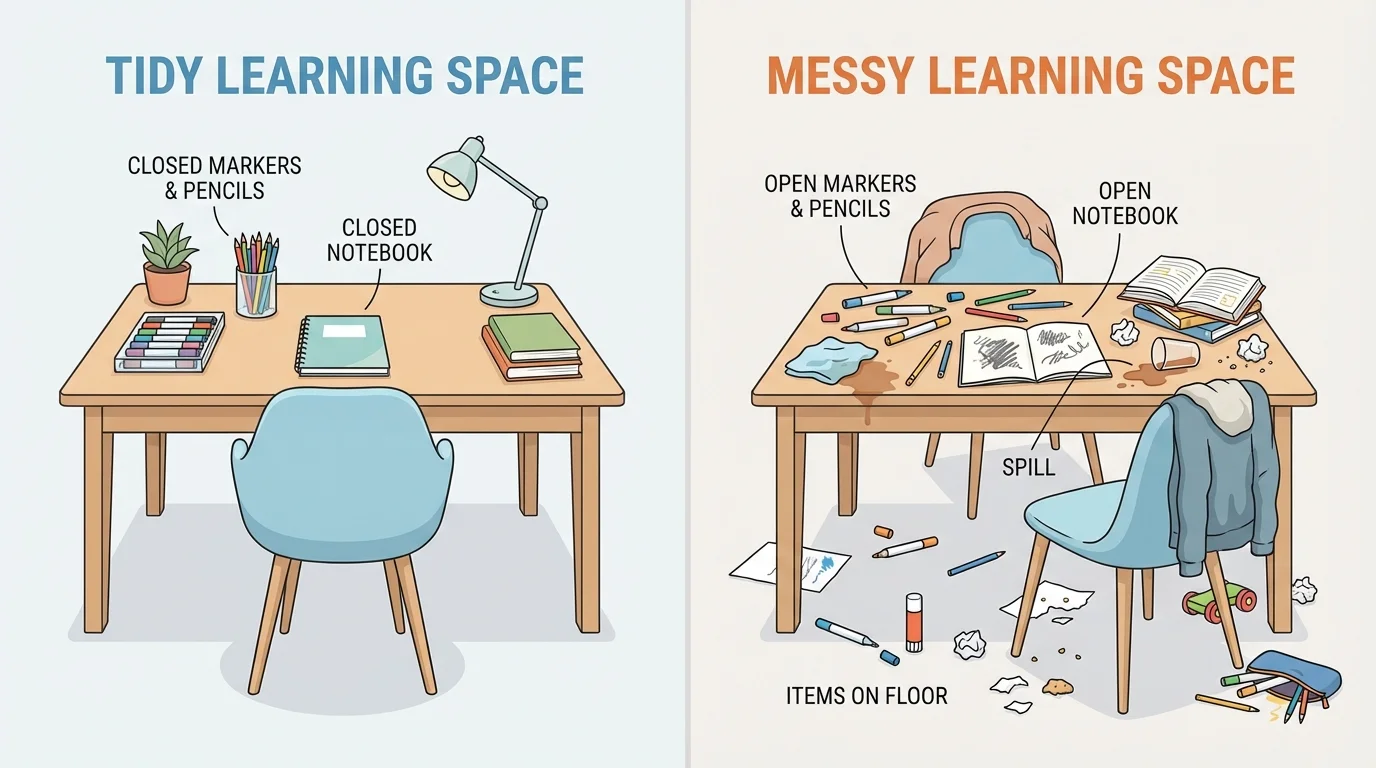
You can use a simple clean-up check: push in the chair, throw away trash, stack books, close supplies, and clear the floor. If you move something, put it back. If you make a mess, clean it up.
These habits matter in community places too. At the library, place books gently on a table. At the park or club, return game pieces and balls to the bin. Shared places stay nice when each person helps a little.
Many things get broken by accident when people are in a hurry. Slowing down, carrying with two hands, and putting items back in the same spot can prevent many problems.
Later, when you use your learning area again, the routine from [Figure 1] still helps: use gently, keep clean, and put away. Good routines work again and again.
As shown in [Figure 3], sometimes a shared resource has a problem. A book may have a torn page. A toy may crack. A tablet screen may break. The safe choice is to stop using it and tell a trusted adult right away.
Do not hide the problem. Do not keep playing with broken pieces. Sharp edges, loose parts, or cracked screens can hurt someone. Telling the truth helps adults fix the problem and keep everyone safe.
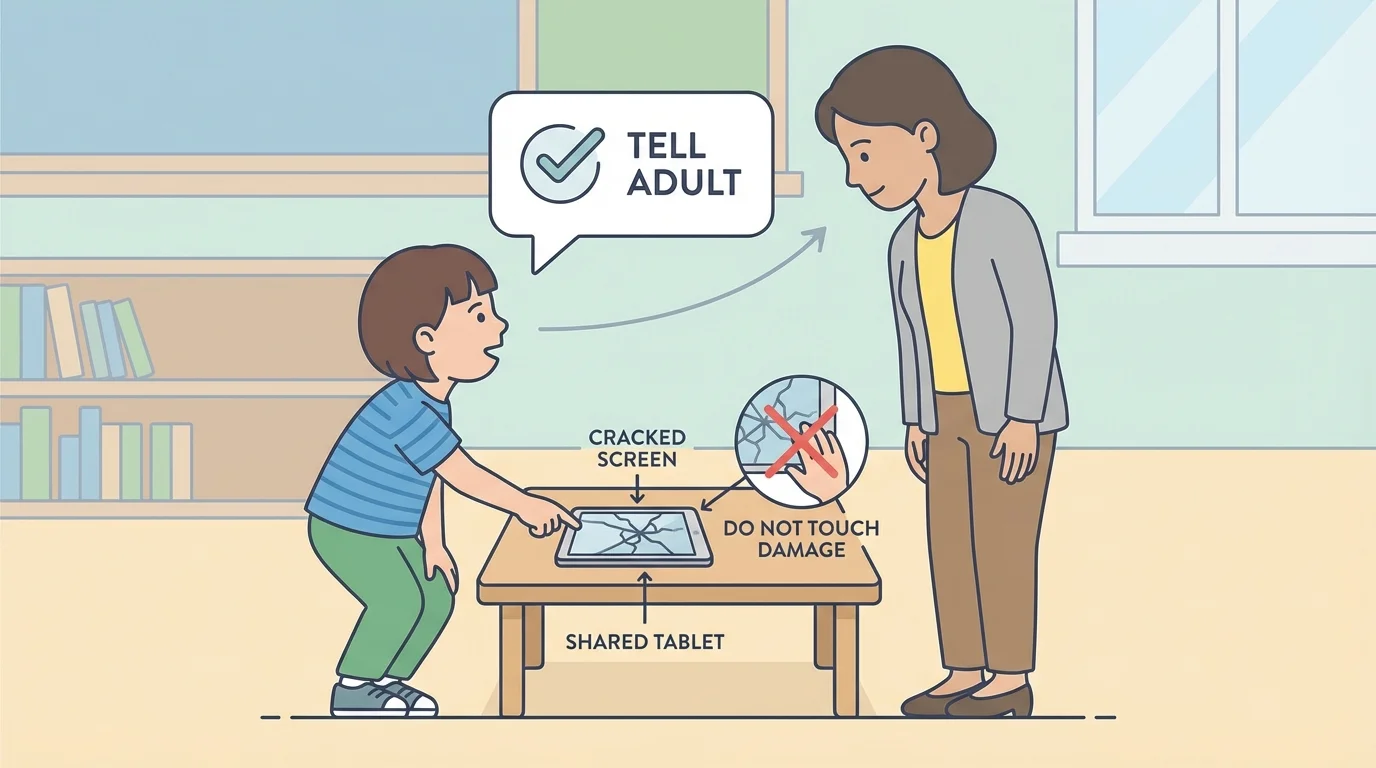
If something is dirty, ask how to clean it the right way. Some things can be wiped. Some things need an adult to help. If something is missing, look carefully in the usual place first, then tell an adult. Being honest is part of responsibility.
Why honesty keeps people safe
When you tell an adult about a spill, a broken item, or a missing piece, the problem can be fixed quickly. Hiding it can lead to bigger messes, damaged materials, or someone getting hurt.
At another time, the neat-and-messy comparison in [Figure 2] helps you remember to check the whole area, not just the one item you used. Safety includes the object and the place around it.
Here are some everyday examples. You finish drawing with family markers. A good choice is to snap on the caps and place the markers in the bin. You borrow a library book. A good choice is to keep it dry, turn pages gently, and return it on time.
You use headphones for an online lesson. A good choice is to unplug carefully, wrap the cord loosely, and place them where your family keeps them. You use blocks with a sibling. A good choice is to pick them up together so no one steps on them later.
Example: A smart choice after a spill
Step 1: Stop using the shared area.
Step 2: Move books, paper, or a device away from the spill.
Step 3: Tell an adult right away.
Step 4: Help clean up if the adult says it is safe.
This protects the materials and keeps people from slipping or damaging something.
Try This: Choose one shared thing you use every day, like a pencil cup, a table, or a tablet spot. Today, practice putting it back neatly every single time.
When you care for shared things, you are doing more than cleaning up. You are showing that you can be trusted. You are making life easier for your family and for other people in your community.
These habits build a strong community. In a community, people help one another. They take turns, share fairly, and fix problems together. Caring for shared materials and spaces is one way you can help every day.
"Take care of things we share, and we take care of each other."
Even small actions matter: carrying with two hands, putting books on a shelf, throwing trash away, and telling the truth when something goes wrong. Safe routines help everyone learn, play, and feel respected.
