Have you ever seen one person reading on a tablet, another person planting flowers outside, and another person helping a pet at the animal clinic in one day? People do important things in many places. Some people learn at home. Some people work outdoors. Some people help in a store, a park, a hospital, or on a computer. The world is full of different settings, and each one matters.
As you grow, it helps to notice that there is not just one "right" place for learning, working, or helping. When you understand this, you can be more respectful, more curious, and better prepared for your own future. You can also see how your family and your community work together.
Setting means the place where something happens. A setting can be a home, a garden, a library, a clinic, a store, a park, or an online space.
Community is a group of people who live, work, learn, or help near one another or together in some way.
People are different, and their days are different too. One person may cook meals in a kitchen. Another may fix cars in a garage. Another may answer questions on a computer from home. Another may care for plants on a farm. These are all useful ways to work and help.
You may also learn in different ways and places. You learn from family members, from books, from videos, from games, from nature walks, and from people in your neighborhood. Learning is not only something that happens in one building. It can happen almost anywhere when you are paying attention.
Some adults keep learning for their whole lives. A nurse, chef, artist, or mechanic may still learn new skills even after becoming very good at their job.
When you notice different settings, you start to understand a big idea: people can do good work in many ways. That helps you respect jobs and helpers you may not see every day.
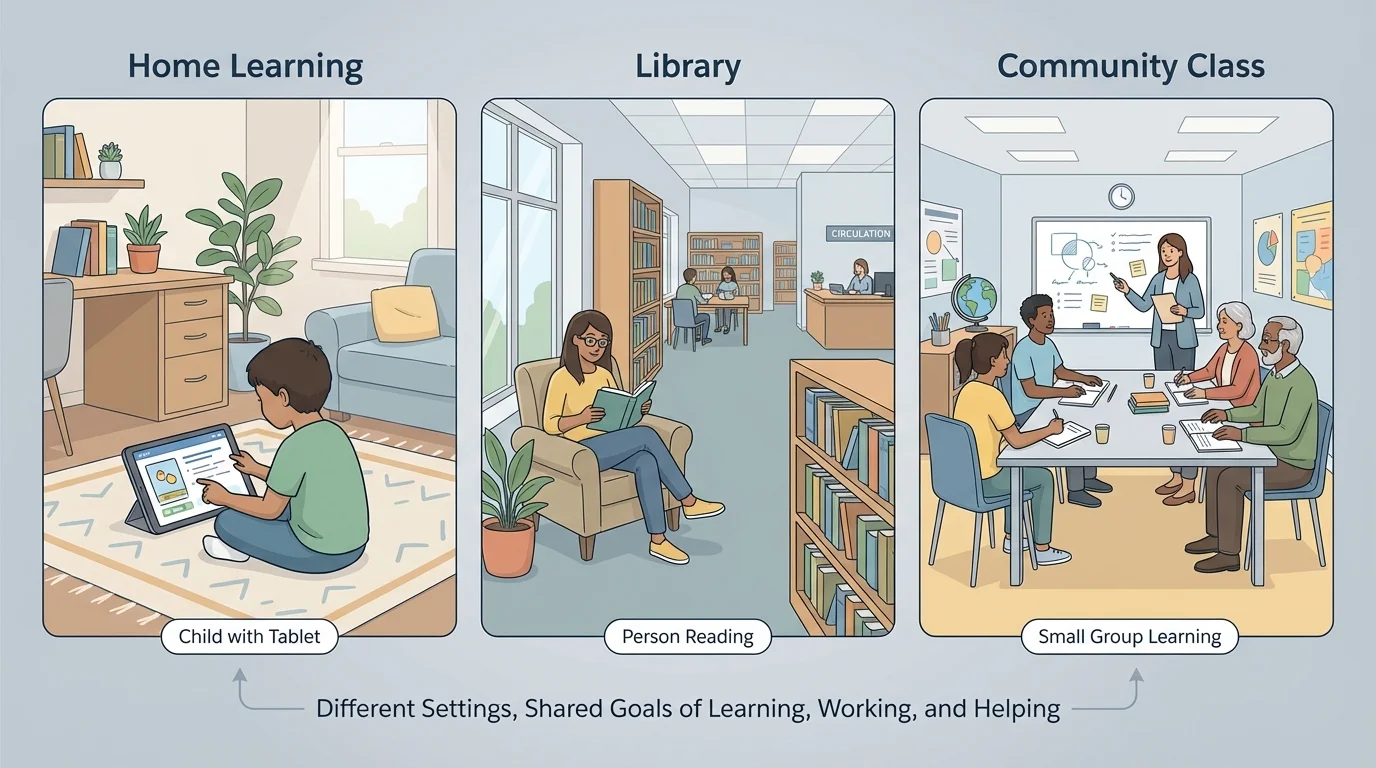
People can learn in many places, as [Figure 1] shows. A child may learn at home on a computer. A teen may learn in a library. An adult may learn in a training class at work. A grandparent may learn how to use a new phone from a family member.
Some learning happens quietly, like reading a story. Some learning happens by doing, like baking, tying shoes, or watering plants. Some learning happens by talking and listening on a video call. All of these are real learning.
If your family member watches a video to learn how to fix a sink, that is learning. If you learn how to fold clothes by watching and trying, that is learning too. If someone learns English from a phone app, that is learning too. Learning can happen little by little each day.
Learning looks different for different people. Some people learn best by watching. Some learn best by listening. Some learn best by trying it with their hands. A good learner keeps an open mind and keeps practicing.
That is why it is kind to avoid saying that everyone must learn the same way or in the same place. The different learning settings in [Figure 1] remind you that home, libraries, community programs, and online spaces can all be places for growth.
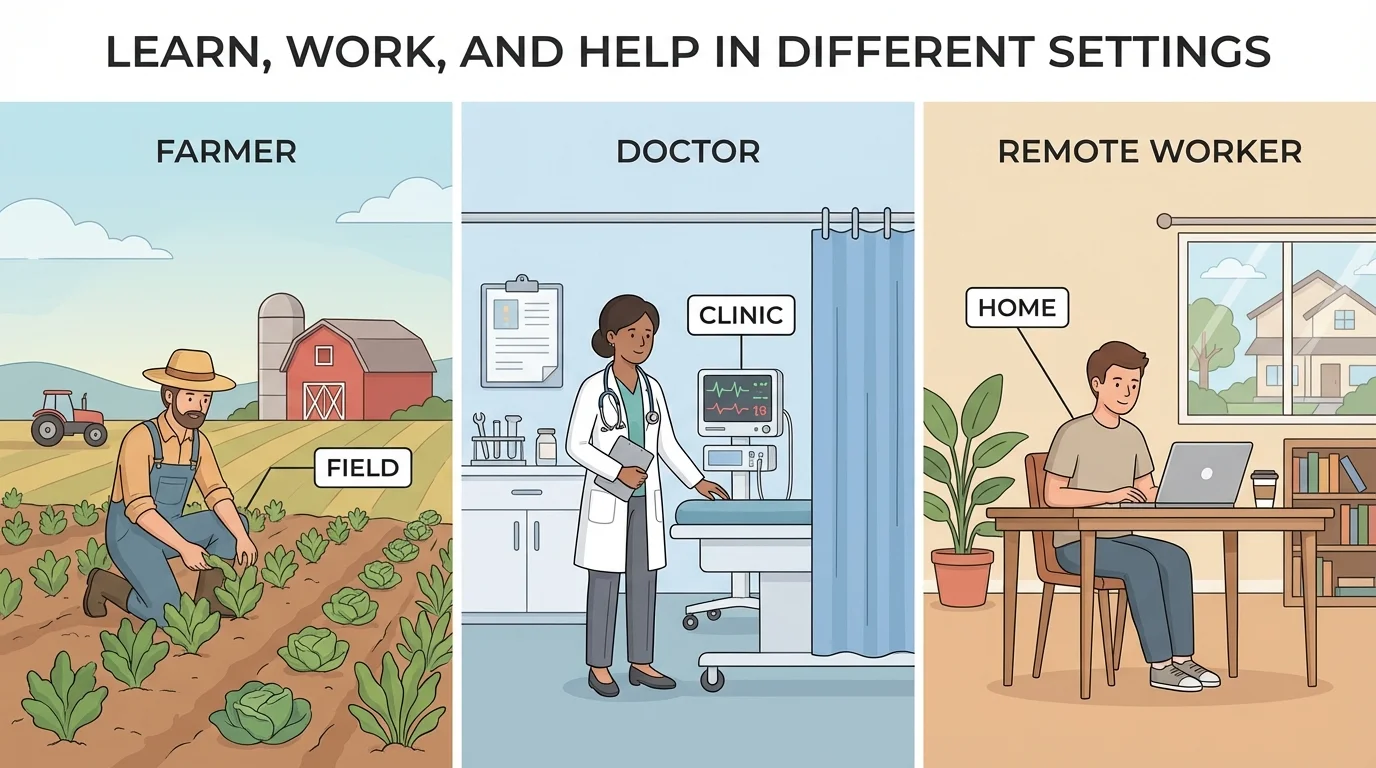
Adults work in many settings, as [Figure 2] illustrates with clear examples. Some work indoors in offices, kitchens, clinics, or shops. Some work outdoors in gardens, on farms, at building sites, or in parks. Some work while traveling in trucks, delivery vans, or service cars. Some work from home on computers.
A doctor may work in a clinic. A mail carrier may work outside and on the road. A baker may start work very early in a kitchen. A graphic designer may work online from a desk at home. A firefighter may work in many places depending on who needs help.
Work settings can look different because the job is different. A person who cares for animals needs one kind of place. A person who fixes internet problems may need another kind of place. A person who plants food needs land and tools. A person who writes stories may need a quiet room and a computer.
When people have the right setting, they can do their jobs better. If a gardener had no garden, growing plants would be hard. If a computer worker had no internet, sending work would be hard. The place matters because it helps people do what they need to do.
Real-life noticing example
Step 1: Look around your day.
You might see a delivery person at the door, a parent on a laptop, and a worker cleaning a park.
Step 2: Name the setting.
One person works on the road, one works at home, and one works outdoors.
Step 3: Notice the purpose.
Each person is doing something useful for other people.
Later, when you think about your own future, this matters. You may enjoy quiet indoor work, busy outdoor work, hands-on work, or online work. The many job settings in [Figure 2] show that there are lots of ways to take responsibility and contribute.
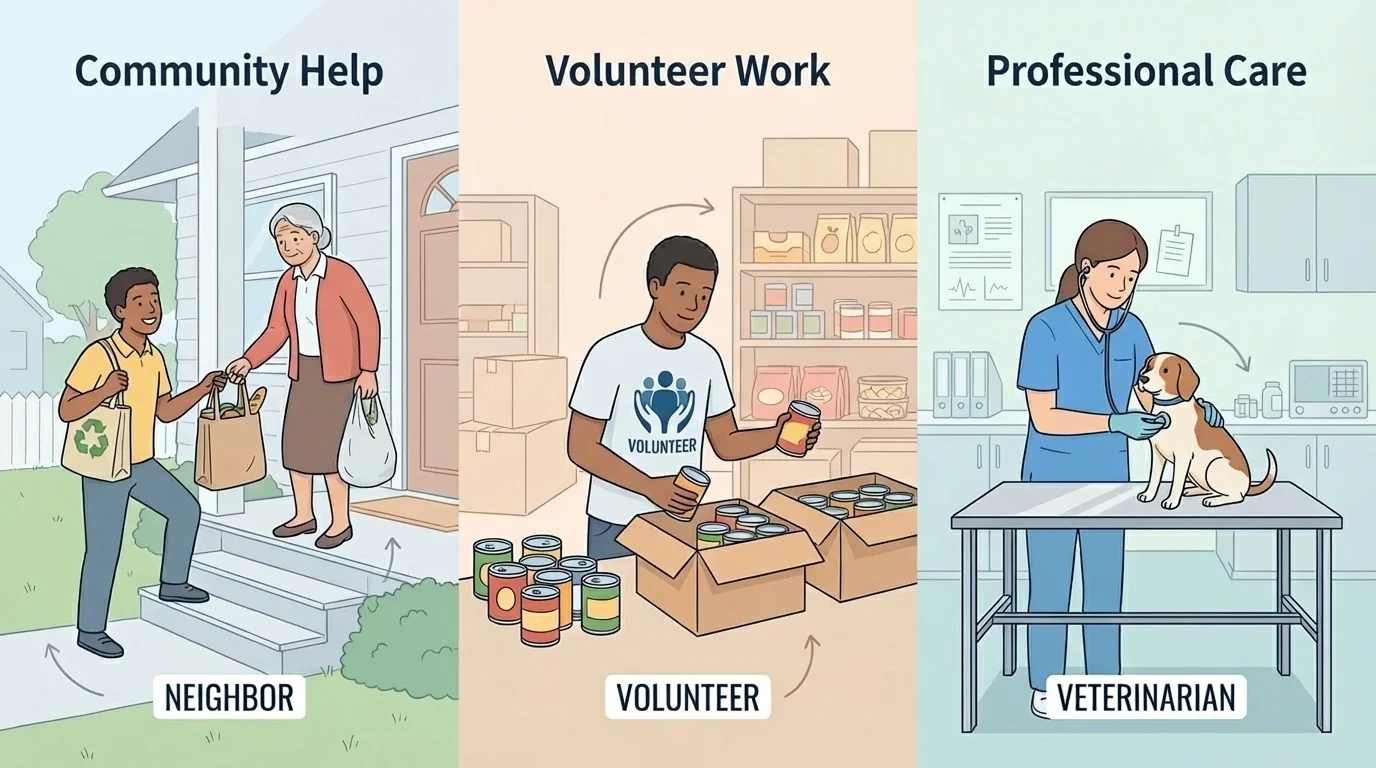
Helping can happen almost anywhere, and [Figure 3] shows that clearly. A neighbor may help carry groceries. A volunteer may sort food donations. A veterinarian may help sick animals. A family member may help a child button a coat. A person online may help someone learn how to solve a problem.
Sometimes helping is part of a job. Sometimes helping is something people choose to do because they care. Both are important. Communities grow stronger when people notice needs and respond kindly.
You can help in small ways too. You can put toys away, feed a pet with a grown-up's permission, hold the door, speak kindly on a video call, or bring a tissue to someone who is sneezing. Small helpful actions make daily life better.
"Many hands make light work."
Helping in different settings also means different rules. In a library, helping may mean using a quiet voice. At home, helping may mean cleaning up. Online, helping may mean waiting your turn to speak and using kind words. The helping scenes in [Figure 3] connect to one big idea: the place may change, but kindness still matters.
Sometimes children think their own routine is the only normal one. But families and communities can be very different. One adult may leave home to work. Another may work at home. One child may learn from a tablet. Another may learn from books and community activities. These differences are okay.
A respectful person does three simple things. First, they observe. That means they look and notice without laughing or being rude. Second, they listen. They let people explain what they do. Third, they speak kindly. They can say, "You work outside," or "You learn online," without saying one way is better than another.
You already know that people have different homes, families, and routines. This idea fits with that: people also learn, work, and help in different settings.
Respect is important because unkind words can hurt feelings. If you say, "That is a weird job," someone may feel sad or embarrassed. If you say, "That job helps people," you show care and understanding.
Good noticing can also help you stay safe and prepared. If you know that a doctor works in a clinic, you know where to go when someone feels very sick. If you know that a librarian helps people find books, you know whom to ask for help. If you know that online helpers should be trusted adults, you make safer choices.
You can start noticing different settings today. Look around your home and neighborhood. Who is learning? Who is working? Who is helping? You may see more than you expected.
Here are a few simple ways to build this life skill. Notice one person and say what setting they are in. Name the job or help they are doing. Say why it matters. For example: "The gardener works outside and helps plants grow." Or: "Grandpa learns on his phone so he can send messages."
Kind words you can use
Step 1: Start with what you see.
"I see you are working on the computer."
Step 2: Name the setting.
"You work from home."
Step 3: Show respect.
"That looks important. Thank you for helping."
When you practice this, you become more aware of the world. You also become more ready for your own future. One day, you will learn new things, do work that matters, and help others too. Your setting may be a home office, a kitchen, a garden, a studio, a clinic, a workshop, or somewhere else. What matters most is using your place well and treating other people's places with respect.
