Walk into a school, a park, or a grocery store, and you can hear many voices, see many foods, and notice many ways families live. That is one of the special things about the United States. People come from many places and have many traditions. When families bring their songs, stories, beliefs, languages, and celebrations, they help make our country what it is today.
A culture is a way of life shared by a group of people. Culture can include food, music, language, clothing, holidays, beliefs, and family traditions. A tradition is something people do again and again because it is meaningful to them.
Families can be similar in some ways and different in others. Some speak English at home. Some speak Spanish, Chinese, Hawaiian, Navajo, Tagalog, or other languages. Some families pray in a church, mosque, synagogue, temple, or at home. Some families have a mom and a dad, some have one parent, some have grandparents helping raise children, and some have two moms or two dads. All of these families are part of the story of the United States.
Culture means the traditions, beliefs, language, food, music, and ways of living that people share.
Tradition is something a family or group does again and again because it matters to them.
Source is something we use to learn information, such as a picture, a story, a song, or a book.
History is not only about presidents and battles. History is also about families. It tells how people cooked meals, raised children, made music, worked, celebrated, and helped their communities. When we learn about many families, we understand our country better.
Many cultures share important ideas, as [Figure 1] shows with children gathering around food, music, and family traditions. Families in many groups care for one another, teach children, celebrate special days, and remember older relatives. They may do these things in different ways, but the loving purpose is often the same.
Many families enjoy special foods, music, art, dancing, and stories. A birthday party, a holiday meal, a family song, or a bedtime story may look different from home to home. Still, each one can help children feel safe, loved, and connected.
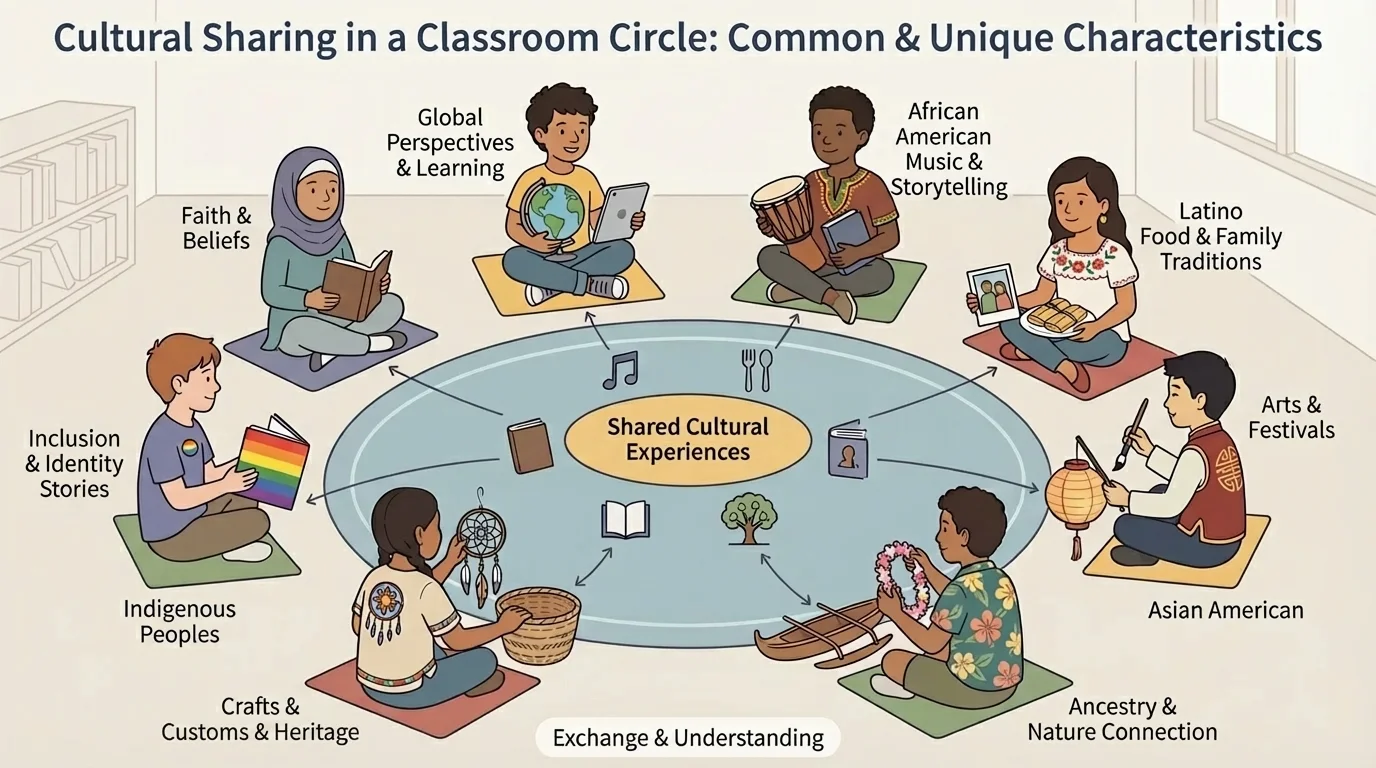
Another common characteristic is community. People often help neighbors, care for elders, welcome babies, and gather for important events. Some groups meet in churches. Others gather in cultural centers, homes, schools, parks, temples, mosques, or synagogues. In many cultures, respect for family and kindness to others are very important.
Some foods that feel very common in the United States, such as tacos, fried rice dishes, cornbread, and poke bowls, connect to traditions from different cultural communities.
Even when traditions are different, they can all matter. Looking again at [Figure 1], we can see that sharing food and stories helps people learn from one another. Similar human needs—love, belonging, and celebration—can be found in many cultures.
Each community also has special traditions and stories. [Figure 2] shows examples from several communities. These traditions help families remember where they come from and what they value.
African American families and communities have shaped the United States in powerful ways. They have contributed spirituals, jazz, blues, gospel, poetry, art, and important leadership for freedom and fairness. Family reunions, church communities, storytelling, and music are meaningful parts of life for many African American families.
Latino families may come from Mexico, Puerto Rico, Cuba, the Dominican Republic, Central America, South America, and other places. Many speak Spanish, while others speak English or both. Traditions can include family gatherings, dancing, special foods, and celebrations such as Día de los Muertos or Las Posadas in some communities.
Asian American communities include families whose roots are in countries such as China, Japan, Korea, India, Vietnam, and the Philippines. These communities have brought languages, festivals, foods, arts, and inventions. Some families celebrate Lunar New Year, wear special clothes on important days, or share stories from grandparents about moving to the United States.
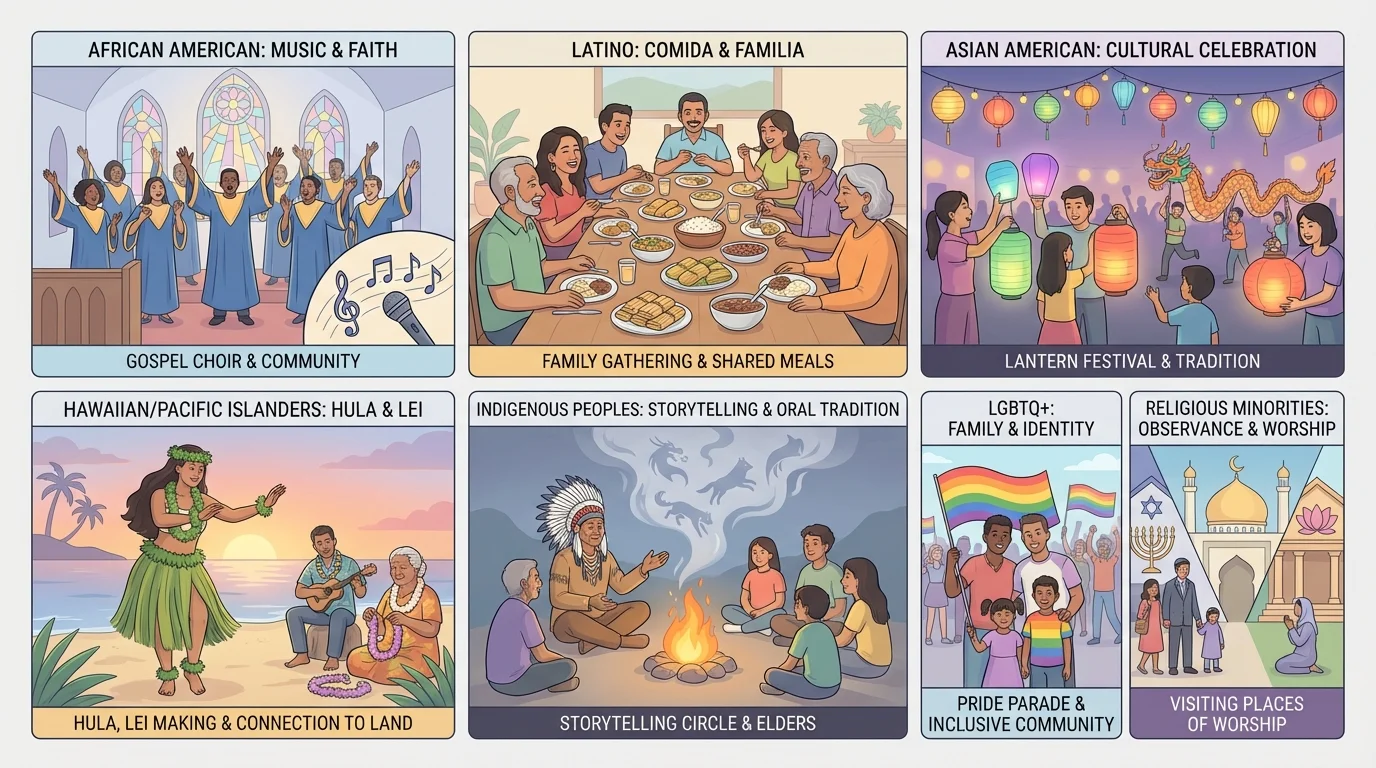
Hawaiian/Pacific Islander families may have roots in Hawaii, Samoa, Guam, Tonga, or other Pacific islands. Traditions can include dance, chant, flowers or leis, ocean knowledge, and caring for land and water. Their cultures remind us how people can stay connected to nature and community.
Indigenous Peoples are the first peoples of the lands that became the United States. There are many Indigenous nations, and each has its own language, history, and traditions. Storytelling, respect for the earth, tribal ceremonies, and arts such as weaving, beadwork, or carving are important in many communities. Indigenous cultures are living cultures today, not just in the past.
LGBTQ families are families that may include people who identify as lesbian, gay, bisexual, transgender, or queer. Some children have two moms, two dads, or family members who express themselves in different ways. Like all families, LGBTQ families share love, care, traditions, and celebrations. They help make neighborhoods, schools, and communities stronger.
Religious minorities are groups whose religion is not followed by most people in a place. This can include Jewish, Muslim, Hindu, Sikh, Buddhist, and other communities. Their traditions may include special prayer times, holidays, clothing, foods, music, and places of worship. These communities help the United States become a place with many beliefs and many ways to practice faith.
When we study these groups, we should be careful not to think every person in a group is exactly the same. Not every family celebrates the same holiday, eats the same food, or speaks the same language. Cultures have patterns, but every family is unique.
[Figure 3] People learn about the past by using different sources. A source can be a photograph, a letter, a song, a family object, an interview, or a book. Using more than one source helps us learn more carefully and more fairly.
A primary source is something from the time we are studying. A family photo, a grandparent telling a memory, a song sung long ago, or a special object from home can be a primary source. A secondary source is something made later, such as a history book or a video that explains the past.
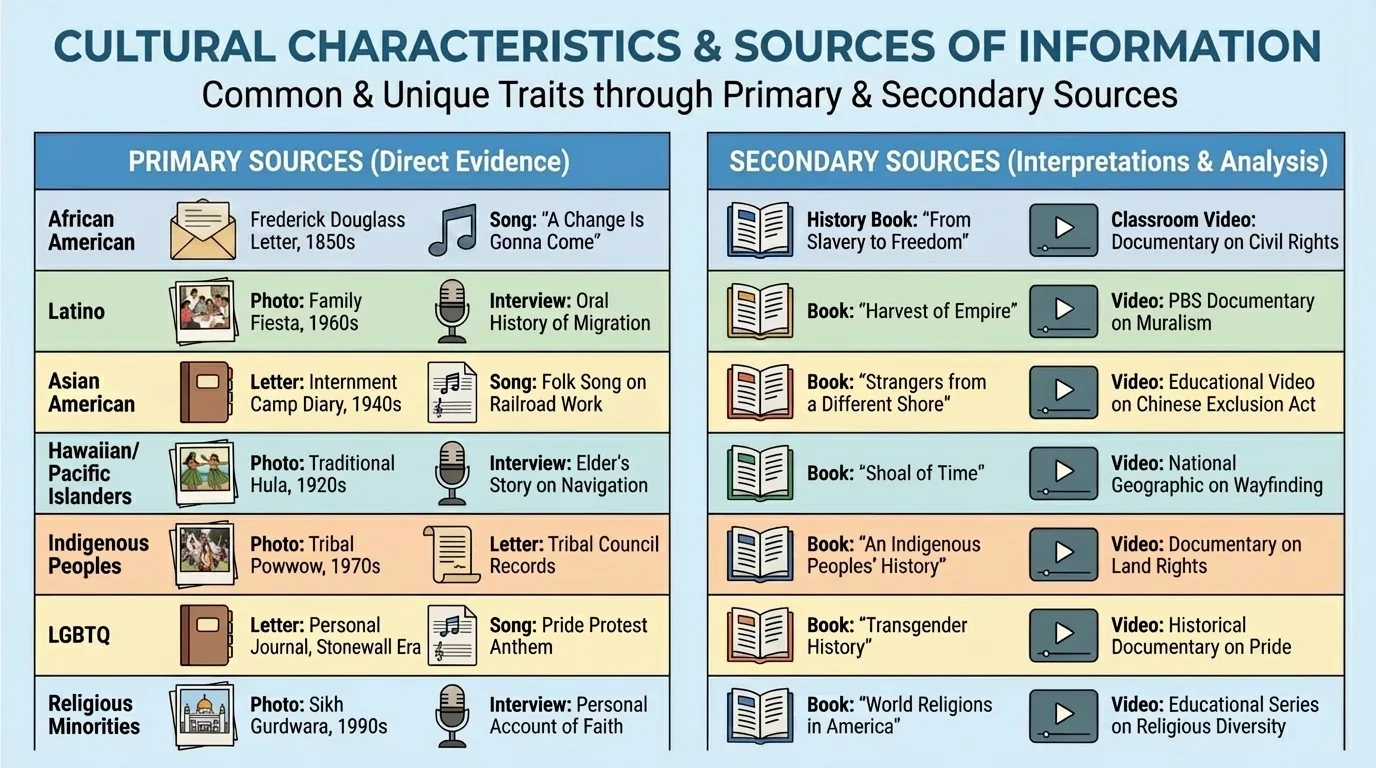
For example, if we want to learn about a Lunar New Year celebration, we might look at photographs, listen to a family member talk about it, and read a children's history book. If we want to learn about Indigenous storytelling, we might hear a story from a community member and also read a book written by an author from that nation. Looking at more than one source helps us avoid mistakes.
Learning from more than one source
A class wants to learn about a family celebration.
Step 1: Look at a photo.
The photo shows people wearing special clothes and sharing food.
Step 2: Listen to a family member.
The family member explains what the celebration means.
Step 3: Read a book.
The book gives more facts and helps the class compare traditions.
Using all three sources helps the class understand the celebration better.
Later, when we compare cultures, [Figure 3] reminds us that photos, objects, songs, and books can all teach us something different. Good learners ask, "What can I learn from this source?" and "What else do I need to know?"
The United States has been shaped by people from many cultures over a long time. Words from different languages, recipes from many homes, music from many communities, and holidays from many faiths all become part of daily life. This is one reason American culture is rich and varied.
African American musicians helped create jazz, blues, and many styles of popular music. Latino communities helped spread foods, art, dance, and Spanish words heard across the country. Asian American communities helped shape farming, railroads, science, medicine, technology, and neighborhood traditions. Hawaiian and Pacific Islander communities brought important knowledge about the ocean, dance, and care for land. Indigenous Peoples have always contributed knowledge about nature, farming, government ideas, language, and art. LGBTQ people have helped make schools, workplaces, and laws more fair. Religious minorities have helped protect freedom of belief for everyone.
Sometimes cultures meet and share ideas. A school concert may include gospel, mariachi, drumming, or songs from many places. A community fair may have dumplings, fry bread, tamales, noodles, and fruit punch. These are examples of people bringing their traditions together while still keeping what is special to them.
Shared and unique at the same time
People can be similar and different together. Many families love children, celebrate important days, and help neighbors. At the same time, each group may have special music, foods, beliefs, languages, or stories. Learning both parts helps us understand people more fully.
When we respect these contributions, we understand the country we live in better. We also learn that the United States keeps growing and changing because new generations continue to add their own voices and traditions.
[Figure 4] History has important people and moments that helped more families be seen and respected. These people and events remind us that fairness and inclusion grow over time. These traditions help families remember where they come from and what they value. Using more than one source helps us learn more carefully and more fairly.
Martin Luther King Jr. was an African American leader who spoke for civil rights and equal treatment. César Chávez helped farmworkers, many of whom were Latino, ask for fair treatment. Wilma Mankiller was a Cherokee leader who worked to help her people and community. Harvey Milk was a leader who spoke up for LGBTQ people. Many religious leaders have also worked for peace, kindness, and freedom to believe.
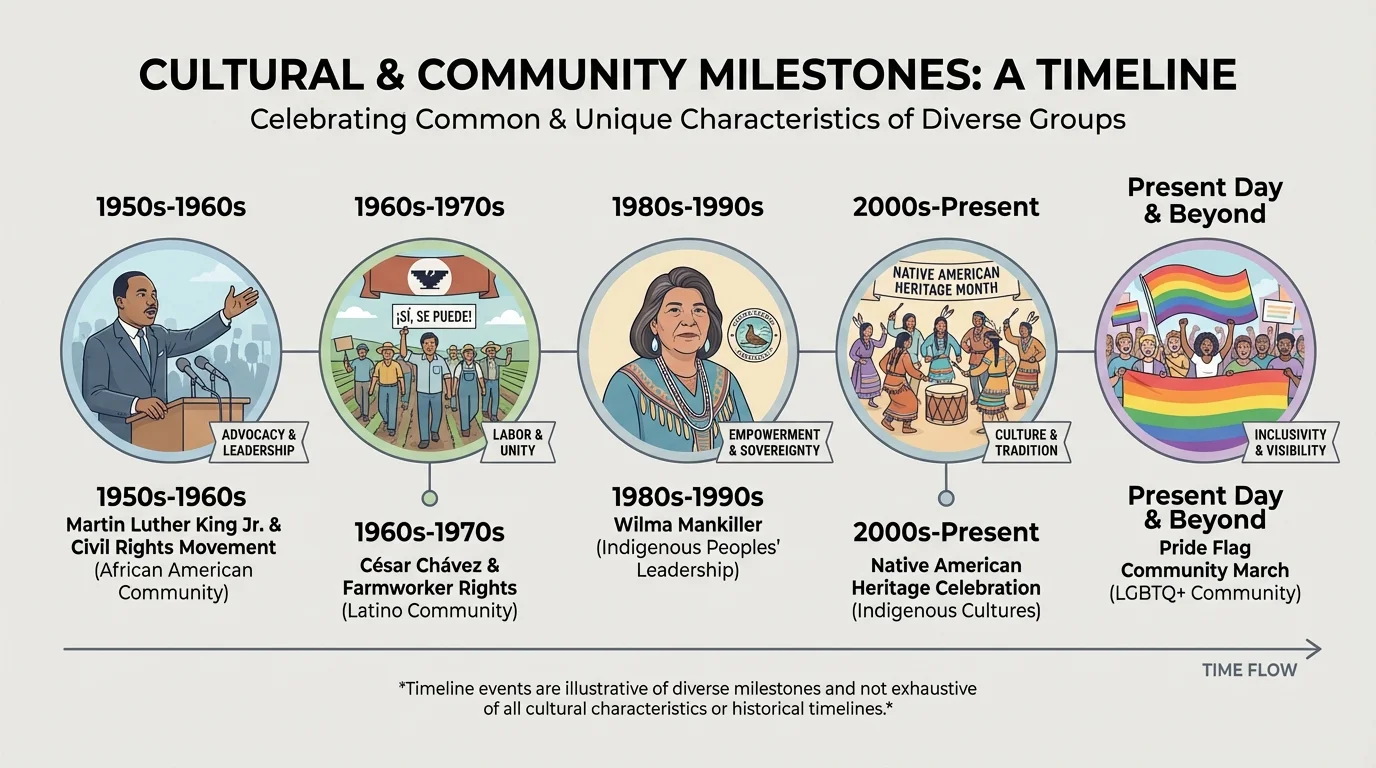
There are also important times of celebration and remembrance. Black History Month honors African American history. Hispanic Heritage Month celebrates many Latino histories and cultures. Asian American and Pacific Islander Heritage Month celebrates many communities and contributions. Native American Heritage Month honors Indigenous Peoples. Pride events celebrate LGBTQ communities. Religious holidays and festivals throughout the year help families remember faith and tradition.
Looking back at [Figure 4], we can see that change happens because people speak up, work together, and teach others. History includes both big leaders and everyday families who keep traditions alive.
Learning about culture helps us become thoughtful classmates and neighbors. When we listen carefully, ask kind questions, and avoid making fun of someone's food, clothing, language, or family, we help everyone feel welcome.
Respect does not mean everyone is the same. Respect means we understand that differences are real and important. It also means we see the shared humanity in all people. A child bringing a special lunch, wearing holiday clothes, singing a family song, or talking about two dads is sharing part of a real life and a real history.
| Community | One example of a unique tradition or contribution | Something many cultures share |
|---|---|---|
| African American | Gospel, jazz, storytelling, civil rights leadership | Family love and celebration |
| Latino | Spanish language traditions, dances, family gatherings | Special foods and holidays |
| Asian American | Lunar New Year, arts, many languages and histories | Respect for family and elders |
| Hawaiian/Pacific Islander | Lei, dance, chant, ocean knowledge | Community and celebration |
| Indigenous Peoples | Tribal traditions, storytelling, care for the earth | Teaching children through stories |
| LGBTQ | Families with different kinds of parents, Pride celebrations | Love, care, and belonging |
| Religious minorities | Special prayer, holidays, places of worship | Beliefs and community gatherings |
Table 1. Examples of unique contributions and shared characteristics across different communities.
When we learn from many sources and many voices, we get a fuller picture of the United States. The country is shaped by families from many cultures, and each group adds something meaningful to the whole.
"Many voices help tell the story of a country."
Every time we read a family story, hear a song, look at a photograph, or listen to someone's memory, we learn more about how people from many backgrounds have built the United States together.
