Have you ever been in a group where everyone wanted something different? One child wants to play tag, another wants to draw, and another wants to read. Being in a group can feel tricky at first, but groups can do wonderful things when people listen to each other. When we listen and think about other people's ideas, we can make choices together in a kind and fair way.
People work in groups every day. At school, students may choose a game for recess, decide how to clean up centers, or pick a book for story time. In a family, people may help decide what to eat or what game to play. Good group decisions happen when people share, listen, and work together.
Group decision means a choice made by people together. A leader helps the group stay organized and kind. A team member helps by listening, sharing ideas, and doing their part.
A group is strongest when everyone matters. That means each person gets a turn to speak and each person gets a turn to listen. Sometimes your idea is picked. Sometimes someone else's idea is picked. Both are part of being in a group.
Groups often make better choices when they hear many ideas. One person may think of something fun. Another person may think of something safe. Another person may think of something fair. When all of those ideas come together, the group can choose wisely.
Listening also helps people feel included. When someone knows others are paying attention, that person feels important. In a classroom, that helps everyone feel like they belong. A happy, respectful group can work better and solve problems more easily, as shown in [Figure 1].
Sometimes a fast choice is not the best choice. If one person grabs control and does not listen, others may feel sad or left out. Good groups slow down, hear everyone, and then decide together.
To listen in a group means more than hearing sounds. It means paying attention with your ears, your eyes, and your mind. You look at the speaker, keep your body calm, and wait until it is your turn.
Listening also means thinking about what another person says. If a classmate says, "Let's build with blocks first," you do not have to agree right away. But you should stop and consider the idea. Maybe it is a good plan for the group.
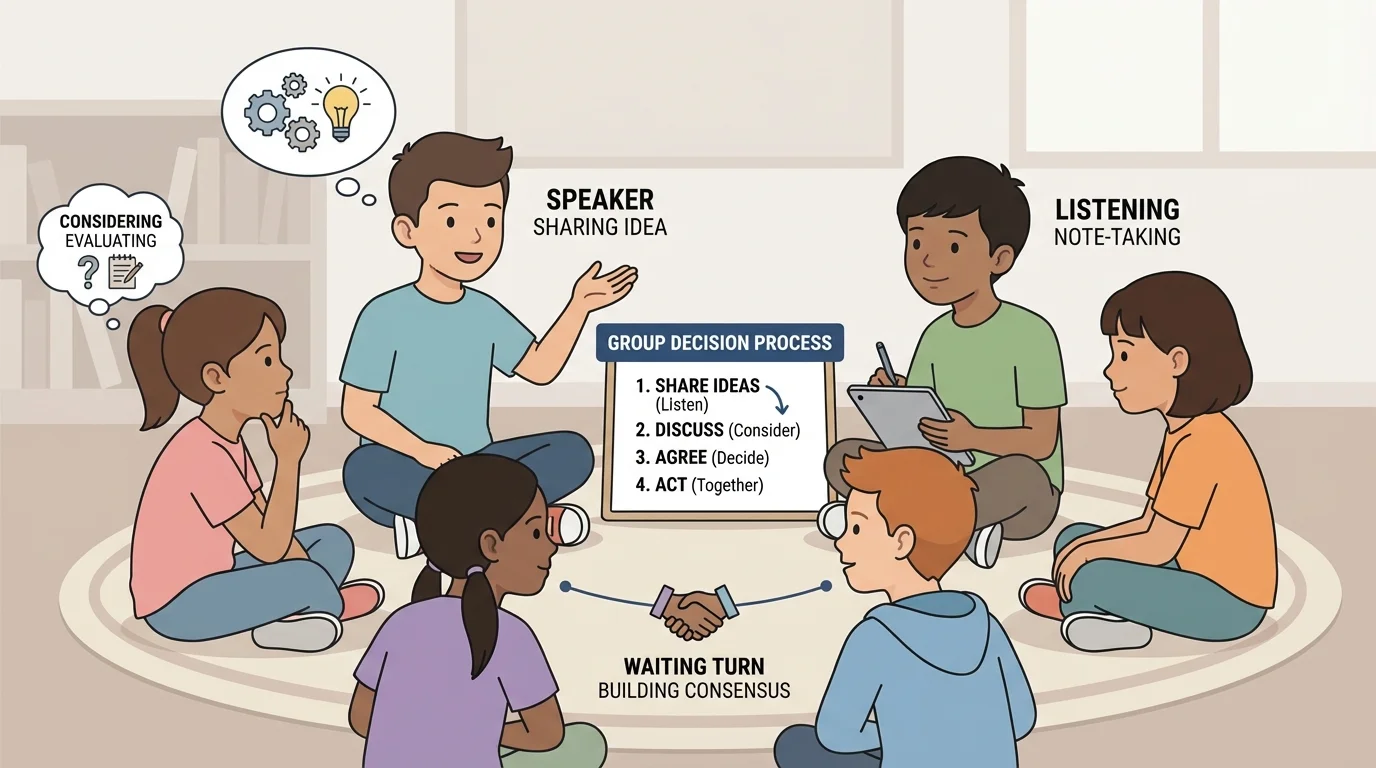
Good listeners do a few simple things. They do not interrupt. They let others finish. They may nod, ask a kind question, or repeat the idea in simple words. For example, a child might say, "You want to draw first." That shows the speaker was heard.
Listening does not mean you must always say yes. It means you show respect. Respect is treating people kindly and showing that their thoughts matter.
Your brain is busy when you listen. It is not just hearing words. It is also helping you remember ideas, think about feelings, and decide what to do next.
When children take turns and listen well, the whole group becomes calmer. The same careful listening we see in [Figure 1] helps groups avoid arguments and helps everyone know what the group is trying to do.
Good groups have leaders and team members who all do important jobs. As shown in [Figure 2], a leader does not boss people around. A responsible leader helps everyone get a turn, keeps the group on task, and uses kind words.
A leader might say, "Let's hear Mia's idea now," or "We need one choice that works for all of us." That kind of leader helps the group stay fair. The leader helps, but the leader is still part of the team.
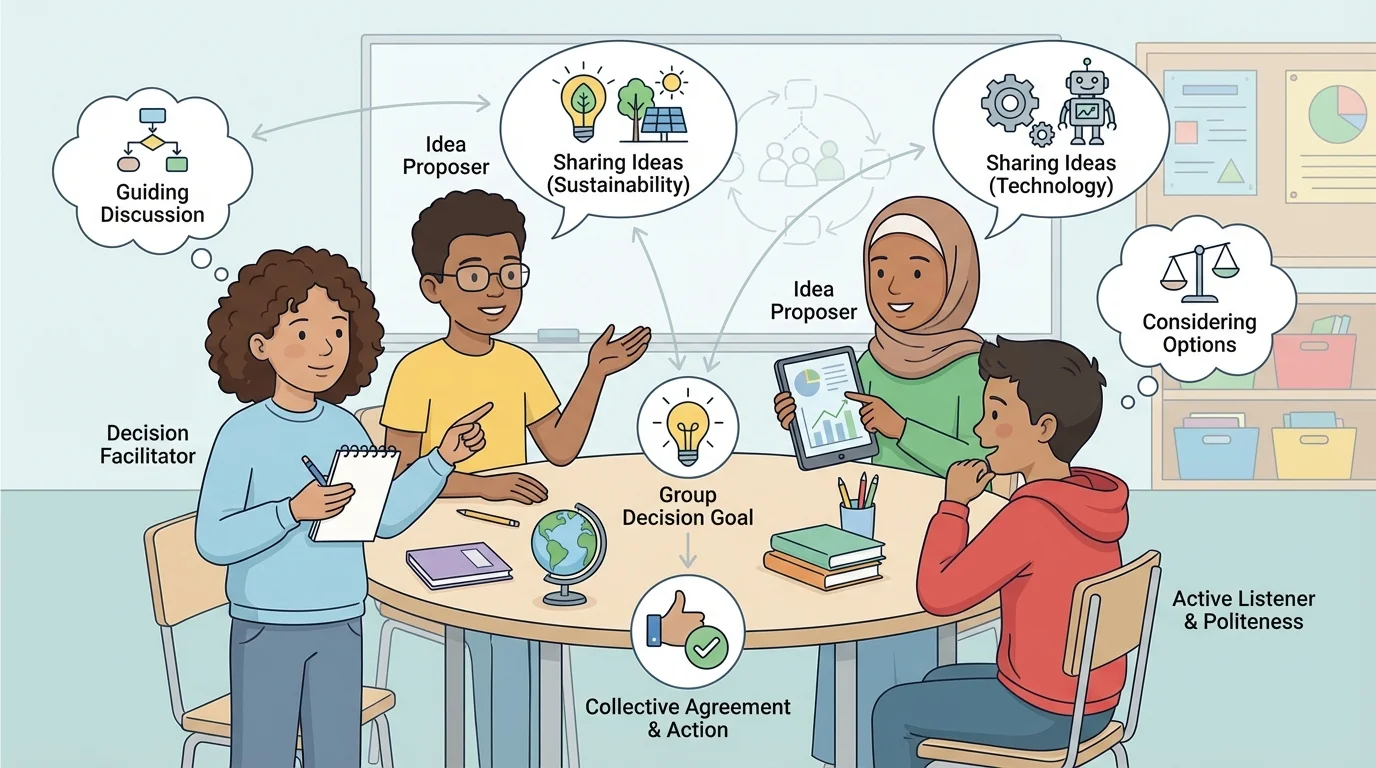
Every team member has responsibility too. Team members listen, share helpful ideas, wait their turn, and help with the final choice. They do not laugh at others' ideas or refuse to help when the group decides.
Responsible groups need both kinds of people: leaders who guide kindly and team members who participate kindly. In [Figure 2], the group works well because everyone has a part to play.
How leaders help without controlling
A strong leader helps the group work together, not just get their own way. The leader invites ideas, reminds others about rules, and helps the group finish the task. Everyone else also helps by being respectful and cooperative.
Sometimes the leader changes from one activity to another. One day one child may lead the line-up plan. Another day a different child may lead a cleanup team. This helps many children learn how to guide and how to follow.
Groups often use simple steps to decide. First, people share ideas. Next, they listen carefully. Then, they think about which idea helps the whole group. Last, they choose and work together on the choice.
These steps help the group stay organized. If everyone talks at once, the group may feel confused. If the group listens one at a time, the choice becomes clearer. Good decisions are not only about what one person likes. They are about what works for everyone.
Example: Choosing a class game
A small group needs to choose a game for indoor recess.
Step 1: Share ideas
One child says puzzles, one says charades, and one says drawing.
Step 2: Listen
Each child gets a turn to explain why the idea is a good one.
Step 3: Think about the group
The group notices that charades lets everyone play together in the room they have.
Step 4: Choose and help
The group picks charades, and everyone helps get ready.
The group decision works well because everyone was heard.
After a choice is made, the work is not over. Group members should support the decision. That means helping the plan happen, even if it was not your first idea. This shows care for the group.
Fair behavior means everyone gets a chance. Respectful behavior means everyone is treated kindly. You can show fairness by taking turns. You can show respect by using calm voices and friendly words.
Sometimes children agree with each other. Sometimes they do not. It is okay to disagree. What matters is how you disagree. You can say, "I like your idea, but I think this one is better for our group," instead of saying something hurtful.
Fair groups also include quiet voices. Some children speak quickly. Others need more time. A responsible group makes space for both. A leader may invite a quiet child to share. Team members may wait patiently.
"We listen, we think, and we choose together."
These habits help the group feel safe. When children know they will be heard, they are more willing to join in. That makes the group stronger.
At school, a table group may choose which color paper to use for a poster. One child likes blue. Another likes green. The group listens and then chooses the color that fits the project best.
On the playground, a group may choose whether to play tag or hide-and-seek. A good group listens to what everyone wants and thinks about space, safety, and fun for all. Then the children play together.
During cleanup, one child may suggest picking up books first. Another may suggest blocks first. The group can listen and choose the order that helps the room get clean quickly. Listening makes teamwork smoother.
You already know how to take turns and use kind words. Group decisions use those same skills, but now you use them to help many people work together.
These simple examples show something important: groups make decisions all the time. The more children practice listening and considering others' ideas, the better they become at solving problems together.
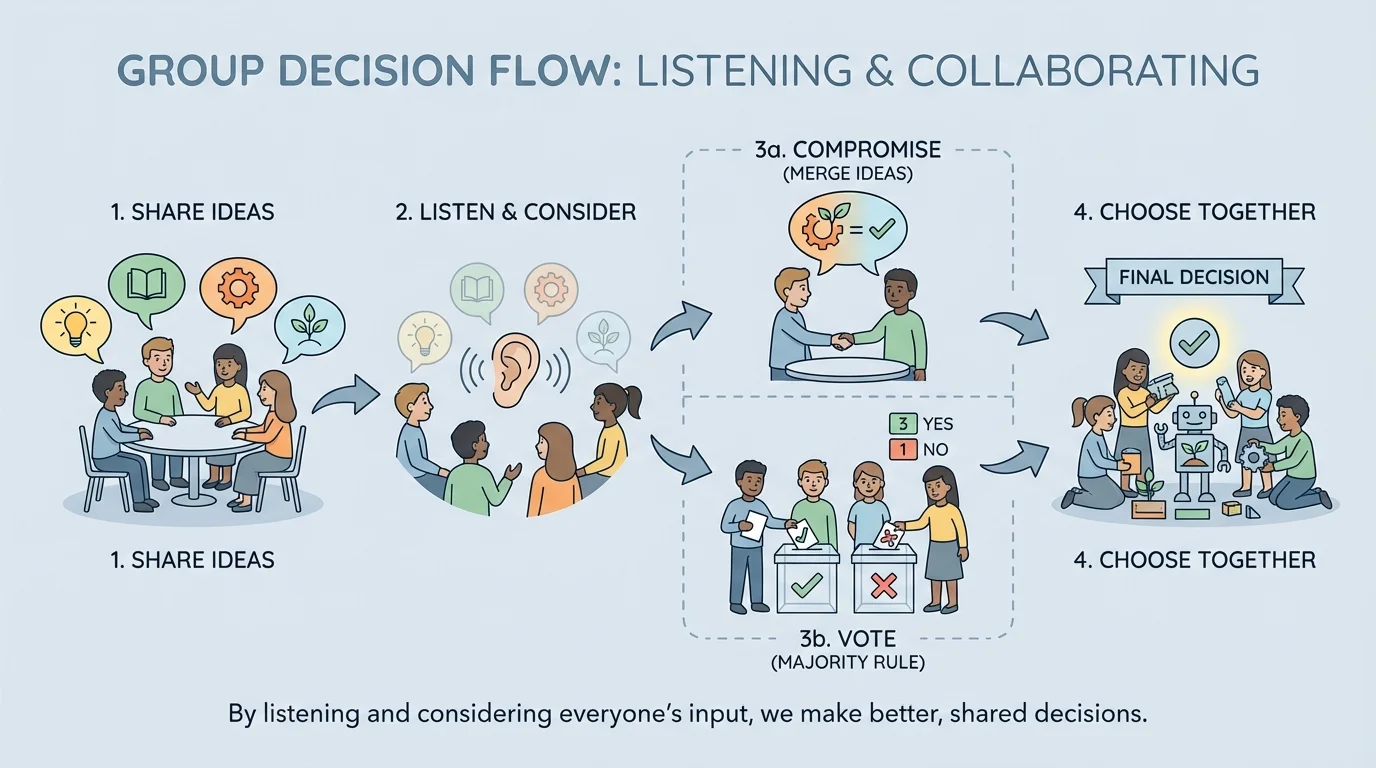
Sometimes group members want different things. That is normal. Groups can still decide together by using simple tools. As shown in [Figure 3], two helpful tools are compromise and vote.
A compromise is when each person gives a little so the group can find a choice that works for everyone. If one child wants to draw animals and another wants to draw houses, they might agree to make a picture with both animals and houses.
A vote is when each person chooses, and the group sees which idea gets the most choices. Voting can be helpful when the group has listened to all ideas and is ready to decide.
Even after a vote, kindness still matters. If your idea is not chosen, you can still help the group. That is what a responsible group member does.
Compromise is not always easy, but it helps people work together. The decision path in [Figure 3] shows that groups do best when they first share and listen before they compromise or vote.
When groups listen to others and consider their ideas, they make smarter, fairer, and kinder decisions. That helps classrooms, families, and teams work well together.
