Why does a country stop for a special day? Sometimes schools close, flags wave, and people gather for parades or quiet moments. These special days are not just days off. They help people remember stories, heroes, and big ideas that matter to the country.
A civic holiday is a special day when people remember something important about their country and its people. Civic holidays can honor brave helpers, important leaders, big events, or the rights people should have.
Civic holidays are special days that help people remember the history, values, and people of a country. They teach us about freedom, fairness, service, leadership, hard work, and respect.
When people celebrate these holidays, they may raise the flag, listen to speeches, sing songs, march in parades, or spend quiet time remembering. These holidays show what people in the United States care about. They remind citizens to be thankful, kind, fair, and helpful.
Some holidays thank people who served the country. As [Figure 1] shows, two important holidays in this group are Veterans Day and Memorial Day, and they are not the same. Both are about service, but they honor different people.
Veterans Day is a day to thank people who served in the military. Many veterans are living today. On this day, people may say thank you, make cards, or join a parade to honor their service and courage.
Memorial Day is a day to remember service members who died while serving the country. It is often a quieter day. People may visit cemeteries, place flags on graves, and have moments of silence. This holiday teaches respect and remembrance.
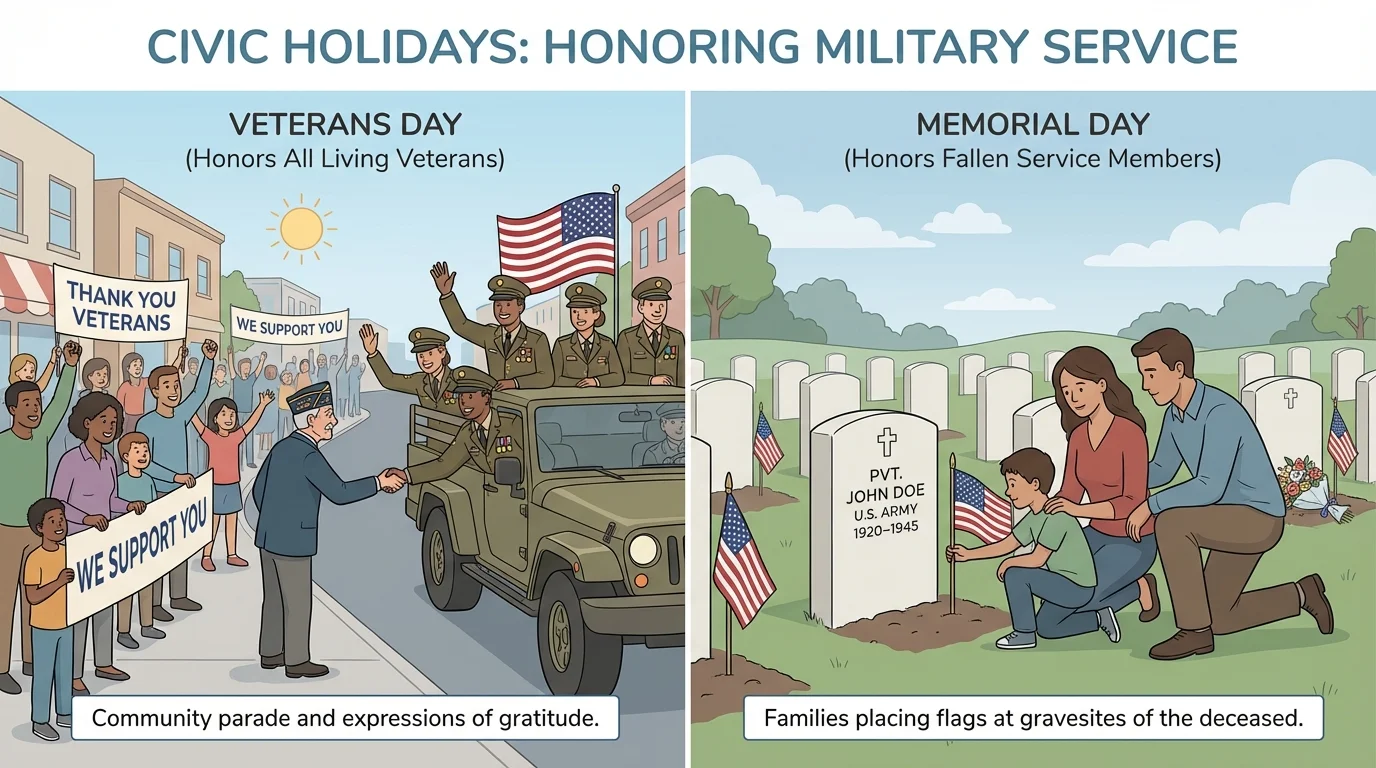
These holidays help children learn that freedom is protected by people who serve others. Later, when you hear about being a good citizen, you can think back to [Figure 1], which compares thanking living veterans with remembering those who died.
Veterans Day is in November, and Memorial Day is in May. Even though both honor military service, each day has its own special meaning.
Another way communities show respect is by flying the American flag and listening carefully during ceremonies. These actions teach that service and sacrifice matter to the whole country.
Some holidays celebrate freedom and fairness for all people. Early in this group, [Figure 2] connects three important holidays: Independence Day, Martin Luther King Jr. Day, and Juneteenth. Each one tells part of the story of liberty and equal rights.
Independence Day, celebrated on July 4, remembers when the United States became its own country. People celebrate with flags, songs, fireworks, and picnics. This holiday reminds citizens to value freedom and the beginning of the nation.
Martin Luther King Jr. Day honors Dr. Martin Luther King Jr. He worked for equal rights and taught people to solve problems peacefully. This holiday reminds us that all people should be treated fairly, no matter what they look like.
Juneteenth celebrates freedom for enslaved African Americans. It remembers an important moment when freedom reached people in Texas after the Civil War. Juneteenth teaches that freedom is precious and that the country has worked to become fairer.
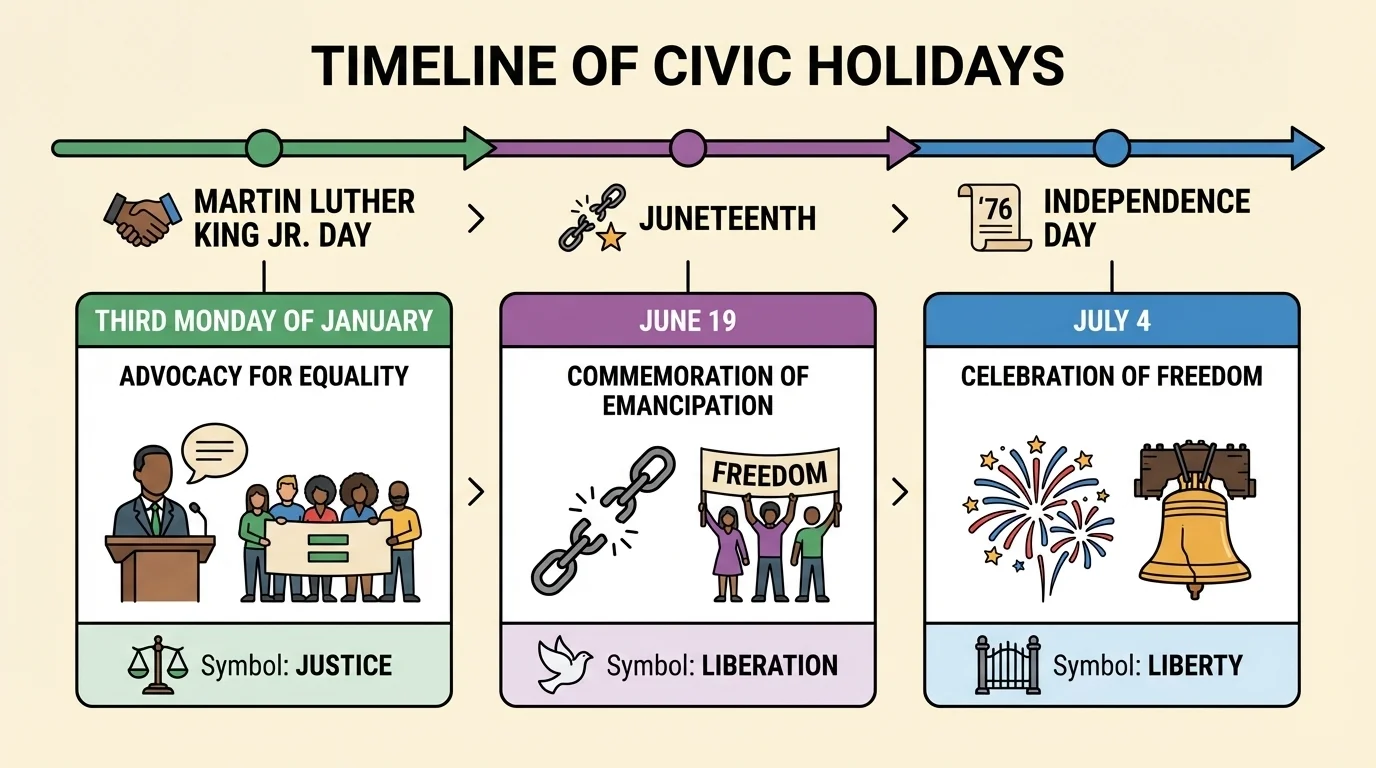
These holidays fit together in an important way. Independence Day celebrates the nation's freedom, Martin Luther King Jr. Day teaches fairness and peaceful change, and Juneteenth remembers freedom more fully reaching people who had been enslaved. Looking again at [Figure 2], you can see how the story of freedom grows over time.
"The time is always right to do what is right."
— Martin Luther King Jr.
When families celebrate these holidays, they are not only having fun. They are also remembering that good citizens care about liberty, justice, and equal treatment.
Some civic holidays honor people whose leadership helped others. Presidents' Day honors U.S. presidents, especially George Washington and Abraham Lincoln. Presidents help lead the country and make important decisions.
On Presidents' Day, children often learn about honesty, courage, and responsibility. George Washington helped lead at the beginning of the country. Abraham Lincoln helped keep the country together during a hard time and is remembered for his role in ending slavery.
César Chávez Day honors César Chávez, a leader who helped farm workers. He worked so workers would be treated more fairly and safely. This holiday teaches that leaders do not always work in the government. Some leaders help by standing up for people and solving problems peacefully.
Leadership can look different
A president leads the whole country, while a community leader may help workers, families, or neighborhoods. Both kinds of leaders can show courage, fairness, and care for others.
These holidays remind citizens that leadership means helping people, making wise choices, and working for the common good.
Other civic holidays teach respect for workers and for the Indigenous peoples of this land. As [Figure 3] introduces, Labor Day and Indigenous Peoples Day honor different groups, but both show that every community matters.
Labor Day honors workers and the jobs they do. Workers build homes, teach children, grow food, drive buses, and help keep towns running. Labor Day reminds us that hard work helps families and communities.
Indigenous Peoples Day honors Native peoples who lived on this land long before the United States began and who still live here today. This holiday teaches respect for Indigenous history, cultures, and communities.
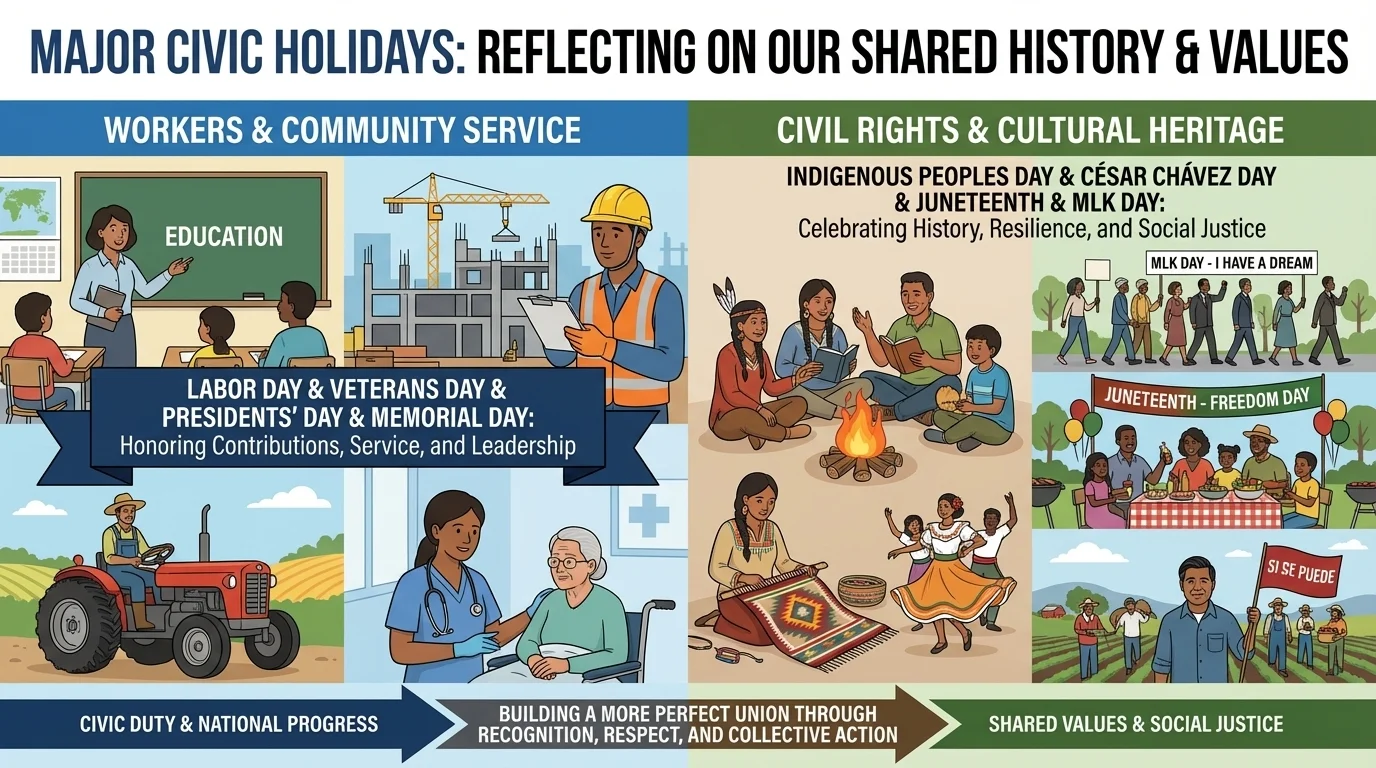
When students think about helping their school or family, they can connect that idea to Labor Day. When they learn about Native peoples and their traditions, they can remember the respect shown in [Figure 3]. Both holidays teach care for people and their contributions.
You already know that communities are made of many people who help in different ways. Civic holidays help us notice those helpers and say that their work, history, and culture are important.
These holidays also remind us to listen to different stories from the past. A country grows stronger when people respect one another.
People celebrate civic holidays in many ways. Some go to parades. Some read books or listen to speeches. Some make flags or sing patriotic songs. Some spend the day serving others, such as cleaning a park or helping a neighbor.
Different holidays can feel different. Independence Day is often loud and festive. Memorial Day may be quiet and thoughtful. Martin Luther King Jr. Day may include service projects. Juneteenth may include music, family gatherings, and learning about history.
| Holiday | What it honors | Big value |
|---|---|---|
| Veterans Day | People who served in the military | Service |
| Memorial Day | Service members who died | Remembrance |
| Independence Day | The country's birth and freedom | Liberty |
| Martin Luther King Jr. Day | Dr. King and equal rights | Fairness |
| Presidents' Day | Presidents and leadership | Responsibility |
| Juneteenth | Freedom for enslaved African Americans | Freedom |
| Labor Day | Workers and their jobs | Hard work |
| Indigenous Peoples Day | Native peoples and cultures | Respect |
| César Chávez Day | César Chávez and farm workers | Justice |
Table 1. Major civic holidays, what each one honors, and the value it teaches.
When people remember these holidays, they are also learning how to be good citizens. They learn to thank others, respect history, and care about justice and freedom for everyone.
