Have you ever looked at a baby picture and heard someone say, "That was when you were little"? That picture is a tiny piece of history. History is all around us—in family photo albums, in stories grandparents tell, in letters, in books, and even in old objects. History helps us learn what happened before now.
History is the story of people, places, and events from the past. The past is everything that already happened. Some things happened yesterday. Some happened a long, long time ago.
We cannot go back in time and watch the past happen again. So how do we learn about it? We learn by looking at clues. These clues help us understand what people did, what they made, what they said, and how they lived.
History is the study of the past. A source is something that gives us information. Sources can be pictures, objects, spoken stories, or writing.
When we learn history, we do not just memorize facts. We also ask questions and talk about what sources tell us. A picture may show clothing from long ago. A diary may tell how a person felt. A story told out loud may help us remember an important event in a family or community.
Stories of the past are preserved in many places. Preserved means kept safe so people can learn from them later. Some stories are kept in museums. Some are kept in homes. Some are written in books. Some are shared by speaking and listening.
We can learn history from images, such as photographs, drawings, paintings, and posters. We can learn from oral accounts, which are stories people tell with their voices. We can also learn from written accounts, such as letters, journals, newspapers, and books.
Some families keep history in very special ways, such as saving a wedding photograph, a recipe card, or a story told every year at a family gathering.
Each kind of source can teach us something important. An old class photo might show what a school looked like years ago. A grandparent's story might explain what games children played. A newspaper might tell about a parade, a storm, or an important town event.
A primary source is something that comes from the time in history we are learning about. It is a direct clue from the past. Primary sources help us get close to the real people and events of long ago.
[Figure 1] Primary sources can be many things: a photograph taken long ago, a letter someone wrote, a diary entry, a ticket stub, a toy, a piece of clothing, or an interview with a person who remembers an event. If a person tells what happened because they were there, that oral account can be a primary source too.
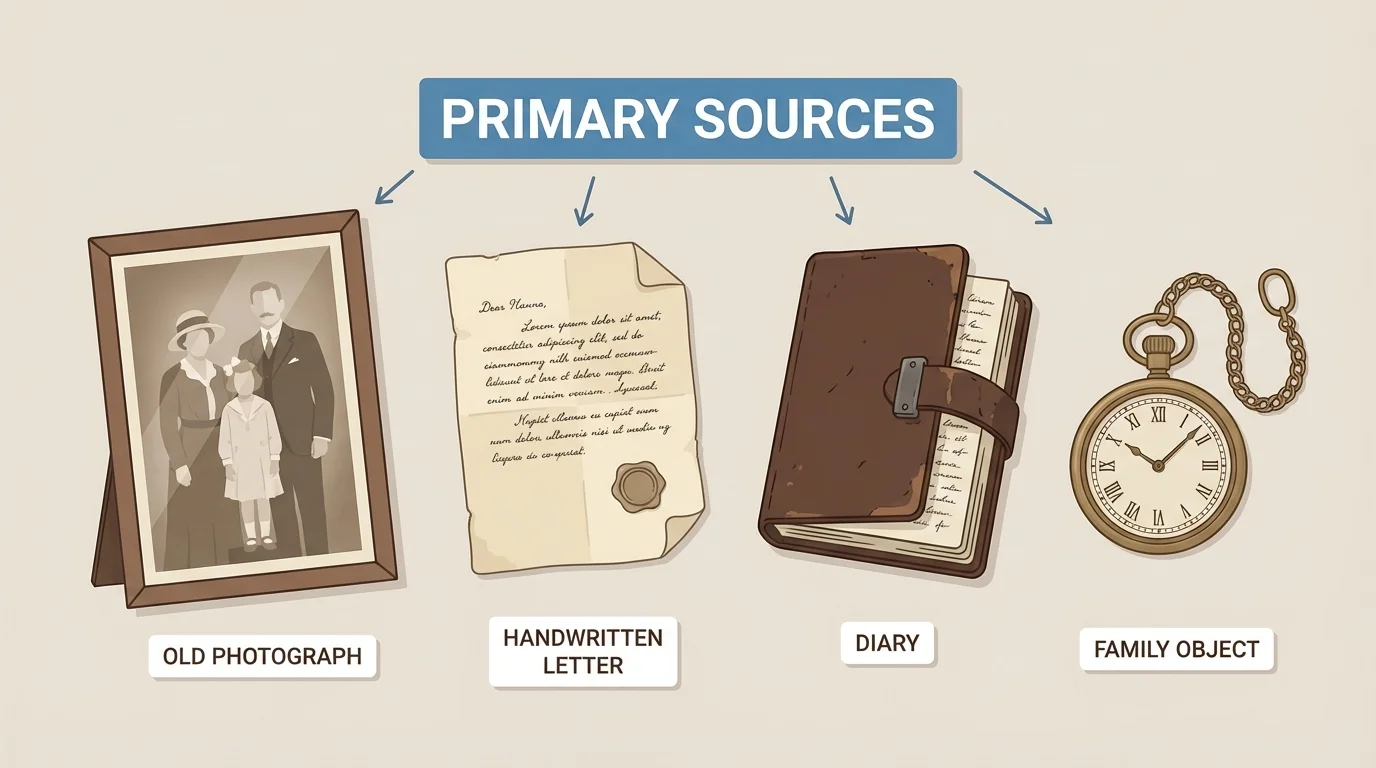
Think about a birthday party. A photo from the party is a primary source. A child's drawing made that day is a primary source. A short note saying, "We had cake and sang songs," written that same day is also a primary source.
Primary sources are exciting because they are real pieces of the past. But they do not always tell the whole story by themselves. One picture may show smiling faces, but it may not explain what happened before or after the picture was taken. That is why historians look at more than one source.
Example: learning from one photograph
Step 1: Look carefully at the image.
You might see children standing outside a one-room schoolhouse.
Step 2: Ask what details stand out.
You may notice their clothes, the building, and whether they are holding books.
Step 3: Decide what the source teaches.
The photograph can teach us what school looked like at that time.
One source can give useful clues, but we often need more sources to understand more.
Later, when we compare ideas, we can return to the kinds of items in [Figure 1]. They remind us that objects, photos, and personal writing can all carry true pieces of the past.
[Figure 2] A secondary source is made after the event happened. It tells about the past instead of coming directly from the time of the event. Secondary sources are often created by people who study and explain history.
Examples of secondary sources include textbooks, biographies, history books, encyclopedia articles, and videos that explain what happened long ago. These sources often use primary sources to build a bigger story.
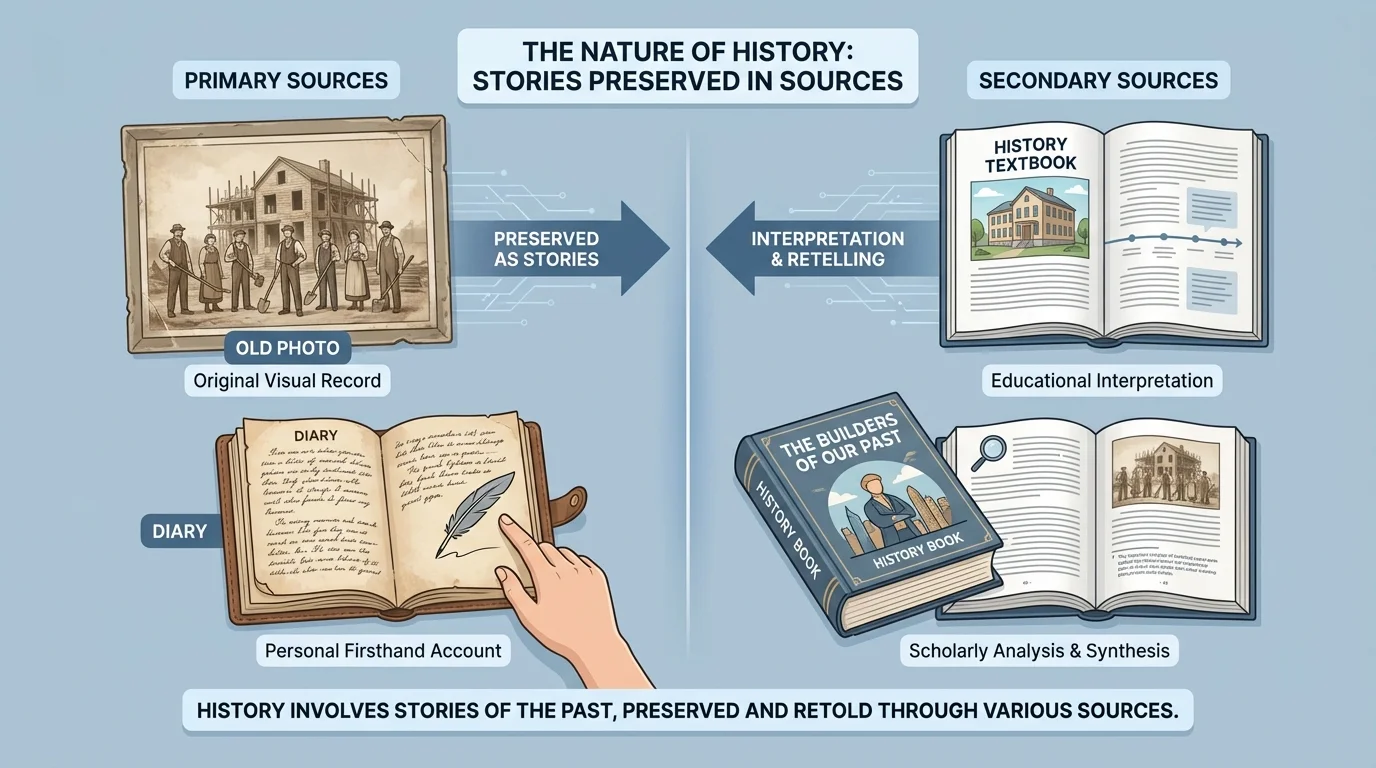
Think again about that birthday party. A book written later called Our Family Celebrations that tells about the party would be a secondary source. It was made after the event. It uses memories or old pictures to explain what happened.
Secondary sources are helpful because they gather information from many places. A history book about a town may use old maps, interviews, letters, and photos. Then the book puts those clues together in one story that is easier to understand.
| Type of source | What it is like | Example |
|---|---|---|
| Primary source | Made at the time or by someone who was there | Old photograph, diary, letter, interview |
| Secondary source | Made later to explain the past | Textbook, history book, article |
Table 1. A comparison of primary sources and secondary sources.
When you look at the difference in [Figure 2], you can see that both types matter. One gives direct clues, and the other helps explain what those clues mean.
Good historians ask good questions. They do not just look quickly and move on. They stop and think. Asking questions helps us understand what a source can teach us.
How historians think about sources
When historians study the past, they ask simple but powerful questions: Who made this? When was it made? What does it show or say? What does it help us learn? What might still be missing? These questions help us talk about ideas from sources in a careful way.
Here are some useful questions: Who made it? When was it made? What do I notice? What does it tell me about the past? What else do I need to know?
If we look at an old playground picture, we might ask: What games were children playing? What clothes are they wearing? Does the playground look like ours today? If we hear an oral account from an older family member, we might ask: What do they remember most clearly? What happened first? What happened next?
Sometimes sources agree, and sometimes they do not. One person may remember an event one way, while another person remembers it differently. That does not mean history is impossible. It means we need to listen, compare, and think carefully.
History becomes stronger when we use more than one source. A single source is like one puzzle piece. Many sources together help us see a bigger picture.
Suppose we want to learn about a school from long ago. We might use a class photograph, a teacher's note, a student's diary, and a page from a history book. The photo shows what the room looked like. The note tells what the teacher planned. The diary tells how a student felt. The history book explains the school's place in the community.
Example: learning about an old town parade
Step 1: Start with a primary source.
A newspaper picture shows people marching with flags.
Step 2: Add another primary source.
An oral account from a grandparent explains that the parade celebrated a special day.
Step 3: Add a secondary source.
A local history book explains why the celebration mattered to the town.
Now the story is fuller because different sources work together.
This is why both primary and secondary sources are important. Primary sources give direct clues. Secondary sources help connect those clues into a clear story.
History is also about time. A timeline puts events in order from earlier to later. Timelines help us understand that some things happened long before others.
[Figure 3] Key people can help us tell historical stories. A grandparent is a key person in family history. A town founder may be a key person in local history. A teacher, firefighter, artist, or leader can become important in a community's story if they helped shape what happened.
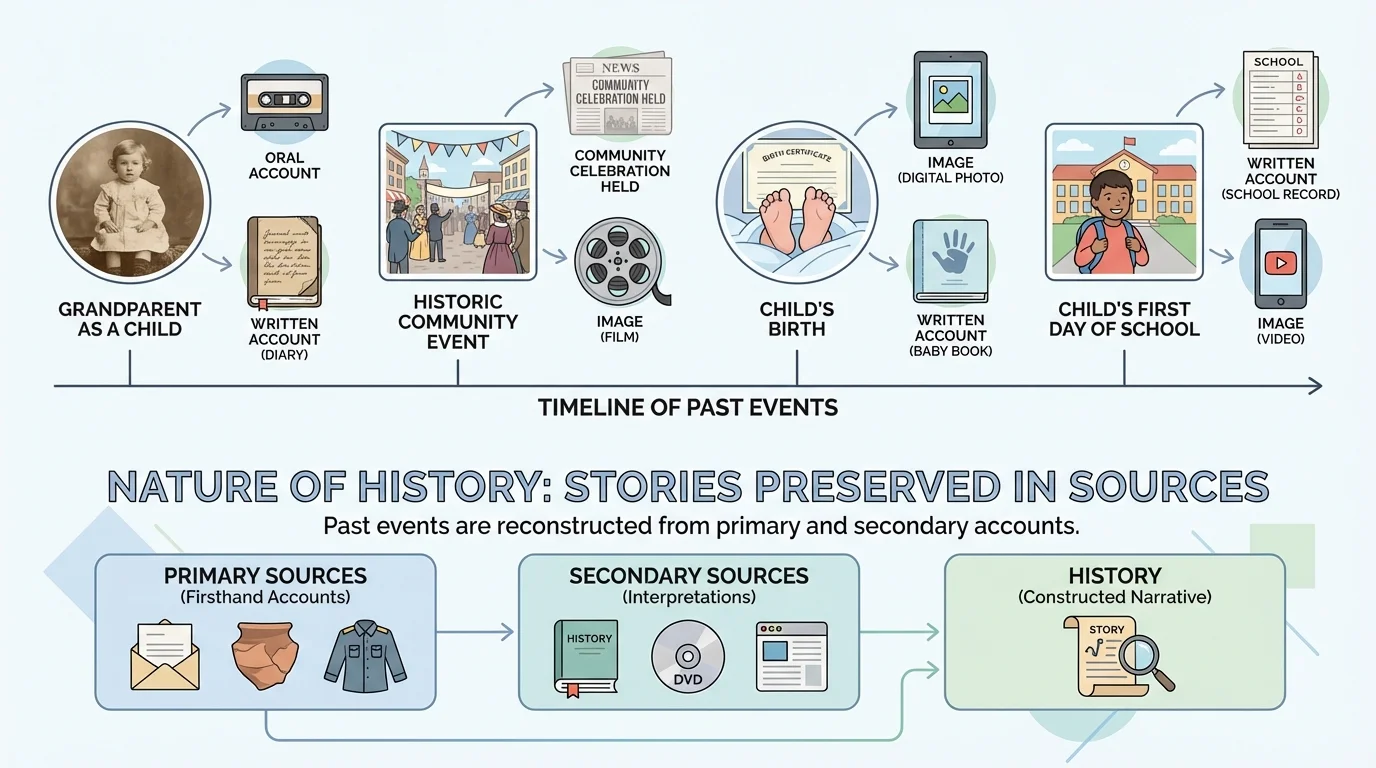
Here is a simple way to think about time: your grandparent as a child came before your parent as a child, and your parent as a child came before you were born. Then came your first day of school. That order matters. History tells us not only what happened, but also when it happened.
We can use timelines for bigger stories too. A town may have been founded first, then a school was built, then a library opened, and later a park was added. Seeing the order helps us understand change over time.
| Earlier | Later |
|---|---|
| A grandparent's childhood photo | A parent's school photo |
| A town's first school building | A newer school building |
| An old family letter | A book written later about the family |
Table 2. Examples of events and sources placed from earlier to later in time.
Looking again at [Figure 3], we can see that history is not a jumble of facts. It is a story arranged in order so we can understand how the past leads to the present.
History matters because it helps us know where people, families, schools, and communities came from. It helps us remember important events. It also helps us understand change. Some things stay the same over time, and some things become very different.
When you listen to a family story, look at an old photo, or read a page in a history book, you are doing the work of a young historian. You are learning from evidence. You are asking questions. You are discussing ideas from sources.
"The more you know about the past, the better you can understand the present."
— A key idea in studying history
History is made of stories from the past, and those stories are preserved in many ways. Images, oral accounts, and written accounts all help us learn. By looking carefully, listening closely, and asking good questions, we can discover the past in a thoughtful way.
