Have you ever noticed that some streets have old houses, brand-new stores, and a playground all in the same place? That is because neighborhoods do not stay exactly the same. They grow, change, and welcome new people over time. When we study how one place changes, we are learning about history and about the people who make a community special.
A neighborhood is the place where people live near one another. It may have homes, streets, parks, schools, stores, and places where people meet. A community is the group of people who live, work, and interact in that place. A neighborhood is made of buildings and places, but a community is made of people too.
Some neighborhoods are in big cities. Some are in small towns. Some are near farms, beaches, or mountains. No matter where they are, neighborhoods can change over time as people build new things, fix old things, and bring new ideas and traditions.
Past means long ago. Present means now. Over time means across many years, as things slowly change or sometimes stay the same.
When we compare the past and the present, we can learn what a neighborhood was like before and what it is like today, as [Figure 1] helps show.
A neighborhood from long ago may look very different today. Long ago, there may have been fewer houses, fewer cars, and more open land. Today, the same area might have sidewalks, traffic lights, apartment buildings, or a library.
For example, a street that once had a dirt road might now have a paved road. An empty field might become a soccer park. A one-room schoolhouse might be replaced by a larger school. These changes happen because people need places to live, learn, shop, and play.
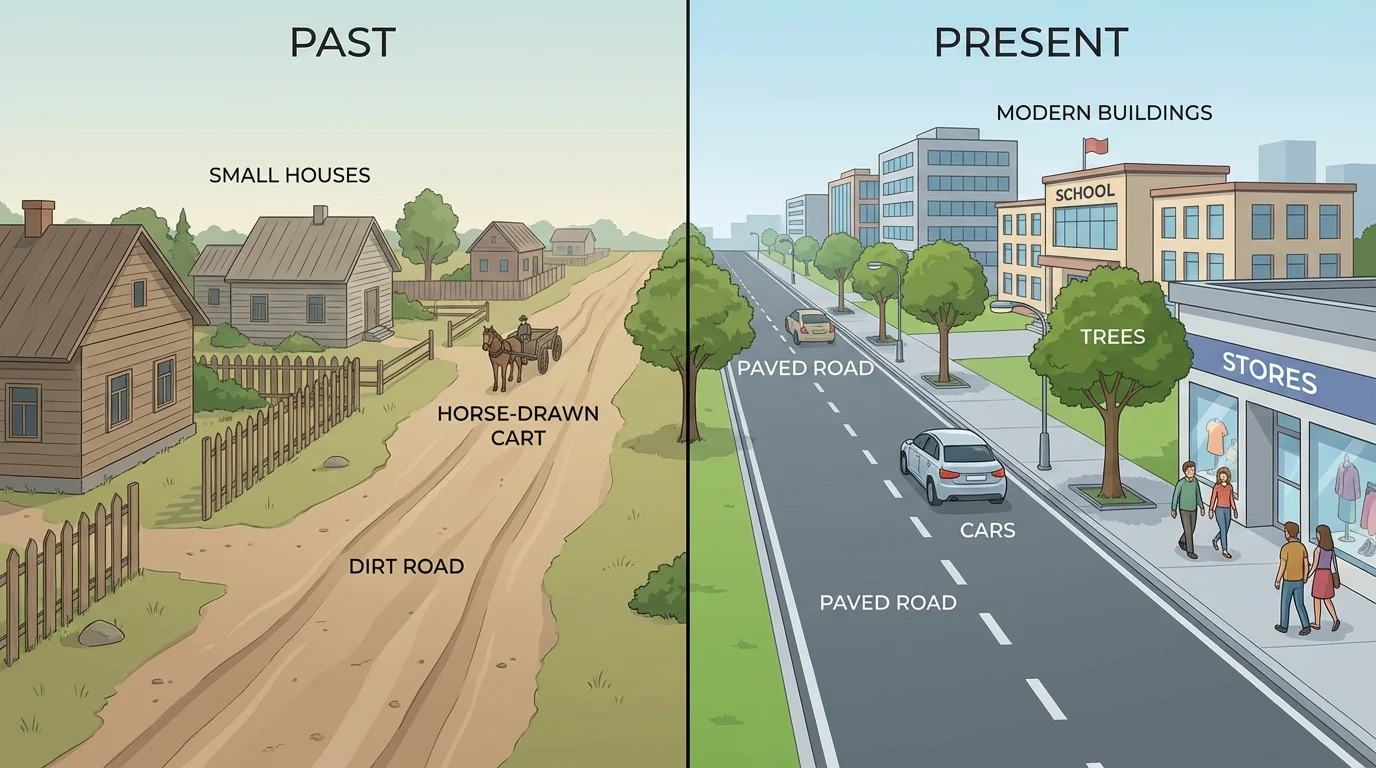
Some changes happen slowly. Trees grow taller. Houses get repaired or painted. New families move in. Other changes happen faster, such as when a new playground is built or a storm damages buildings and people rebuild them.
When we talk about change over time, we also notice what stays the same. A church, a town hall, a bridge, or a favorite park might still be in the neighborhood many years later. Even if the place looks different, people may still gather there.
Some neighborhoods have buildings that are more than 100 years old. People protect these old places because they help tell the story of the community.
Looking closely at old and new pictures helps us notice details. We may see old clothes, wagons instead of buses, or fewer signs on buildings. In the present, we might see bicycles, buses, murals, and many kinds of stores.
Let's think about one made-up neighborhood called Maple Street. About 80 years ago, Maple Street had a few small houses, a dirt road, and a corner shop. There were not many cars, so children often walked everywhere. Many families knew one another because only a small number of people lived there.
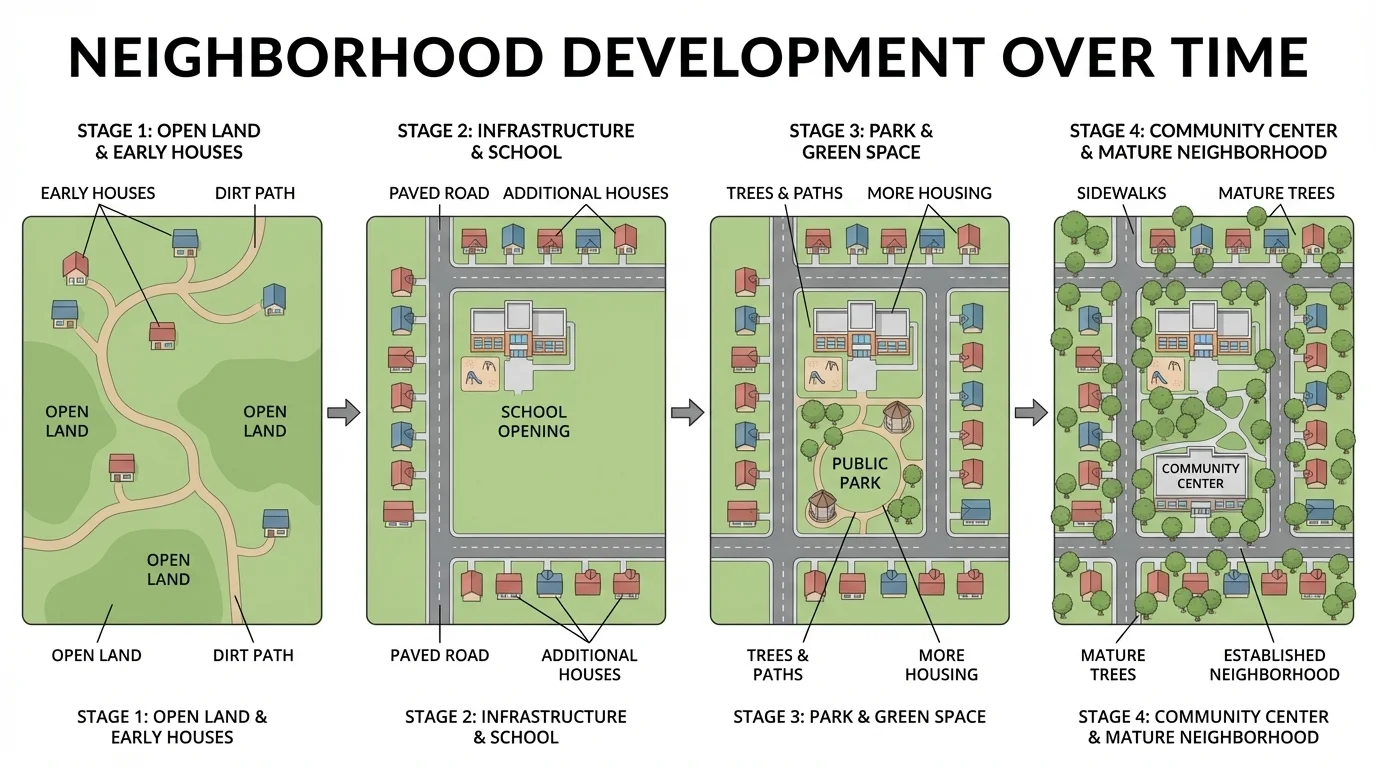
Later, more families moved to Maple Street. Workers built more homes. The dirt road was paved. A bus route was added so people could travel more easily. A school opened nearby, and a small playground was built for children.
Years later, Maple Street grew again. New stores opened, including a grocery store and a bakery. Some older homes were fixed up. An apartment building was added so more people could live in the area. Trees were planted along the sidewalks, and the playground became a larger park.
Example: Maple Street then and now
Step 1: Long ago, Maple Street had open land, a few homes, and one small shop.
Step 2: As more people arrived, roads, homes, and a school were added.
Step 3: In the present, Maple Street has more buildings, more people, and more places to gather.
This example shows that neighborhoods often change because people's needs change.
Maple Street is still the same neighborhood, but it does not look exactly the way it did before. That is an important idea in history: places can keep their name and still change a lot over time.
One of the most important reasons neighborhoods change is that new people move in and share their lives with others. People from different cultures help shape a community, and food, art, stores, and celebrations can all become part of one neighborhood.
Culture includes the ways people live, celebrate, cook, speak, sing, dress, and tell stories. As [Figure 2] shows, when families from many cultures live in one community, the neighborhood becomes richer in ideas and traditions.
For example, one family might open a restaurant that serves foods from their home country. Another family might start a market with ingredients that were not sold there before. A neighborhood festival may include different kinds of music and dance. Murals on walls may show the stories and hopes of the people who live there.
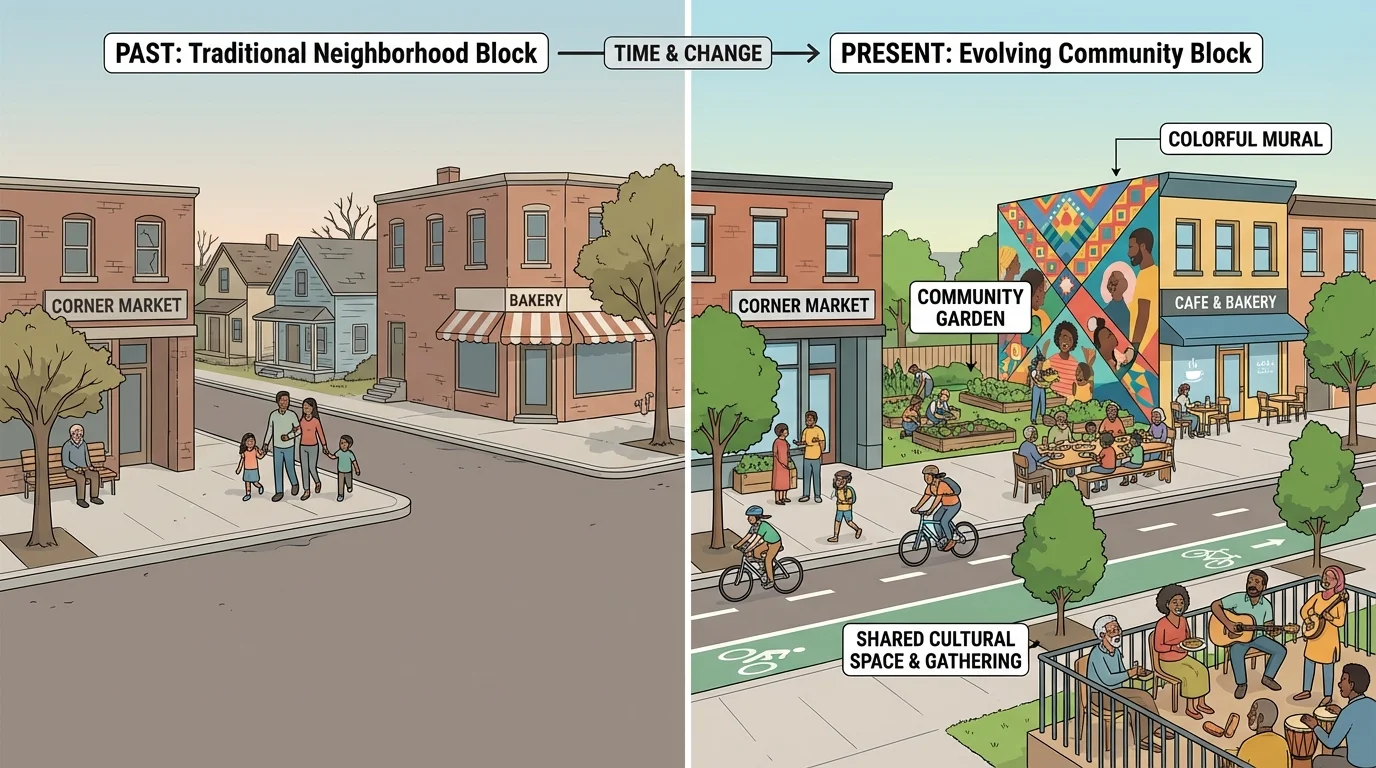
A neighborhood can also change when people build places that meet community needs. A community garden may be planted so families can grow food together. A new place of worship may be built. A language center or cultural center may open to help families feel welcome and connected.
As we saw earlier with street changes in [Figure 1], change can be seen in buildings and roads. But culture changes a neighborhood in another way too: it changes the sounds, smells, celebrations, and stories of a place. That kind of change is just as important as new streets or stores.
How cultures influence a neighborhood
People influence communities by bringing traditions, foods, music, languages, holidays, art, work skills, and ideas for solving problems. Over time, these contributions can change what a neighborhood looks like and how it feels to live there.
Sometimes children in a neighborhood learn greetings in more than one language. Sometimes neighbors share foods at a block party. Sometimes a festival becomes a yearly tradition because many families enjoy it. These are signs that people from different cultures are helping build the community together.
Neighborhoods change for many reasons. One reason is transportation. When new roads, buses, or train stations are added, it becomes easier for people to move around. More people may choose to live there because traveling is easier.
Another reason is jobs. If new businesses open nearby, families may move to the area for work. Stores and services may also grow. A quiet area can become busy when many people move in and begin working there.
Weather and safety can also cause change. After a flood, fire, or storm, buildings may need to be repaired or rebuilt. People may work together to make the neighborhood stronger and safer than before.
Community decisions matter too. Leaders and neighbors may decide to build a park, plant trees, fix a school, or open a library. These choices change the neighborhood for the future.
People form communities so they can support one another. Communities include families, teachers, firefighters, police officers, nurses, shop owners, and many others who work together.
Even small changes matter. A bench near a bus stop, a painted crosswalk, or a cleaner park can make a neighborhood better for everyone.
Not everything changes. Some parts of a neighborhood stay the same for a long time. A family may live in the same house for many years. A school mascot may stay the same. A park may still be the place where children play, even if new swings are added.
The people in a community often keep important traditions. Neighbors may still wave hello, help one another after storms, or gather for a yearly parade. These repeating actions help a community feel connected.
This is why historians look for both change and continuity. Change means something became different. Continuity means something stayed the same. Both help tell the full story of a place.
To find out how a neighborhood changed, people use sources. As [Figure 3] shows, a timeline can help organize this information by placing events in order. A source is something that gives us information about the past.
A primary source is something from the time being studied. Old photographs, letters, maps, posters, newspapers, and buildings can all be primary sources. If a grandparent remembers what the street looked like long ago and tells you, that memory can also be a primary source.
A secondary source is something made later by someone who studied the past. A history book for children or a short video about the town's history is a secondary source.
Example: Finding clues about a neighborhood
Step 1: Look at an old photograph of the street.
Step 2: Notice what is there: houses, roads, trees, signs, or wagons.
Step 3: Compare it with a photograph from today.
Step 4: Ask what changed and what stayed the same.
Sources help us learn the story of a neighborhood using real clues.
Historians do not just guess. They study evidence from sources to understand how people lived and how communities changed.
A timeline helps us put events in order from long ago to now. Timelines help us see that change happens step by step.
Here is a simple timeline for Maple Street: first there was open land and a few houses. Then the road was paved. Later, a school opened. After that, a park was built. Finally, a community center opened for classes and events.
| Time | What Happened |
|---|---|
| Long ago | Open land and a few homes |
| Later | Road was paved |
| After that | School opened |
| Next | Park was built |
| Today | Community center serves many families |
Table 1. A simple timeline of changes in the made-up Maple Street neighborhood.
When we place events in order, we understand the story better. We can tell what happened first, next, and last. We can also see how one change often leads to another. For example, once more families moved in, the neighborhood needed a school and a bigger park.
Later, when we think about cultural changes, [Figure 2] stays important too, because new families and traditions often appear along the timeline of a neighborhood's growth.
Learning about change over time helps us understand our own neighborhood better. It reminds us that communities are built by many people over many years. People in the past made choices, and people today make choices too.
Children are part of the community. They can notice what is special, learn about local history, respect different cultures, and help care for shared places. Picking up litter, being kind to neighbors, and taking care of parks all help a community stay strong.
When we learn how one neighborhood changed, we learn that communities are living places. They grow, welcome new people, remember old stories, and keep changing into the future.
