Have you ever looked at baby pictures and noticed how much a person changes over time? History works a lot like that. Long ago, people lived, worked, traveled, celebrated, and solved problems. To understand what happened first, next, and last, we use a useful tool called a timeline.
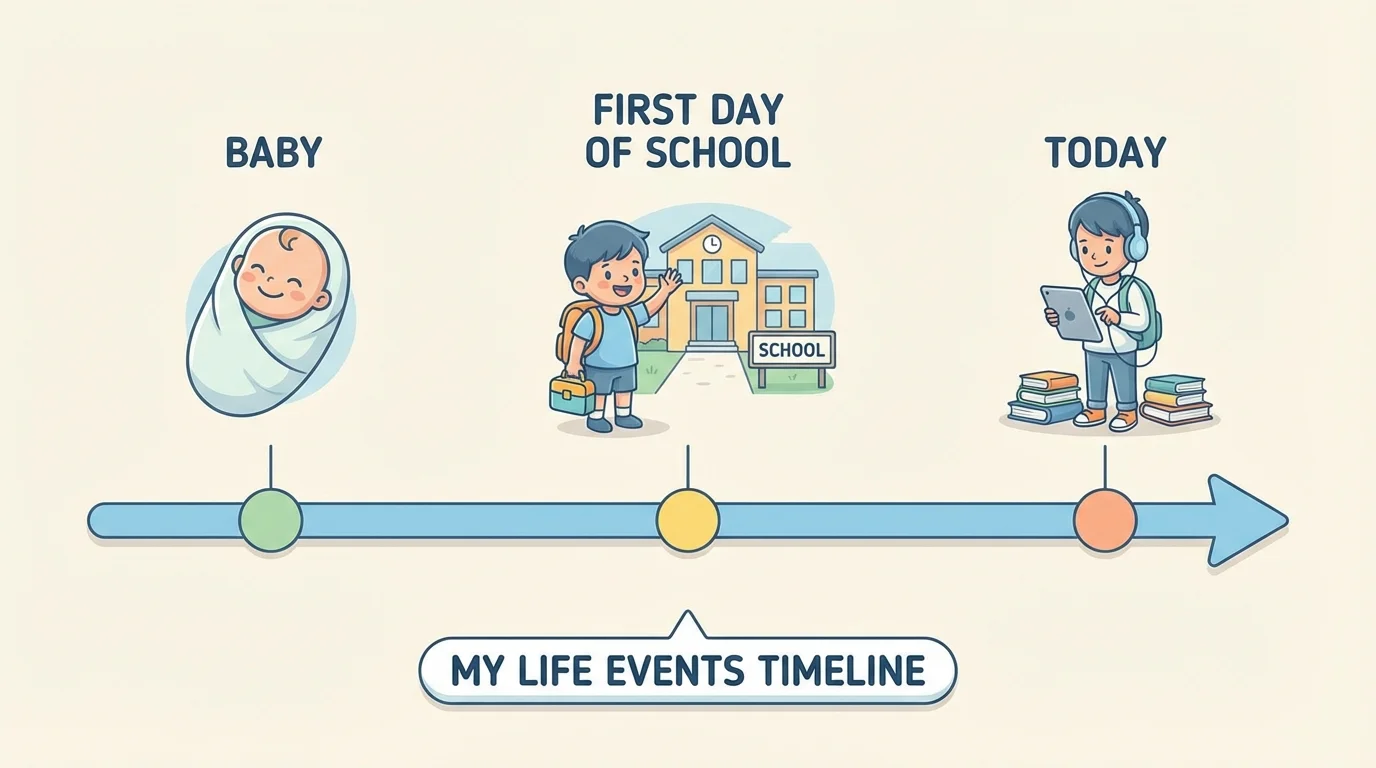
A timeline is a line that shows events in time order. It helps us place things from the past in the correct order, from earliest to latest, as [Figure 1] shows. A timeline can be about one person, one family, one town, or a whole country.
On a timeline, the event that happened first goes at the beginning. The event that happened later goes farther along the line. This helps us understand how events unfold over time. We may also use words like past, present, and future. The past already happened. The present is happening now. The future has not happened yet.
Timeline means a line that shows events in the order they happened.
Event means something that happens.
Here is a simple example: a child is born, then starts school, then celebrates a birthday today. Those moments can be placed in order on a timeline. Timelines are important because history is about understanding when things happened, not just what happened.
[Figure 3] When we study history, we do more than memorize dates. We also think about how one event connects to another event. A timeline helps us see those connections clearly.
People who study history want to know how life changed over time. A timeline makes it easier to notice change. It can show when a leader was born, when a town was built, or when a famous trip happened.
Timelines also help us ask good questions. We can ask, What happened before this? We can ask, What happened after this? We can ask, Which events happened close together? These questions help us discuss ideas about the past.
How a timeline conveys information
A timeline does not only list events. It shows order, time passing, and sometimes change. When we look at a timeline, we can tell which event came first, which came later, and how people or places changed over time.
For example, a timeline about transportation might show walking, horse-drawn wagons, trains, cars, and airplanes. That timeline tells us that travel changed as people invented new ways to move.
To read a timeline, look carefully at the dates and labels, as [Figure 2] illustrates. The dates tell when something happened. The labels or pictures tell what happened. Some timelines go from left to right. Others may go from top to bottom, but they still show time in order.
Look for clue words such as first, next, then, and last. These words help us explain the sequence of events. If one event is placed before another on the timeline, it happened earlier.
Sometimes a timeline uses only years, such as 1969. Sometimes it may use full dates. Younger students often begin with simple time words and years. Older students may use exact dates and longer periods of history.
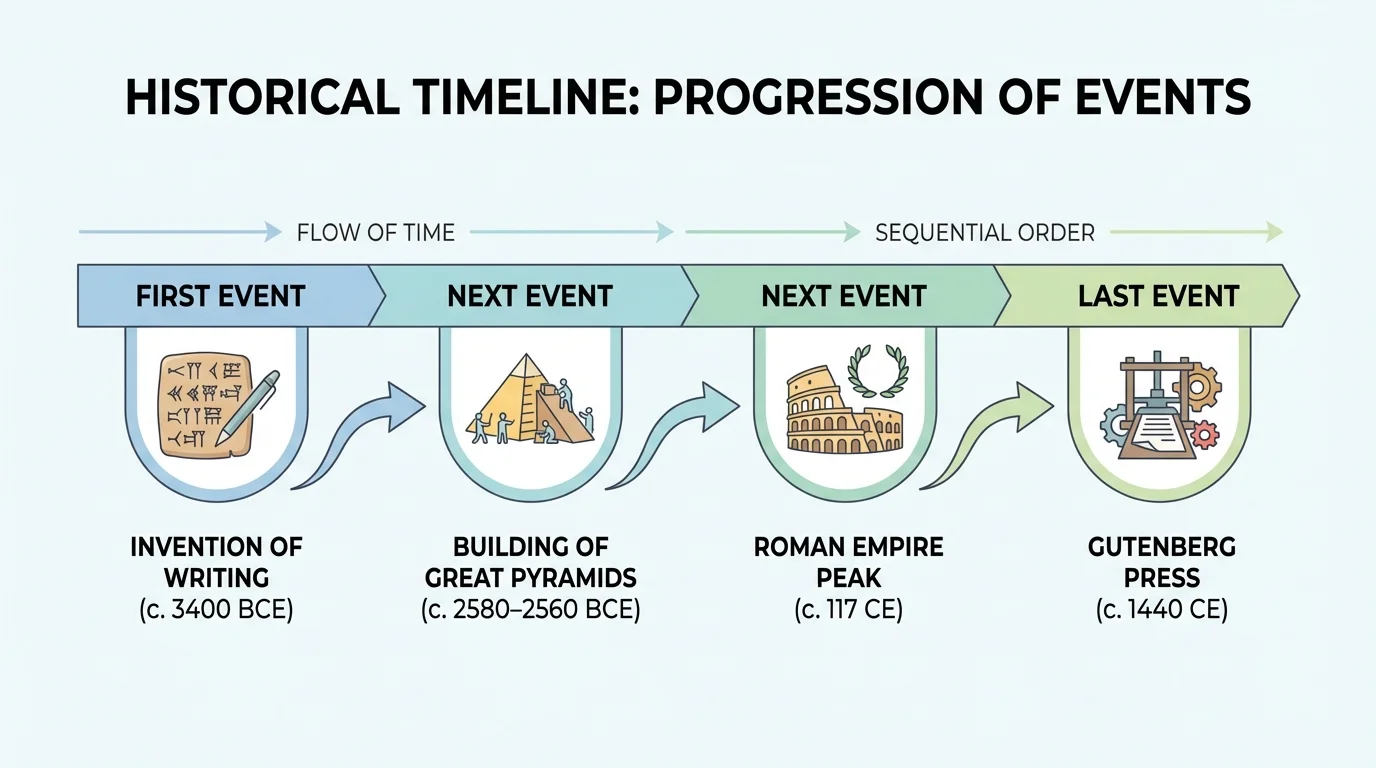
A timeline can be short or long. A short timeline may show one week in a family story. A long timeline may show hundreds of years in a nation's history. Even when timelines are different sizes, they still help organize events in order.
We can explain the information a timeline conveys by saying things like, "This timeline shows the order of important events," or "This timeline shows that one event happened many years after another." That kind of explanation is an important history skill.
Historians use sources to learn about the past and decide where events belong on a timeline. The two main kinds are primary sources and secondary sources.
A primary source comes from the time of the event or from a person who was there. A photograph, a letter, a diary, a speech, or an old newspaper can be a primary source. These sources give us clues from the past itself.
A secondary source tells about the past after the event happened. A history book, a biography, or a class article can be a secondary source. These sources often use information from primary sources to explain what happened.
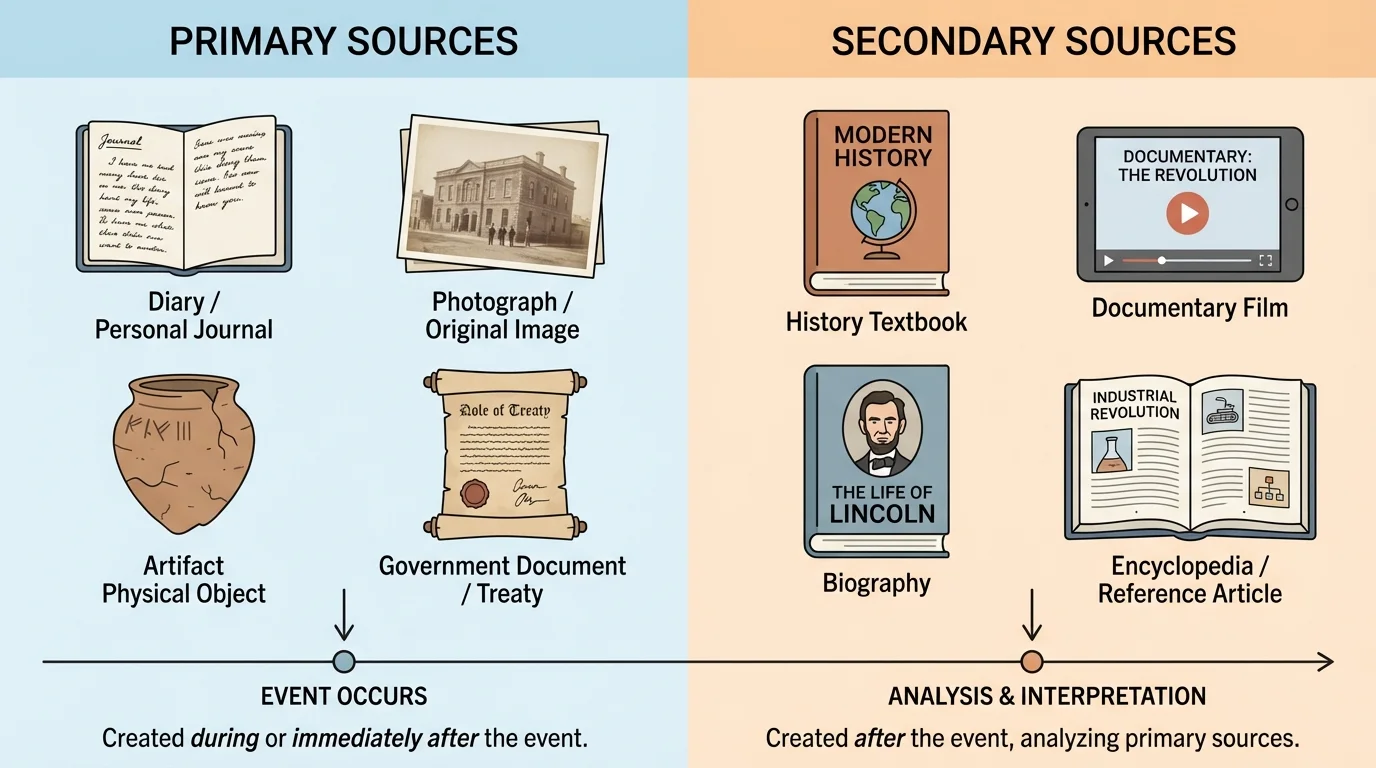
If we want to make a timeline about a town, we might look at an old photo of the town hall. That photo is a primary source. We might also read a book about the town's history. That book is a secondary source. Both can help us place events in order.
Using sources to place an event on a timeline
Step 1: Look at a source.
A newspaper from long ago says a bridge opened in 1950.
Step 2: Find the date and event.
The event is "bridge opened," and the date is 1950.
Step 3: Put it in order.
If the town library opened in 1948 and the bridge opened in 1950, the library comes first on the timeline.
This helps us organize history using evidence.
When we use sources, we should ask if the information matches other evidence. Careful historians compare clues. They do not guess.
One famous timeline tells the story of the historical figure Neil Armstrong. The events of his life are arranged in order, and the moon landing timeline in [Figure 4] helps us see that clearly.
Neil Armstrong was born in 1930. Years later, he became a pilot. After more training, he became an astronaut. In 1969, he walked on the moon. Putting these events in order helps us understand his life story and why the moon landing was important.
If these events were mixed up, the story would not make sense. He had to be born before he could become a pilot. He had to train before he could travel to space. A timeline makes those connections easy to see.
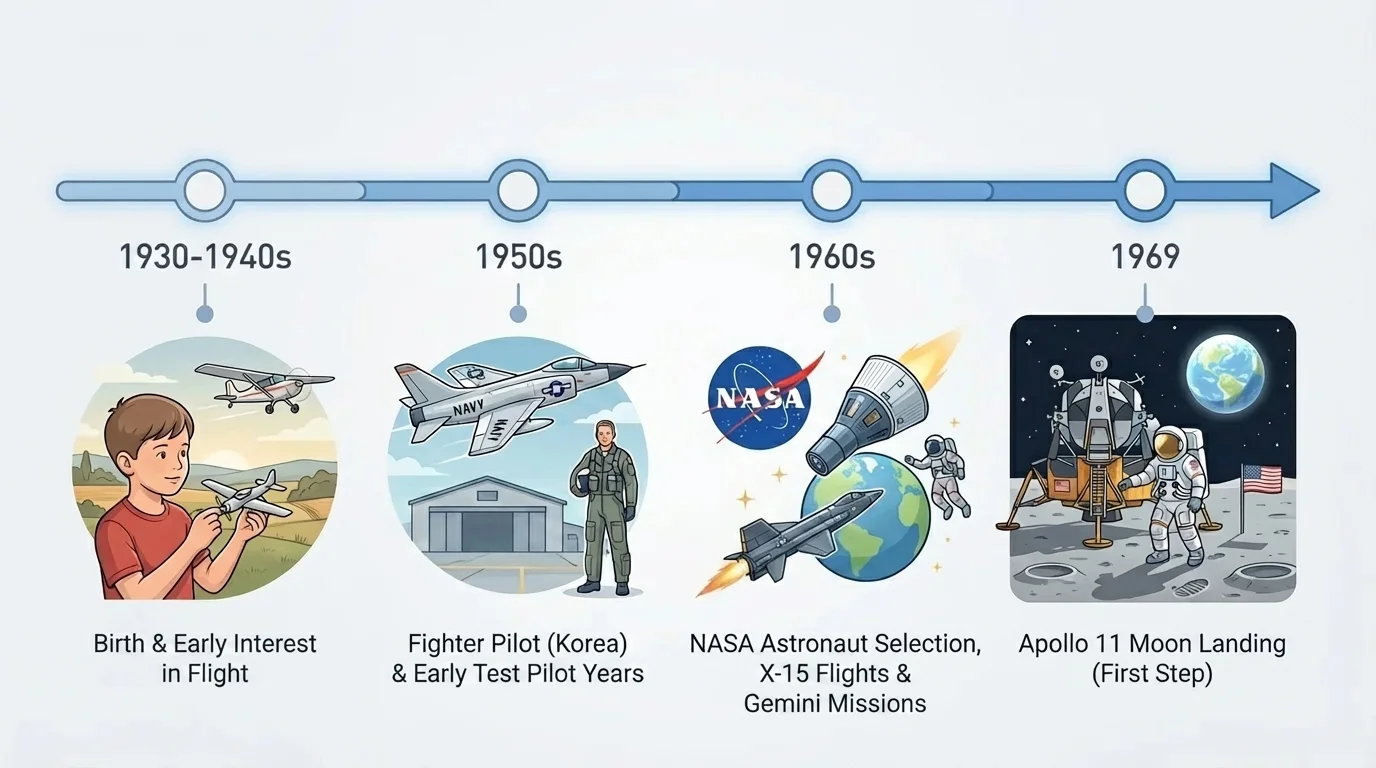
This kind of timeline conveys more than order. It also shows growth, learning, and a big achievement. Much later in history discussions, we can return to [Figure 4] to explain how smaller events led to one important event.
Neil Armstrong was the first person to walk on the moon. His moon walk became one of the most famous events on many American history timelines.
Many timelines include key figures because people often help shape history. A key figure might be a leader, inventor, explorer, scientist, or activist.
History is not only about famous people. Your school and community have history too. A timeline could show when a school opened, when a playground was added, when a new principal arrived, or when a special celebration happened.
Suppose a school opened in 1980, added a library in 1985, built a garden in 1995, and celebrated its 40th year in 2020. Putting these on a timeline helps us see how the school changed over time.
| Year | Event |
|---|---|
| 1980 | School opens |
| 1985 | Library added |
| 1995 | Garden built |
| 2020 | 40th anniversary celebrated |
Table 1. A simple school history timeline with events in chronological order.
From this timeline, we can explain the information it conveys: the school came first, then the library, then the garden, and later the anniversary celebration. We can also tell that the school became older and added new features over time.
Good historians ask questions. A timeline helps us answer them with evidence. We might ask, "Which event happened first?" "What happened after the bridge was built?" or "How did the town change between two events?"
We can also discuss ideas from sources. If one photo shows an empty field and a later photo shows a school, we can talk about what changed. If an old newspaper says the town celebrated a new park, we can place that event on the timeline and discuss why it mattered.
Questions that timelines help answer
Timelines help answer questions about order, change, and importance. They help us explain not only when events happened, but also how events connect to one another.
For example, when we looked at source types in [Figure 3], we learned that different sources can help confirm a date. If both a newspaper and a history book say the same event happened in the same year, we can feel more confident placing it on the timeline.
When we looked earlier at how to read dates and labels in [Figure 2], we saw that even a simple line can tell a rich story. A timeline is like a map of time.
Chronological order means arranging events by time, from first to last. This is one of the most important ideas in timelines.
Sequence means the order in which things happen. If we know the sequence, we can retell a story correctly.
A century is 100 years. Some long timelines use centuries to organize a lot of history. For second grade, it is enough to know that a century is a very long time.
Remember that words like before, after, earlier, and later help describe time. These words are useful when reading and explaining timelines.
Using these words carefully helps us speak like historians. Instead of saying only "This happened," we can say "This happened before that," or "This event came later on the timeline."
Timelines should be accurate. That means the dates and events should match the evidence from sources. If a date is wrong, the order may become confusing.
Careful historians compare information, ask questions, and talk about ideas respectfully. They know that one source may give only part of the story. Looking at more than one source helps build a stronger timeline.
When we organize historical events, we are doing important thinking. We are sorting, comparing, asking questions, and explaining how the past fits together. That is why timelines are such powerful tools in history.
