Have you ever wanted the last cookie, the last swing, or the last red marker at the same time as someone else? That happens because some things are limited. In economics, we learn that people cannot always have every single thing they want. There may not be enough to go around, or people may not have enough money, time, or help to get it. This big idea is called scarcity, and it affects families, schools, stores, and whole communities.
Scarcity means there is not enough of something for everyone to have all they want. People have many wants and needs, but the things used to meet those wants and needs are limited.
Scarcity is the idea that goods, services, and resources are limited, so people cannot always have everything they want or need.
Scarcity does not mean there is nothing at all. It means there is less than people would like to have. A class may have pencils, but not enough for every child to get five pencils. A store may have apples, but not enough for every family to buy ten bags. When something is limited, people have to think carefully about how to use it.
Sometimes scarcity is easy to see. If there are only 5 library books about dinosaurs and 20 children want them, not every child can check one out at the same time. Sometimes scarcity is harder to see. A parent may want more time to work, cook dinner, and play with a child, but time is limited too.
Economics talks about different kinds of things people use. As [Figure 1] shows, some things are objects we can hold, some are jobs people do, and some are materials from nature or made by people to help produce other things.
A good is something people can touch or hold. A backpack, a sandwich, a toy, and a pair of shoes are goods. Goods are made, grown, or prepared for people to use.
A service is work that someone does for another person. A haircut, a bus ride, a doctor visit, or teaching are services. You cannot hold a service in your hand, but it is still something people need or want.
A resource is something used to make goods or provide services. Water, trees, land, sunlight, workers, tools, and time can all be resources. Without resources, many goods and services could not be made.
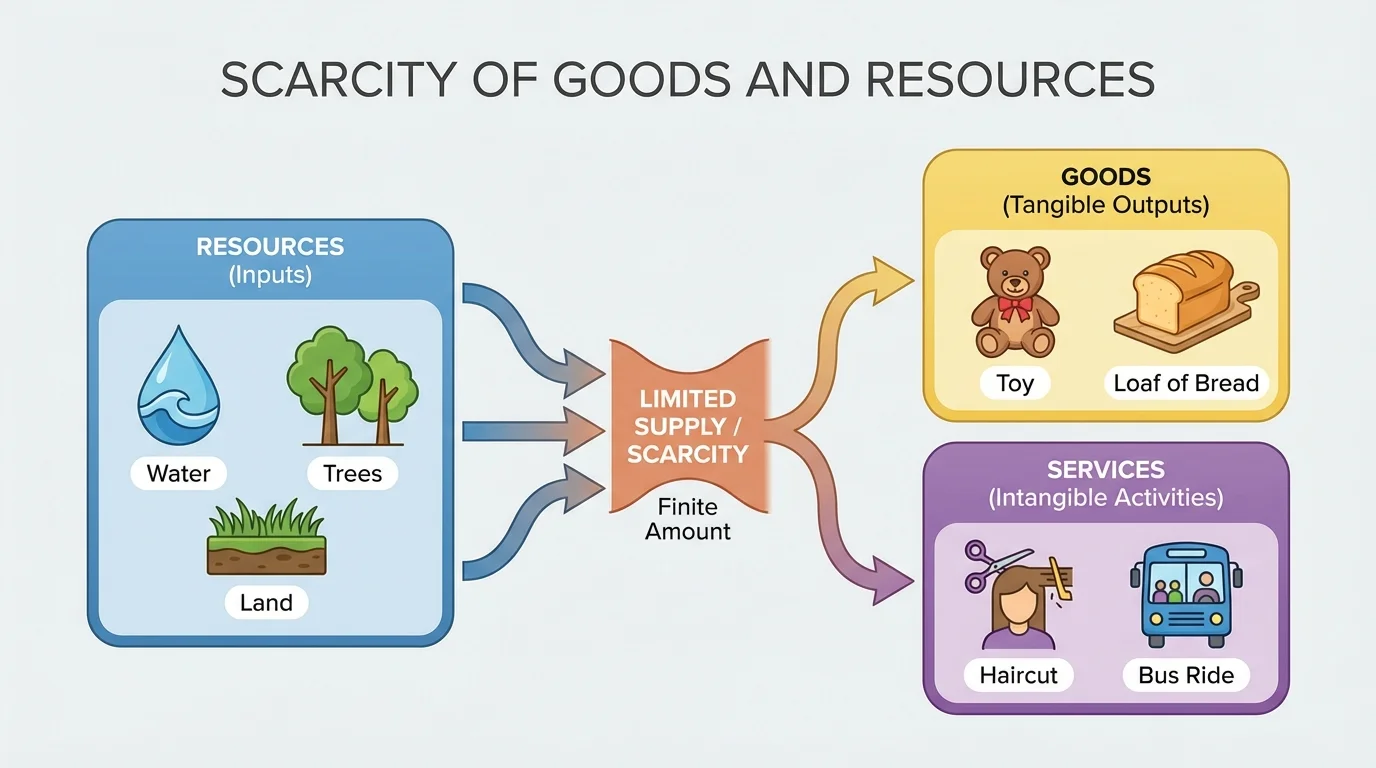
If a bakery has flour, water, and workers, it can bake bread. But if the bakery runs low on flour, bread becomes more limited. That is scarcity of a resource causing scarcity of a good. In the same way, if there are not enough bus drivers, bus service can be limited too.
How scarcity connects the three ideas
Resources help make goods and services. When resources are scarce, the goods and services made from them can also be scarce. For example, less water can make it harder to grow food, and fewer workers can mean fewer services are available.
People use goods and services every day, but they do not always notice the resources behind them. A glass of juice may come from oranges, water, land, sunlight, trucks, factory workers, and store workers. If any part is limited, getting the juice becomes harder.
One reason is that people have different amounts of money. A family might need food, clothes, a home, and medicine first. After paying for those needs, there may not be enough money left for extra toys or treats. Scarcity means people often must choose the most important things first.
Another reason is that there may not be enough items available. If a store has only 8 coats and 12 people want them, then 4 people cannot get a coat right away. The coats are scarce because the amount available is smaller than the amount wanted.
Time can be scarce too. A doctor may want to help many patients in one day, but there are only so many hours. That means some people may have to wait for an appointment. In this case, the service is limited by time.
Workers and tools can also be scarce. If there are not enough people to fix roads, build homes, or deliver mail, those services may take longer. If there are not enough machines or trucks, making and moving goods can be harder.
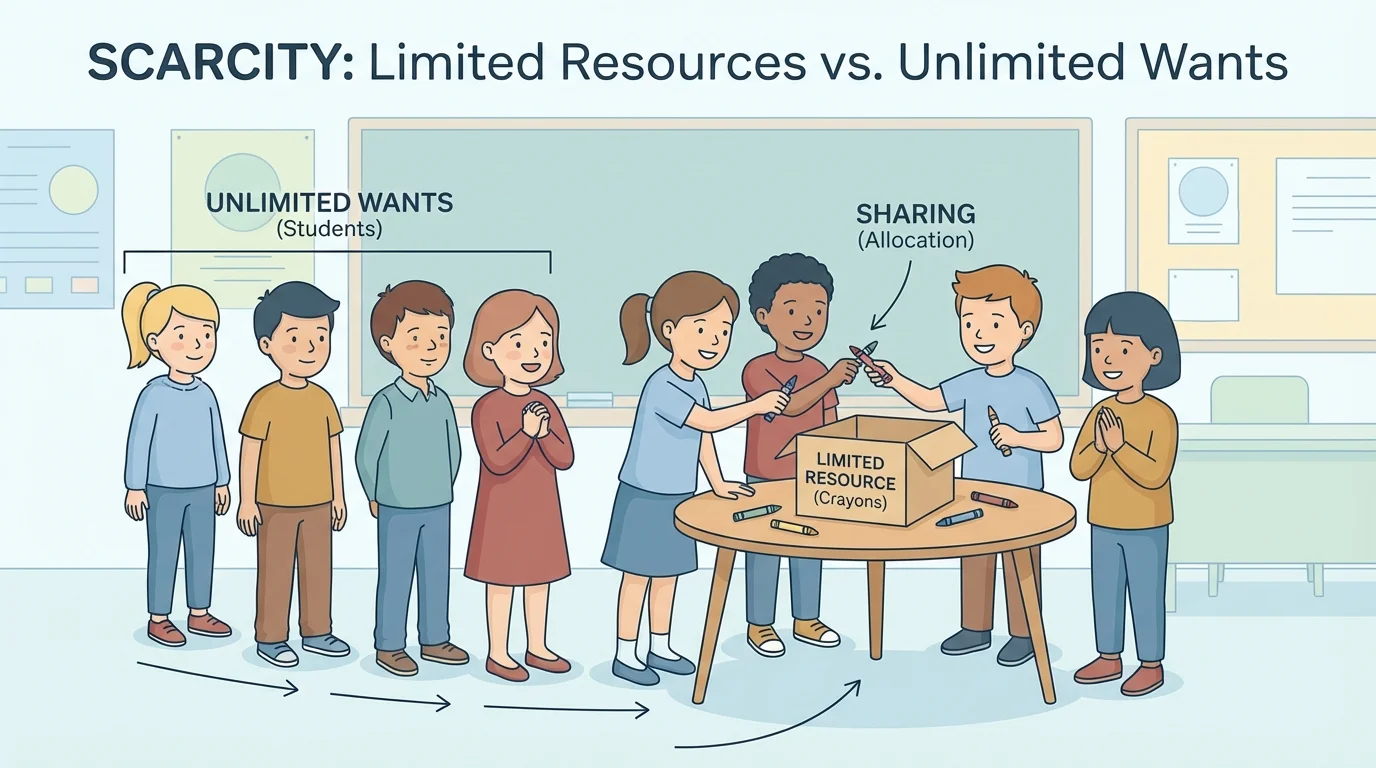
[Figure 2] Scarcity happens in places students know well. In a classroom, there may be fewer crayons, glue sticks, or tablets than students. That means children share, take turns, or wait.
At recess, there may be one ball but many children who want to play with it. At lunch, there may be a favorite snack that runs out before everyone gets one. These are simple examples of scarcity. The item exists, but there is not enough for everyone to have it at the same time.
At home, a family may have to decide how to spend money on groceries, rent, electricity, and clothing. If money is limited, the family cannot buy every toy or game a child wants. This does not mean the wants are bad. It means resources are limited.
In nature, fresh water can be scarce in some places. Good farmland can be limited. Wood, fish, and clean air are important resources too. If people use too much and do not protect these resources, scarcity can become a bigger problem.
Later, when we think again about classroom sharing, [Figure 2] reminds us that scarcity does not always lead to arguing. It can also lead to taking turns, planning, and being fair.
Some communities must work very hard to get clean water because water is not equally available everywhere. A resource can be common in one place and scarce in another.
This is why communities make rules and plans. They may build wells, save water, recycle materials, or grow food carefully. People try to use what they have in ways that help more people.
Because things are limited, people must make choices. A choice means picking one thing from two or more possibilities. Choosing one thing often means not choosing something else.
[Figure 3] When you give up one thing to get another, that is called a trade-off. If you have enough money for either a book or a puzzle, choosing the book means giving up the puzzle for now. If a school buys more art supplies, it may have less money left for something else.
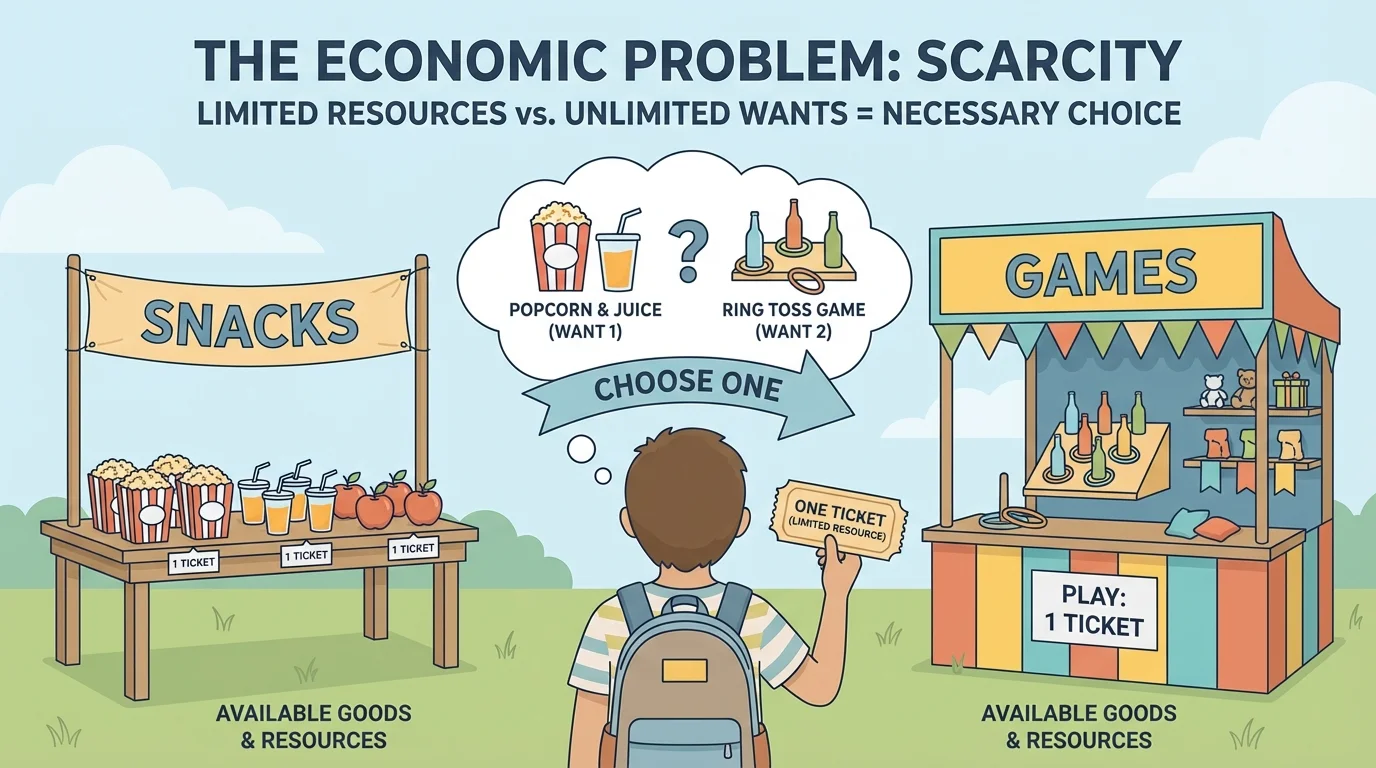
Trade-offs happen all the time. A family may choose to repair a car instead of taking a trip. A farmer may use land to grow corn instead of planting more apples. A city may decide whether to spend money on a park, a library, or road repairs.
Some choices are about needs and some are about wants. A need is something important for living, like food, water, shelter, and clothing. A want is something we would like to have, like a new toy or a special dessert. When resources are scarce, needs often come before wants.
Everyday choice example
Lena has enough money for one item at the school store.
Step 1: Look at the choices
She can buy a notebook or a pack of stickers.
Step 2: Think about what is most important
She needs the notebook for class, but the stickers are just for fun.
Step 3: Make the choice
She buys the notebook.
The trade-off is that she gives up buying the stickers right now.
Thinking carefully about choices helps people use limited resources in smart ways. It does not make scarcity disappear, but it helps people respond to it.
People cannot stop scarcity completely, but they can respond to it in helpful ways. As [Figure 4] shows, one good response is to use resources wisely instead of wasting them.
Sharing is one response. In class, students can share books or art supplies. In a family, people can share rooms, meals, or tools. Sharing lets more people use limited goods.
Saving is another response. Families may save money so they can buy important things later. Communities may save water during dry times. Stores may plan carefully so they do not run out of popular items too quickly.
People can also recycle, repair, and reuse. Fixing a broken bike instead of throwing it away can save materials. Using both sides of paper can save trees. Turning off dripping water helps protect a valuable resource.
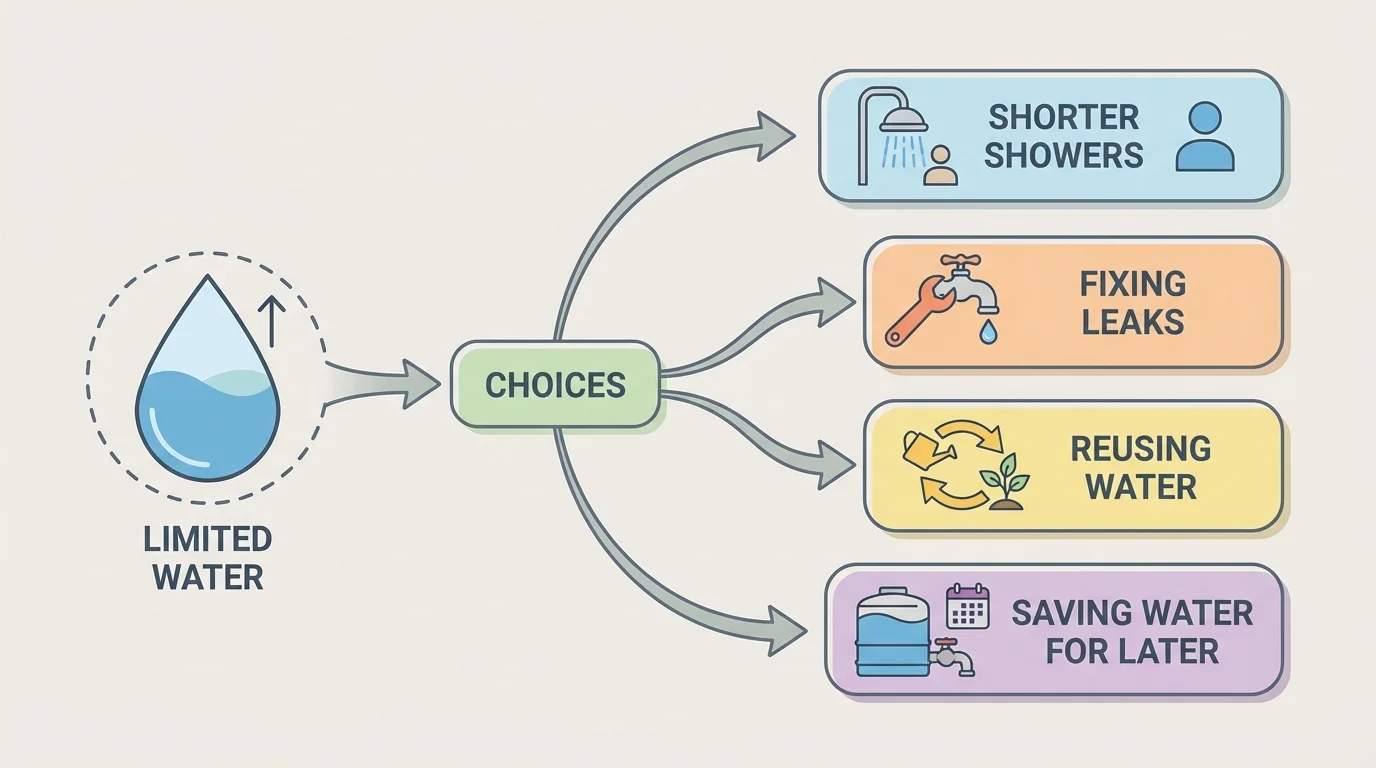
When we look back at water use, [Figure 4] helps us see that one scarce resource can lead to many smart actions. Even small actions can matter when many people work together.
You already know that people use things from nature, such as water, soil, and trees. Those are resources. Economics adds the idea that these resources are limited, so people must decide how to use them.
Using resources wisely is important because many resources cannot be replaced quickly. If people waste food, water, or wood, there may be less for others now and later.
Sometimes scarcity simply means waiting your turn. Other times it can feel unfair because some people have much less access to important goods and services. Not everyone lives near the same stores, doctors, parks, or clean water.
This matters because some goods and services are very important. If a person cannot get enough healthy food or medical care, scarcity affects daily life in a serious way. Communities often try to help by building services, sharing resources, and supporting families.
Economics helps us ask good questions: Who has access? Who is waiting? What resources are limited? What choices can help more people? These questions help people make kinder and wiser decisions.
"Because resources are limited, choices matter."
Learning about scarcity also teaches empathy. If someone cannot get something they need, it may not be because they did something wrong. Sometimes the problem is that resources are limited or not shared fairly.
Economics is the study of how people use limited resources to meet their wants and needs. This may sound like a big idea, but children see it every day.
At a store, shoppers choose what to buy. At a school, leaders decide how to use money for books, lunches, and playground equipment. In a town, workers decide how to use land, water, and time. All of these choices connect to scarcity.
Sometimes prices change when goods are scarce. If a favorite fruit is hard to grow because of bad weather, there may be less of it in stores. When something is harder to get, it can become more expensive. Even young students can notice that some things cost more when they are harder to find.
| Situation | What is scarce? | What happens? |
|---|---|---|
| Only a few library books | Books | Students wait or share |
| Not enough drivers | Workers | Bus service is limited |
| Dry weather | Water | People save water |
| Limited family money | Money | Needs are chosen first |
Table 1. Examples of scarcity and how it affects people's choices.
When students understand scarcity, they start to notice an important truth: not getting everything we want is part of life. The goal is not to feel upset about every limit. The goal is to make good choices, share fairly, and care for resources.
Let us connect the important words. A resource like water helps make a good like juice. A worker may provide a service such as delivering the juice to a store. If water, workers, or trucks are limited, scarcity can make the juice harder to get. Then people must make choices and accept trade-offs.
This is why scarcity matters so much. It helps explain why people wait, share, save, compare needs and wants, and try not to waste. It also helps explain why communities make plans for the future.
