Have you ever noticed that one cookie at a bakery may cost less than a whole cake, or that getting a haircut costs money even though you do not take home a toy or snack? Money is used for many different things, and not everything has the same price. Some things cost a little, and some things cost a lot. Learning why helps us become smart shoppers and careful users of money.
People use money to buy things they need and things they want. When we look closely, we learn that different goods and services have different monetary values. That means they are worth different amounts of money. A pencil may cost less than a backpack. A bus ride may cost less than a doctor visit. These differences happen for important reasons.
As [Figure 1] shows, a good is something you can touch and take home. An apple is a good. A book is a good. Shoes are goods. A service is work that someone does for you. A haircut is a service. A car wash is a service. A teacher provides a service by teaching students. Goods are objects you can hold, while services are actions or jobs people do.
Both goods and services are important. We need goods like food, clothes, and school supplies. We also need services like trash pickup, bus driving, and medical care. Even though both are useful, they do not all cost the same amount. One good can cost more than another good, and one service can cost more than another service.
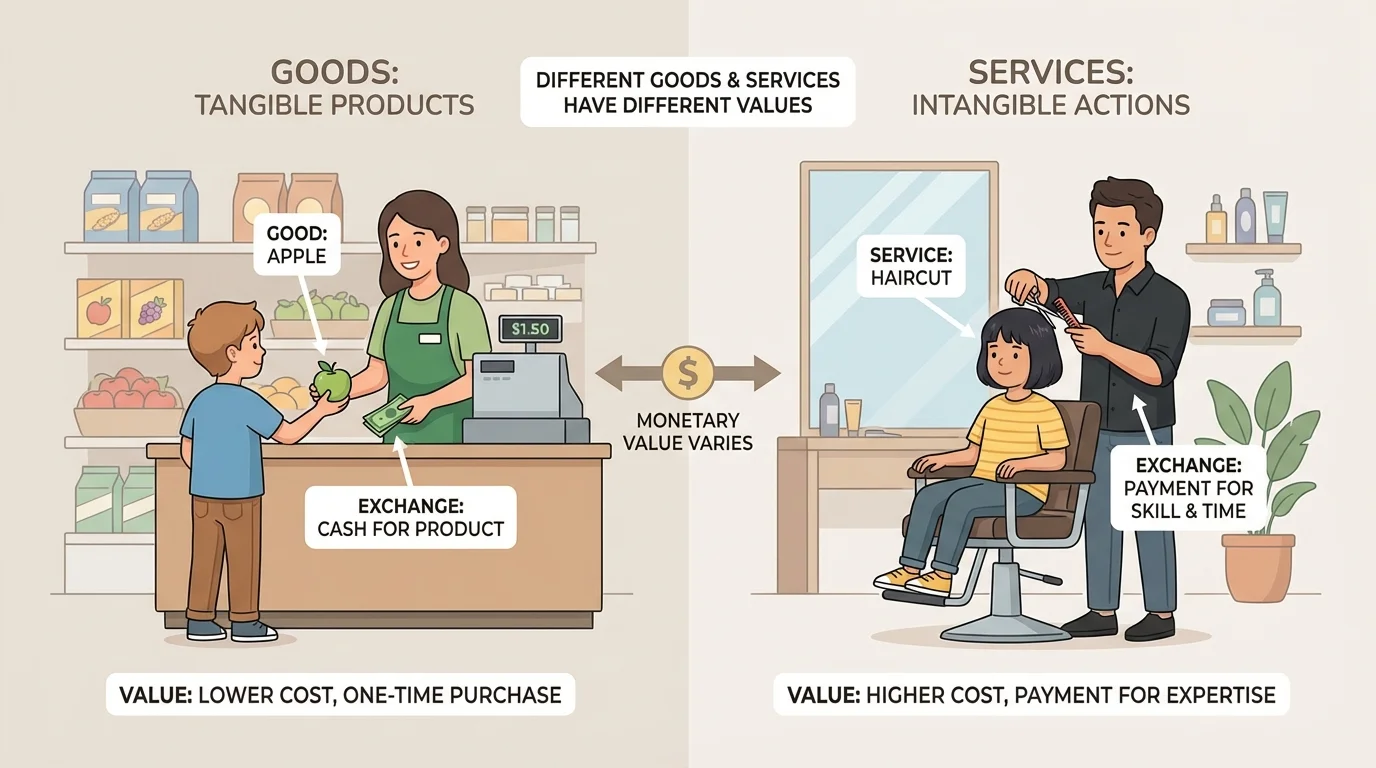
For example, a loaf of bread may cost $3, while a new bike may cost $120. Both are goods, but the bike costs more. A haircut may cost $15, while fixing a broken sink may cost $80. Both are services, but the sink repair costs more. The kind of item or work matters when we think about price.
Monetary value means how much money something costs or is worth. Different goods and services have different monetary values because they are not all made the same way and do not all give the same amount of use.
When people buy something, they are making a choice about how to use their money. That is why it helps to understand prices. If we know what makes prices different, we can make better decisions.
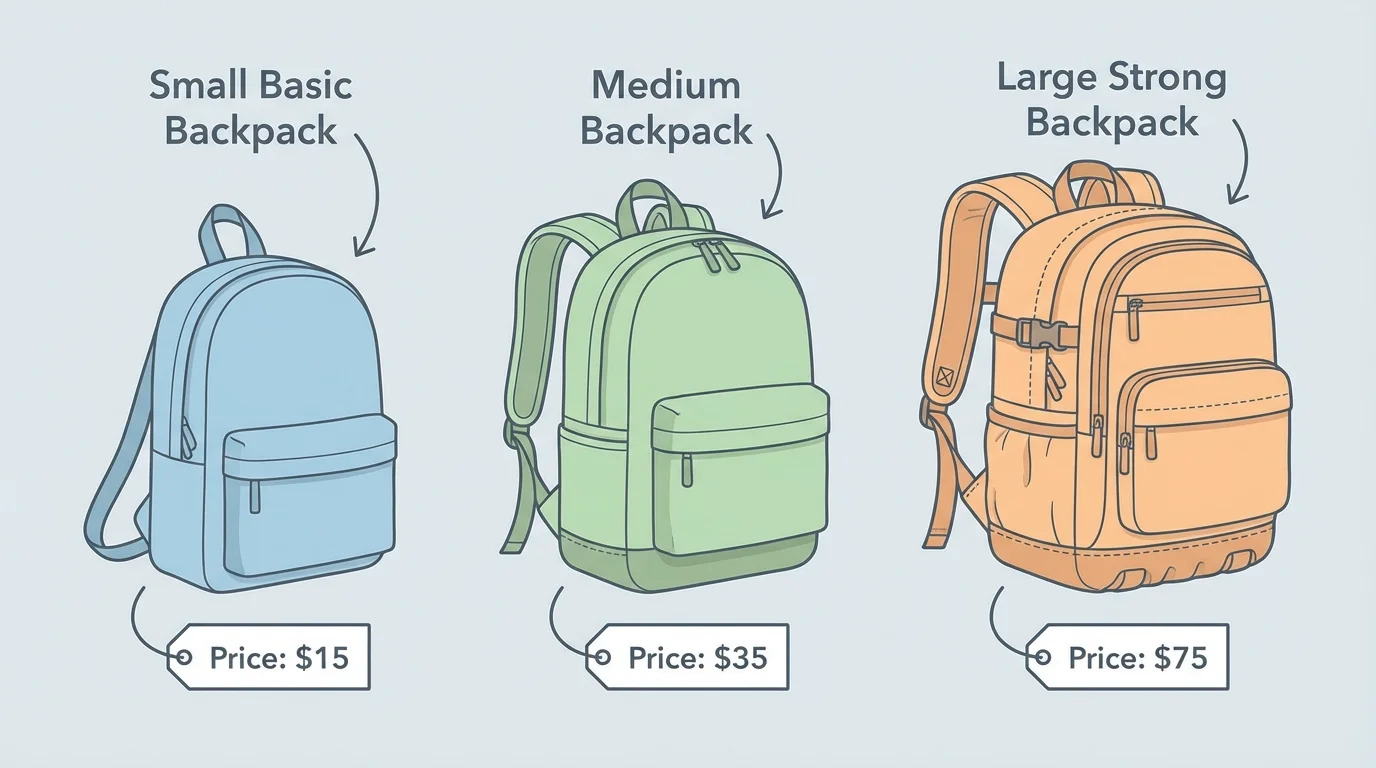
Not all goods and services are equal. As [Figure 2] illustrates, even two items that seem similar can have different prices because of size, strength, or features. A small backpack may cost less than a large backpack. A plain notebook may cost less than one with a hard cover and colorful designs.
One reason prices are different is size. Bigger things often use more materials, so they may cost more. If one juice box costs $2 and a larger bottle costs $4, the larger bottle has a higher price because it gives more drink. Another reason is quality. A stronger umbrella that lasts longer may cost more than a weak umbrella that breaks easily.
Materials matter too. A wooden table may cost more than a cardboard table because wood is stronger and lasts longer. The same is true for clothes, toys, and school supplies. Things made with better materials often cost more money.
Services can have different prices because of time and skill. A person who washes dogs may charge less than a person who repairs computers. Repairing a computer may take special training and careful work. If a job takes longer or needs special skills, it may cost more.
Location can also change price. A bottle of water at a park may cost more than a bottle of water at a grocery store. The item is similar, but the place where it is sold can change the price. This reminds us that price is not only about the object itself.
A service can cost money even when you do not receive a physical item. When someone teaches, cleans, repairs, or helps, their time and skill have value.
Sometimes a price also depends on how many people want something. If many people want the same popular toy, the price may be higher. If fewer people want it later, the price may go down. Students do not need to memorize big business words to see this pattern. They can simply notice that demand can affect price.
Seeing a price tag is only the first step. Smart buyers look carefully. They ask, "What am I getting for this amount of money?" Two markers might not cost the same. One marker may dry out quickly, and another may last longer. The second one may be the better choice, even if it costs a little more.
We can compare prices in simple ways. Suppose one eraser costs $1 and a pack of three erasers costs $2. The pack costs more altogether, but you get more erasers. We can count and compare. Since three erasers for $2 gives more than one eraser for $1, the pack may be a better value if you need several erasers.
We can also use simple math to compare. If one notebook costs $2 and another costs $5, the difference in price is \(5 - 2 = 3\). The second notebook costs $3 more. If one toy costs $8 and another costs $6, then \(8 - 6 = 2\). The first toy costs $2 more.
Comparing two goods
Lena sees two boxes of crayons. One box has \(8\) crayons for $2. Another box has \(16\) crayons for $3.
Step 1: Compare the number of crayons.
The second box has more crayons because \(16 > 8\).
Step 2: Compare the prices.
The second box costs more money because $3 is more than $2.
Step 3: Think about value.
For only $1 more, Lena gets \(16 - 8 = 8\) extra crayons.
If Lena needs many crayons, the second box may be the better value.
Cheaper does not always mean better. If a pair of shoes costs less but falls apart quickly, you may need to buy another pair soon. A more expensive pair that lasts longer may save money over time. Careful thinking helps us notice this.
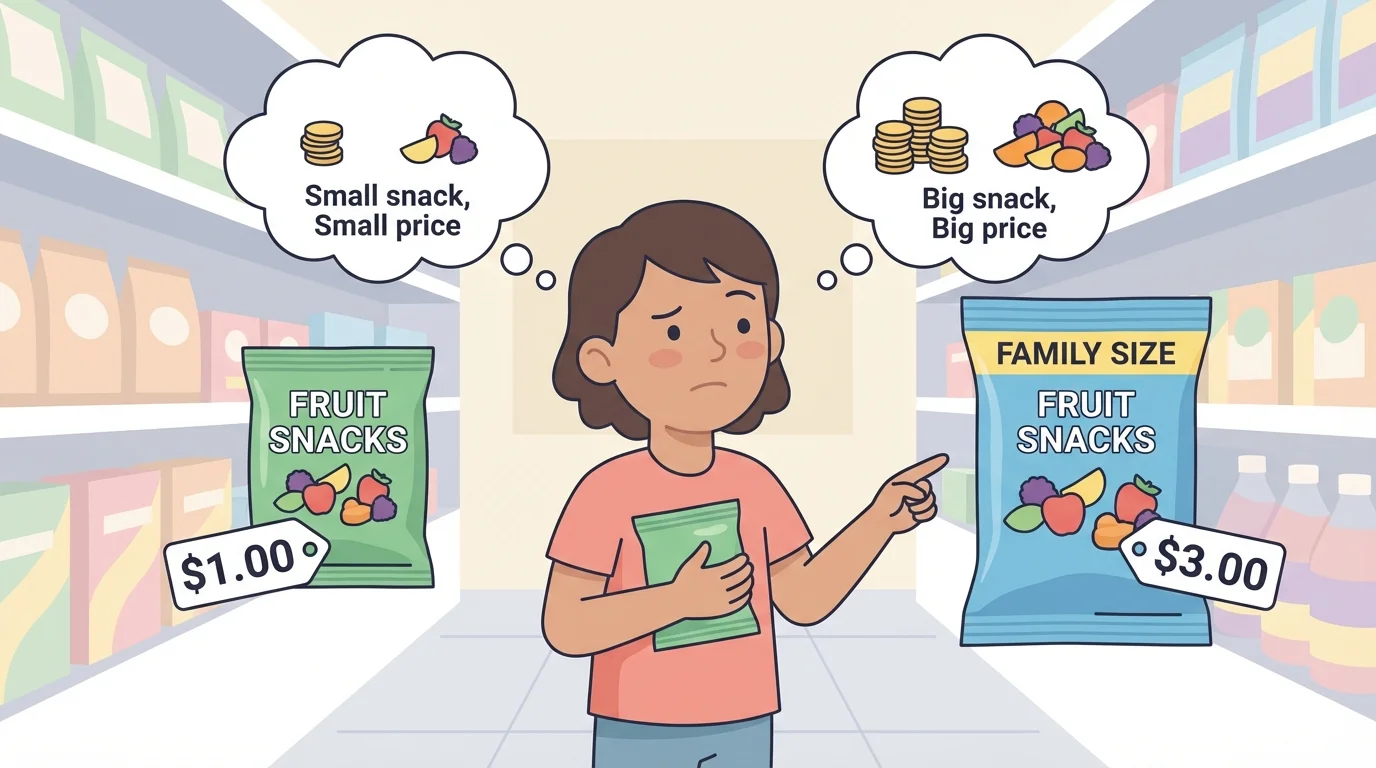
When we choose how to spend money, we think about cost and benefit. Cost is the money we give up to buy something. Benefit is what we gain from it. As [Figure 3] shows, a smart choice means looking at both the price and what you get.
If a student has $5, that student cannot buy everything. The student must choose. A snack for $2 leaves $3. A small toy for $4 leaves $1. We can write these as \(5 - 2 = 3\) and \(5 - 4 = 1\). Looking at what is left helps the student decide carefully.
Needs and wants matter too. Food, school supplies, and warm clothes are often needs. A second toy or extra candy may be wants. There is nothing wrong with wants, but needs usually come first. When money is limited, people often buy the most important things before the less important things.
Benefits can be different for different people. One child may think a library card is a great benefit because reading is important to that child. Another child may care more about sports equipment. This shows that value can depend on what a person needs, likes, or plans to do.
Still, there are good questions every buyer can ask: Is this something I need now? Is there a less expensive choice? Will this last a long time? Am I getting enough for the price? Those questions help people think before spending money.
Costs and benefits work together
To make an informed financial decision, a buyer does not look only at the price. The buyer also thinks about what the item or service will do, how long it will last, and whether it is worth the money. A low cost can be helpful, but a significant benefit matters too.
This way of thinking applies to services too. A music lesson may cost more than a movie ticket, but the lesson may help a child learn a skill over many weeks. The movie gives enjoyment for a short time. Both choices can be good, but their benefits are different.
Here are some everyday comparisons that show how prices can be different.
| Choice | Price | What to Notice |
|---|---|---|
| Single pencil | $1 | Good for one pencil |
| Pack of \(5\) pencils | $4 | More pencils for a higher total price |
| Small pizza | $8 | Less food |
| Large pizza | $12 | More food for $4 more |
| Quick car wash | $6 | Basic service |
| Full car wash | $10 | More cleaning and more time |
Table 1. Examples of goods and services with different prices and reasons to compare value.
Look at the pencils. The pack costs more than one pencil, but it gives more pencils. If a student only needs one pencil, the single pencil may be enough. If a student needs several pencils, the pack may make more sense. The best choice can change depending on the situation.
Comparing a service
A quick car wash costs $6. A full car wash costs $10.
Step 1: Find the difference in price.
\(10 - 6 = 4\)
Step 2: Think about the benefit.
The full car wash may clean more parts of the car and take more time.
Step 3: Decide which is better for the need.
If the car is only a little dusty, the $6 wash may be enough. If the car is very dirty, the $10 wash may be worth it.
The better choice depends on the cost and the benefit together.
Now think about food. A small pizza for $8 and a large pizza for $12 are both goods. The large pizza costs $4 more because \(12 - 8 = 4\). But if it feeds more people, it may be worth the extra money. Families often compare size and price before buying.
We can also compare two services with the same kind of work. One babysitter may charge $10 for one hour, and another may charge $12 for one hour. The second babysitter costs more. A family might decide the extra cost is worth it if that babysitter has more experience or special training.
Remember: Money choices are about more than finding the lowest price. Good decision-making means noticing price, usefulness, quality, and how much you really need the item or service.
Being thoughtful with money does not mean never spending it. It means using it carefully. When we understand that different goods and services have different values, we are less likely to rush. We can pause, compare, and choose wisely.
Earlier, [Figure 1] helped us see the difference between goods and services, and that matters when we shop. We may be deciding between buying an object, such as a lunch box, or paying for someone's work, such as a haircut. Both can be important, but they are priced in different ways.
We also return to the idea from [Figure 2]: a larger or stronger item may cost more because it uses better materials or gives more use. That same thinking can help with coats, books, sports balls, or lunch containers.
And the comparison in [Figure 3] reminds us to think about value, not only price. A higher price is not always a bad choice, and a lower price is not always the best choice. What matters is whether the cost matches the benefit for the buyer.
As students grow, they will make more money choices on their own. They might choose snacks, school supplies, games, or gifts. Understanding value now builds strong habits for later. Smart financial decisions start with simple questions and careful thinking.
