Have you ever wanted something right away, but your money needed more time to grow? That happens to everyone. A toy, a game, a book, or a craft set may look exciting today, but sometimes we must save little by little. Learning how to solve money word problems helps us make good choices. It helps us know how long to save, how much we still need, and which choice is better for us.
Money math is part of everyday life. When we think about buying something, we are thinking about its cost. When we think about how happy or useful that item will be, we are thinking about its benefit. Good financial decisions mean looking at both. A snack might cost only a little, but a book might last much longer. A game may cost more, but if you really want it, saving for it can be worth the wait.
To make a smart choice, we ask simple questions. [Figure 1] How much does it cost? How much money do I earn or save each week? How many weeks will it take? These questions turn into math problems we can solve.
Cost is the amount of money needed to buy something.
Benefit is the good thing you get from a choice, like fun, learning, or usefulness.
Save means to keep money instead of spending it right away.
Allowance is money a child may earn or receive regularly, such as each week.
When you know these words, financial word problems become easier to understand. The math tells you the answer, and the words help you know what the question is asking.
A financial word problem is a story problem about money. Many saving problems follow the same pattern with equal amounts saved each week. First, find the total cost of the item. Next, find how much money is earned or saved each week. Then ask: how many groups of that weekly amount make the total cost?
We can write that idea with a simple number sentence:
weeks needed = cost divided by money saved each week. For example, if a game costs $20 and you save $5 each week, the equation is \(20 \div 5 = 4\).
That means the child needs 4 weeks to save enough money. Saving problems are often division problems because we are splitting the total cost into equal weekly parts.
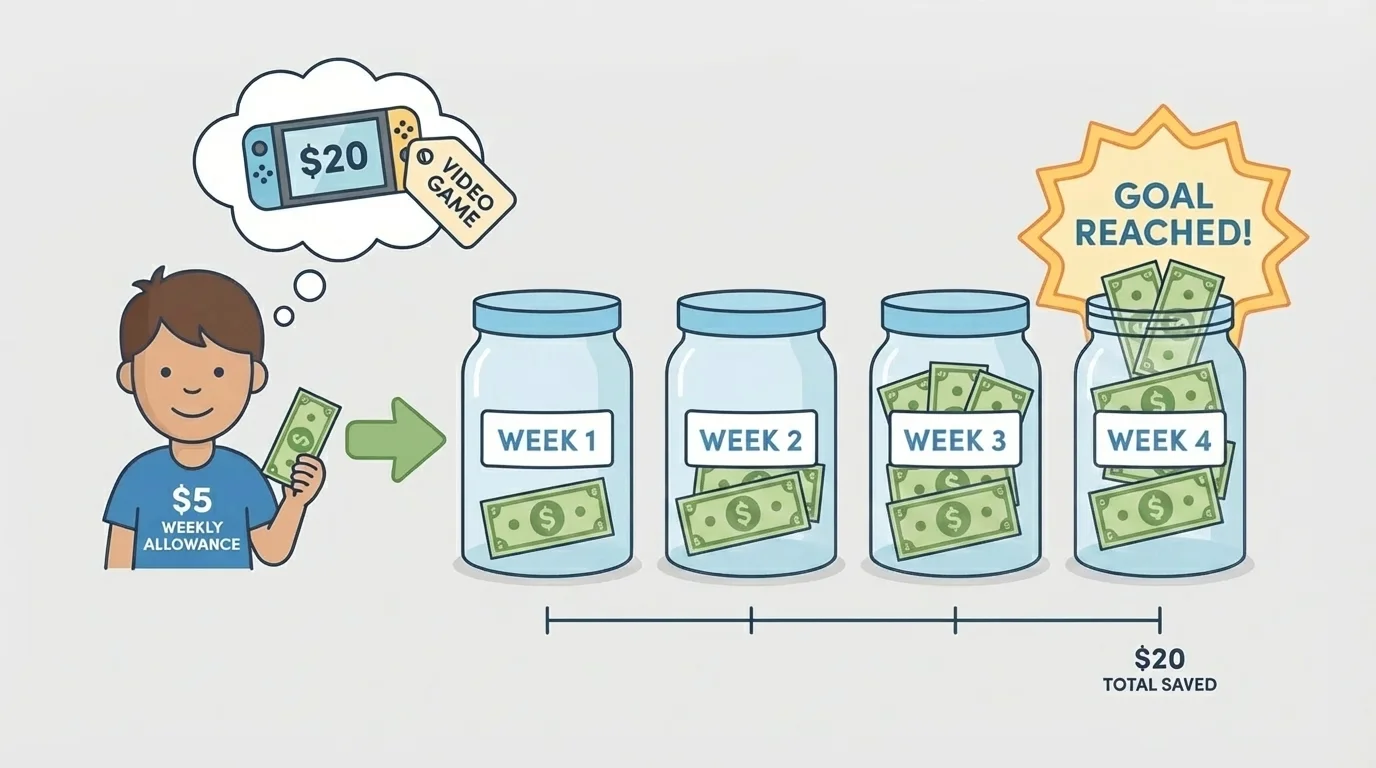
Another way to think about it is with repeated addition. If you save $5 each week, then after week 1 you have $5, after week 2 you have $10, after week 3 you have $15, and after week 4 you have $20. Repeated addition and division both help solve the same problem.
You already know helpful math facts for this topic: addition tells how money grows, subtraction tells how much is left, and division tells how many equal groups there are.
Sometimes children like to count up instead of dividing. That is fine. What matters is understanding the story and choosing a math method that works.
Let us solve some money problems step by step. Watch for the cost, the amount earned, and what the question asks.
Worked example 1
A puzzle costs $18. Mia earns $3 each week. How many weeks must she save?
Step 1: Find the important numbers.
The cost is $18, and Mia saves $3 each week.
Step 2: Write the division problem.
\(18 \div 3 = 6\)
Step 3: Check with addition.
\(3 + 3 + 3 + 3 + 3 + 3 = 18\)
Mia needs 6 weeks.
This example shows that equal weekly savings can be grouped until they reach the total cost.
Worked example 2
A toy truck costs $16. Leo saves $4 each week. How many weeks will it take?
Step 1: Identify the total cost and weekly savings.
The truck costs $16. Leo saves $4 each week.
Step 2: Divide.
\(16 \div 4 = 4\)
Step 3: Explain the answer.
After 4 weeks, Leo will have \(4 + 4 + 4 + 4 = 16\).
Leo needs 4 weeks.
Notice that the answer tells time, not dollars. In these questions, we are often solving for the number of weeks.
Worked example 3
A book costs $15. Ava gets $5 each week. How many weeks does she need to save?
Step 1: Read carefully.
The total cost is $15. Ava saves $5 each week.
Step 2: Solve with division.
\(15 \div 5 = 3\)
Step 3: Check.
After 3 weeks, Ava has \(5 + 5 + 5 = 15\).
Ava needs 3 weeks.
When the cost and the weekly savings match a known division fact, the problem can be solved very quickly.
Money math also helps us compare choices. A financial decision means choosing what to do with money. Sometimes you can buy one thing sooner than another. Looking at both the cost and the benefit helps you decide.
[Figure 2] Money math also helps us compare choices. Suppose a book costs $12 and a ball costs $15. A child earns $3 each week. For the book, the math is \(12 \div 3 = 4\). For the ball, the math is \(15 \div 3 = 5\). The book can be bought after 4 weeks, but the ball takes 5 weeks.
If the child wants something sooner, the book is the better choice. If the child thinks the ball is more fun and is willing to wait longer, the ball may be the better choice. The math does not choose for you, but it helps you understand your options.
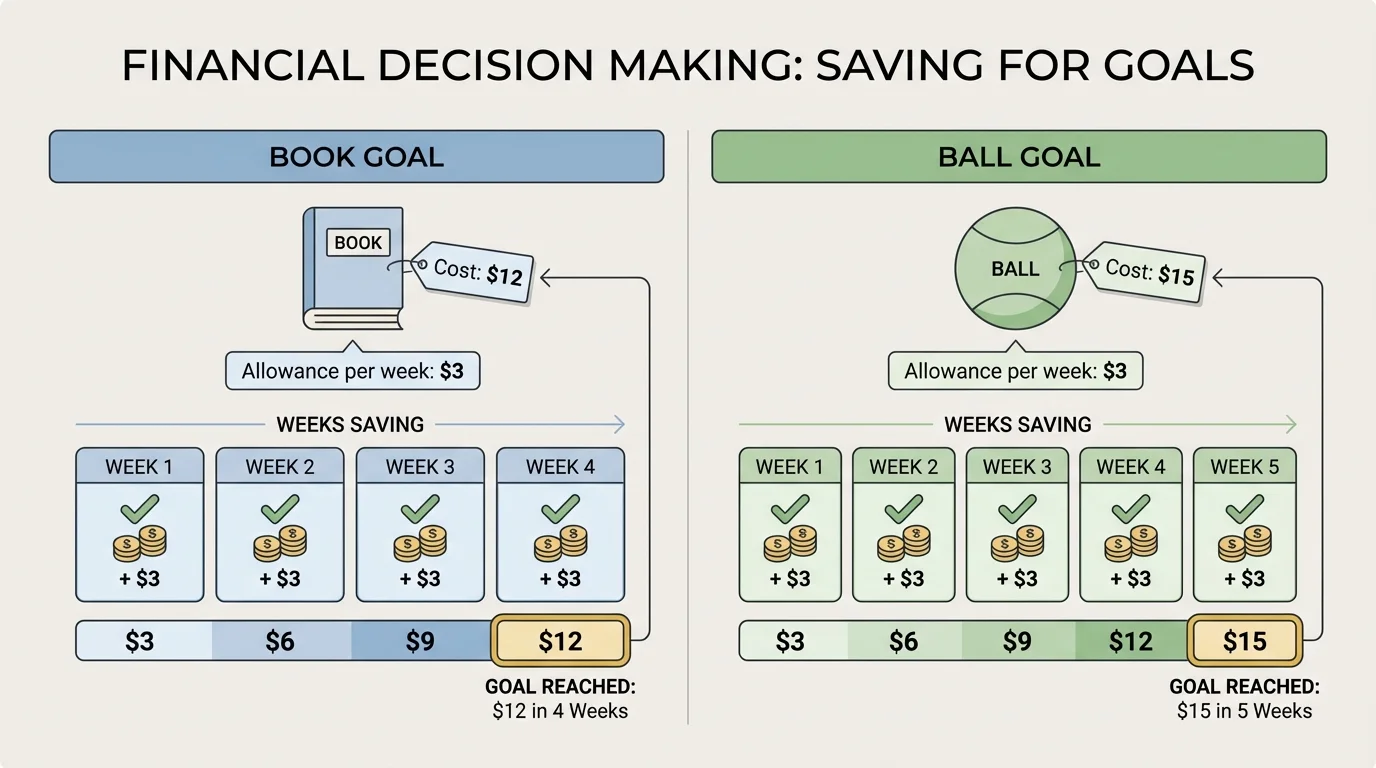
This is why learning about costs and benefits matters. One item may cost less. Another item may cost more but give more use or more joy. Smart choices come from thinking about both.
| Item | Cost | Saved Each Week | Weeks Needed |
|---|---|---|---|
| Book | $12 | $3 | \(12 \div 3 = 4\) |
| Ball | $15 | $3 | \(15 \div 3 = 5\) |
Table 1. A comparison of two items showing cost, weekly savings, and weeks needed.
Children use these skills in many real situations. You may save for a school fair, a small gift, a new set of markers, or a favorite game. Adults use similar thinking too. They may save for furniture, a bicycle, or a trip. The numbers may be bigger, but the idea is the same: compare the cost with how much money comes in.
A budget is a simple plan for money. Even a second grader can make a small budget. If you know you earn $4 each week, you can decide whether to spend all of it now or save some of it for later. If you spend $2 and save $2 each week, your savings grow more slowly than if you save all $4.
Saving helps with planning. When people save a little at a time, they can reach a goal without needing all the money at once. Solving simple word problems shows how long the plan will take and helps people decide whether the goal is worth the wait.
Here is another real-life example. A sticker pack costs $6. A child saves $2 each week. The equation is \(6 \div 2 = 3\). That child needs 3 weeks. Small numbers like these help children see how saving grows over time.
Sometimes the division does not come out evenly. This is an important kind of money problem. A child may need one extra week to have enough. Reaching part of the cost is not enough if you still cannot buy the item.
[Figure 3] Sometimes the division does not come out evenly. Suppose a toy costs $10 and a child saves $4 each week. After 1 week, the child has $4. After 2 weeks, the child has $8. That is still not enough. After 3 weeks, the child has $12, and now the child can buy the toy.
Even though \(10 \div 4\) is not a basic whole-number fact, we can use counting to solve the problem. The child needs 3 weeks, because 2 weeks gives only $8, and $8 is less than $10.
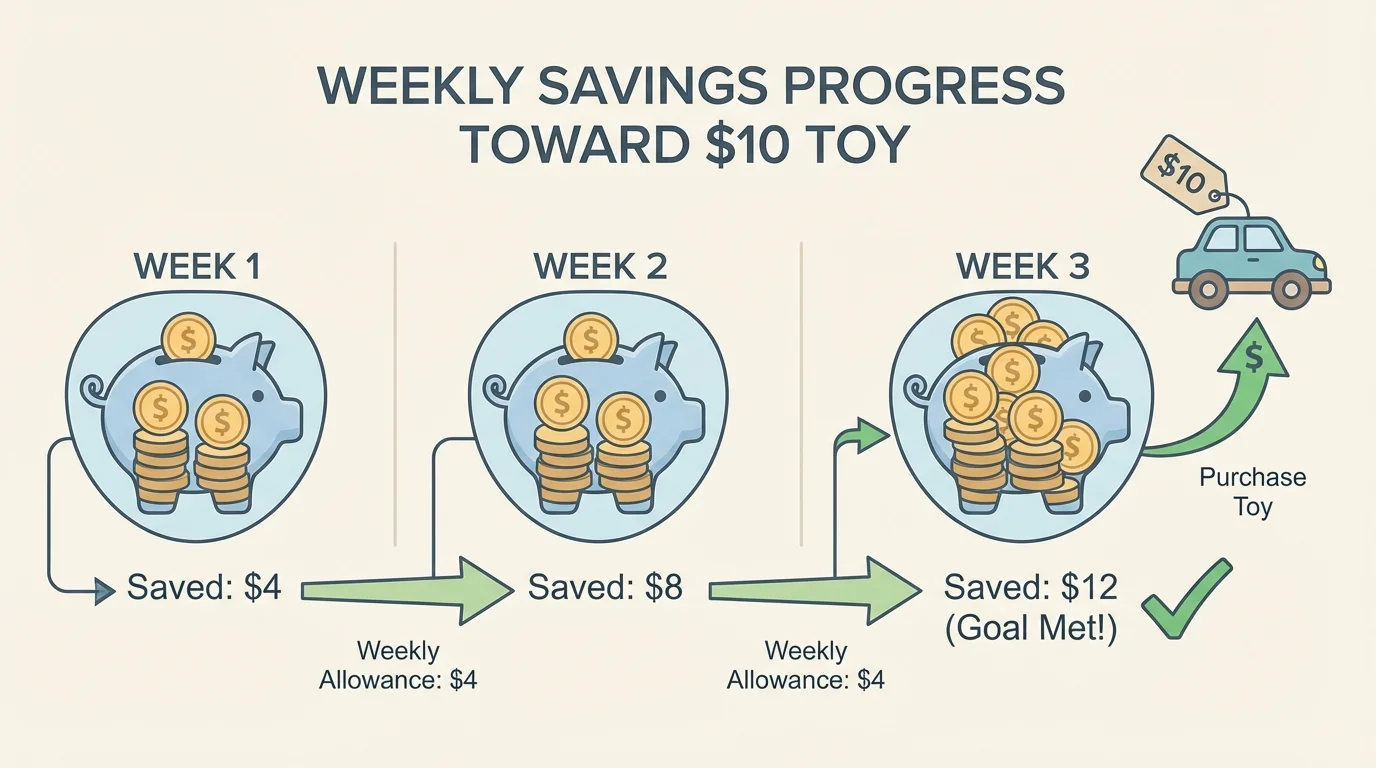
This idea is very useful. If your money is not enough yet, you must keep saving until you have at least the cost. Later, when you compare choices again, [Figure 2] helps remind us that waiting time is part of the decision too.
Some people save coins in jars and are surprised by how fast small amounts add up. Saving just a little each week can turn into enough money for something special.
Let us look at one more example. A craft kit costs $14. Nina saves $5 each week. After 1 week she has $5. After 2 weeks she has $10. After 3 weeks she has $15. Nina needs 3 weeks because $10 is not enough, but $15 is enough.
When you solve these problems, always ask, "Do I have enough money yet?" That question helps you avoid stopping too soon.
Read the story carefully. Circle or notice the cost and the amount earned or saved each week. Decide whether the question is asking for dollars or weeks. Most saving problems in this lesson ask for weeks.
You can solve with division, repeated addition, or counting up by equal amounts. If an item costs $20 and you save $5 each week, then \(20 \div 5 = 4\). You can also count: $5, $10, $15, $20. Both ways give 4 weeks.
Always check whether the answer makes sense. If something costs more money, it usually takes more weeks to save for it. If you save more money each week, it usually takes fewer weeks.
"Saving a little now can help you buy something important later."
Money choices become clearer when math and thinking work together. The numbers show what is possible, and your goals help you choose what matters most.
