Two people can watch the very same event and tell the story in different ways. One person may remember the loud music. Another may remember the rain. A photograph may show the crowd, while a diary may tell how someone felt. Historians know this happens all the time, so they do not depend on just one source. They compare many sources to learn what happened in the past as clearly as possible.
When we learn about history, we are learning about real people and real events. But the past is not sitting in front of us. We cannot go back in time and watch it happen again. Instead, we study clues left behind. These clues can come from writing, pictures, objects, recordings, and other evidence.
If a historian reads only one account of an event, that account might leave out important details. It might even contain a mistake. By comparing more than one source, historians can notice what is the same and what is different. If several sources say the same thing, that detail may be more reliable. If sources disagree, historians ask more questions and look for more evidence.
This is a little like being a detective. A detective does not solve a mystery by listening to only one witness. A historian also gathers information from many places. That helps build a fuller understanding of the past.
Source means something that gives information. In history, a source helps us learn about people, places, and events from the past.
Event means something that happened at a certain time, such as a parade, a battle, an election, or a famous speech.
Some events are small, like the opening of a town library. Some are very large, like the first moon landing. No matter the size of the event, comparing sources helps us understand it better.
Historians often sort sources into two important groups, and the side-by-side view in [Figure 1] helps show the difference. A primary source is made by someone who was there at the time of the event, or by something created during that time. A diary entry written on the day of a parade is a primary source. A photograph taken during the parade is also a primary source.
A secondary source is made later by someone who studies the event. A textbook chapter about the parade, written years afterward, is a secondary source. So is a history article that explains what happened by using many primary sources.
Neither kind is automatically perfect. A primary source can be powerful because it comes from the time of the event, but it may show only one person's view. A secondary source can be helpful because it puts together information from many places, but it depends on how carefully the writer studied the evidence.
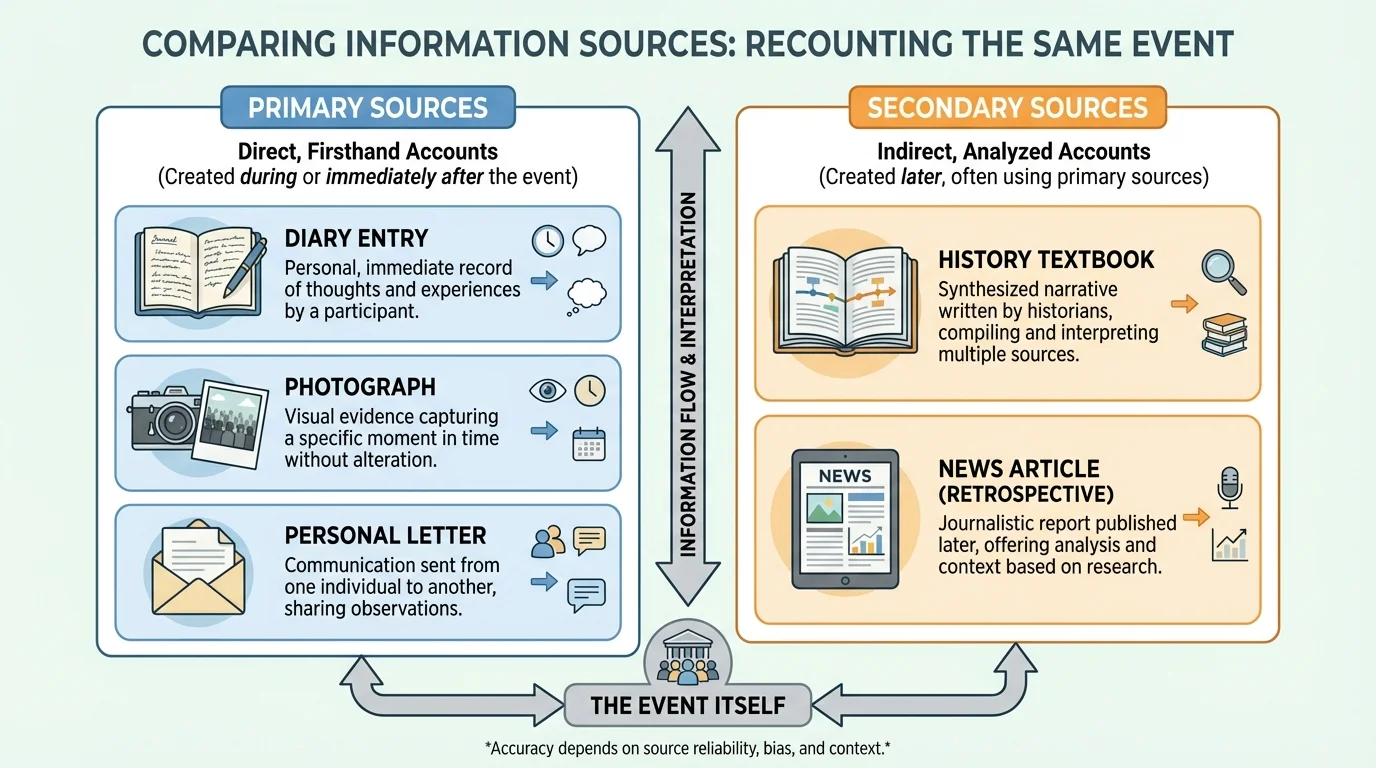
Here are some common examples:
| Type of source | Examples | How it helps |
|---|---|---|
| Primary source | letters, diaries, photographs, maps from the time, newspaper from the day, objects | Shows direct evidence from the time of the event |
| Secondary source | textbook, biography, encyclopedia article, documentary made later | Explains the event after studying evidence |
Table 1. Examples of primary and secondary sources and how each type helps historians.
Sometimes a source can be tricky to classify. For example, a book written long ago by a person who lived through an event can be a primary source for that event. The important question is this: was the source created during the time or by someone directly connected to it, or was it created later to explain the event?
When students compare sources, it helps to begin by asking, "Is this source from the time of the event, or is it explaining the event later?" That first question gives us a strong start.
When you compare accounts, the question path in [Figure 2] helps you look carefully instead of guessing. Start by checking the basic facts. Ask: Who was involved? What happened? When did it happen? Where did it happen? Why did it happen? How did it happen?
Next, look for details that match. If two sources both say a parade started in the morning, that is a matching detail. After that, look for details that differ. One source might say the streets were crowded, while another says the crowd was small near the end.
Then ask what each source adds. A photograph may show what people wore. A diary may show how someone felt. A newspaper report may tell the order of events. Each source may hold a different piece of the puzzle.
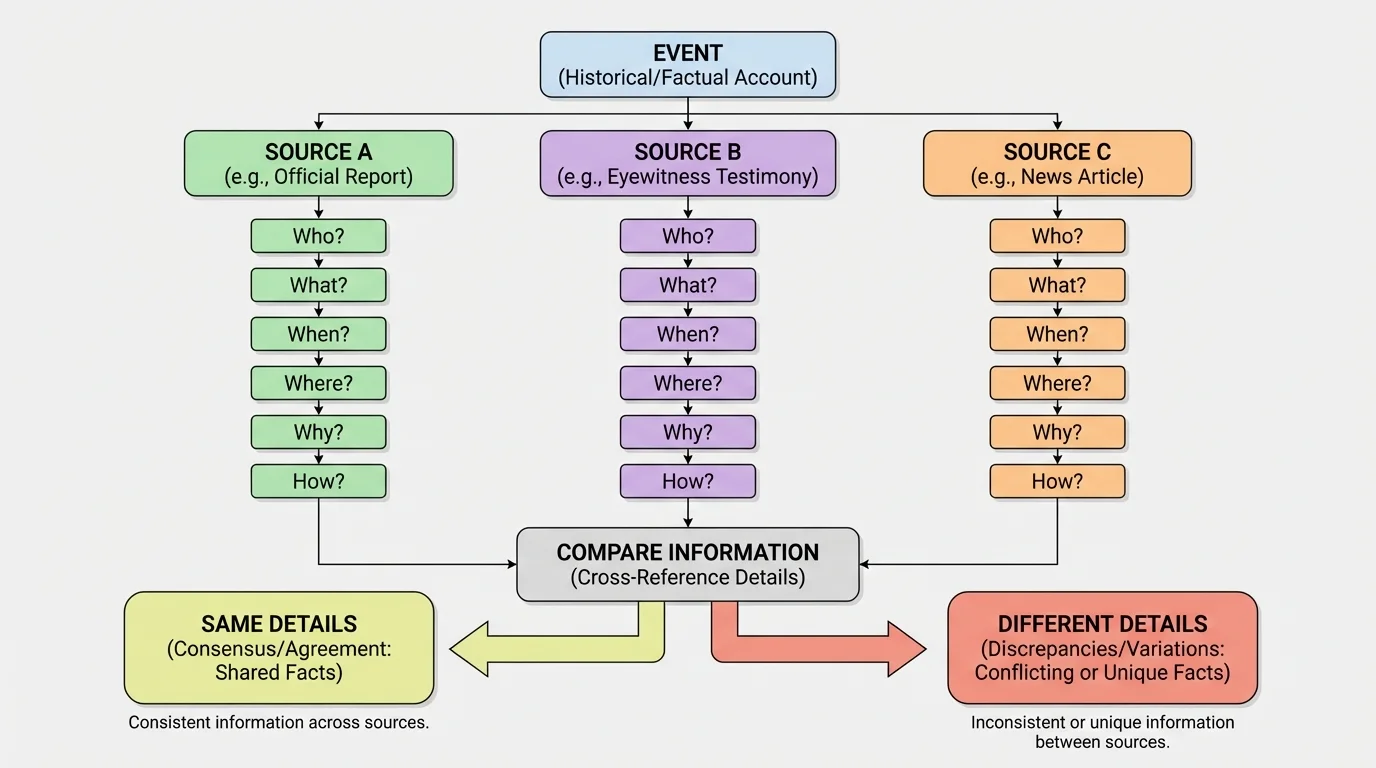
Good comparing also means paying attention to exact words. If one source says "many people cheered" and another says "a few people clapped," those descriptions are not exactly the same. Historians notice those differences because words shape how we understand the event.
Comparing is more than spotting differences
When historians compare sources, they are not trying to choose a winner right away. They are trying to learn from each source. A source that leaves out one detail may still be useful for another detail. Careful comparison helps historians make stronger explanations of the past.
A helpful way to organize your thinking is to keep notes in categories. You might list what all sources agree on, what only one source says, and what you still need to find out. That makes your thinking clear and careful.
Sources about the same event do not always match perfectly. One reason is point of view. Point of view means the position or opinion from which someone sees something. A child at a parade may focus on the candy thrown from a float. A police officer may focus on keeping the street safe. Both were at the same event, but they noticed different things.
Another reason is memory. People do not remember everything exactly the same way, especially after time has passed. A person writing years later may forget details or mix up the order of events.
Sources also have different purposes. A newspaper article may try to inform the public. A diary may be private and personal. A speech may try to persuade people. Because the purpose is different, the details chosen may be different too.
Audience matters as well. A writer may explain an event one way for children and another way for adults. A textbook often uses simple, broad details, while a letter may include small personal moments.
Sometimes sources differ because one source has incomplete information. A photograph freezes only one moment. It cannot show what happened before or after that exact second. That is why a photo is useful, but it should not be the only source we use.
Historians sometimes learn new things about old events when a letter, photo, or diary is discovered many years later. One new source can add an important missing detail.
Instead of being frustrated when sources differ, historians become curious. Differences can lead to better questions, and better questions can lead to a better understanding of the past.
A simple local event can show how comparison works. The same town parade can look different in different sources, as [Figure 3] illustrates through a diary, a photograph, and a history book. Suppose we are studying a parade held in a town in 1955.
The first source is a diary written by a child who attended the parade. The diary says, "The band was so loud, and I caught two pieces of candy. It started late because of rain." This source gives us feelings and personal details.
The second source is a photograph taken on the main street that day. The photo shows people holding umbrellas, a marching band, and a large flag. This source gives us visual evidence about weather, clothing, and what was happening in that moment.
The third source is a local history book written many years later. It says, "The 1955 parade honored veterans and drew families from nearby farms into town." This source gives a broader explanation of the event's purpose and significance.
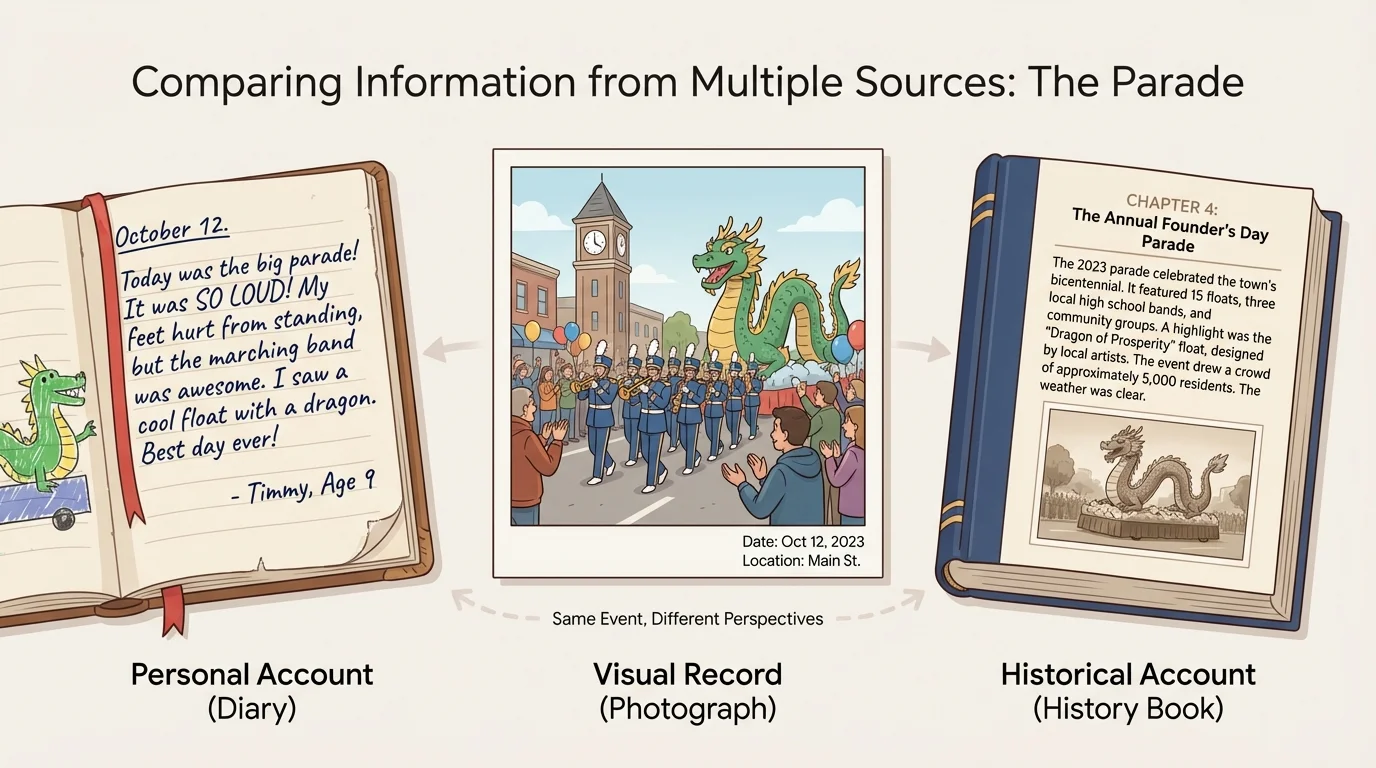
Now we compare them. The diary and photograph both suggest rain. The diary says the parade started late because of rain, and the photo shows umbrellas. The history book does not mention rain, but it explains why the parade mattered to the town.
| Source | What it tells us | What it may leave out |
|---|---|---|
| Diary | Feelings, sound, candy, late start | May focus on one child's experience |
| Photograph | Umbrellas, band, flag, street scene | Shows only one moment |
| History book | Purpose of parade, importance to town | May not include small details from the day |
Table 2. Comparison of three sources about the same town parade.
By putting these sources together, we can make a stronger explanation: the town parade in 1955 honored veterans, many families attended, it likely rained, and the band played loudly enough for children to remember it clearly. No single source told the whole story by itself.
Worked comparison
Question: What can we say about the weather and the purpose of the parade?
Step 1: Find details about weather.
The diary says the parade started late because of rain. The photograph shows umbrellas. These two sources support the idea that the weather was rainy or wet.
Step 2: Find details about purpose.
The history book says the parade honored veterans. The photo shows a large flag, which fits with a patriotic event.
Step 3: Combine the evidence carefully.
A careful statement is: The parade honored veterans, and rainy weather likely affected the event.
This example shows why comparison matters. One source gave emotion, one gave an image, and one gave background. Together, they created a fuller picture of the same event.
Some events are so famous that many kinds of sources have been preserved. The simple sequence in [Figure 4] helps place different moon-landing sources in order. In 1969, the United States sent astronauts to the moon on Apollo 11. Key figures included Neil Armstrong, Buzz Aldrin, and Michael Collins.
A live television report from 1969 is a primary source because it comes from the time of the event. A photograph of Neil Armstrong on the moon is also a primary source. A science or history textbook written later is a secondary source because it explains the event after it happened.
If we compare these sources, we notice that each one does a different job. The live report captures excitement and surprise. The photograph shows what the landing looked like. The textbook explains why the event was important in history.
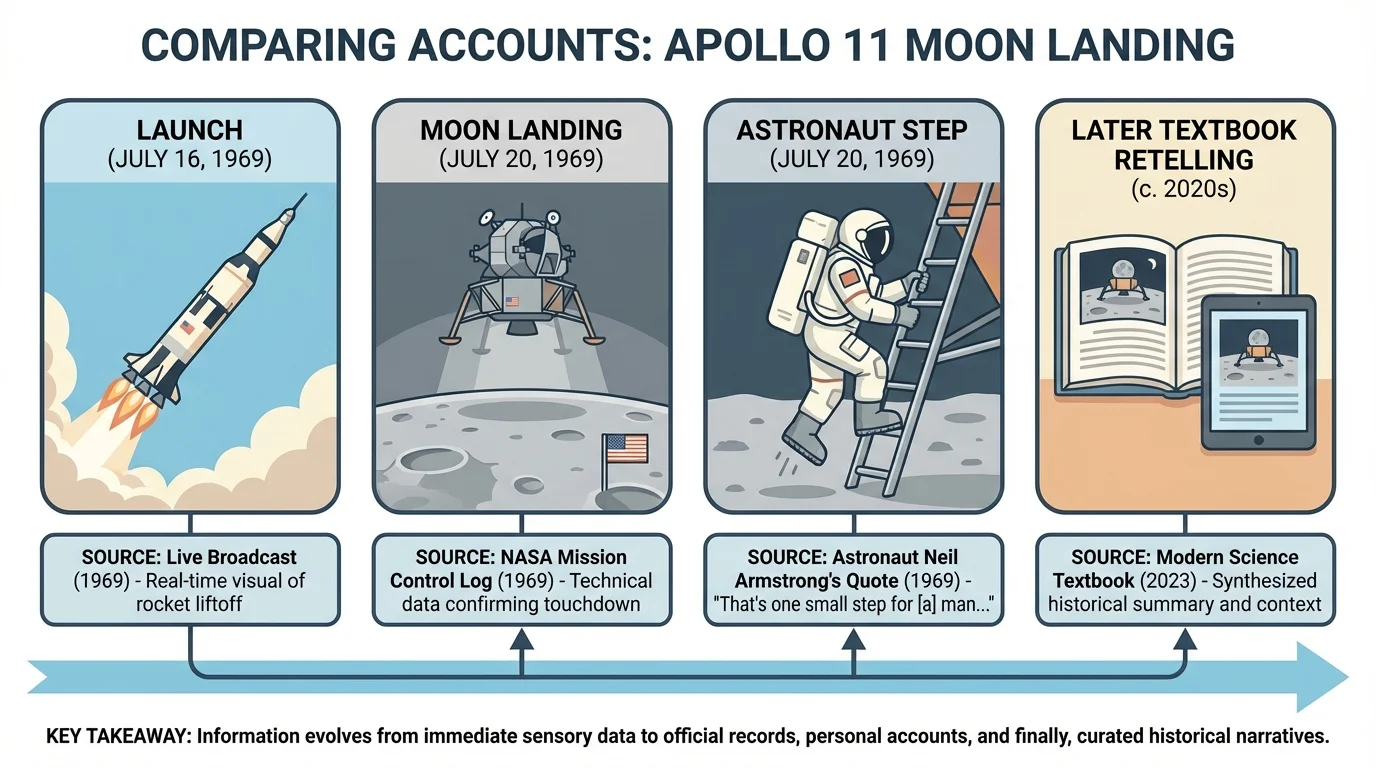
The moon landing also helps us think about time. Sources made during the event tell us what people saw and felt right then. Sources made later often explain causes, results, and why the event mattered over time.
A timeline can help historians and students keep events in order. For the moon landing, the order matters: launch, travel, landing, first step onto the moon, return to Earth, and later retellings in books and documentaries. Keeping sources connected to time prevents confusion.
When studying history, always ask two time questions: "When did the event happen?" and "When was this source made?" Those are not always the same.
Looking back at the parade example in [Figure 3] and the moon-landing sequence in [Figure 4], we can see a pattern. Small local events and world-famous events both become clearer when we compare sources from the time with sources written later.
Historians do not simply count sources and pick the biggest number. They ask how strong the evidence is. A source may be close to the event, detailed, and supported by other sources. That usually makes it more useful.
Evidence is the information that helps prove or support an idea. In history, evidence can come from words, pictures, objects, maps, and recordings. Strong explanations are built from strong evidence.
Historians also look for bias. Bias means favoring one side or view. A source with bias is not always useless, but historians read it carefully. For example, a newspaper that strongly supports one leader may describe an event differently than a newspaper that opposes that leader.
Trustworthy history writing often uses several sources and shows where the information comes from. If one source makes a claim that no other source supports, historians may be careful about accepting it right away.
"The more carefully we compare sources, the more clearly we can explain the past."
Sometimes the best answer is not a complete answer. Historians may say, "The sources suggest this," or "Most evidence shows this." That kind of careful wording is a strength, not a weakness, because it respects the evidence.
When you talk or write about sources, comparison words help make your thinking clear. Words like both, however, similarly, different, in contrast, and according to help connect ideas.
Here are some useful sentence starters:
These words do more than make writing sound good. They show exactly how pieces of evidence fit together. A strong explanation of the past does not just list facts. It connects facts from different sources in a clear way.
As we saw earlier in the source chart in [Figure 1] and the comparison steps in [Figure 2], good historical thinking starts with asking what kind of source you have and then checking how its information matches or differs from other sources.
When historians compare information from multiple sources recounting the same event, they are doing careful, thoughtful work. They listen to different voices, test details against evidence, and build the best explanation they can from the clues the past has left behind.
