Long before Colorado became a state, its mountains, valleys, grasslands, and rivers were already full of life, movement, and human stories. People hunted, traded, traveled, raised families, told stories, and built knowledge of the land over many generations. Colorado was never an empty place waiting to be discovered. It was a homeland, a crossroads, and a meeting place for many cultures.
To understand Colorado's history, we need to look through multiple perspectives. That means we ask: How did Native peoples view this land? Why did Spanish explorers come here? What did trappers and traders want? What happened when different groups met? Sometimes people cooperated. Sometimes they traded. Sometimes they fought. Sometimes one group wrote down a story, while another group passed it along through spoken history.
When we study all of these viewpoints together, we get a fuller and fairer picture of the past.
Present-day Colorado has high mountains, dry plateaus, flowing rivers, and wide plains. Because the land is so varied, different groups used it in different ways. Some lived in one area for long periods. Some moved seasonally to follow animals, weather, or plant foods. Some traveled through Colorado on trade routes that connected faraway places.
Primary source means something from the time being studied, such as a journal, letter, map, object, or oral history passed down by people connected to the events.
Secondary source means something made later by someone studying the past, such as a textbook, museum sign, or history book.
Perspective means the way a person or group sees and understands events.
As [Figure 1] shows, different peoples knew Colorado in different ways. A mountain pass might be a travel route to one group, a hunting area to another group, and a difficult barrier to someone else. A river could be a source of water, food, and travel. The same place could have many meanings.
Many Native nations are connected to Colorado's history. These include the tribal nations of the Ute, Cheyenne, Arapaho, Apache, Comanche, and Pueblo peoples, among others. Their histories are long and rich, and they did not all live in the same way.
The Ute people are especially important in Colorado history because they have lived in the region for a very long time, especially in mountain and western areas. On the eastern plains, the Cheyenne and Arapaho became important nations in later periods. Apache and Comanche peoples also moved through or used parts of the region. To the south, Pueblo peoples in nearby areas traded and shared ideas with others across the Southwest.
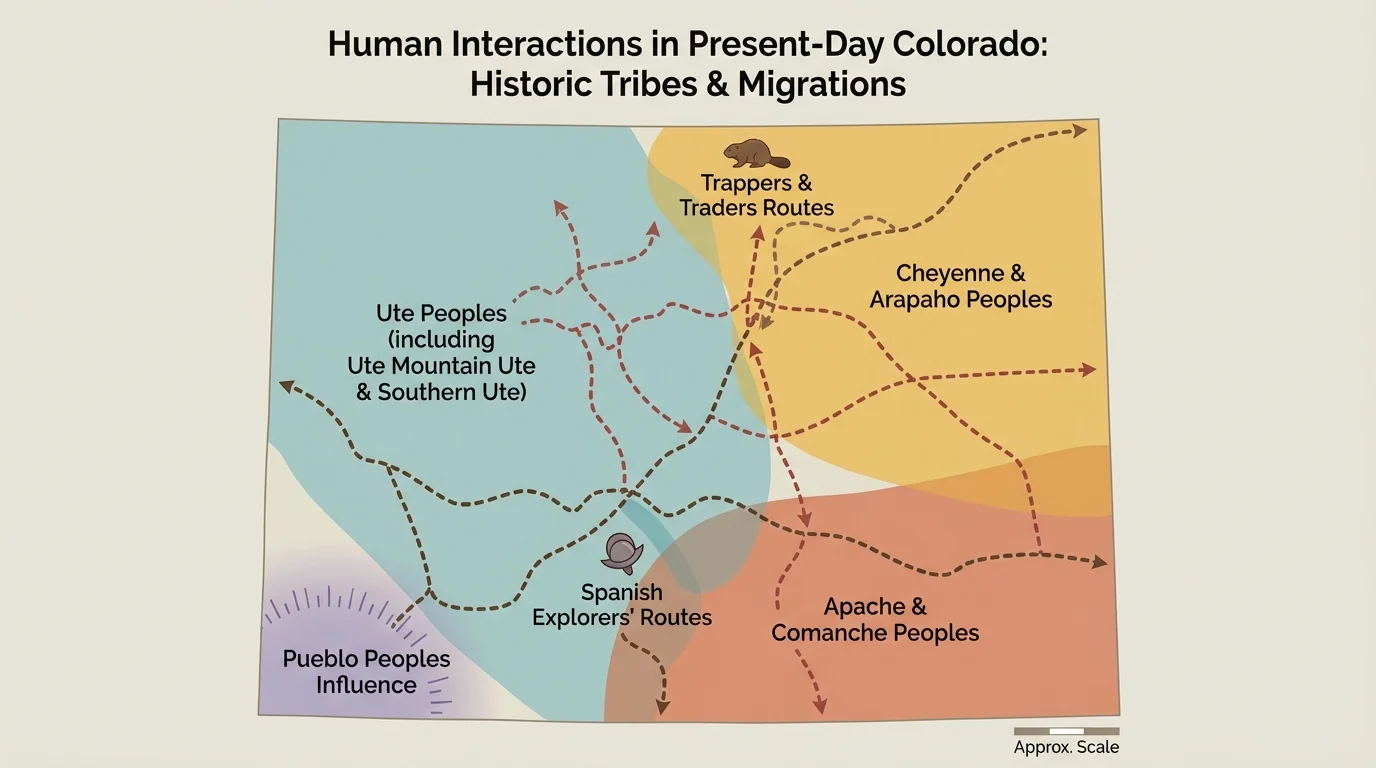
These groups interacted in many ways. They traded food, hides, horses, pottery, tools, and knowledge. They also formed alliances and competed for resources. Movement was a normal part of life. People adjusted to weather, animal migrations, trade chances, and changes caused by other groups entering the region.
It is important not to think of Native groups as all the same. Each nation had its own language, traditions, leaders, and ways of living. Even groups that were neighbors could have different customs and beliefs.
| Group | Connected Areas in Present-day Colorado | Examples of Interactions |
|---|---|---|
| Ute | Mountains, western valleys, plateaus | Trade, hunting, seasonal travel |
| Cheyenne | Eastern plains | Trade, alliances, buffalo hunting |
| Arapaho | Eastern plains and Front Range areas | Trade, travel, diplomacy |
| Apache | Southern regions and travel corridors | Movement, trade, cultural exchange |
| Comanche | Plains and southern routes | Horse culture, trade, competition |
| Pueblo peoples | South of Colorado, linked by trade | Trade in goods, ideas, and farming knowledge |
Table 1. Examples of Native groups connected to present-day Colorado and some of their interactions.
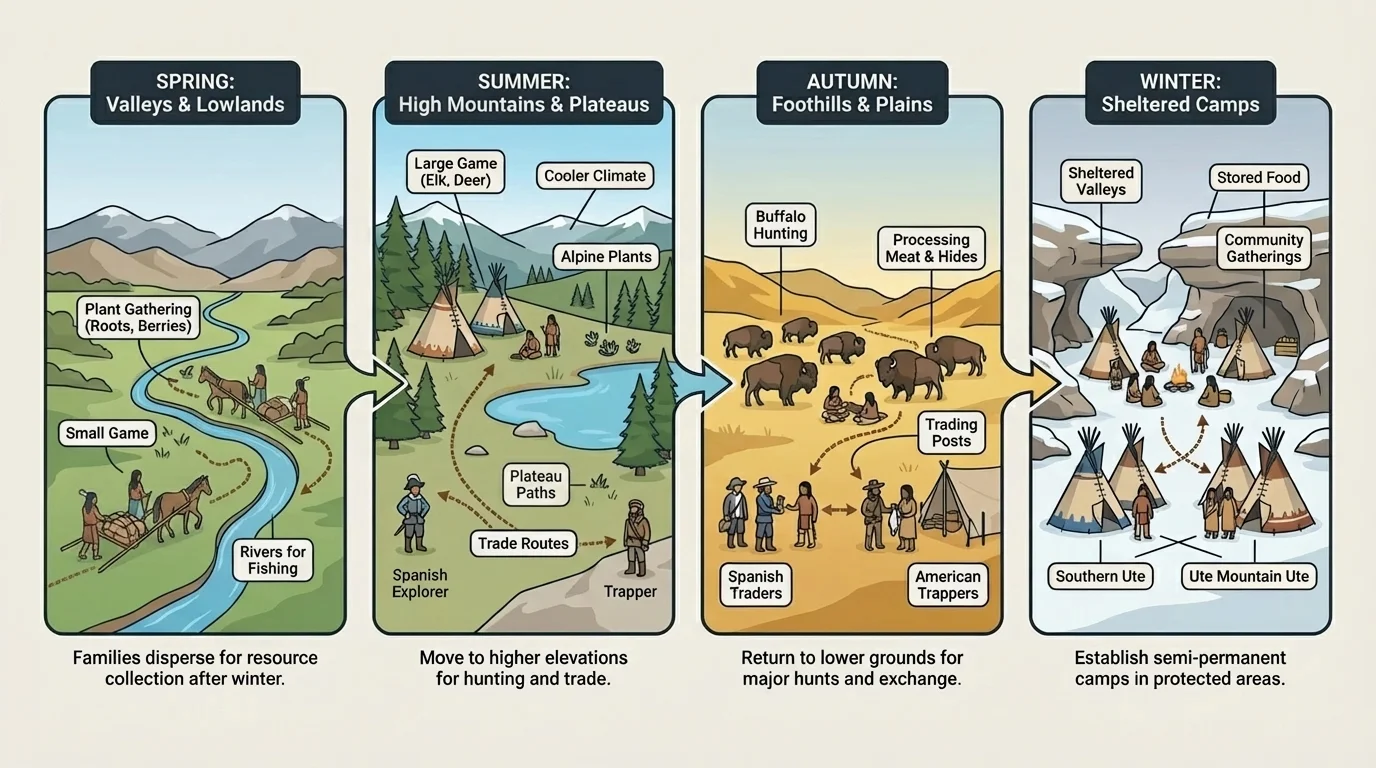
As [Figure 2] illustrates, the Ute people have one of the deepest historical connections to Colorado. Ute communities knew how to live in mountain and plateau environments, and their lives followed the seasons. They hunted animals such as deer and elk, gathered plants, and traveled to different places during the year.
Seasonal movement helped Ute families use resources wisely. In warmer months, some groups might move into higher areas to hunt or gather plants. In colder months, they might return to more sheltered places. This movement was not random. It was based on careful knowledge of the land, water, plants, and animals.
Today, two federally recognized Ute tribes in Colorado are the Ute Mountain Ute Tribe and the Southern Ute Indian Tribe. These communities are not just part of the past. They are living nations in the present, with governments, cultural traditions, and strong ties to their homelands.
The terms historical Native nations and present-day tribes both matter. When we study the past, we learn about people who lived long ago. But Native nations did not disappear. They are still here. That is why respectful history includes both the past and the present.
Many Colorado place names come from Native languages or from words used to describe Native peoples and places. Place names can remind us that history stays on the land.
From a Ute point of view, Colorado is not only a place on a map. It is a homeland filled with memory, meaning, and responsibility. Looking back at [Figure 2], we can see that seasonal movement was part of a carefully planned and organized way of life, not wandering without purpose.
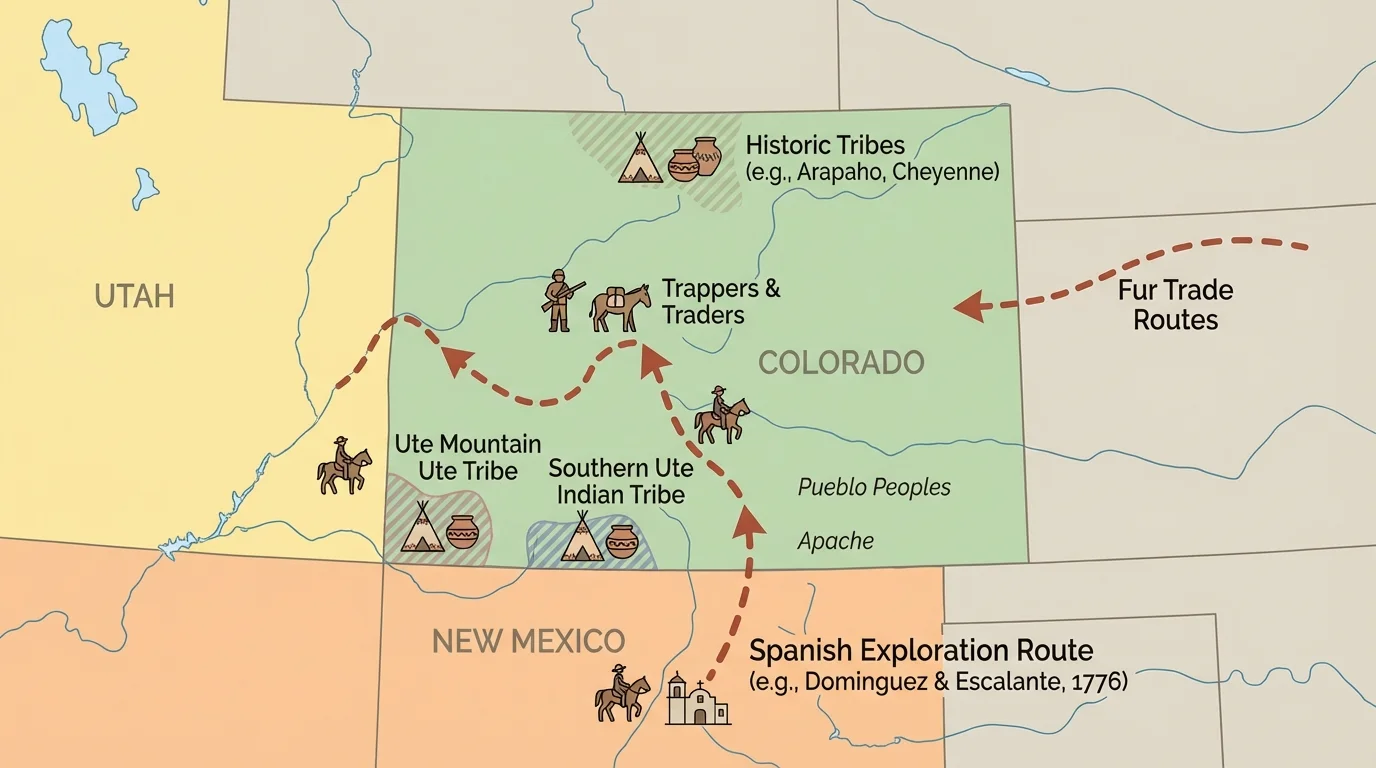
As [Figure 3] shows, in the 1500s and 1600s, Spanish explorers traveled north from areas such as New Mexico into parts of the land that is now Colorado. They were often looking for wealth, routes, land, and opportunities to expand Spain's power.
Some explorers hoped to find gold and silver. Others wanted to map the land or learn about Native peoples already living there. Spanish expeditions brought horses, metal goods, and new languages into wider regional networks. They also brought new claims to land and power.
From the explorers' perspective, they were entering a frontier full of possibility. From Native perspectives, strangers were arriving in lands that already had owners, names, histories, and rules. This difference in perspective is very important. A Spanish journal might describe an area as if it were being newly found, while Native people knew it deeply already.
Spanish contact changed life in many places. One of the biggest changes in the wider region was the spread of horses. Horses transformed travel, hunting, and trade for many Native groups. But contact also brought danger, including violence, pressure over land, and diseases that harmed Native communities.
Looking at one event from two perspectives
A Spanish explorer and a Ute family might describe the same meeting in very different ways.
Step 1: The explorer writes in a journal that he entered new territory and met local people.
Step 2: A Native oral history might remember that outsiders came into a homeland where people were already living and making decisions.
Step 3: A historian compares both accounts to understand what happened more fully.
This helps us see that no single source tells the whole story.
When we return to [Figure 3], the route on the map reminds us that exploration was not just movement across empty land. It was movement into Native spaces.
In the 1700s and 1800s, trappers and traders became very important in Colorado. Trappers hunted animals, especially beavers, for their fur. Beaver pelts were used to make hats and were valuable in faraway markets. Traders exchanged goods among Native peoples, Spanish communities, and later American settlements.
Trade connected many cultures, as [Figure 4] illustrates with goods and people moving in several directions. Native peoples traded food, horses, robes, and local knowledge. Traders brought metal tools, cloth, beads, weapons, and other goods. Many people depended on each other, even when they came from different backgrounds.
Trappers often learned from Native guides how to travel through mountains, cross rivers, and survive harsh winters. Without Native knowledge, many newcomers would have struggled even more. This is an important human interaction: one group learning from another, even in times of competition.
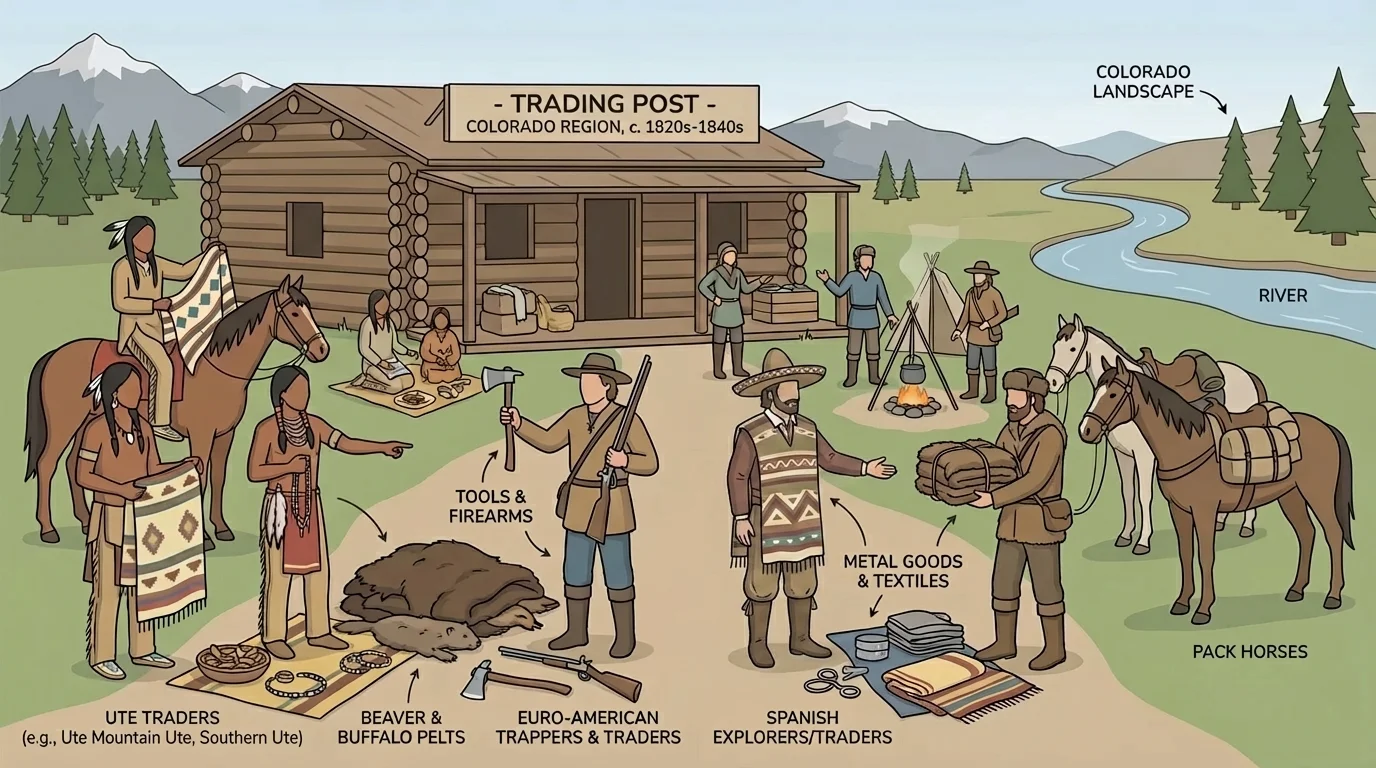
Trading posts and forts became meeting places. One famous place was Bent's Fort in southeastern Colorado. There, Native peoples, traders, travelers, and others exchanged goods and news. These places were busy, multilingual, and multicultural.
But trade did not always bring peace. As more outsiders arrived, pressure on land and animals increased. Beaver populations dropped in some places. Competition over routes and resources could lead to conflict. Some trade relationships were fairer than others, and some gave more power to newcomers than to Native communities.
People can interact in positive and negative ways at the same time. Trade can bring useful goods and new ideas, but it can also lead to unfairness, competition, and conflict.
Looking again at [Figure 4], we can see that a trading post was more than a store. It was a place where cultures met, languages mixed, and choices had consequences.
As [Figure 5] shows, historians use primary sources and secondary sources together. A Spanish journal, a trader's letter, a government map, an artifact, and a Native oral history can all help us learn about Colorado.
No source is perfect. A journal might leave out Native voices. An official report might try to make one side look better. An oral history might focus on what a community most wanted remembered. That is why comparing sources matters.
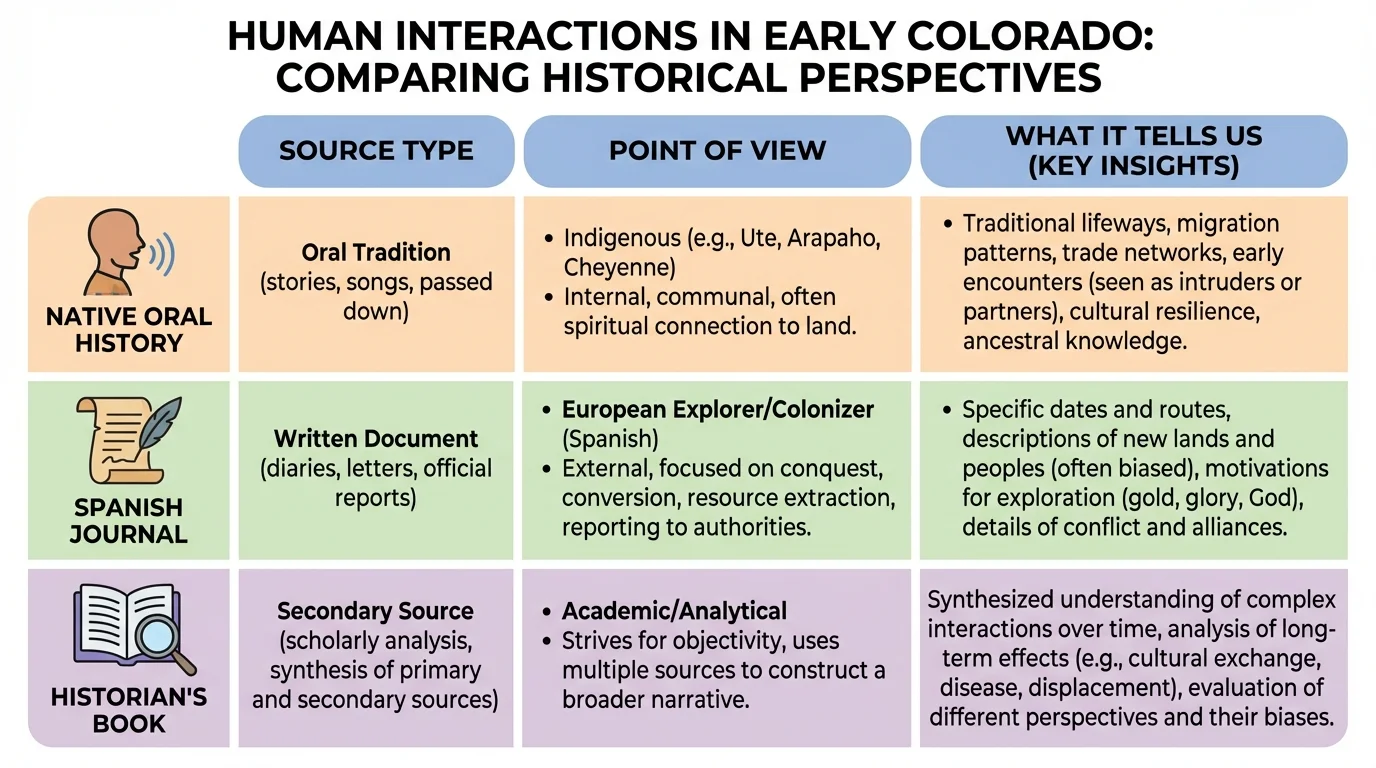
For example, a trapper might describe a valley as a good place for beavers and profit. A Ute family might describe the same valley as part of a homeland with hunting grounds, sacred meaning, and family memory. A modern historian might combine both views and add evidence from archaeology, maps, and oral history.
Learning history from multiple perspectives does not mean every source says the same thing. It means we listen carefully, compare evidence, and notice what each source helps us understand.
Why perspective changes history
The same event can feel very different depending on who lived it. If one group gains land, another group may lose land. If one journal says "discovery," another community may say "invasion." Studying perspective helps us ask better questions and avoid one-sided history.
As we see in [Figure 5], one source may tell us what happened, while another helps explain why it mattered.
Over time, more and more outsiders came into Colorado. First came explorers and traders. Later came soldiers, settlers, miners, railroad builders, and government officials. These changes brought stronger pressure on Native lands and ways of life.
Some agreements were made through diplomacy and treaties. A treaty is a formal agreement between nations or governments. But many treaties with Native nations across the United States were broken or changed unfairly. This caused loss of land, movement away from homelands, and deep hardship.
Disease also caused terrible loss. Native communities often had no protection against illnesses brought from Europe. This was one of the most harmful effects of contact, even when people did not fully understand how disease spread.
Even so, Native peoples survived. They kept languages, family traditions, ceremonies, and community strength. Survival is an important part of Colorado history. The story is not only about loss. It is also about resilience, leadership, and continuity.
"History is richer when more voices are heard."
The Ute Mountain Ute and Southern Ute continue to live, govern, and preserve culture today. Their presence reminds us that Colorado history is not finished. It is ongoing.
When people in Colorado visit museums, study maps, hear place names, or attend cultural events, they can still see the marks of these long interactions. Roads may follow old travel routes. Town names may come from Spanish or Native languages. Stories passed down in communities continue to teach younger generations.
Understanding Colorado's past means recognizing that many groups shaped it. Native nations were here first and remain important today. Spanish explorers changed regional connections. Trappers and traders linked cultures through exchange, learning, and conflict. Each group had goals, beliefs, and experiences that influenced what happened.
Studying history through multiple perspectives helps us be more accurate and more respectful. It shows that the past is not just one story told by one group. Colorado's history is made of many voices meeting on the same land.
