Colorado did not grow from just one group of people. It was shaped by many communities, each bringing ideas, traditions, work, and leadership. Some groups had lived in the region for thousands of years. Others arrived later and changed the land, the government, the economy, and everyday life. To understand Colorado's history, we need to look at many voices together.
When historians study a place, they ask questions like these: Who lived here first? Who came later? Who had power? Who was left out? Who wrote down the story? These questions matter because history is not only about dates. It is also about people and how their choices affected others.
A region is an area with shared land, history, or culture. Colorado is a region with mountains, plains, rivers, deserts, and towns. Over time, different groups have used these places in different ways. Some hunted buffalo on the plains. Some farmed in river valleys. Some built railroads. Some opened churches, businesses, and schools. Some fought for fair laws and equal rights.
These groups include Indigenous Peoples, European settlers, African Americans, Latinos, Asian Americans, and many religious communities. Their stories overlap. Sometimes groups cooperated, traded, and learned from each other. Sometimes they disagreed or fought over land, resources, or political power. Both kinds of stories are part of Colorado's development.
Political groups are groups that affect rules, government, voting, land ownership, and power. Cultural groups are groups connected by language, traditions, beliefs, food, music, art, or shared history. A group can be both political and cultural at the same time.
For example, a church community can be cultural because of its traditions and religious celebrations, but it can also be political if it helps people organize for change. A neighborhood can be cultural because of music, food, and language, and political if its people work together to improve schools or demand equal treatment.
To learn about Colorado, historians use primary sources and secondary sources. A primary source comes from the time being studied, such as a diary, letter, photograph, treaty, historical newspaper, map, speech, or oral history. A secondary source is created later, like a textbook, article, or documentary that explains the past.
Using more than one point of view helps us get closer to the truth. A newspaper written by settlers during a gold rush may celebrate new towns and jobs. However, an oral history from an Indigenous family may explain how the same event brought loss of land and danger. Both sources tell us something important. Historians compare them instead of choosing only one.
Example of different sources
Step 1: A historian reads a miner's letter from the gold rush.
The miner says Colorado offers opportunity and excitement.
Step 2: The historian studies a Cheyenne or Arapaho account.
This source may describe broken promises, disappearing buffalo, and pressure on Native homelands.
Step 3: The historian compares both.
Now the event is not just a success story for miners. It is also a story about conflict, change, and unfairness for others.
This is why point of view matters. It reminds us that history can sound different depending on who is speaking and what they experienced.
Long before Colorado became a state, Indigenous Peoples lived in this land. These nations included the Ute, Cheyenne, Arapaho, Apache, and others. They built communities, developed trade routes, passed down stories, cared for the land, and governed themselves.
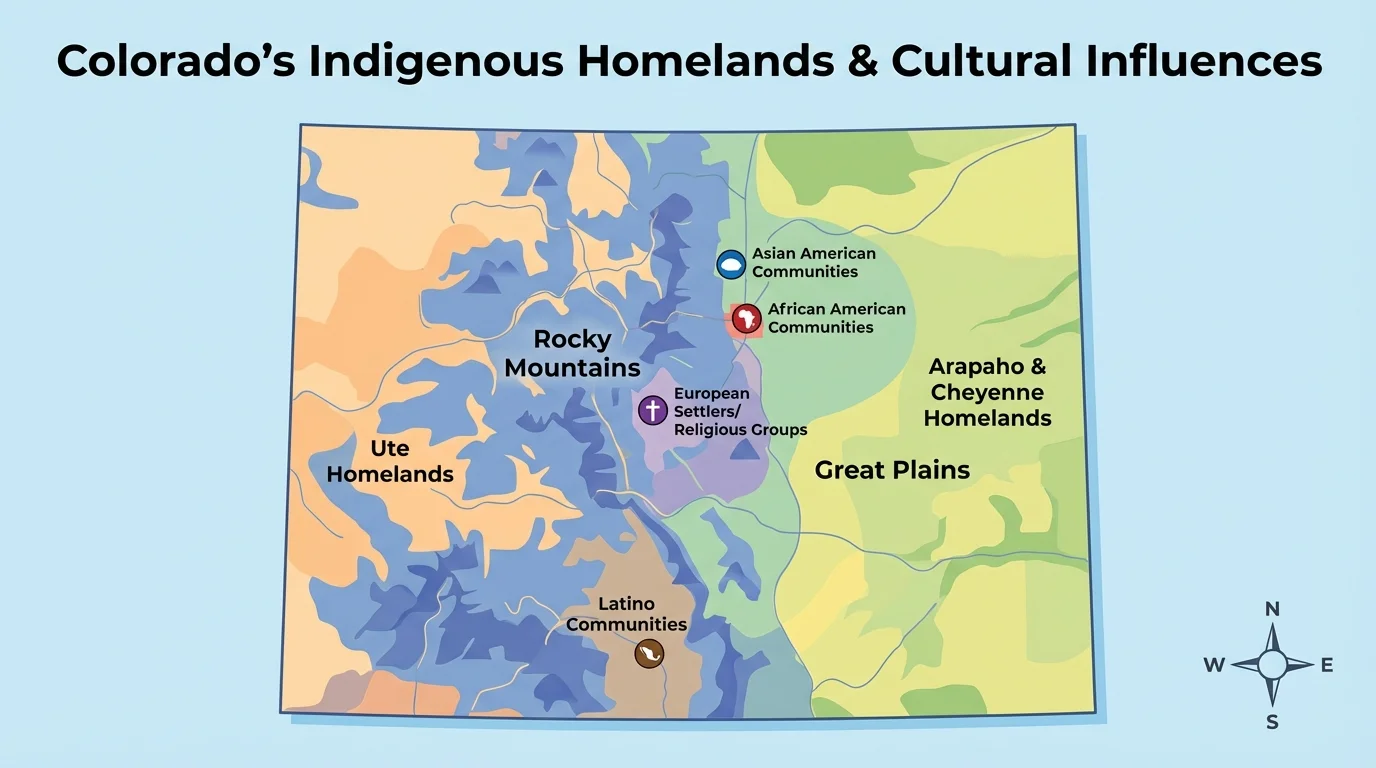
The Ute people lived mainly in the mountain and western areas of what is now Colorado. They knew the land deeply and moved with the seasons. On the plains, the Cheyenne and Arapaho hunted buffalo and traded with other groups. Indigenous nations had strong systems of leadership, rules, and family life. They were not all the same. Each nation had its own language, traditions, and ways of living.
As [Figure 1] shows, Indigenous Peoples affected Colorado in lasting ways. Many place names come from Native languages or from tribes who lived in the area. Knowledge about plants, water, seasons, and travel routes helped later newcomers survive. Trade networks already connected parts of the region before Europeans and Americans arrived.
Primary sources for Indigenous history include oral histories, artifacts, winter counts, and treaties. Secondary sources include books and museum exhibits. It is important to remember that many Native histories were shared by speaking, not by writing. That does not make them less valuable. Oral tradition is an important way of recording the past.
When we study Native nations, we should not talk about them only in the past. Indigenous communities still live in and around Colorado today. Their governments, cultures, and traditions continue. The homeland map in [Figure 1] helps us see that Colorado history begins with Native peoples and still includes them now.
Colorado has two federally recognized Ute tribes today: the Southern Ute Indian Tribe and the Ute Mountain Ute Tribe. Both continue to protect culture, land, and community life.
Native groups also influenced political development. Treaties and forced removal changed who controlled land in Colorado. These events shaped borders, settlement, and law. Understanding Colorado's growth means understanding both Native leadership and the unfair ways Native people were pushed aside.
Control of the region changed over time. European settlers were not one single group either. Spanish explorers came early to the Southwest. French traders moved through parts of the interior. Later, many settlers from the eastern United States and from Europe came for land, mining, ranching, and business.
As [Figure 2] shows, Spanish-speaking communities influenced southern Colorado before it was part of the United States. Communities connected to New Spain and later Mexico brought language, farming methods, religion, and settlement patterns. After the Mexican–American War, more of the region came under U.S. control, and this political shift changed laws about land and government.
The gold rush in 1858 and 1859 brought many newcomers. Mining camps grew quickly into towns. Railroads later connected Colorado to other places, making trade and travel easier. Farms and ranches expanded. This growth helped build the state's economy, but it also caused conflict over land and resources.
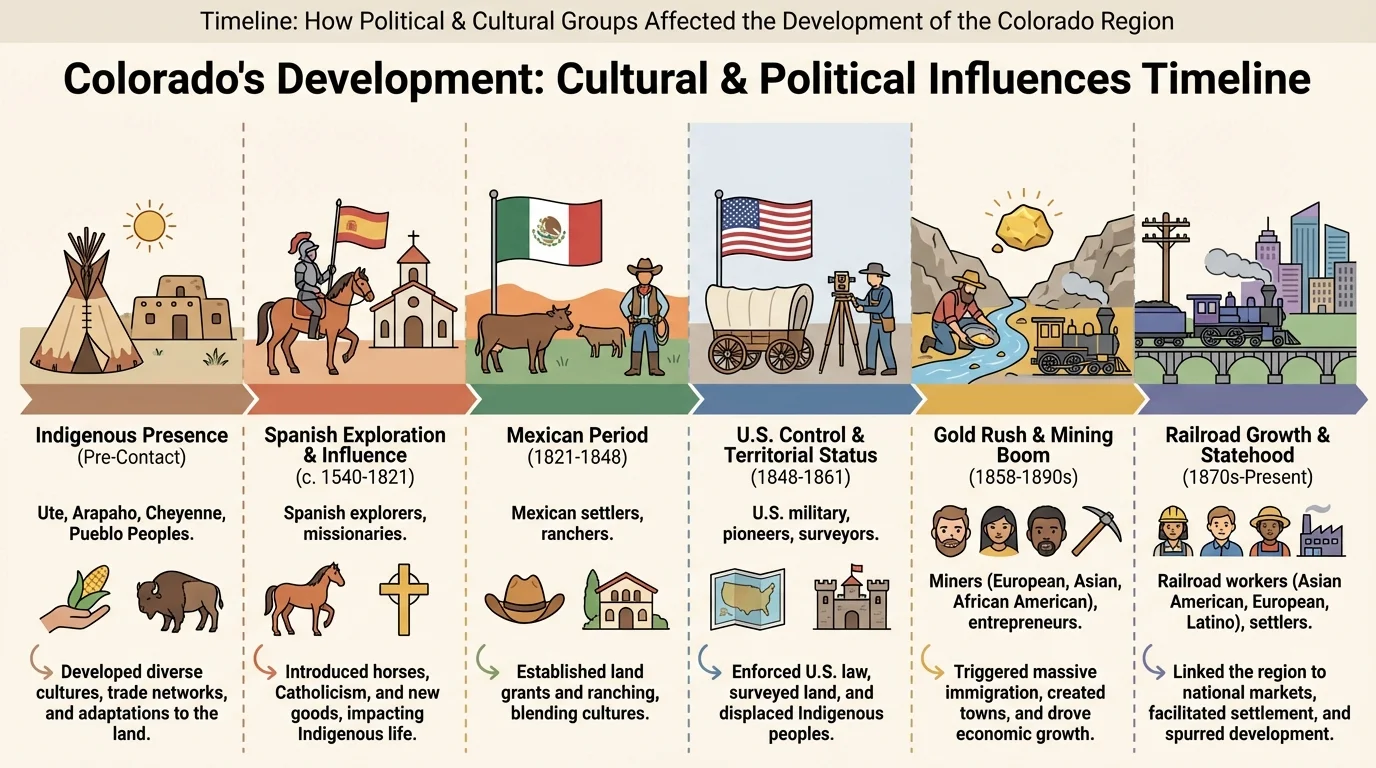
European settlers affected Colorado politically by helping create towns, counties, and state government. They wrote laws, built courthouses, and pushed for Colorado to become a state in 1876. At the same time, many of these political systems favored settlers and often ignored or harmed Native people and other groups.
Primary sources from this period include maps, mining claims, town records, letters, and government documents. A settler diary may describe excitement about a new town. A treaty document may reveal how land was taken. Looking at both helps us understand that settlement brought opportunity for some and loss for others.
The timeline in [Figure 2] makes an important idea clear: Colorado's development was not one simple march forward. It was a series of changes in power, ownership, and identity.
African American history in Colorado includes courage, hard work, and community building. Black people came to Colorado as miners, soldiers, cowboys, business owners, teachers, and families looking for a safer and more hopeful life. In Denver, the neighborhood of Five Points became a major cultural center through its churches, businesses, and music spaces.
After the Civil War, some African Americans moved west to escape racism and build new lives. People known as Exodusters moved to places including Colorado. Black communities worked to create schools, churches, newspapers, and businesses. These institutions gave people support and a voice.
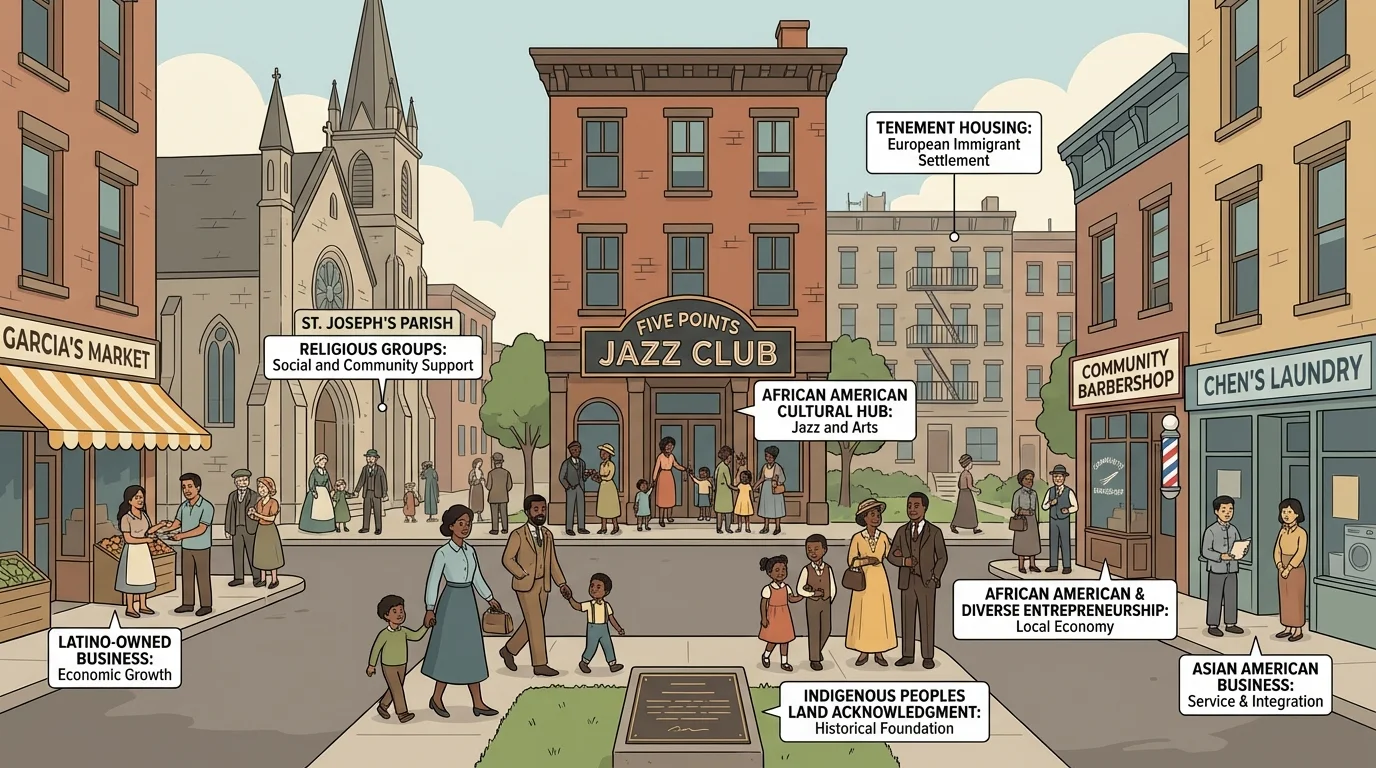
As [Figure 3] shows, Five Points in Denver became famous for jazz music, food, and Black-owned businesses. It was sometimes called the "Harlem of the West." Musicians performed there, and families gathered there. This neighborhood helped shape Colorado's cultural life.
African Americans also shaped Colorado politically. Black leaders fought unfair laws and demanded equal rights. Soldiers served in the military, and community leaders pushed for voting rights, better schools, and fair treatment. Newspapers and speeches are important primary sources that show these efforts.
"The vote is precious. It is almost sacred."
— John Lewis
This quote is from a national civil rights leader, but it connects to Colorado as well. Many groups in Colorado history had to fight to be treated fairly under the law. The community life shown in [Figure 3] reminds us that neighborhoods can be centers of both culture and political action.
Latino communities have deep roots in Colorado, especially in the southern part of the state. Some families lived in the region before Colorado was part of the United States. Others arrived later from New Mexico, Mexico, and other places. They helped build farms, ranches, railroads, mines, and neighborhoods.
Latino influence can be seen in language, place names, food, music, art, and festivals. Spanish was spoken in many communities long before Colorado became a state. Farming systems, irrigation practices, and village life in some places grew from Hispanic and Indigenous traditions together.
Latino workers played major roles in mining, railroad work, and agriculture. They also organized for better treatment. In some places, workers faced unfair pay and dangerous conditions, so communities came together to demand change. That means Latino communities shaped Colorado not only through their labor, but also through civic action and leadership.
Culture can shape a region in everyday ways. A region is not changed only by governors and lawmakers. It is also changed by the languages people speak at home, the foods sold in markets, the songs played at celebrations, and the traditions families pass on. Latino communities have shaped Colorado in all of these ways.
Sources for Latino history include church records, land grant papers, photographs, oral histories, and newspapers in Spanish and English. If we used only English-language sources, we would miss part of Colorado's story. That is why multiple sources matter so much.
Asian American communities also helped shape Colorado. Chinese immigrants worked on railroads and in mining and service jobs. Japanese immigrants helped grow crops and build farming communities. These communities added skills, traditions, businesses, and family networks to the state.
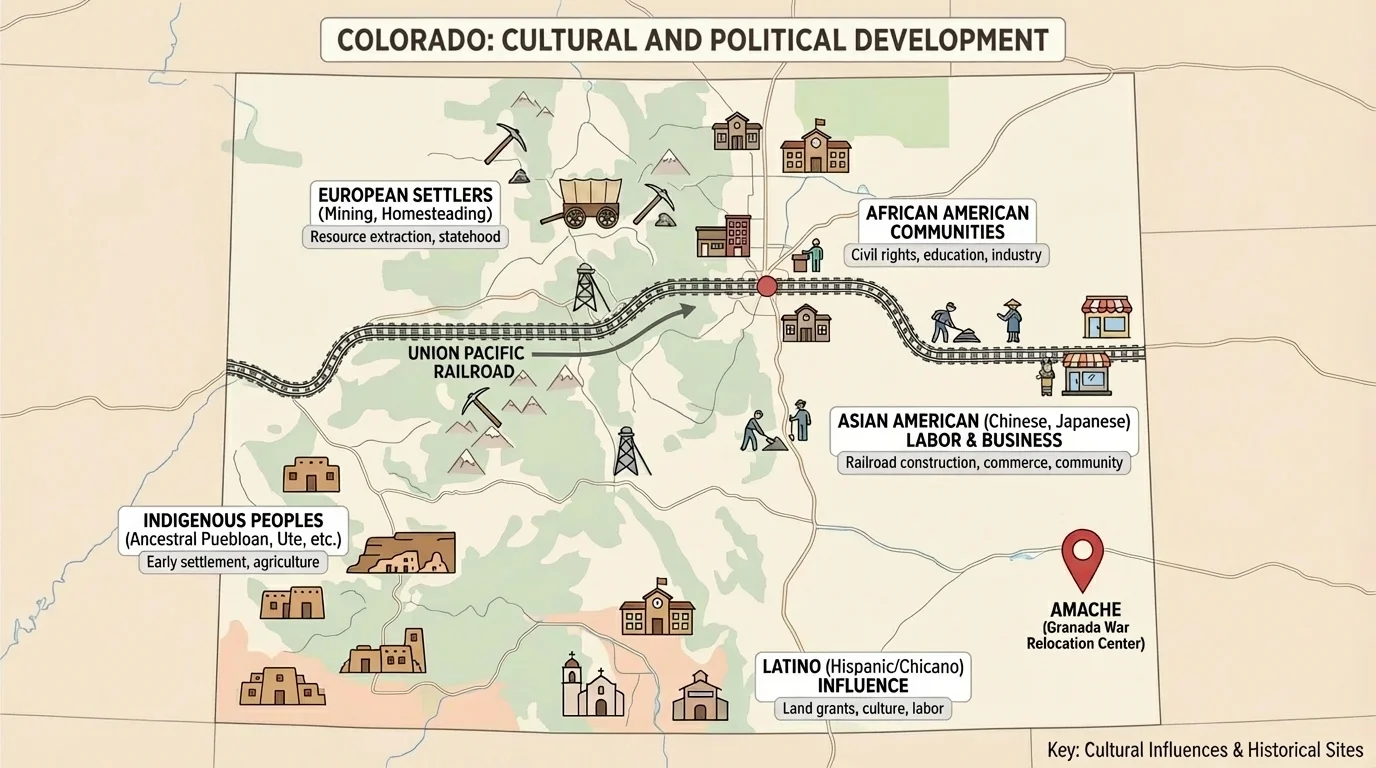
As [Figure 4] shows, Chinese workers were important to railroad building in the American West. Railroads changed Colorado by bringing people, goods, and ideas more quickly across long distances. Yet Chinese immigrants often faced unfair laws and prejudice. Some were treated as outsiders even though their labor helped build the region.
Japanese American families became important farmers in parts of Colorado. During World War II, however, many Japanese Americans were forced from their homes and sent to incarceration camps. One of these camps, called Amache, was in Colorado. This was a serious injustice. It shows how government decisions can deeply affect people's lives.
After the war, some families rebuilt their communities. Their story is one of both loss and strength. Primary sources from this history include photographs, camp records, letters, and oral histories. These sources help students understand not only facts, but also feelings and personal experiences.
The map connects two very different parts of Asian American history in Colorado: contribution and injustice. Both are necessary to study if we want a truthful history.
Religious groups have also influenced Colorado's development. Churches, synagogues, temples, mosques, and other faith communities have helped build schools, hospitals, charities, and gathering places. They shaped both culture and politics by teaching values, organizing neighbors, and helping people in times of need.
Catholic missions and churches were important in many early Hispanic communities. Protestant churches helped form towns and social groups in growing settlements. Jewish communities in Colorado built businesses, charities, and synagogues and contributed to city life, especially in places like Denver. In more recent times, Buddhist, Muslim, Hindu, Sikh, and other faith communities have added to Colorado's diversity.
Religious communities sometimes influenced public issues too. They may have supported education, cared for the poor, welcomed immigrants, or argued about laws and fairness. Even when people disagreed, religion remained part of how many communities understood right and wrong and how they worked together.
| Group | Examples of Contributions | How We Learn About Them |
|---|---|---|
| Indigenous Peoples | Trade routes, land knowledge, governance, place names | Oral histories, treaties, artifacts |
| European settlers | Towns, railroads, mines, state government | Maps, diaries, laws, newspapers |
| African Americans | Neighborhoods, music, businesses, civil rights action | Newspapers, speeches, photos, oral histories |
| Latino communities | Farming, language, festivals, labor organizing | Church records, land papers, bilingual newspapers |
| Asian Americans | Railroads, farms, businesses, community rebuilding | Letters, camp records, photos, oral histories |
| Religious groups | Schools, hospitals, charities, traditions | Church records, community histories, buildings |
Table 1. Examples of how different groups influenced Colorado and the kinds of sources historians use to study them.
Religion is an example of how one group can affect both daily life and public life. A faith community may celebrate holidays, share food traditions, and sing certain kinds of music. It may also help shape neighborhood rules, charity work, and local leadership.
One event in Colorado can look very different depending on who tells the story. A railroad owner might see tracks as progress. A worker might remember hard labor and danger. A Native family might remember how railroads brought settlers onto land that had once been theirs. A town leader might see a new church as community growth, while another person might ask who was welcome there and who was not.
This is why historians compare sources carefully. They ask: Who made this source? When? Why? What might be missing? A photograph can show clothing, buildings, and faces, but not all thoughts and feelings. A speech can show what a leader wanted people to believe. A textbook can explain a broad story, but it may leave out smaller communities unless the writer is careful.
Good historians do not stop at one source. They look for patterns across many sources and listen for voices that were often ignored in older histories.
Using many sources helps us build a fairer picture of Colorado. It helps us see both achievement and injustice. It helps us understand why some groups had more power and why others had to struggle to be heard.
Today, Colorado's cities, towns, and rural areas still show the influence of these many groups. Street names, festivals, foods, music, languages, buildings, and local traditions all carry history. So do debates about land, rights, schools, and memory. The past is not gone. It still affects the present.
When you visit a museum, read a marker, hear a family story, or study an old map, you are seeing only part of the story unless you ask whose voice is included. Colorado developed through cooperation, conflict, migration, hard work, creativity, and political struggle. No single group made Colorado alone.
Understanding this makes history richer and more honest. It shows that a region grows from many people, many viewpoints, and many kinds of contributions.
