A shovel, a train, a sprinkler, a power plant, and a computer may seem like very different things. But each one helped change how people lived in Colorado and across the United States. Technology is not only about phones and tablets. It also includes tools, machines, and systems that help people solve problems. Over time, new inventions made work faster, travel easier, and communication more efficient. They also changed land, cities, and the environment.
Technology means the tools and methods people create to do work or solve problems. Some inventions are small, like a better shovel. Some are huge, like railroad systems or computer networks. When technology changes, communities change too. Towns can grow around mines, farms can produce more food, and families can travel farther than before.
Colorado is a good place to study these changes because it has mountains, rivers, plains, farms, mines, railroads, factories, research centers, and growing cities. The history of Colorado connects to important events in the United States, such as westward expansion, industrial growth, World War II, the Cold War, and the rise of the digital age.
Impact is the effect something has on people, places, or events. A technology can have positive impacts, such as making work easier, and negative impacts, such as causing pollution or danger.
When historians study technology, they ask important questions. Who used it? Who benefited from it? What problems did it solve? What new problems did it create? Those questions help us understand why inventions matter in history.
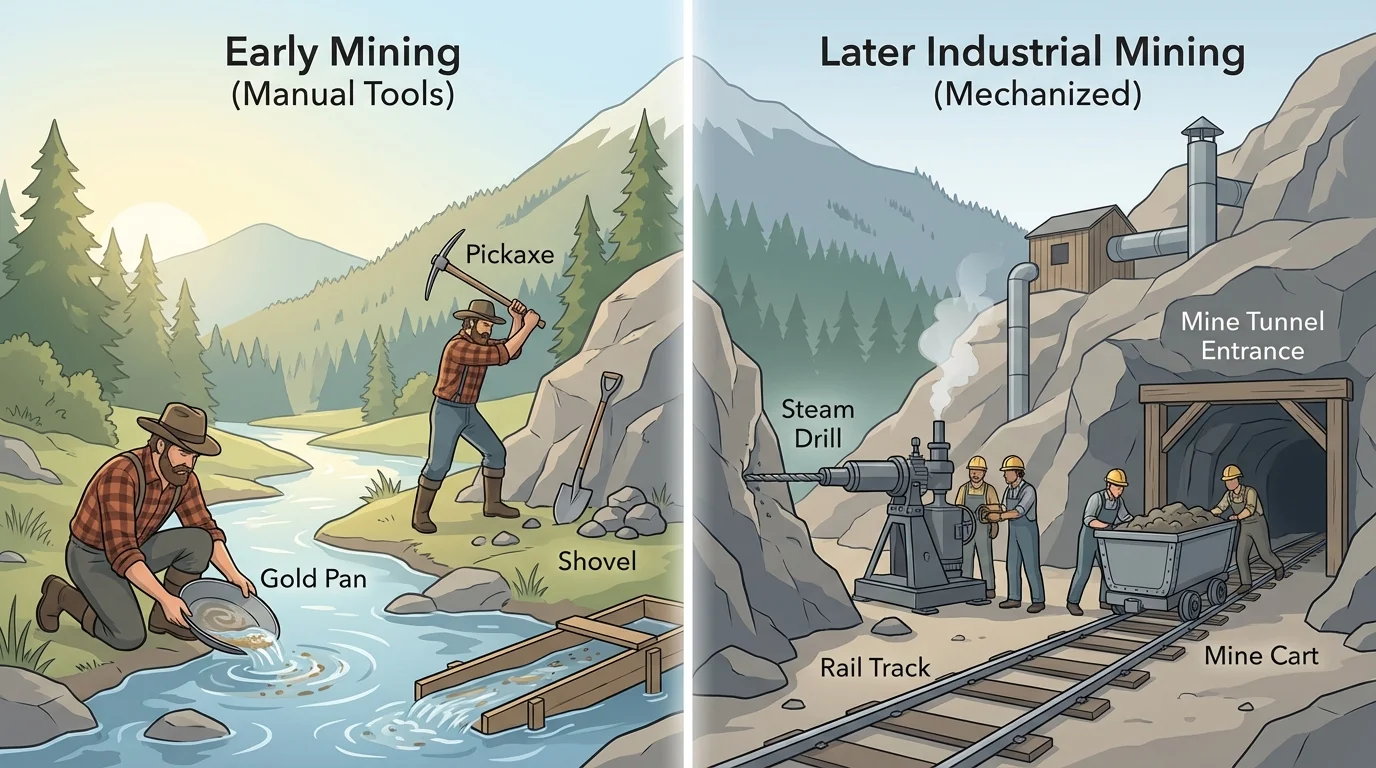
In the 1800s, many people came to Colorado hoping to find gold and silver. This period is often called a gold or silver rush because so many people moved quickly to mining areas. At first, miners used simple tools such as pans, picks, shovels, and hand drills. But mining changed over time. It became more powerful and more dangerous as machines, explosives, and transportation systems supported the work, as shown in [Figure 1]. These changes helped turn small camps into busy towns.
The first miners often searched streams for loose gold. Later, miners dug deep into mountains to reach ores hidden underground. An ore is rock that contains valuable metal. Reaching deep ore required stronger tools. Steam-powered drills and better blasting methods allowed miners to cut into hard rock faster than workers using only hand tools.
New mining technology brought more than machines inside mines. Rail lines and ore carts moved heavy rock from mines to mills. At mills, machines crushed the rock so workers could separate valuable metals. This made mining more productive, but it also increased noise, dust, and damage to the land. Some rivers became polluted by waste from mining.
Mining towns such as Central City, Leadville, and Cripple Creek grew because technology made it possible to remove more minerals. Businesses opened to serve miners, including stores, hotels, and rail depots. Technology did not only change work underground. It changed where people lived and how towns were built.
Mining also brought risk. Cave-ins, explosions, and poor air made mines dangerous. Better pumps, helmets, and supports improved safety somewhat, but mining remained hard work. When we look back at [Figure 1], we can see that stronger machines increased production, yet they also made the scale of mining much larger. That larger scale could help the economy while harming the environment.
Colorado's mountains contain many valuable minerals, including gold, silver, coal, and later uranium. Different resources became important at different times, so technology kept changing to reach them.
Colorado mining history also connects to national history. Metals from western mines supported growing industries across the United States. Coal powered trains and factories. Silver and gold affected trade and money. In this way, mining technology in Colorado helped support industrial growth in the United States.
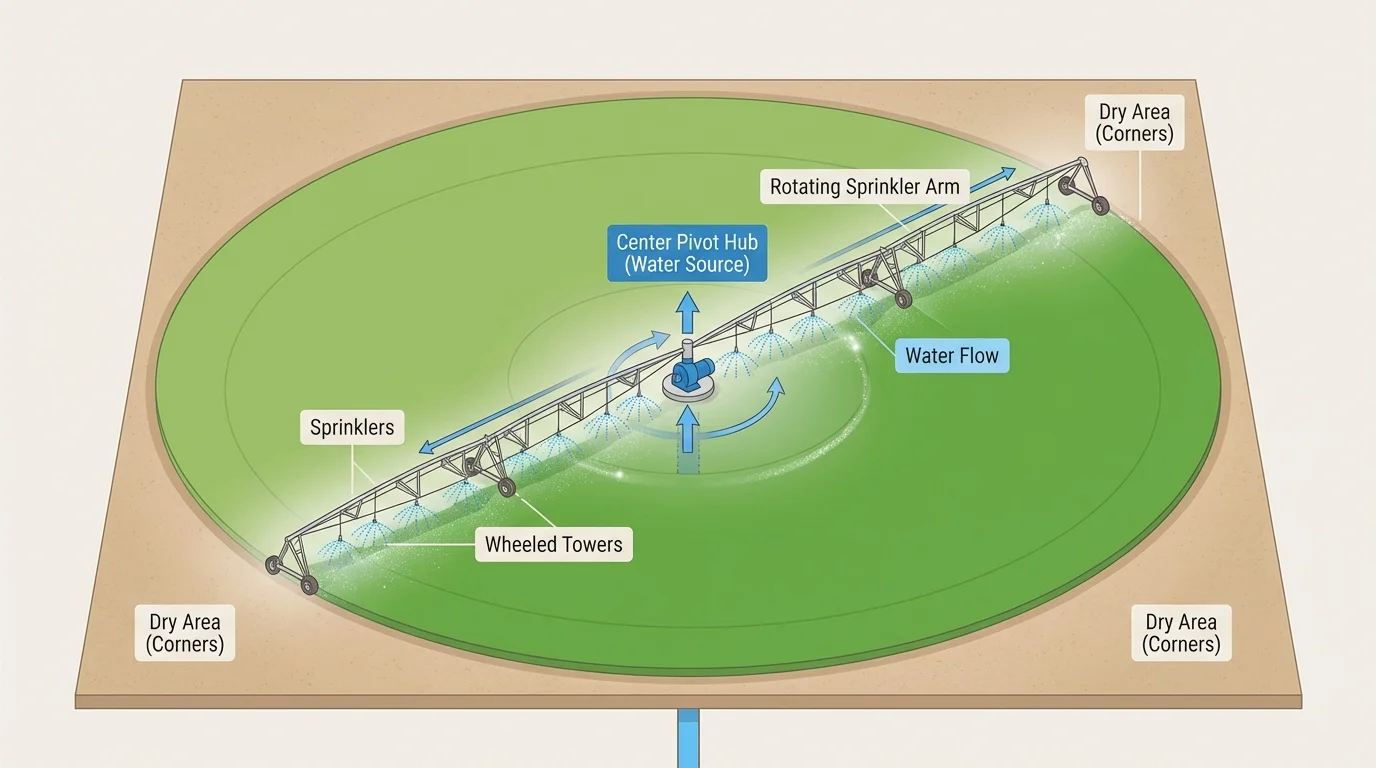
Farming in Colorado can be difficult because much of the state is dry. Farmers cannot depend only on rainfall. They need ways to move water to crops. That is where irrigation becomes important. Irrigation is the process of bringing water to land that needs it. One important modern method is center pivot irrigation, which waters land in a wide circle, as shown in [Figure 2].
In a center pivot system, a long pipe with sprinklers is attached to a central water source. The pipe slowly rotates around the center point. As it turns, the sprinklers spread water across the field. From above, these fields often look like giant green circles on the land. This technology helps farmers water large areas with less labor than older methods.
Before advanced irrigation, farmers often had to dig ditches or carry water in more limited ways. Canal systems were important in many western states, including Colorado. Later, pumps and motor-powered systems made it easier to move water farther and more evenly. This allowed farmers to grow crops in places that might otherwise be too dry, as shown in [Figure 2].
Center pivot irrigation can help farmers grow corn, alfalfa, wheat, and other crops. It saves time and can use water more carefully than flooding a whole field. Still, it also depends on a steady water supply and energy to run the equipment. In dry regions, people must think carefully about how much water is available.
The circular pattern comes from the rotating arm, not from the shape of the land itself. This shows how technology can change the look of a place. When people look down from an airplane or satellite, they can often spot center pivot fields right away.
Why irrigation matters
Agricultural technology helps people produce more food, but it also changes natural systems. Irrigation can turn dry land into productive farmland. At the same time, it can lower water levels in rivers or underground supplies if too much water is used. Good planning helps communities balance farming needs with care for the environment.
Colorado agriculture is tied to the larger history of the American West. As more settlers moved west, farming technology became essential. Better plows, tractors, combines, and irrigation systems helped feed a growing population in the United States. Technology made farms more productive, but it also reduced the need for as many farm workers.
[Figure 3] shows how transportation networks connect distant places. Colorado has high mountains, deep valleys, and wide plains. Moving people and goods across this land has never been simple, and new transportation technology helped Colorado grow. Without roads, rails, and later airports, it would have been much harder for mines, farms, and cities to succeed.
At first, many travelers used trails, wagons, stagecoaches, and horses. These methods worked, but they were slow and hard during bad weather. Then railroads arrived. Railroad technology changed Colorado in major ways during the late 1800s and early 1900s. Tracks connected mining towns to larger cities and connected Colorado to the rest of the nation.
Railroads carried ore, coal, cattle, lumber, and people. They made trade faster and cheaper. Denver grew into an important transportation center because rail lines linked it to many other places. Mountain railroads also helped tourists visit scenic parts of the state. Transportation technology supported both business and travel.
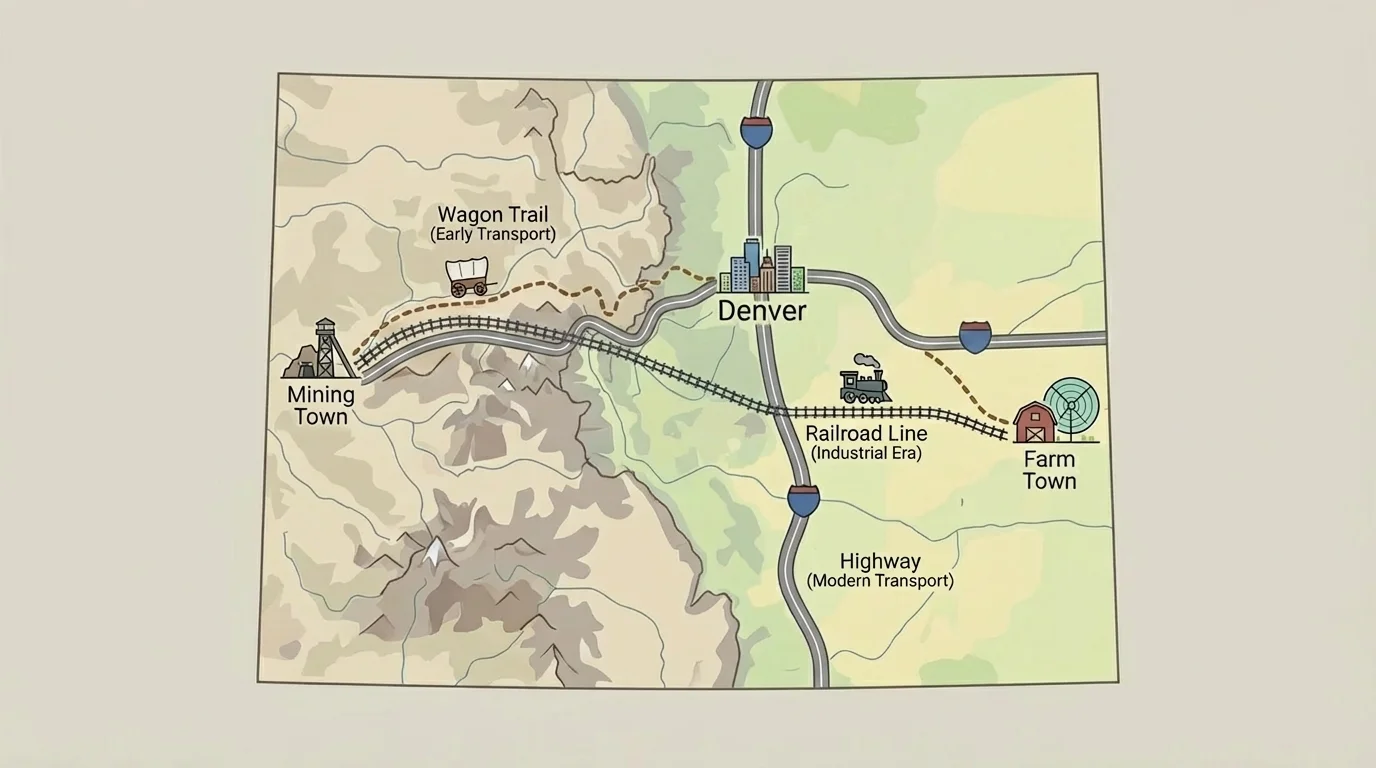
Later, automobiles changed travel again. Cars and trucks needed roads and highways, so governments and workers built more paved routes. Trucks gave businesses a new way to move goods. Families could travel when they wanted instead of following train schedules. Air travel later made long-distance movement even faster.
These changes help explain why transportation matters so much in history. Faster travel can lower costs, bring supplies more quickly, and help communities stay connected. But roads and rails can also cut through natural areas and change the land. Like other technologies, transportation brings both gains and costs.
Colorado connection: Why railroads mattered
Step 1: Mines produced heavy materials such as coal and ore.
Step 2: Wagons could carry some loads, but long trips were slow and difficult.
Step 3: Railroads moved larger loads faster and linked towns to buyers and factories.
Step 4: Because goods moved more easily, towns grew and more businesses opened.
This is one reason transportation technology had such a large impact on Colorado's development.
Transportation history in Colorado matches larger United States trends. The nation expanded with wagon trails, then railroads, then highways and airports. Each new system increased movement and connected regions more closely than before.
By the early 1900s, the United States was becoming more industrial. Industry means large-scale production of goods, often in factories. Colorado shared in this growth. Factories processed food, refined metals, and made products needed by a modern economy. Electricity became more common in homes, schools, and workplaces, which changed everyday life.
One major industrial development was the use of assembly lines. Instead of one worker making an entire product alone, different workers or machines handled different parts of the process. This made production faster and often cheaper. Across the country, factories could make more cars, machines, tools, and household goods than before.
Industrial growth created jobs, but it also led to long hours, low pay for many workers, and unsafe conditions in some workplaces. Labor groups pushed for better treatment. In Colorado and elsewhere, workers sometimes went on strike to demand safer conditions and fairer wages. Technology could increase production, but it did not automatically make life fair.
Earlier in history, many goods were made by hand in small shops or at home. Industrial technology changed that by moving more production into large factories with machines and power sources such as steam and electricity.
Electricity was especially important. It powered lights, machines, streetcars, and later household appliances. That changed the rhythm of life. Workplaces could operate more hours, cities could stay active after dark, and homes became more comfortable in new ways. Industrial technology was not just about factories. It changed daily routines for families too.
These developments connected Colorado to national events such as the Progressive Era and rapid urban growth. Cities grew larger, businesses became more complex, and technology became part of ordinary life for more Americans.
In the 1900s, scientists learned more about the atom and discovered ways to release enormous amounts of energy. This led to nuclear technology. Nuclear technology includes the use of nuclear energy for power, research, and weapons. It became especially important during World War II and the Cold War.
Colorado has a connection to this history because uranium, a mineral used in nuclear processes, was mined in parts of the state. Uranium became valuable during the atomic age. The United States wanted it for research and for building nuclear weapons. This linked Colorado resources to major national and global events.
Nuclear technology had mixed impacts. On one hand, nuclear power plants can produce large amounts of electricity. On the other hand, nuclear weapons are extremely destructive, and nuclear waste must be handled carefully. People also worried about radiation and accidents. This is a strong example of how a powerful technology can be both useful and dangerous.
"Technology is a useful servant but a dangerous master."
— Often attributed to Christian Lous Lange
Students learning about nuclear history should understand that it is part of a larger story. Scientific discovery, war, fear, energy needs, and government decisions all shaped how nuclear technology developed. Colorado's uranium mining shows how one state can be connected to huge events in United States history.
[Figure 4] shows how computers changed over time. Few inventions have changed modern life as much as computer technology in the 20th century. Early computers were very large and used mostly by governments, scientists, and big organizations. Over time, computers became smaller, faster, and more useful in everyday life.
At first, computers helped perform complex calculations and manage information. Later, personal computers brought this power into homes, schools, and offices. People could write, store records, create art, and learn in new ways. Computers changed business, education, science, and entertainment.
Colorado became part of this story through research centers, aerospace work, and growing technology companies. The state's connection to science and engineering helped it take part in the computer and communications revolution. Satellites, weather systems, mapping tools, and digital communication all depend on computer technology.
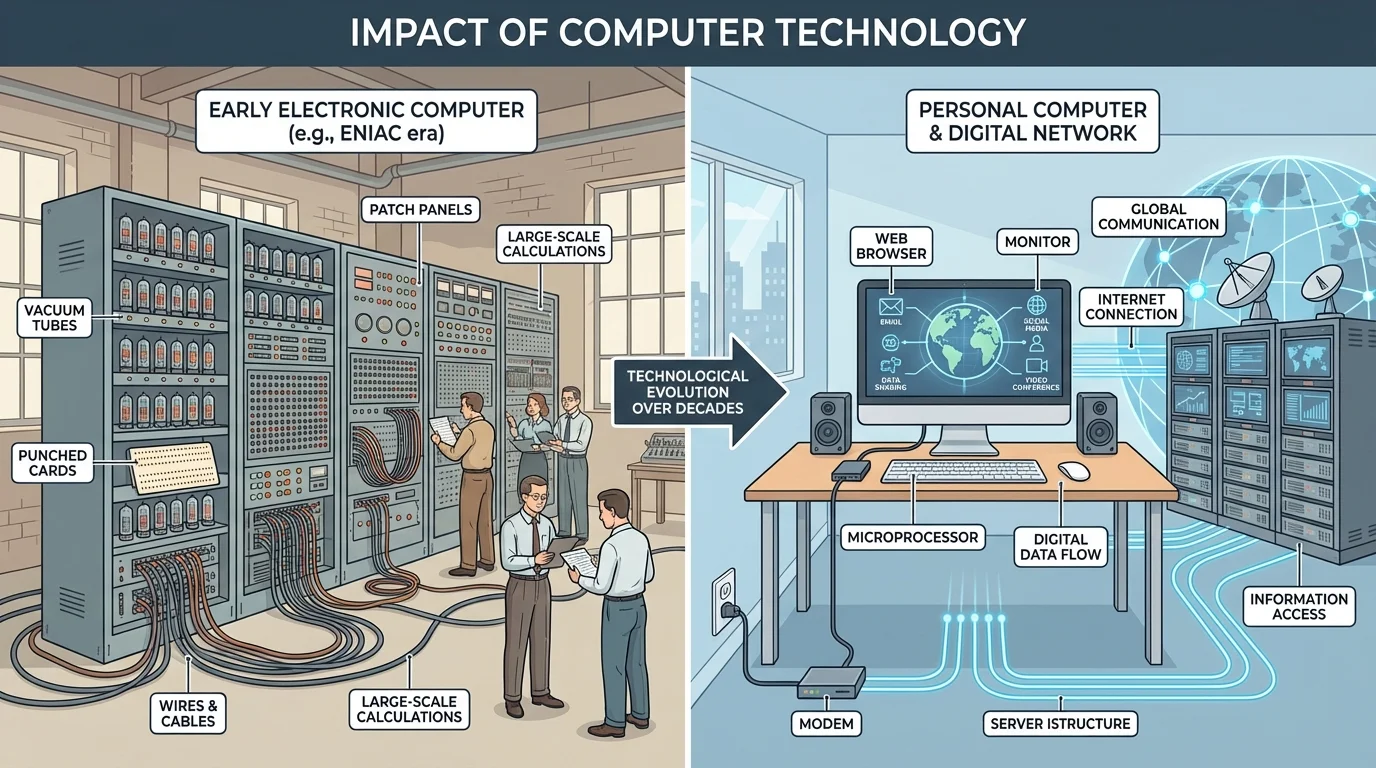
The shift from giant machines to personal devices helps explain why computers affected so many people. A technology that once served only experts gradually became part of ordinary daily life. Students today use digital tools for tasks that once took much more time.
Computer technology also changed how people communicate. Email, digital records, video calls, and the internet made it easier to share information quickly across long distances. But computers also created new challenges, such as protecting private information and making sure everyone has access to technology.
Some of the earliest computers filled whole rooms. Today, a small laptop or tablet can do tasks that once required huge machines and many workers.
The rise of computers connects Colorado history to major national developments in science, defense, business, and communication. The computer age helped shape the modern United States just as railroads and factories shaped earlier periods.
When we compare mining machines, irrigation systems, railroads, factories, nuclear power, and computers, we see a pattern. New technology often helps people do more in less time. It can increase production, improve communication, or make travel easier. It can also create jobs and help communities grow.
But technology can also cause problems. Mining can scar land and pollute water. Irrigation can strain water supplies. Railroads and highways can change habitats. Factories can create pollution and poor working conditions. Nuclear technology can be dangerous. Computers can spread false information quickly or leave out people who do not have access.
That is why historians study both the benefits and the costs. An invention is not just a machine. It becomes part of human choices. People decide how to use it, who controls it, and how to respond to its effects.
The history of technology is easier to understand when we place it in order. The timeline below shows how Colorado developments connect to larger United States history.
| Time Period | Technology | Colorado Connection | United States Connection |
|---|---|---|---|
| 1800s | Mining tools and rail support | Gold and silver mining towns grew | Westward expansion and industrial growth |
| Late 1800s to 1900s | Irrigation and farm machines | More farming on plains and valleys | Feeding a growing national population |
| Late 1800s to 1900s | Railroads, roads, automobiles | Denver and other towns became better connected | National trade and travel expanded |
| Early 1900s | Factories, electricity, assembly lines | Processing, refining, and city growth | Rapid industrialization |
| Mid-1900s | Nuclear technology | Uranium mining linked Colorado to atomic history | World War II and Cold War changes |
| Late 1900s | Computers and digital communication | Research, aerospace, and technology industries grew | Rise of the information age |
Table 1. Major technological developments and their links between Colorado history and United States history.
Across all of these periods, one idea stays the same: technology changes more than tools. It changes jobs, landscapes, communities, and the way people understand their world. Colorado history gives us many clear examples of that process.
