Why do some towns grow near rivers, while others are built near oceans or on wide flat land? The answer is not random. People often choose where to live, travel, farm, and work because of the land and water around them. The world's physical features can be helpful in many ways, but they can also make life difficult. Learning about this helps us understand why people do different kinds of activities in different places.
The physical environment is the natural world around us. It includes landforms such as mountains, plains, hills, and valleys. It also includes bodies of water such as rivers, lakes, and oceans. Weather and climate, soil, plants, and natural materials in the ground are part of the physical environment too.
People depend on the physical environment every day. We drink water, grow food in soil, travel across land, and build homes in places that fit local conditions. Some environments make these activities easier. Other environments make them harder or even dangerous.
Opportunity is a helpful condition that makes an activity easier to do. Constraint is a limit or challenge that makes an activity harder to do. In geography, the physical environment can provide both opportunities and constraints at the same time.
For example, a river can be an opportunity because it provides water for drinking, farming, and transportation. The same river can be a constraint if it floods and damages homes or roads. This is an important idea: one part of nature can help people in one way and challenge them in another.
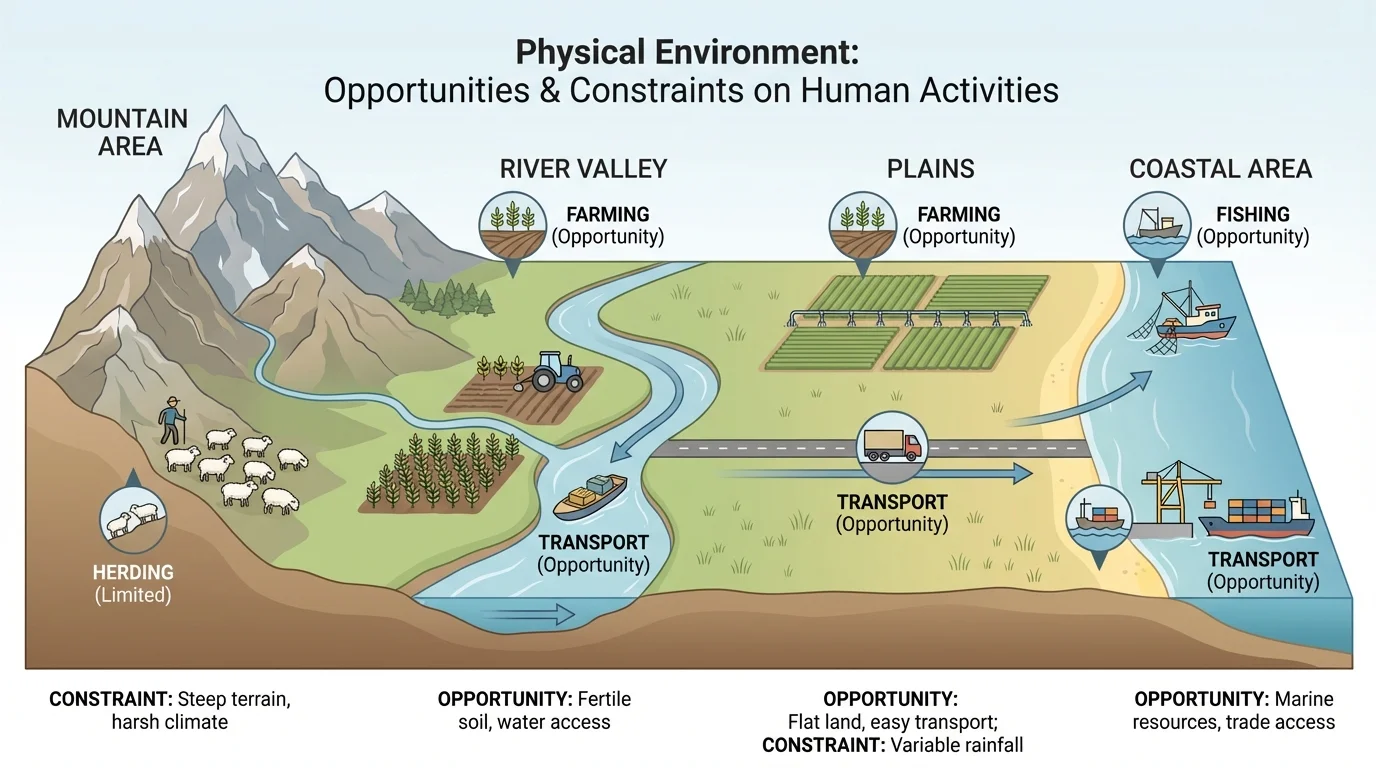
Different land and water features shape human life in different ways, as [Figure 1] shows. A place with rich soil and enough rain can be well suited to farming. A place near the sea can support fishing, shipping, and trade. A river valley can provide fresh water and flat land for communities.
Landforms affect where people build towns and what jobs they do. Flat plains are often good for farming because large machines can move across the land more easily. Valleys are often good places for settlement because they may have water and soil that can grow crops. Forests provide wood, shelter for animals, and places for recreation.
Water is especially important. Rivers can be used for transportation, irrigation, and drinking water. Lakes can provide fish and attract visitors. Coasts allow people to build ports where ships bring goods from other places. Long ago and today, many cities grew near water because water supports so many human needs.
The kind of soil in a place matters too. Soil that is deep and rich helps plants grow well. This gives farmers an opportunity to grow crops such as wheat, corn, rice, or vegetables. In places with poor soil, farming is more difficult, so people may need to raise animals instead or trade for food from other areas.
Another opportunity comes from natural resources. These are useful materials from nature, such as trees, water, coal, oil, metals, and stone. People use natural resources to build homes, make products, create energy, and earn money. A forest may support logging, while a windy area may be a good place for wind turbines.
Some of the world's earliest cities grew in river valleys because rivers gave people water, transportation routes, and fertile land for crops.
Even climate can create opportunities. In warm places with long growing seasons, farmers may be able to grow crops for much of the year. In snowy places, people may develop winter sports, tourism, and special kinds of transportation. As we saw earlier in [Figure 1], one type of place may support farming while another supports fishing or herding.
The physical environment also creates limits, as [Figure 2] illustrates. A steep mountain may protect a community, but it can also make travel difficult. A dry desert may have beautiful open land, but it often has very little water. People must work around these conditions if they want to live there.
Climate is the usual weather in a place over a long time. Climate can strongly affect human activity. In very cold regions, the ground may stay frozen for much of the year. This makes farming difficult and can make building roads or homes harder. In very hot and dry regions, people may struggle to find enough water for drinking and crops.
Mountains are another example of a constraint. High mountains can block roads and make it hard to move goods from one place to another. Building in the mountains may cost more because slopes are steep. People may have to build tunnels, bridges, or winding roads to travel safely.
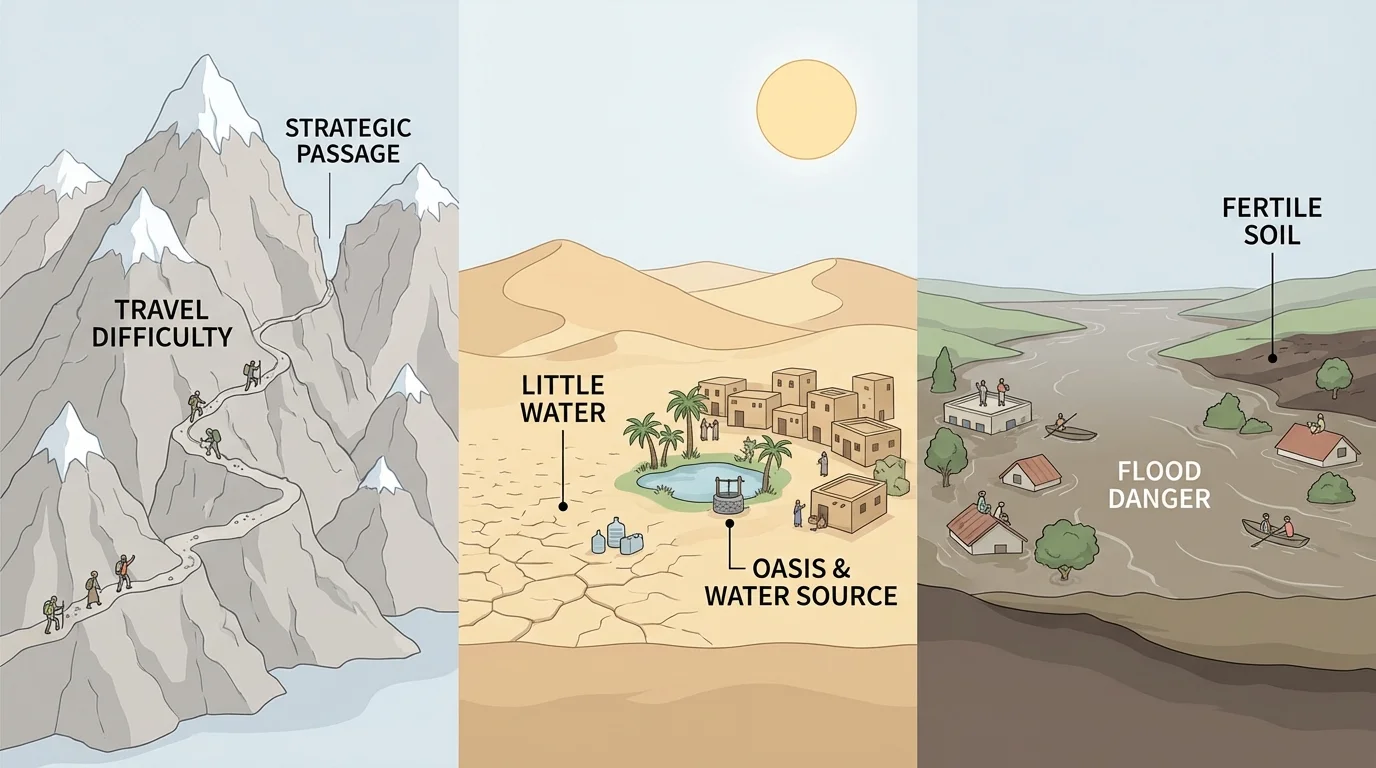
Water can also create problems. Floods may cover fields, roads, and houses. Storms near coasts can bring high waves and strong winds. In some places, too much rain causes landslides, while in other places too little rain causes drought. Both extremes make daily life harder.
Sometimes the environment limits the kinds of jobs people can do. A rocky area may not be good for farming. A place far from rivers, roads, or harbors may not be easy for trade. That means people may need different ways to earn a living, such as mining, tourism, herding, or crafts.
One place can help and limit at the same time. A coast may support fishing and trade, but it may also face hurricanes. A river valley may have rich soil, but it may flood. A mountain area may offer fresh water and beautiful scenery, but travel may be slow. Geography often works in this balanced way.
This is why people study risk as well as resources. The same environment that offers benefits may also require careful planning. Later, when we look at real places, [Figure 2] helps us remember that mountains, deserts, and flood-prone rivers can shape how people build and move.
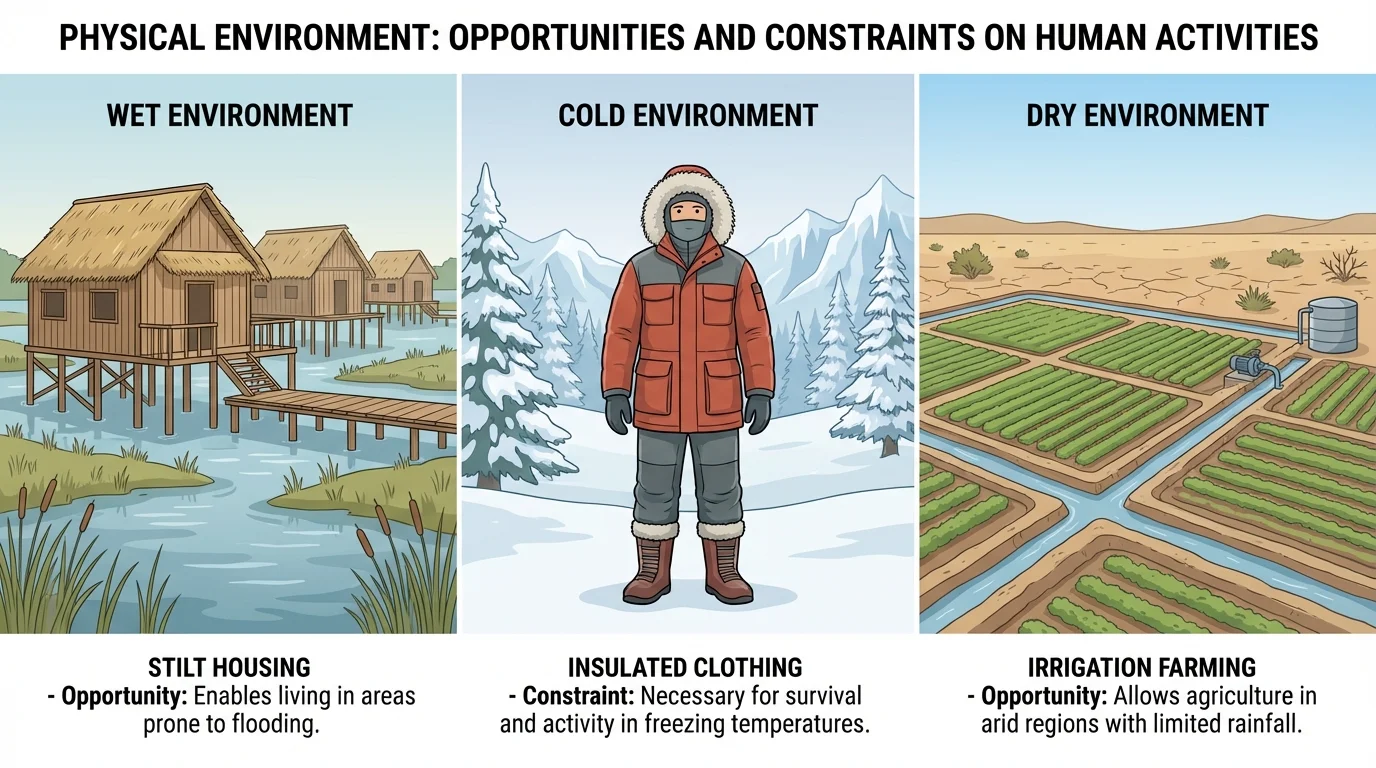
People are not passive. They change their behavior and tools to fit the places where they live, as [Figure 3] shows. This is called adaptation. Instead of doing the same thing everywhere, people make choices that match their environment.
In wet places that flood often, people may build houses on stilts to raise them above water. In dry places, farmers may use irrigation, which means bringing water to crops through canals, pipes, or ditches. In snowy places, people may wear thick clothing, use special tires, or build roofs that let snow slide off more easily.
People also adapt by changing transportation. Boats work well on rivers and lakes. Camels have been used in deserts because they can travel long distances with little water. In mountain areas, people may use switchback roads, cable cars, or pack animals. The environment helps decide which transportation works best.
Farmers adapt too. They choose crops that match the climate and soil. Rice grows well in warm, wet places. Wheat often grows well on broad plains. In cold places with short summers, farming may be limited, so people may fish, herd animals, or import food from warmer places.
Example of adaptation in one place
A family lives near a river that sometimes floods.
Step 1: They identify the environmental challenge.
The river gives them water and fish, but it may also rise after heavy rain.
Step 2: They adapt their home and travel.
They build the house on higher ground or on stilts and keep a boat for travel during floods.
Step 3: They keep using the opportunity.
They still use the river for water, fishing, and transportation.
This example shows that people often stay in useful places and adjust to the risks.
Adaptation does not remove every problem, but it can make life safer and more successful. Thinking back to [Figure 3], homes, clothing, and farming tools often tell us a lot about the environment around a community.
Examples from around the world show the same big idea in different ways. Even though these places are far apart, people in each one respond to the opportunities and constraints of their environment, as [Figure 4] shows.
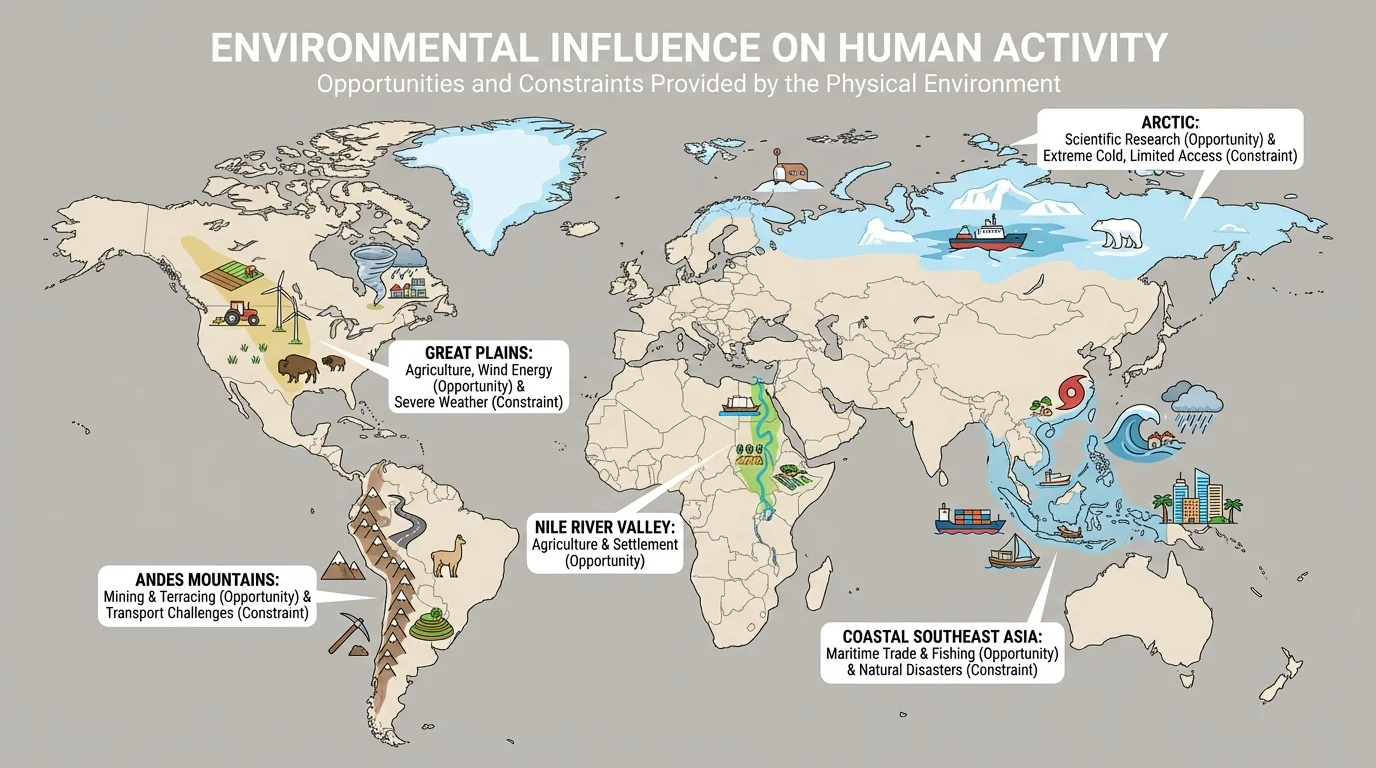
In the Nile River Valley in Africa, the river has long provided water and fertile soil. This creates excellent opportunities for farming and settlement. At the same time, people must manage water carefully because life depends heavily on the river.
In the Great Plains of North America, wide flat land and grasslands have supported farming and ranching. The flat land makes it easier to use machines and transport crops. However, strong winds, drought, and storms can create serious problems for people and farms.
In the Andes Mountains of South America, steep land makes travel and building difficult. Yet mountain slopes can also be used in clever ways, such as terrace farming. Terraces are steps cut into hillsides to create flat places for crops. This is a smart adaptation to a mountainous environment.
In the Arctic, freezing temperatures and long winters create many constraints. Farming is very difficult, and travel can be dangerous. Still, people adapt with warm clothing, insulated homes, and activities such as fishing and hunting. Modern technology also helps people live in cold regions.
In coastal Southeast Asia, access to the sea supports fishing and trade. But these areas may also face tropical storms, flooding, and rising water. Communities often adapt with boats, raised buildings, and disaster planning.
| Place | Opportunities | Constraints | Adaptations |
|---|---|---|---|
| Nile River Valley | Water, fertile soil, farming | Dependence on river, flood risk | Water management, river-based settlement |
| Great Plains | Flat land, farming, ranching | Drought, storms, strong winds | Large-scale farming, irrigation, weather planning |
| Andes Mountains | Fresh water, unique crops, tourism | Steep slopes, hard travel | Terrace farming, mountain roads |
| Arctic | Fishing, hunting, natural resources | Extreme cold, short growing season | Insulated housing, special clothing |
| Coastal Southeast Asia | Fishing, ports, trade | Storms, flooding | Raised homes, boats, storm preparation |
Table 1. Examples of how different environments provide opportunities, create constraints, and lead to adaptation.
These case studies show that no place is simply "good" or "bad." What matters is how well people understand their environment and respond to it. The world map in [Figure 4] helps connect these examples across different continents.
People often settle where the physical environment supports their needs. They look for water, land for homes, transportation routes, and chances to earn a living. This is one reason many cities began near rivers, coasts, or fertile valleys.
The environment also shapes jobs. Farmers need suitable land, water, and climate. Fishers need access to oceans, lakes, or rivers. Miners work where useful minerals are found. Tourism may grow in places with beaches, mountains, forests, or snowy slopes.
Transportation is closely linked to geography. Flat areas often make road and rail building easier. Rivers and oceans allow ships to move goods. Mountains and swamps may slow transportation and make it more expensive. Because of this, some places become busy centers of trade while others stay more isolated.
You may already know that people need food, water, shelter, and safety. Geography adds an important idea: where those needs are easiest or hardest to meet depends a lot on the physical environment.
Even schools, stores, and neighborhoods are affected by location. A town in a farming area may have grain elevators and farm supply stores. A coastal town may have docks and seafood markets. A mountain town may have tunnels, ski shops, or steep roads. Human activity is closely tied to place.
People use the environment for many purposes, but they also need to take care of it. If forests are cut too quickly, animals lose habitat and soil may wash away. If rivers are polluted, people and wildlife may lose clean water. If land is overused, it may become less productive.
Good decisions help people keep using opportunities without causing too much harm. Farmers can protect soil. Communities can build in safer places. Cities can prepare for storms and floods. People can use water carefully in dry areas. These choices matter because the environment supports life.
"People shape places, and places shape people."
Understanding opportunities and constraints helps communities plan wisely. If leaders know an area floods often, they can avoid building important buildings in risky spots. If they know an area has good wind, they may build wind turbines there. Geography helps people make smart choices about the future.
