A state issue can affect many people at once, but not always in the same way. A new road, a school rule, a water problem, or a change in voting laws may seem helpful to some people and harmful to others. That is why learning about different viewpoints is so important. When people speak up, share their experiences, and work together, they help everyone understand the issue more clearly.
In civics, a perspective is the way a person or group sees something. A farmer, a teacher, a student, a business owner, and a tribal leader may all care about the same issue, but each one notices different parts of it. One issue can look very different depending on who is affected, as [Figure 1] illustrates through a community discussion with many voices.
When states make decisions, leaders should listen to more than one side. If they only hear one opinion, they may miss important facts. When they hear many viewpoints, they can make fairer choices. Different perspectives can help people spot problems, find better solutions, and understand how decisions affect real lives.
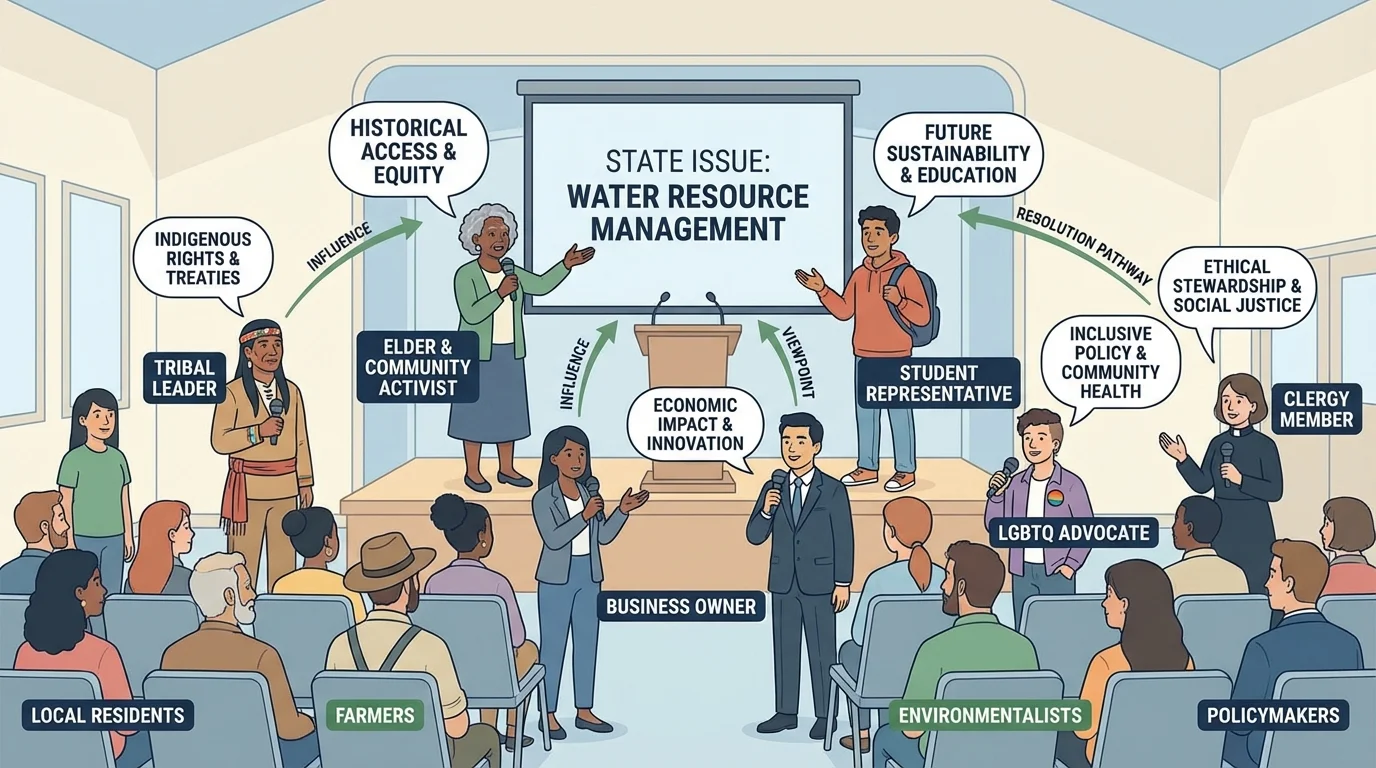
Listening to different groups does not mean everyone agrees. In fact, people often disagree. But respectful disagreement is part of democracy. People can ask questions, share evidence, and explain why an issue matters to them. This helps communities learn instead of simply argue.
Public opinion is what people in a community or state think about an issue. A civic issue is a problem or question that affects the community and needs people or government to respond. A community is a group of people who live, work, or share life together in the same place.
Sometimes students can see this in school. If a school changes recess rules, students, teachers, and families may all have opinions. The same thing happens across a whole state, just on a larger scale.
Many people help shape the way state issues are viewed. Some are well known, like governors, mayors, judges, or reporters. Others are everyday people who speak at meetings, write letters, organize neighbors, or share their stories. A single person with courage and clear ideas can help others notice a problem.
Groups also have strong influence. A advocacy group works to support a cause. A neighborhood association may ask for safer streets. A veterans group may ask for better services. A youth group may speak up about parks or after-school programs. Religious groups, labor groups, tribal governments, and civil rights organizations can all help shape how people think about an issue.
The news media can also influence public opinion. Newspapers, TV, radio, and websites help people learn what is happening. Journalists can draw attention to a problem by reporting facts, interviewing people, and showing how an issue affects families.
Leaders in government also shape solutions. They may hold meetings, write laws, create programs, or vote on policies. But good leaders often learn from the public first. Citizens and groups do not just watch government; they help guide it.
Civil rights are rights that protect people from unfair treatment. African Americans have played a major role in helping states think about fairness, justice, education, voting, and equal opportunity. Their efforts have changed laws and attitudes in many places.
For example, African American leaders and families have worked to challenge unfair school systems, unfair housing, and barriers to voting. When people march peacefully, speak in court, write in newspapers, or organize communities, they can help others see an issue differently. A problem that some people ignored may become impossible to ignore once real stories are heard.
In many states, African American churches, educators, activists, and community groups have supported job training, youth programs, and voter education. They help people understand that a state issue is not only about rules on paper. It is also about whether people are treated with dignity and respect.
Many important changes in American life began when local people in states and cities spoke up first. State and local action often helps lead to larger national change.
The contributions of African Americans remind us that people who have faced injustice often bring powerful knowledge about what fairness should look like.
Latinos have strongly influenced how states view and solve issues. They have helped bring attention to workers' rights, fair pay, school support, language access, health care, and representation in government. These are important state concerns because they affect daily life.
For example, if families speak Spanish as well as English, they may need school notices or health information in both languages. Latino leaders and community groups may help a state see that information is most useful when families can read and understand it. This changes how people view the issue. What first looked like a small problem may be understood as a fairness issue affecting many children and parents.
Latino farmworkers and labor organizers have also helped states think about working conditions, safety, and pay. Their experiences help others understand where food comes from and how workers should be treated. In this way, the voices of workers can influence both public opinion and state laws.
Latino artists, teachers, veterans, elected leaders, and students also shape state life. They show that civic participation includes culture, service, and leadership, not just politics.
Japanese Americans have influenced how states think about fairness, belonging, and the protection of rights. Their history includes a painful time during World War II when many Japanese Americans were forced from their homes and sent to internment camps. This injustice teaches an important lesson: fear can lead to bad decisions if people do not protect freedom and equality.
Because of that history, Japanese American communities and allies have helped states remember the past and work to prevent similar wrongs. Museums, memorials, speakers, and community events help people learn that a state should never judge people unfairly because of their background.
Japanese Americans also contribute through business, farming, education, military service, and public leadership. Their stories help communities see that every group has something valuable to offer. Remembering injustice from the past can guide wiser choices in the present.
Sovereignty means having the right to govern oneself. Indigenous Peoples, including tribal nations, bring important knowledge and leadership to state issues, especially about land, water, fishing, forests, and cultural protection. They have lived on and cared for these lands for a very long time, and that knowledge matters, as [Figure 2] shows through discussions about natural resources.
Tribal governments are not just clubs or organizations. They are governments with their own leaders and traditions. When a state makes decisions about roads, rivers, wildlife, or sacred places, tribal nations may be deeply affected. Their voices can help everyone understand the history of the land and the long-term effects of decisions.
For example, if a factory may pollute a river, Indigenous leaders may speak about treaty rights, fishing, clean water, and respect for nature. Their perspective can widen the discussion. The issue is not only about business or jobs. It is also about health, promises made long ago, and care for future generations.
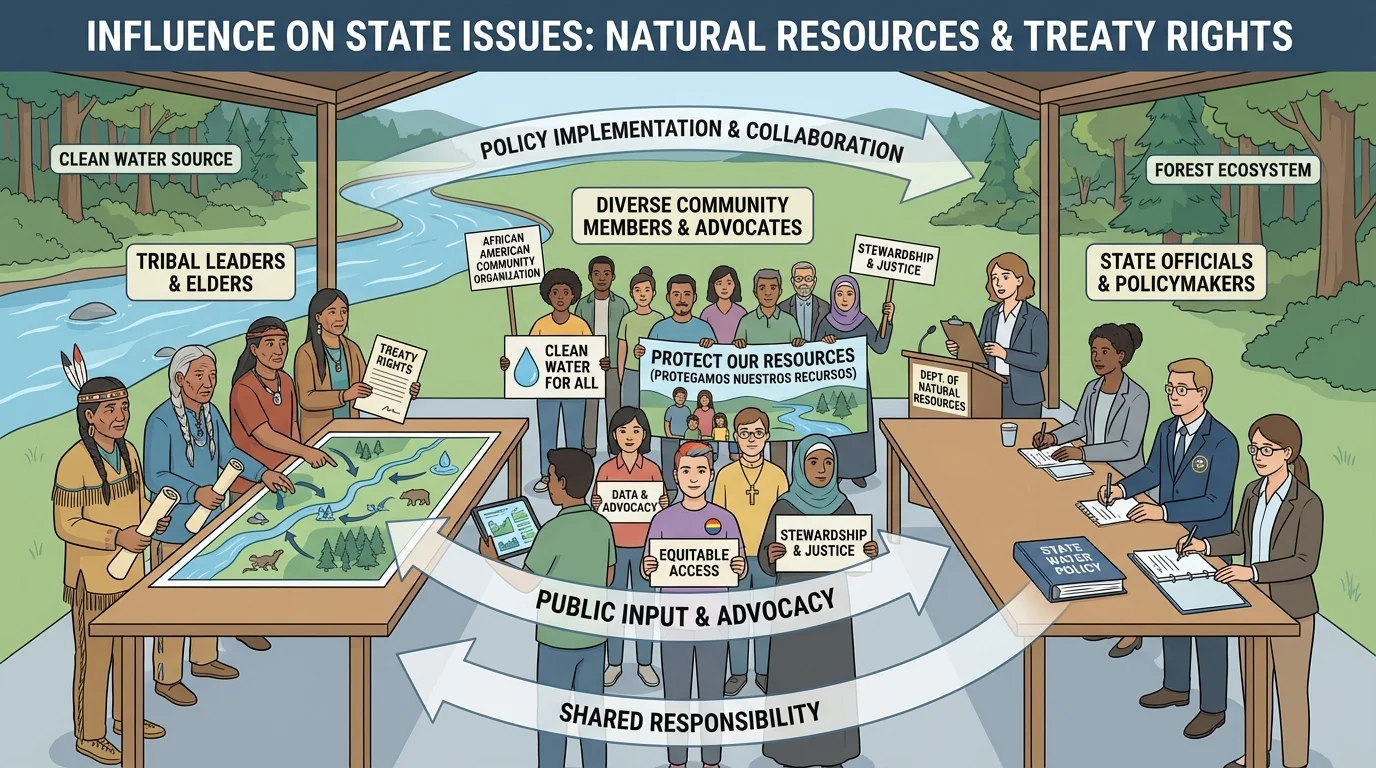
Indigenous Peoples also strengthen states through language revival, education, environmental protection, and cultural events. Their contributions help others see that solving problems often requires both modern science and traditional knowledge. Later, when people debate water use or land care, this kind of shared decision-making remains important.
LGBTQ people and groups have helped states think more carefully about fairness, safety, and respect. They have worked to address bullying, discrimination, unequal treatment, and the need for safe schools and workplaces. When people share stories about being left out or treated unfairly, others may begin to see the issue in a new way.
For example, students and families may ask schools to create anti-bullying rules that protect everyone. Community groups may encourage states to improve laws or services so that all people are treated fairly. These efforts can change both public opinion and public policy.
LGBTQ advocates also remind communities that every person deserves dignity. Their work often helps states think about how laws and rules affect real people, not just ideas on paper.
Religious groups influence state issues in many ways. They may share moral teachings, organize volunteers, run food banks, support shelters, or speak up for people in need. Because many religious groups are active in local communities, they often notice problems early.
For example, a religious group may help people experiencing homelessness and then speak to state leaders about housing. Another group may support refugees, children, or prisoners returning to society. Their service gives them firsthand knowledge, and that knowledge can shape how others understand the issue.
People in different religions do not always agree with one another, and some people do not belong to any religion. In a democracy, that is acceptable. The important idea is that people can share their beliefs respectfully while the government works to protect freedom for everyone.
Why service can change opinions
When a group helps people directly, it often learns facts that others cannot easily see. A food pantry may notice rising hunger before many officials do. A shelter may notice that families need more affordable homes. Service can turn private concern into public action.
Religious groups are one example of how values, service, and experience can influence public discussions in a state.
State issues are often solved through many steps, not all at once. A concern may begin with citizens noticing a problem. Then more people learn about it, discuss it, and ask leaders to act. The path from concern to action includes public discussion, media attention, meetings, and decisions.
[Figure 3] People may speak at a school board meeting, a city council meeting, or a state hearing. They may write letters, sign petitions, join peaceful protests, or vote. Groups may gather facts, tell personal stories, or suggest solutions. All of these actions can influence how others view the issue.
Government officials then may study the problem, debate choices, and pass a law or create a program. Sometimes courts become involved if a law seems unfair. Sometimes the final solution is a compromise, which means each side gives up a little to reach an agreement.
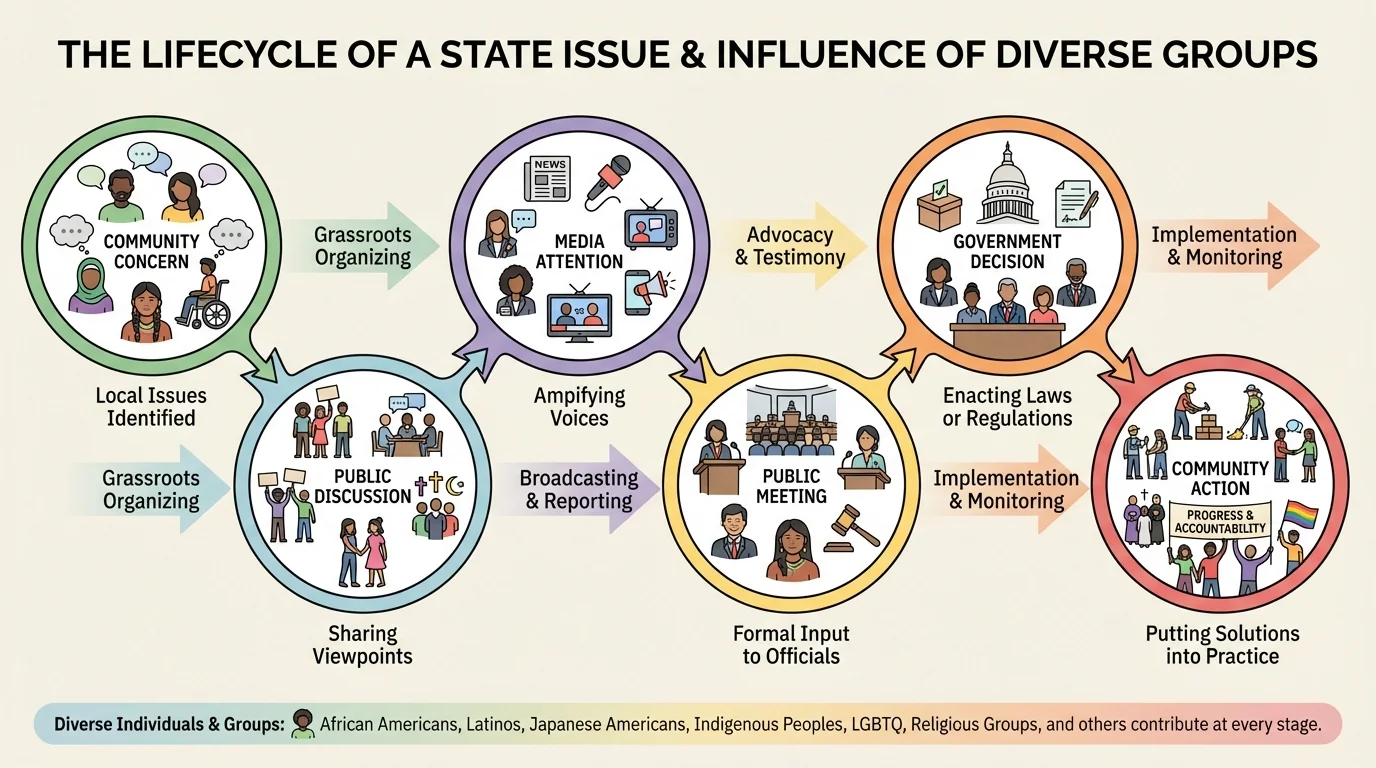
Not every issue is solved quickly. Some take years. But public action matters. This process reminds us that change often starts when people speak up and others choose to listen.
Case study: A water issue in one state
A state is deciding how to use water from a river during a dry year.
Step 1: Different groups explain their needs.
Farmers need water for crops. Families need clean drinking water. Tribal nations want to protect fishing and treaty rights. Business owners worry about jobs. Environmental groups want wildlife and wetlands protected.
Step 2: The issue is viewed in many ways.
One group may focus on money and jobs. Another may focus on health. Another may focus on history and promises. Another may focus on nature and future generations.
Step 3: Leaders search for a fair solution.
State officials can hold meetings, hear evidence, and make a plan that shares water carefully, protects health, and respects rights as much as possible.
This example shows why listening to many groups leads to better decisions.
When only one side is heard, a solution may seem simple but create new problems. When many sides are heard, a state has a better chance of finding a wise and fair answer.
One helpful way to study a civic issue is to ask simple questions. Who is affected? How are they affected? What evidence do they have? What values matter to them? What are the short-term and long-term results of a decision?
These questions help students become careful thinkers. They also help citizens avoid judging too quickly. A loud opinion is not always the best one. Sometimes the people most affected by an issue are the ones who have been heard the least.
| Group or Person | How They Influence a State Issue | Example of Concern |
|---|---|---|
| Community members | Share experiences and speak at meetings | Safer neighborhoods |
| African American leaders and groups | Advocate for fairness and equal treatment | Voting access, education |
| Latino leaders and groups | Raise awareness about labor, language, and services | Worker safety, school communication |
| Japanese American communities | Teach lessons from history and protect rights | Civil liberties, remembrance |
| Indigenous Peoples and tribal nations | Bring knowledge of land, water, and sovereignty | Natural resources, sacred places |
| LGBTQ people and groups | Advocate for safety and equal treatment | Anti-bullying, fairness |
| Religious groups | Provide service and moral viewpoints | Homelessness, hunger |
| Government officials | Make and carry out policies | Laws and programs |
Table 1. Examples of how different people and groups influence the way state issues are understood and addressed.
This table shows that influence comes from many directions. It does not belong only to famous leaders. It also belongs to neighbors, families, and local organizations that care enough to get involved.
A strong state needs informed and respectful citizens. That means listening carefully, asking questions, checking facts, and thinking about fairness. It also means understanding that people from different backgrounds may bring important knowledge.
You do not have to agree with every viewpoint. But you should try to understand it. When citizens understand multiple perspectives, they are better prepared to solve problems together.
"The strength of a community is measured by how well it listens to all of its people."
At your age, you can already practice these skills. You can listen respectfully, notice whose voices are missing, and think about how choices affect different groups. These are important habits of citizenship.
