Who decides whether a road gets repaired, how state parks are protected, or what rules schools must follow? You may be surprised to learn that these decisions are often made by state government, not just by the national government in Washington, D.C. In Colorado, leaders, citizens, judges, and many workers all play different parts. State government is a lot like a team: each person has a job, and the team works best when everyone does their part.
Colorado's state government affects everyday life. It helps make rules for schools, roads, public safety, health services, wildlife protection, and state parks. If a bridge needs repair, if firefighters need support during a wildfire, or if people want changes in education, state government often becomes involved.
State government is important because each state has its own needs. Colorado has mountains, plains, farms, cities, rivers, forests, and changing weather. Because of that, Colorado leaders must make choices that fit the people and places in this state. The government of Colorado is designed to serve the people who live here.
State government is the government of a single state, such as Colorado. It makes state laws, provides services, and protects the rights and safety of people in that state.
Citizen means a member of a country who has rights and responsibilities. Citizens can take part in government in different ways, such as voting and speaking about issues.
In Colorado, people do not all do the same job in government. Some people lead. Some make laws. Some enforce laws. Some decide whether laws are fair. Some carry out important public work every day. And citizens themselves are a major part of how government works.
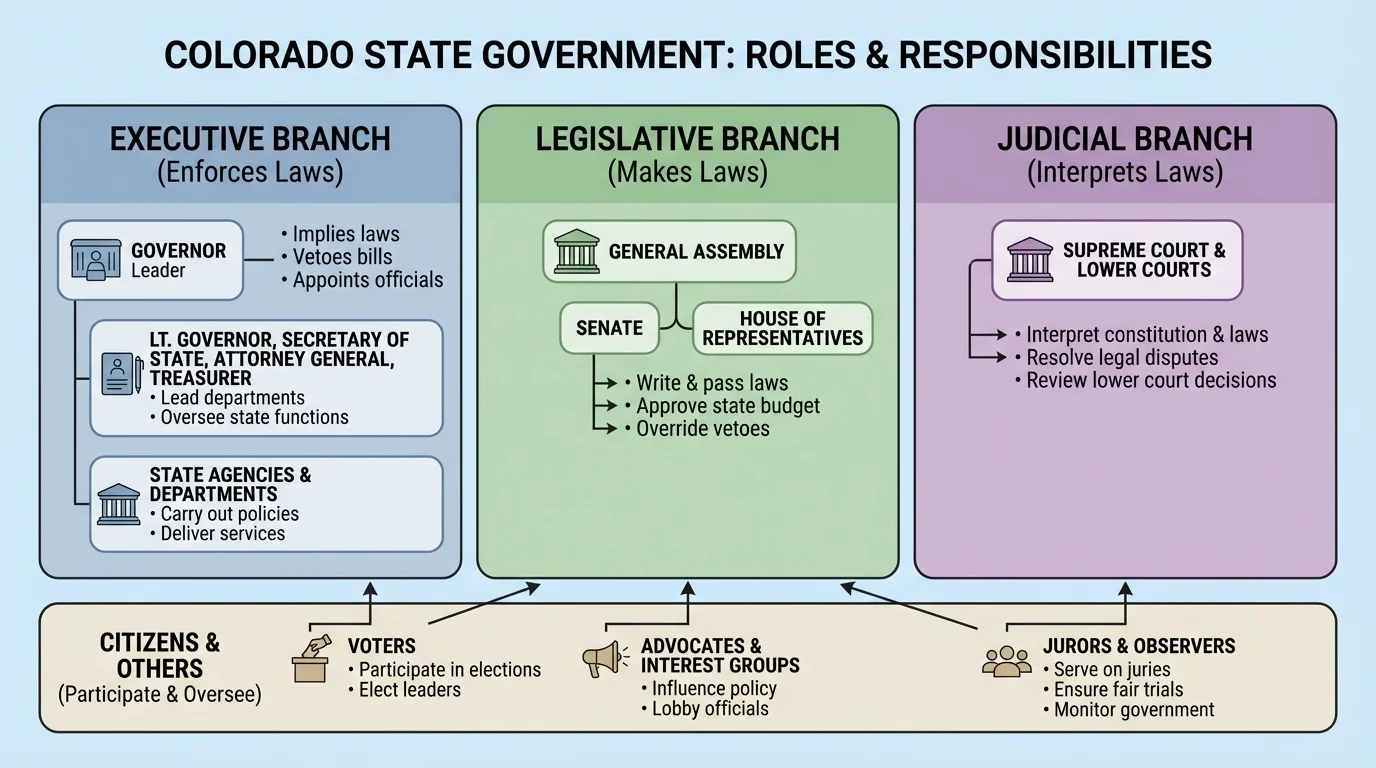
[Figure 1] shows how Colorado's branches of government share power so that no one person or group has too much control. This system has three parts: the executive branch, the legislative branch, and the judicial branch. Each branch has a different main job, but they work together.
The executive branch carries out laws. The legislative branch makes laws. The judicial branch interprets laws and decides cases in court. This structure helps keep government organized and fair.
Colorado also has a state constitution. A constitution is the basic plan for government. It explains how the government is set up, what powers it has, and what rights people have. Colorado's constitution helps guide state leaders when they make decisions.
Even though the three branches have different jobs, they are connected. A law may start in the legislature, be signed by the governor, and later be reviewed by a court. That means understanding state government is really about understanding many roles working together.
Colorado became a state in 1876, which is why it is sometimes called the Centennial State. That was 100 years after the United States declared independence in 1776.
As we saw in [Figure 1], the three branches divide responsibilities. This helps prevent confusion and reminds people that government is not just one leader giving orders. It is a system of shared work.
The executive branch is led by the governor. The governor is the state's chief executive. In simple terms, the governor helps carry out state laws, leads state agencies, prepares a budget plan, and responds to emergencies. During a wildfire, flood, or snowstorm, the governor may help organize the state's response.
The governor also has the power to sign bills into law or reject them with a veto. A veto means the governor says no to a bill. This does not mean the governor works alone. The governor works with many advisers, agency leaders, and other elected officials.
Another important leader is the lieutenant governor. This person helps the governor and may take over certain duties when needed. Colorado also has other elected executive officials, such as the secretary of state, the state treasurer, and the attorney general. Each has a special role.
The secretary of state helps oversee elections and keeps important state records. The state treasurer manages state money. The attorney general serves as the state's chief lawyer and helps enforce laws. These leaders make sure the state government can function in many different areas.
Why executive leaders matter
Executive leaders take laws and turn them into action. If lawmakers pass a law about road safety, executive agencies help put the law into practice. If the state budget includes money for parks, executive leaders help decide how that money is used.
Many executive branch workers are not famous, but their jobs matter. They may work in transportation, health, education, natural resources, agriculture, or public safety. Their role is to serve the people of Colorado by doing the daily work of government.
[Figure 2] helps show how an idea can move through the legislative branch and become law. Colorado's lawmaking group is called the General Assembly. The General Assembly has two parts: the Senate and the House of Representatives.
People in the legislature are elected to represent citizens in different areas of the state. State senators and state representatives listen to concerns, discuss ideas, and vote on bills. A bill is a proposed law. Not every bill becomes a law. Lawmakers must study it carefully first.
Legislators have important jobs. They introduce bills, debate them, suggest changes, and vote. They also help decide how state money should be spent. For example, they may help decide funding for schools, roads, water projects, or safety programs.
Usually, a bill goes through several steps. It may be introduced, discussed in committee, debated by lawmakers, voted on in both houses, and then sent to the governor. This process takes time because laws should be considered carefully.
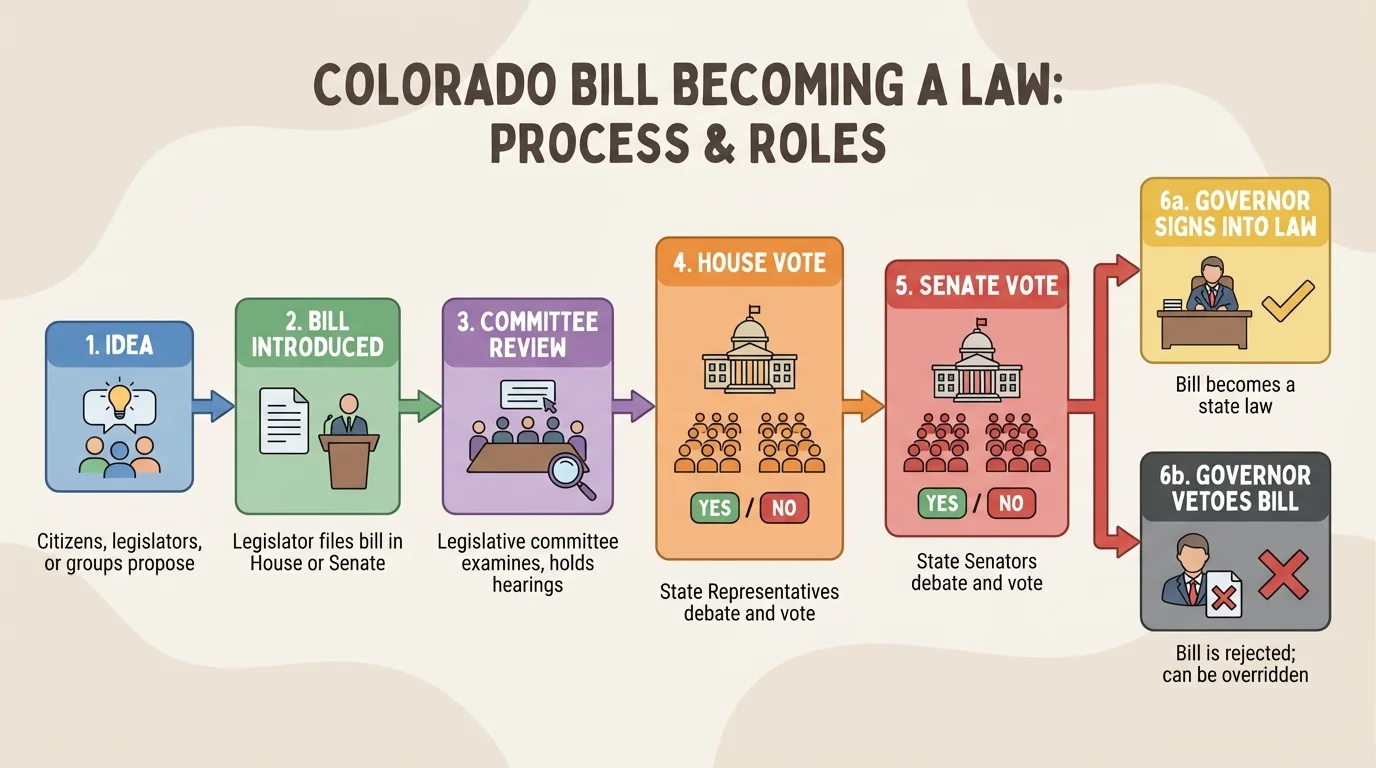
Committees are small groups of lawmakers who study bills closely. They hear ideas, ask questions, and decide whether a bill should move forward. This is one reason laws are not made quickly or carelessly.
Later, when citizens contact a lawmaker or speak about an issue, they are often trying to influence the process shown earlier in [Figure 2]. This reminds us that representatives are supposed to listen to the people they serve.
Colorado lawmaking example
A community wants safer school crossings near busy roads.
Step 1: Citizens and local leaders notice a problem.
Families, teachers, and city leaders explain that students need safer places to cross streets.
Step 2: A lawmaker writes a bill.
A state representative or senator may propose a bill to improve road safety rules or provide money for crossing improvements.
Step 3: The legislature studies and votes.
Committees discuss the bill, lawmakers debate it, and both houses vote.
Step 4: The governor decides.
If the governor signs the bill, it becomes a law and state workers may help carry it out.
This example shows that leaders in the legislative and executive branches both play important roles.
Legislators are leaders, but they are also representatives. Their job is not only to speak. Their job is to listen, learn, and make choices for the good of the state.
The judicial branch includes courts and judges. Judges do not make laws or carry them out. Instead, they interpret laws. That means they explain what laws mean and decide how they apply in real cases.
A judge listens carefully to facts, follows the law, and makes decisions fairly. Courts may hear cases about rights, safety, rules, and disagreements. In some cases, courts decide whether a law or action follows the constitution.
This branch is important because fairness matters. If people think a law was applied in the wrong way, courts can review what happened. Judges help make sure laws are used justly, not randomly.
Remember that laws are rules made by government. The judicial branch does not create those rules. It helps decide what the rules mean and whether they are being followed correctly.
Some courts in Colorado handle local issues, while higher courts handle larger or more complex cases. Even though students may not see judges often, the judicial branch protects rights and helps settle disputes peacefully.
The judicial branch also connects to the other branches. A judge may review a law passed by the legislature or an action taken by the executive branch. In that way, the branches balance one another, much like the three-part system shown in [Figure 1].
[Figure 3] illustrates several ways citizens can help shape state government. The people of Colorado are not just observers of government; they are active participants. Citizens help choose leaders, share opinions, obey laws, and serve their communities.
One of the best-known citizen roles is voting. Adults who are eligible can vote for governor, lawmakers, and other state leaders. Voting gives citizens a voice in who represents them. When many people learn about issues and vote carefully, government more accurately reflects the needs and views of the people.
Citizens can also contact lawmakers, write letters, attend meetings, join peaceful groups, or speak about issues they care about. A person who wants cleaner rivers, safer roads, or stronger schools can share those ideas with state leaders. Citizens can influence what problems government pays attention to.
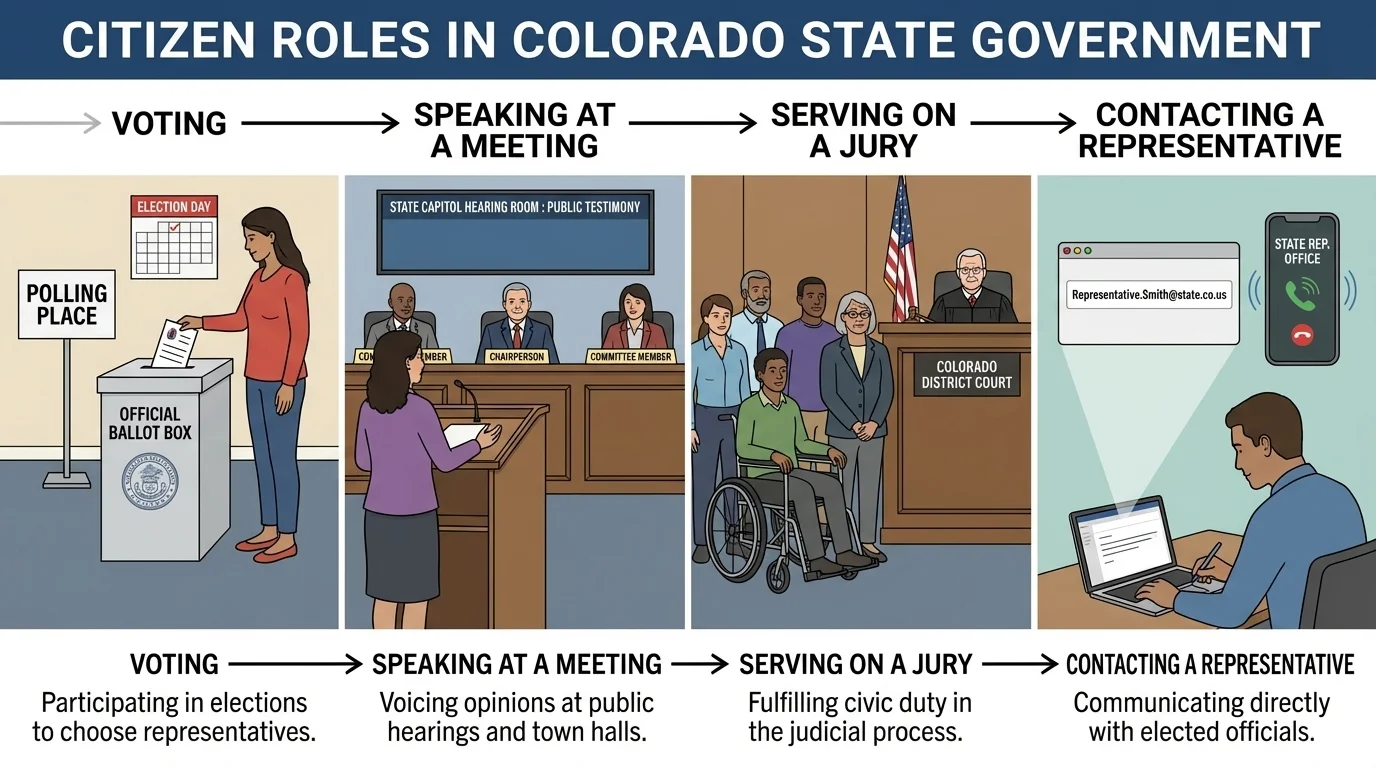
Another important role is jury service. In some court cases, citizens serve on a jury to help decide facts fairly. This gives regular people a direct role in the judicial system. It is a serious responsibility.
Citizens also help government by following laws, paying taxes, and staying informed. Taxes provide money for services such as roads, schools, and public safety. Staying informed means learning from trustworthy sources and thinking carefully before making decisions.
"Government of the people, by the people, for the people..."
— Abraham Lincoln
As shown earlier in [Figure 3], citizenship involves more than voting. It includes speaking respectfully, listening to others, and taking part in solving shared problems.
State government depends on many people besides elected leaders. These workers often do the day-to-day jobs that keep the state running. For example, state troopers help with highway safety, park rangers protect natural areas, health workers support public health programs, and transportation workers help maintain roads.
Teachers and school leaders also connect with state government because the state helps set education rules and provide funding. Wildlife officers protect animals and enforce outdoor laws. Election workers help citizens cast ballots accurately and safely. Accountants, engineers, attorneys, office workers, and technology experts also play roles.
Another group students may hear about is lobbyists. A lobbyist is a person who tries to persuade government leaders about an issue. For example, a group that cares about farming, clean air, or public health may ask a lobbyist to explain its ideas to lawmakers. Lobbyists are one way organized groups share information, though lawmakers must still decide what is best.
News reporters also have a role, even though they are not part of government. They inform the public about state decisions, laws, and debates. When citizens know what leaders are doing, they can make better choices and hold government accountable.
Colorado has many state agencies with very different jobs. Some focus on roads and transportation, while others help manage forests, water, health programs, or wildlife.
This wide variety of roles shows that government is not only about speeches and elections. It also includes planning, researching, protecting, teaching, building, and serving.
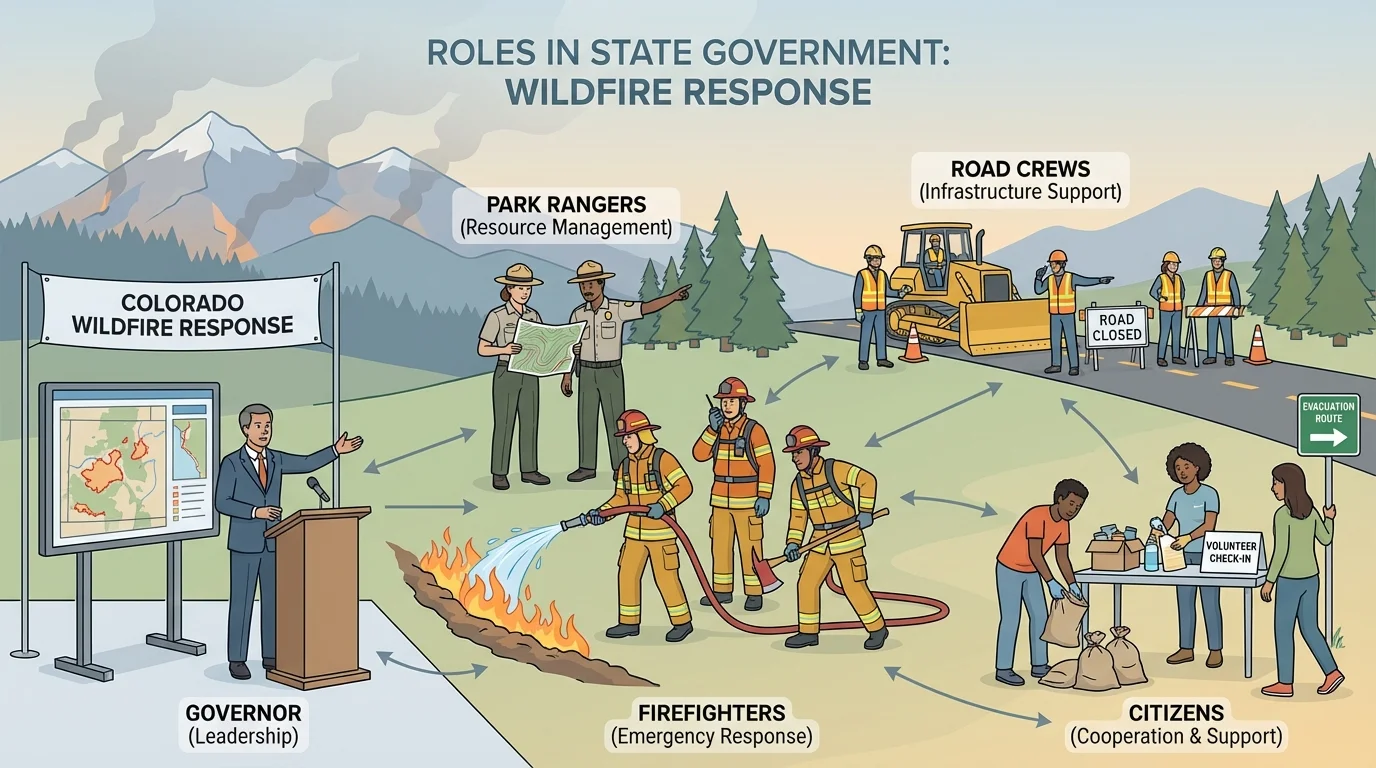
[Figure 4] shows how many roles can come together during a Colorado emergency. State problems are usually too big for one person to fix alone. Leaders, citizens, and workers must cooperate. This teamwork is one of the most important ideas in civics.
Think about a wildfire in Colorado. The governor may help organize emergency action. Lawmakers may approve funding for response or recovery. Judges may handle legal questions if disputes arise. Firefighters, park workers, transportation crews, and health officials do direct work on the ground. Citizens follow safety directions, help neighbors, and rebuild communities.
Consider another example: improving schools. Citizens speak up about what students need. Lawmakers debate education funding. The governor signs laws or budget plans. State education officials help carry out policies. Teachers and principals then put these plans into action in classrooms.
Water is another Colorado issue. Farmers, city leaders, scientists, lawmakers, and citizens may all care about how water is shared and protected. Because Colorado has dry areas as well as snowy mountains, water decisions affect many people. Solving such problems requires listening, planning, and compromise.
When students look again at [Figure 4], they can see that good government is really a network of roles. Some people lead, some respond, some make rules, some interpret rules, and some support the whole system through civic participation and daily public service.
Why cooperation matters
State government works best when different roles connect. Leaders need information from citizens. Citizens need honest information from leaders and reporters. Agencies need laws and funding. Courts need facts and fairness. No part can do the whole job alone.
That is why civics is not only about knowing names of leaders. It is also about understanding relationships between people, branches, and responsibilities.
In a democracy, people have rights, but they also have responsibilities. A democracy is a system in which the people have power through voting and participation. Rights may include speaking, voting when eligible, and asking government to listen. Responsibilities include obeying laws, respecting others, and helping the community.
Good citizens do not have to agree on every issue. In fact, people often disagree strongly about taxes, land use, education, or safety rules. What matters is that they use peaceful and respectful ways to solve problems. Listening is just as important as speaking.
Students can practice citizenship even before they are old enough to vote. They can learn about issues, ask questions, discuss ideas respectfully, care for public places, and understand how laws affect communities. They can notice how decisions in Colorado shape life around them.
When people understand the variety of roles in state government, they can see that leadership is shared. The governor leads in some ways, lawmakers in others, judges in others, and citizens always matter. State workers, community groups, and many helpers make the system work every day.
