Have you ever noticed a broken sidewalk, a crowded park, or a street that feels unsafe to cross? Problems like these do not always get fixed just because someone sees them. Change often starts when a person speaks up, asks questions, and works with others. That is one important part of being a citizen. Citizens do more than follow rules. They also help improve their community and their state.
A citizen is a legal member of a country with certain rights and responsibilities. In the United States, citizens have both rights and responsibilities. Rights are freedoms protected by law, while responsibilities are actions people should take to help their community work well. When citizens participate, they help leaders understand what people need.
Government decisions affect daily life. They can shape schools, roads, parks, libraries, water systems, safety rules, and many other parts of a community. If people never shared their ideas, leaders might not know what changes are needed. Participation helps government stay connected to the people it serves.
Government is the system people use to make rules, provide services, and solve public problems. Local government serves a city, town, or county. State government serves the whole state, such as Colorado.
In a democracy, people have a voice. Adults may vote, but even children can take part in important ways. Students can learn about issues, share ideas with trusted adults, speak at meetings with family support, write letters, and join service projects. These actions show that rights are not just words on paper. They are tools people use to make a difference.
Different levels of government do different jobs, as [Figure 1] shows. Local government usually handles problems close to home. This can include parks, trash pickup, police and fire services, town streets, school districts, and community buildings.
Local government leaders may include a mayor, city council members, county commissioners, and school board members. A school board helps make decisions about public schools. A city council helps make city rules and decide how money is spent. Because local government is nearby, citizens often have a direct chance to attend meetings and speak to leaders.
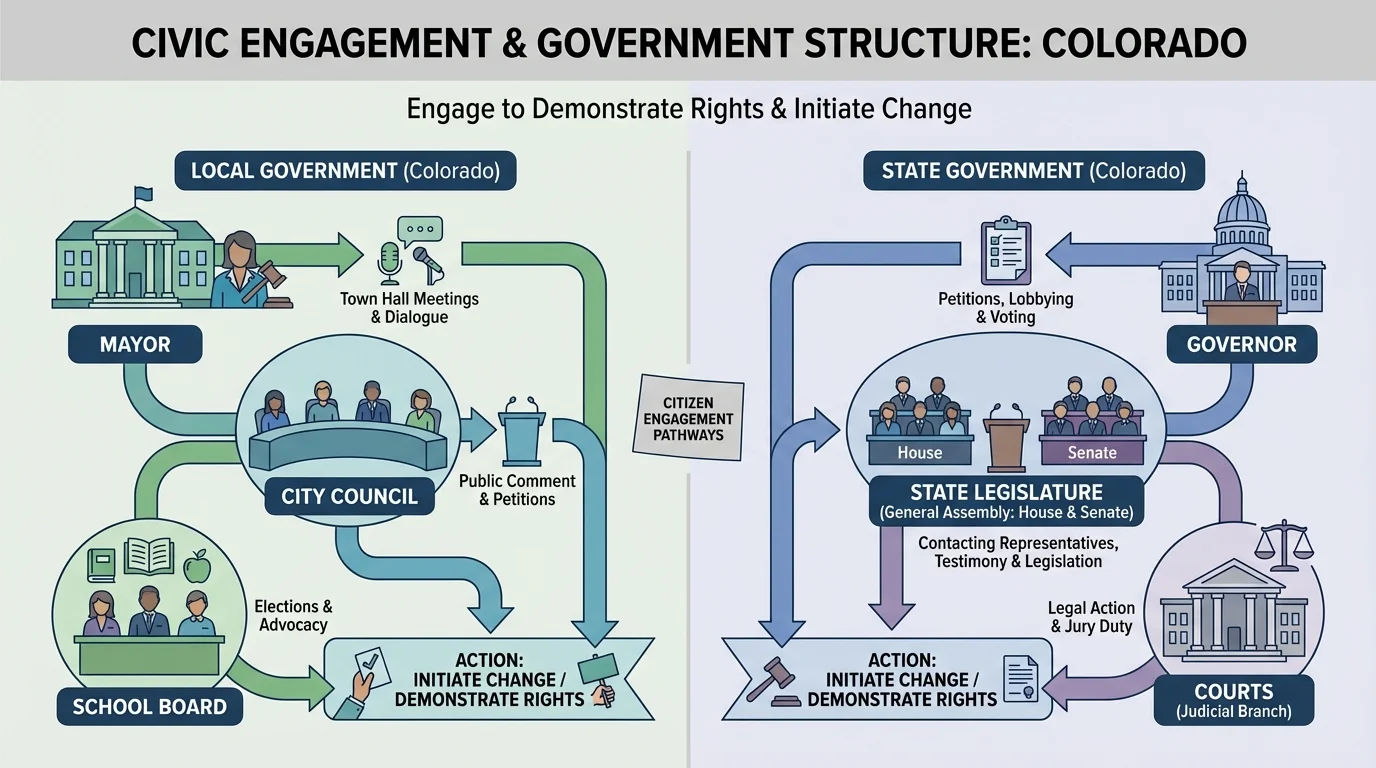
State government works on larger issues that affect the whole state of Colorado. It helps make state laws, manages highways, supports state parks, and oversees many statewide programs. Colorado's state government has three branches. The executive branch includes the governor, who helps carry out laws. The legislative branch, called the General Assembly, makes laws. The judicial branch includes courts that interpret laws.
This structure matters because citizens may need to contact different leaders depending on the problem. If a family wants a safer crosswalk near school, they might talk to local leaders. If people want a change in a law that affects all schools in Colorado, they might contact state lawmakers. Knowing which level of government handles a problem makes it easier to seek change.
| Level of government | Examples of leaders | Examples of issues |
|---|---|---|
| Local | Mayor, city council, school board, county commissioners | Parks, local roads, libraries, school concerns, neighborhood safety |
| State | Governor, state senators, state representatives, state judges | State laws, highways, state parks, statewide education and safety rules |
Table 1. This table compares local and state government leaders and the kinds of issues they handle.
Citizens can use several rights to share ideas and ask for change. One important right is petition. A petition is a request signed by many people to show support for an idea. Another important right is freedom of speech, which means people can speak and write about issues. Citizens also have the right to assemble, which means they can gather peacefully to support a cause.
People also have the right to contact government leaders. They can write a letter, send an email, call an office, or speak during a meeting. Adults may vote if they meet the legal requirements, and voting is one major way citizens choose leaders and make decisions. Even before they can vote, children can practice citizenship by learning, listening, and sharing respectful ideas.
Rights and action work together. Having a right means people are allowed to take part. Using that right means speaking up in a thoughtful way. For example, freedom of speech allows a person to say, "Our park needs more trash cans," and the right to petition allows that person to gather support from neighbors.
Using rights responsibly is important. Citizens should tell the truth, use facts when possible, and listen to others. Not everyone agrees on every issue, and that is normal in a democracy. What matters is that people take part respectfully.
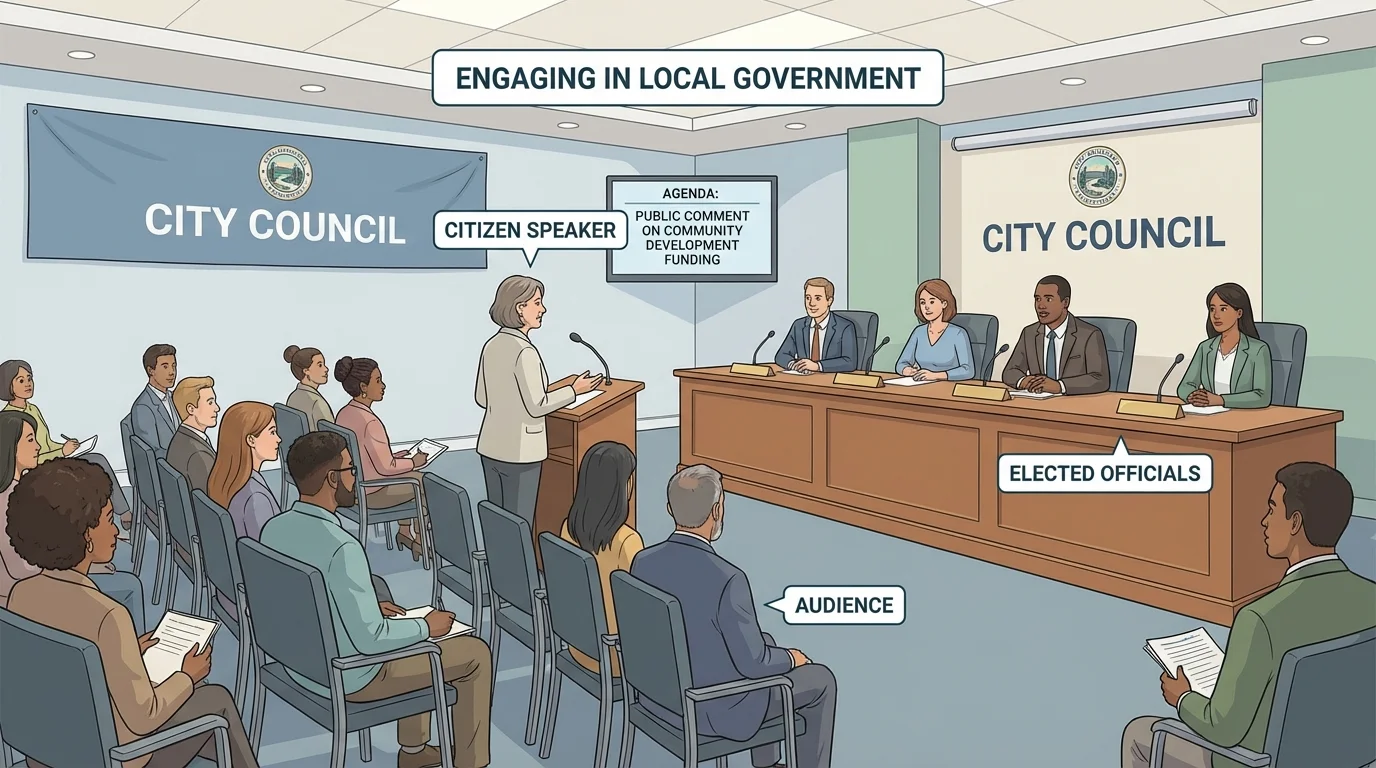
One of the clearest ways to get involved is to attend a local meeting, as [Figure 2] illustrates. City council meetings, county meetings, and school board meetings are often open to the public. Citizens can listen to what leaders discuss and learn how decisions are made.
Many meetings include public comment. This is a time when people may speak to leaders about a concern or idea. A speaker might ask for better playground equipment, more library hours, or safer traffic signs near a school. Public comment is powerful because leaders hear directly from the people affected by the decision.
Citizens can also write letters or emails to local officials. A short, clear message often works well. It should explain the problem, tell why it matters, and suggest a solution. For example, a student and parent might write, "The crosswalk near Pine Street is hard to see. Many children walk there after school. Please add brighter signs or painted lines."
Another way to engage is by joining community groups. Some towns have youth councils, neighborhood groups, clean-up teams, or advisory boards. These groups let citizens share ideas, gather information, and work together. Community action often becomes stronger when many voices join together.
Example: Improving a neighborhood park
A group of families notices that the swings at a park are broken and there is not enough shade.
Step 1: They observe the problem carefully.
They take notes about the broken equipment and visit the park at different times of day.
Step 2: They gather support.
They talk with neighbors and find out that many families have the same concern.
Step 3: They contact local leaders.
They write to the parks department and speak during a city council meeting.
Step 4: They suggest a solution.
They ask for repairs and a shade structure instead of only complaining.
This kind of action shows how local government can respond to citizens who participate.
Students can be part of this process too. They may help collect ideas, create posters with facts, or practice a short speech with an adult. Young people often notice problems that adults miss because they use playgrounds, sidewalks, buses, and schools every day.
State government may seem farther away than city hall, but citizens can still take part. Adults and families can contact state senators and state representatives. These lawmakers help create laws for Colorado. Citizens can share whether they support or oppose a bill, which is a proposed law.
A bill goes through several steps before it can become a law. Lawmakers discuss it, vote on it, and sometimes change it. Citizens can follow this process by reading news, visiting state government websites, or listening to public discussions. When people understand what a bill would do, they can speak more clearly about it.
Some citizens give testimony at hearings. A hearing is a meeting where lawmakers listen to opinions and information before making decisions. For example, if a bill would change school lunch rules or safety rules for buses, parents, teachers, and community members might speak about how the change would affect children.
Colorado's state legislature is called the General Assembly. It includes two parts: the Senate and the House of Representatives.
Citizens may also sign petitions about statewide issues, join community campaigns, or help others learn about a topic. As students grow older, they can become even more involved by volunteering in community projects, attending public events, and eventually voting.
The local and state levels are connected. A concern that starts in one town can grow into a statewide issue if many communities face the same problem. As we saw in [Figure 1], understanding which level of government handles each issue helps citizens choose where to direct their energy.
Change often follows a series of steps, and [Figure 3] maps this process from the first concern to possible action. The first step is noticing a problem clearly. A citizen might see litter piling up near a river, a dangerous intersection, or books missing from a school library.
Next, people gather facts. They might count how many times a problem happens, ask others what they have seen, or learn which government office is in charge. Facts make an argument stronger. Saying "This matters" is helpful, but saying "Many families cross here every afternoon and the paint is faded" is even clearer.
After that, citizens share the problem and propose ideas. They may talk with neighbors, teachers, local leaders, or state lawmakers. Sometimes they create a petition. Sometimes they speak at a meeting. Sometimes they write letters or ask for a meeting with an official.
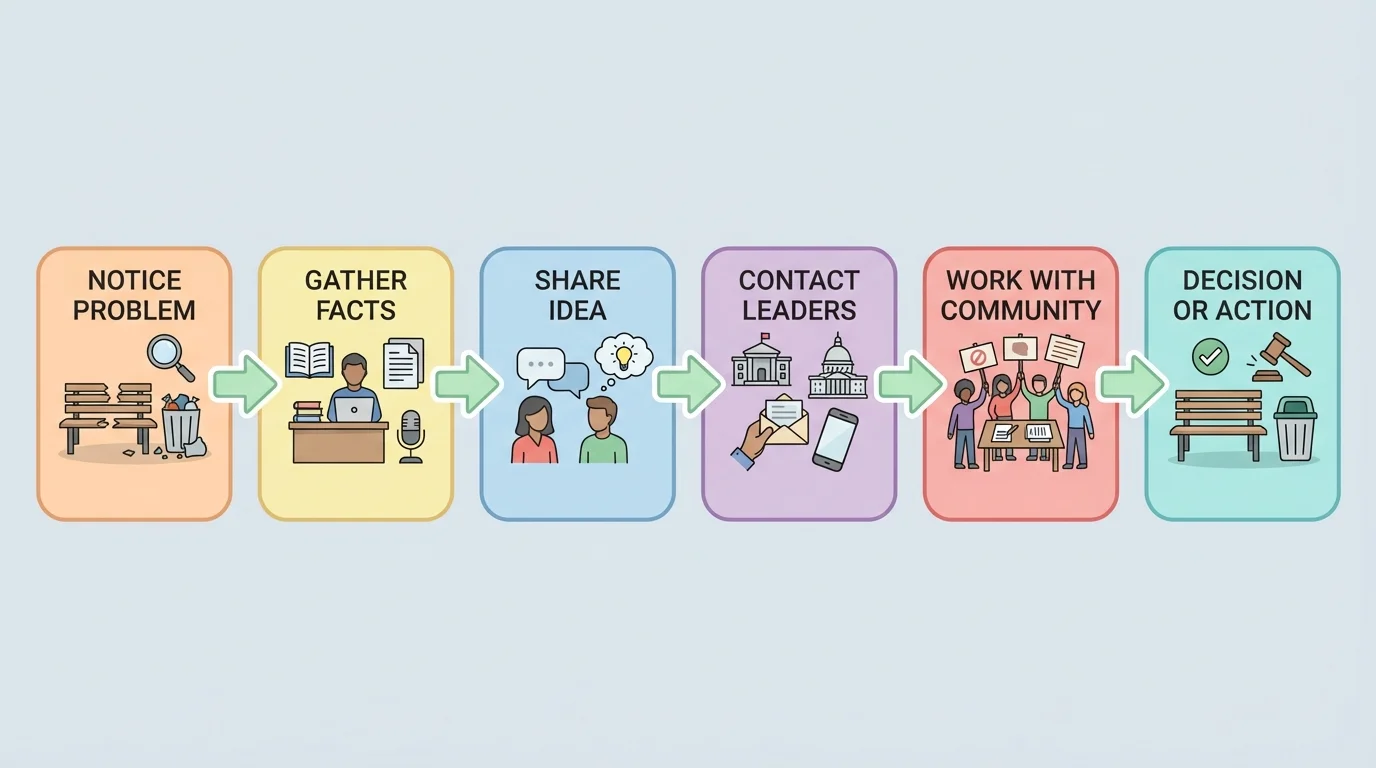
Then comes teamwork. Big changes often need many people. One person may start the idea, but a group can gather support, explain the issue, and keep following up. Leaders may ask questions, study costs, and decide what can be done now and what may take longer.
Finally, a decision is made. Sometimes change happens quickly, such as repainting a crosswalk. Sometimes it takes time, especially if a new law or extra money is needed. Citizens may need patience and persistence. Persistence means continuing to work on something even when it is not solved right away.
Change is usually a process, not a single moment. A good idea may move from a conversation, to a letter, to a meeting, to an official decision. Citizens help this process by staying informed and continuing to participate.
Later, if people want to explain this process to others, they can point back to the steps shown in [Figure 3]. The order helps citizens remember that effective action usually begins with noticing and learning before asking for a solution.
Suppose students notice that cars drive too fast near their school. They talk with teachers and families, who agree the area feels unsafe. Parents attend a local meeting and ask for speed signs or a crossing guard. If the town approves the request, this is an example of citizens using their rights to improve local safety.
In another example, families may want longer weekend hours at the library. They gather information about how many people use the library and contact the library board or city leaders. Their goal is not just to complain, but to show why the change would help the community. Leaders can make better decisions when citizens bring reasons and evidence.
A state example might involve a rule that affects many schools across Colorado. Parents and teachers might contact lawmakers and explain how the rule works in real classrooms. They may support a new bill or ask for changes in an existing law. This shows that state government can also be influenced by citizen voices.
Example: From classroom idea to community action
A fourth-grade class learns about recycling and notices that their town has very few recycling bins in parks.
Step 1: The class records what they find.
They list parks they visit and note where bins are missing.
Step 2: They build a respectful message.
They explain that more bins could reduce litter and help the environment.
Step 3: They share their idea.
With teacher and family help, they send letters to local officials.
Step 4: They stay involved.
They follow the issue and thank leaders if improvements are made.
This example shows that even young citizens can help begin change.
Not every effort succeeds right away. Some ideas cost too much money, need more planning, or affect different groups in different ways. Still, participation matters because it teaches leaders what people care about and helps communities solve problems together.
Good citizenship is not only about speaking. It is also about listening. Citizens should try to understand different opinions. One family may want more lights in a park for safety, while another may worry about harming nighttime wildlife. Leaders must balance many needs, and citizens help when they speak clearly and respectfully.
Responsible citizens also check facts before sharing information. They ask questions such as: Who is in charge of this issue? What evidence do we have? What solution are we suggesting? Careful thinking makes participation stronger.
Rules and laws are meant to help communities live and work together. Citizens are not separate from government. In a democracy, the people are part of how government works.
Respectful action includes using calm words, following meeting rules, and understanding that change can take time. It also means caring about others, not only about oneself. A strong community grows when citizens work for the common good, which means what helps everyone.
When citizens take part in local and state government, they demonstrate their rights in real life. They show that democracy is active, not silent. Whether the issue is a safer street, a better park, a school concern, or a statewide law, citizens can learn, speak, organize, and help bring about change.
