One empire ruled the colonies, but many people living there began to think of themselves as something new. That change did not happen all at once. It grew from arguments over laws, taxes, rights, trade, and power. By the time fighting began in 1775, the conflict was not just about paying money to Britain. It was about who had the right to govern the colonies and what freedom meant.
Before the American Revolution, Britain controlled Thirteen Colonies along the Atlantic coast of North America. These colonies were part of the British Empire, but they were far away from the king and Parliament in London. Because of this distance, many colonists were used to managing local affairs on their own. Colonial assemblies helped make laws, towns held meetings, and people expected a voice in government.
By the mid-1700s, the colonists were not all the same. They lived in New England, the Middle Colonies, and the Southern Colonies. Some were farmers, merchants, craftspeople, sailors, or plantation owners. Colonists belonged to different religions and came from different backgrounds. Even so, many shared the experience of living in the colonies rather than in Britain itself. Over time, this helped create a growing American identity.
Remember that Britain had fought the French and Indian War in North America before the Revolution. Britain won more land, but the war was expensive, and British leaders wanted the colonies to help pay the costs.
The French and Indian War mattered because it changed the relationship between Britain and the colonies. Before the war, Britain often allowed the colonies a great deal of freedom. After the war, British leaders tried to tighten control. That shift led to anger and mistrust.
[Figure 1] Political problems grew when Britain began passing law after law, and colonists felt their rights were being ignored. The chain of events shows how each new act increased tension between Britain and the colonies. Many colonists believed that because they had no elected representatives in Parliament, Parliament should not tax them.
This belief became the famous protest: "No taxation without representation." Colonists were not saying they never wanted to pay taxes. They were saying that taxes should not be forced on them by a government in which they had no voice.
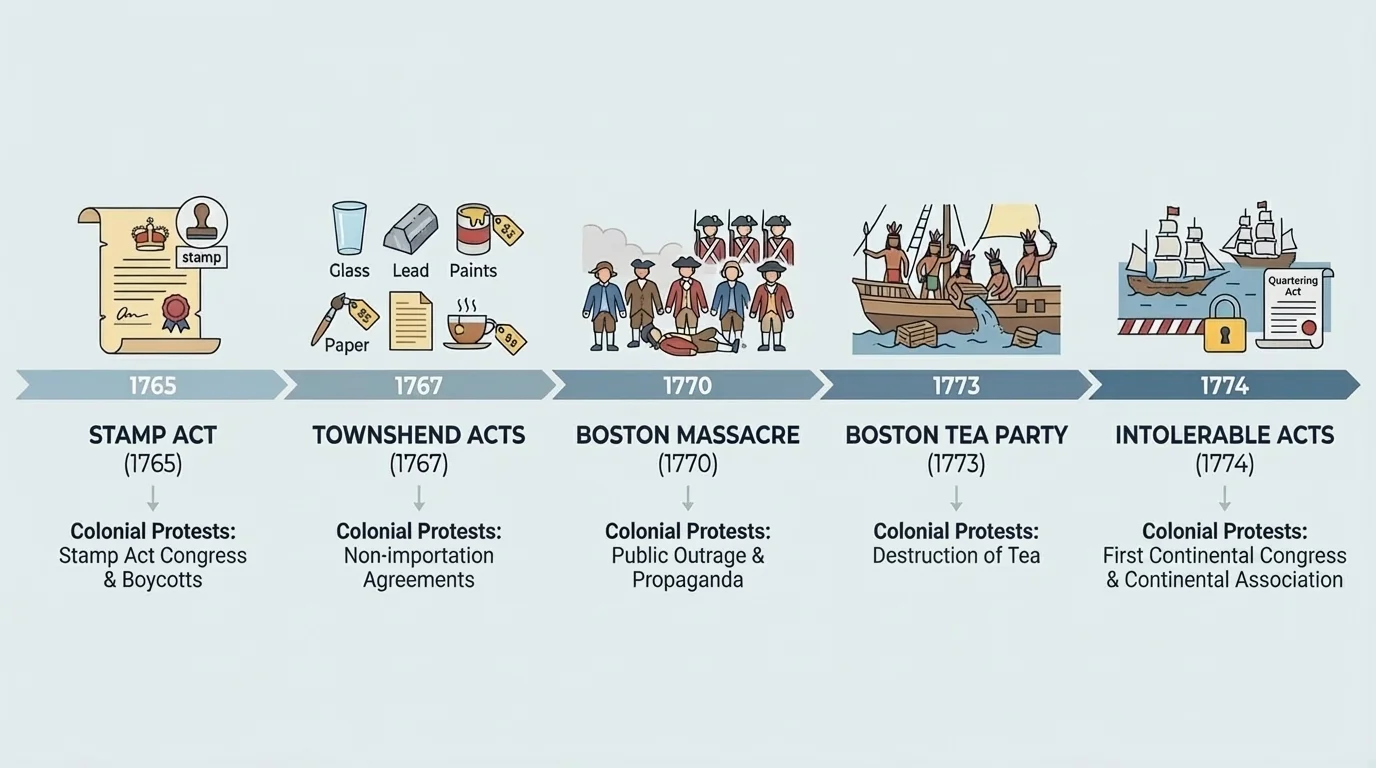
In 1765, Britain passed the Stamp Act. It required colonists to buy a stamp for printed materials such as newspapers, legal papers, and licenses. Colonists were furious. They protested, wrote angry speeches, and sometimes threatened tax collectors. The act was later repealed, but the argument over power remained.
Britain then passed the Townshend Acts, which taxed imported goods such as glass, paper, paint, lead, and tea. British soldiers were sent to Boston to keep order, but their presence increased tension instead. In 1770, a fight between soldiers and colonists ended in the Boston Massacre, when five colonists were killed. Patriots used this event in speeches, newspapers, and drawings to turn more people against British rule.
Later came the Tea Act, which gave the British East India Company special advantages in selling tea. Colonists saw this as another attempt to control them. In 1773, members of the Sons of Liberty dumped tea into Boston Harbor in protest. This became known as the Boston Tea Party.
Britain answered with the Intolerable Acts, called the Coercive Acts in Britain. These laws punished Boston and Massachusetts by closing the harbor and limiting self-government. Instead of frightening the colonies into obedience, they pushed many colonists closer together. Looking back at [Figure 1], we can see how protests and punishments built step by step into open crisis.
Representation means having someone speak and make decisions for you in government. Parliament was Britain's lawmaking body. Many colonists argued that Parliament had no right to tax them because they did not elect members to it.
To respond, colonial leaders met at the First Continental Congress in 1774. This was important because colonies that often acted separately now began working together. They sent petitions, declared their rights, and agreed to boycott British goods.
Revolutions are not only fought with weapons. They are also built from ideas. During the years before the war, colonists discussed rights, freedom, and government more than ever before. Writers of the Enlightenment, such as John Locke, argued that people had natural rights, including life, liberty, and property. They also argued that government exists to protect those rights.
If a government fails to protect rights, Locke said, the people can change or replace it. These ideas were powerful in the colonies. They helped many colonists believe that resisting Britain was not just allowed but necessary.
How ideas spread
In the colonies, people shared revolutionary ideas through newspapers, pamphlets, speeches, sermons, and conversations in taverns and town meetings. News traveled more slowly than it does today, but ideas still spread quickly enough to unite people across the colonies.
Groups such as the Sons of Liberty organized protests. Committees of Correspondence sent letters and messages from colony to colony, helping people learn what Britain was doing and how other colonists were responding. This communication built unity.
Women played important roles too. They organized boycotts, made homespun cloth instead of buying British cloth, managed farms and businesses, and supported soldiers. Some women, such as Abigail Adams, also spoke strongly about liberty and government.
Not everyone experienced the Revolution in the same way. Free African Americans sometimes joined the Patriot cause, hoping liberty would expand. Enslaved Africans heard the language of freedom too, but many remained enslaved. Some were promised freedom if they fought for the British. Native American nations faced hard choices as well. Many believed that a British victory might better protect their lands from colonial settlers, so some sided with Britain.
Some girls and women helped the Patriot cause by refusing to buy British tea and cloth. Their choices at home mattered because boycotts worked only if families changed what they bought and used.
These social changes mattered because they showed that the Revolution was about more than battles. It was also about who belonged, who had rights, and who had power in society.
Economic causes were a major part of the conflict. Britain followed a system called mercantilism. Under this system, colonies existed mainly to help the mother country grow rich and powerful. The colonies supplied raw materials, and Britain sold finished goods back to them.
Britain also used trade laws called the Navigation Acts to control colonial trade. Colonists could not always sell goods where they wanted or buy from the cheapest sellers. Some merchants smuggled goods to avoid these rules.
Taxes affected ordinary life. Paper, tea, and imported goods cost more. Merchants lost money when trade was interrupted. Dockworkers, sailors, and craftspeople could suffer when ports were closed or boycotts changed trade patterns. Economic arguments were not just about big ideas. They touched jobs, prices, and family budgets.
| British Policy | What It Did | Colonial Reaction |
|---|---|---|
| Stamp Act | Taxed printed materials | Protests and petitions |
| Townshend Acts | Taxed imported goods | Boycotts and unrest |
| Tea Act | Favored British tea sales | Boston Tea Party |
| Intolerable Acts | Punished Massachusetts | Colonies united more closely |
Table 1. Major British policies and common colonial reactions before the Revolution.
Boycotts became a powerful tool. When colonists refused to buy British goods, they used economic pressure instead of weapons. In a way, they were saying that money and trade could be used in political struggles. That idea still matters today when people use sanctions, strikes, or organized consumer choices to demand change.
Case study: Why a boycott mattered
A shopkeeper in Boston sells imported British cloth. If many families stop buying that cloth and choose homespun cloth instead, the shopkeeper orders less from Britain. British merchants then lose sales and may pressure Parliament to change the law.
Step 1: Colonists disagree with a British law.
Step 2: They stop buying British goods.
Step 3: British merchants lose money.
Step 4: Economic pressure adds to political pressure.
This shows how economics and politics were closely connected.
Economic tension helped turn disagreement into resistance. It also drew more people into the conflict because nearly everyone buys, sells, works, or pays for something.
[Figure 2] As anger grew, peaceful protest slowly turned into armed conflict. Key places in the Northeast became centers of protest, planning, and finally fighting. Boston was especially important because it was a busy port city and a place where tension with British troops ran high.
After the Intolerable Acts, the colonies met again. The Second Continental Congress began meeting in 1775 after fighting had already started. By then, many leaders were still hoping for peace, but events moved quickly.
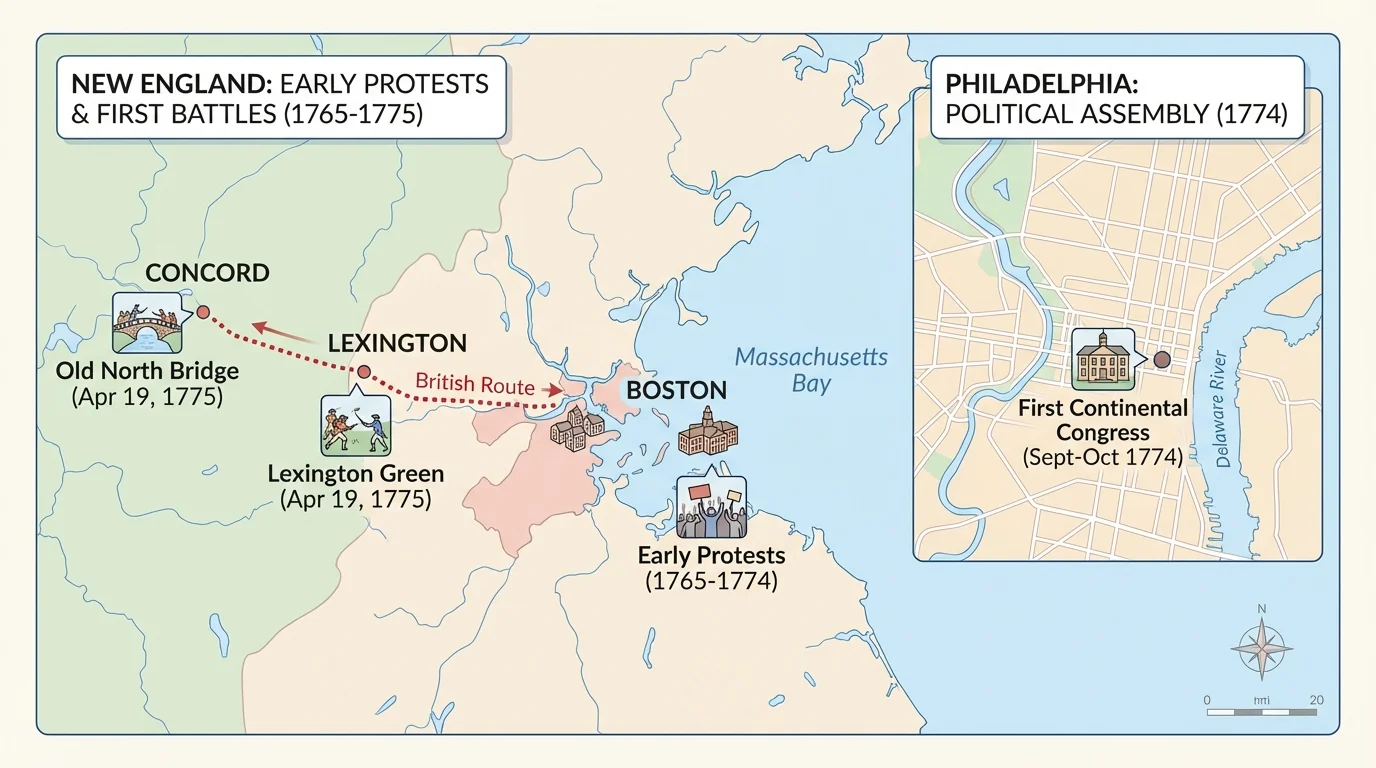
The first battles took place at Lexington and Concord in Massachusetts in April 1775. British troops marched to seize colonial weapons. Colonial militia met them, and shots were fired. No one knows for certain who fired first. These opening shots became known as the "shot heard round the world" because they began a revolution whose ideas would influence many other places.
Another early battle was Bunker Hill in June 1775. The British won the battlefield, but they suffered heavy losses. This showed that colonial forces could stand up to trained British soldiers.
"These are the times that try men's souls."
— Thomas Paine
The colonies then created the Continental Army and chose George Washington as its commander. This was a huge step. It meant the colonies were no longer just protesting. They were organizing for war.
At first, not all colonists wanted complete independence. Some hoped the king would listen and solve the conflict. But support for independence grew. One reason was the pamphlet Common Sense by Thomas Paine, published in 1776. Paine wrote in clear language that ordinary people could understand. He argued that it made no sense for a small island to rule a distant continent.
On July 4, 1776, the Declaration of Independence was adopted. Written mainly by Thomas Jefferson, it stated that the colonies were now free and independent states. It also explained why. The document said that all people are created equal and have rights that government must protect.
Why the Declaration mattered
The Declaration of Independence did more than announce a break from Britain. It gave reasons for the break, listed complaints against King George III, and stated big ideas about rights and government that would shape the United States for years to come.
The Declaration was a political document, but it also had social power. Its words about equality and rights inspired many people, even though those ideals were not fully applied to everyone at the time. Enslaved people, women, and others would later use its ideas to demand greater justice.
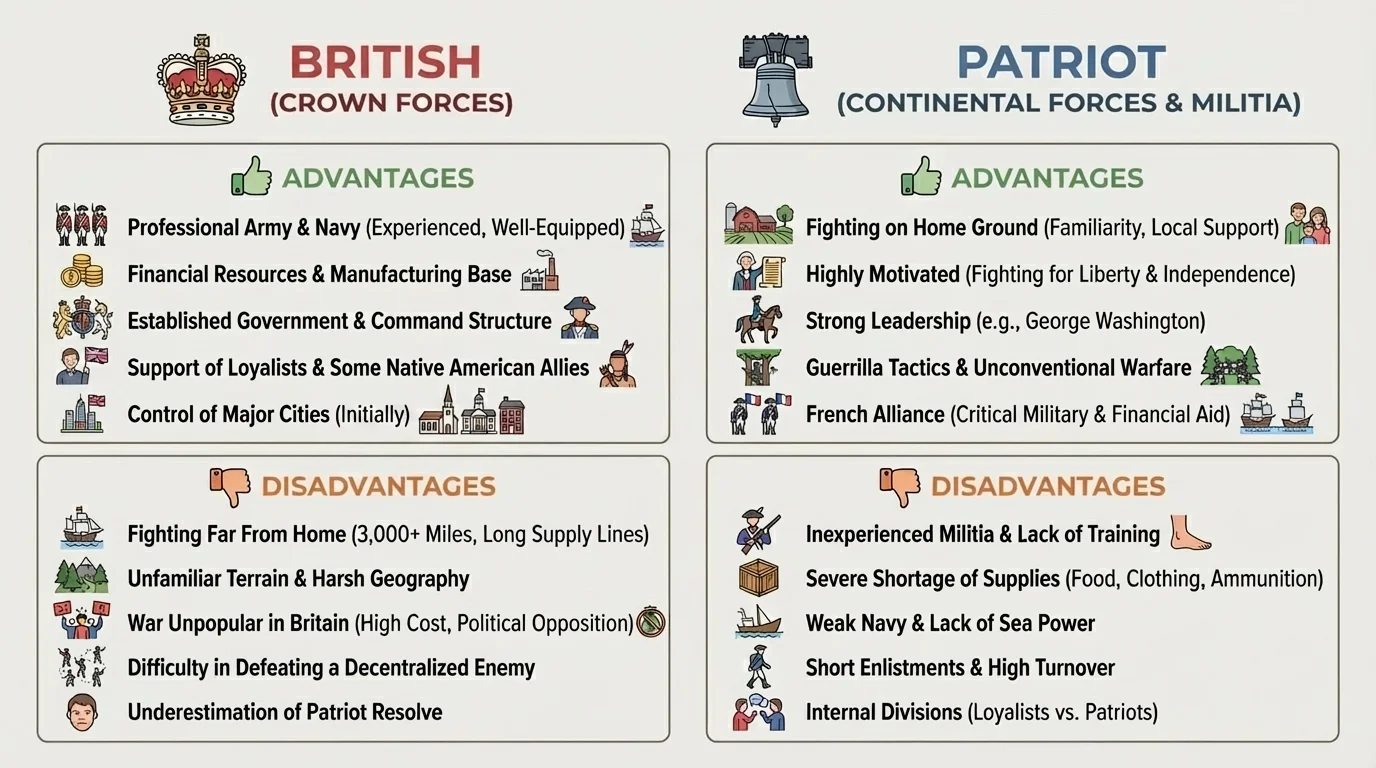
Winning independence was far from certain. Each side had important strengths and weaknesses, as [Figure 3] and [Figure 4] show. Britain had a strong army, a powerful navy, and more money. The colonies had fewer trained soldiers and fewer supplies, but they fought on familiar land and were deeply motivated.
The Patriots also had strong leadership in George Washington. He was not perfect, but he kept the army together during very hard times. This mattered because an army that falls apart cannot win, even if its cause is popular.
Early in the war, Washington faced many defeats and retreats. However, he kept the army alive. One bold success came at Trenton in late 1776, when Washington crossed the icy Delaware River and surprised Hessian soldiers allied with Britain. This victory raised Patriot morale.
A major turning point came at Saratoga in 1777. American forces defeated a British army there. This victory convinced France that the Patriots had a real chance to win. France then became an ally, sending money, troops, ships, and supplies.
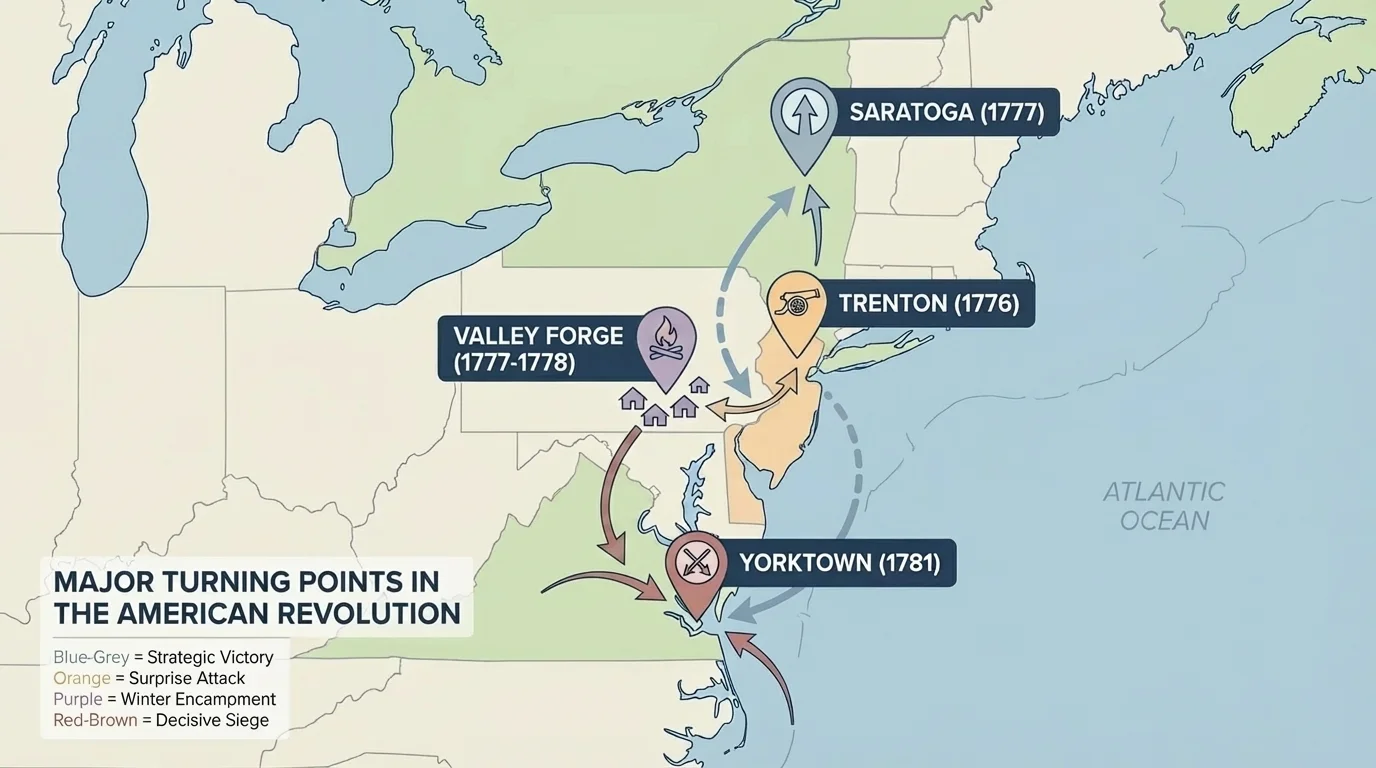
The French alliance changed the war. The conflict was now larger than a struggle between Britain and its colonies. It became part of a wider international war. We can trace how major turning points shifted the war over time.
During the winter at Valley Forge in 1777–1778, Washington's soldiers suffered terribly from cold, hunger, and disease. Yet the army survived. Baron von Steuben, a Prussian military officer, helped train the soldiers to fight more effectively. So Valley Forge became a place of hardship but also improvement.
Later, the fighting moved south. The British hoped to gain support from Loyalists there, but the war remained difficult. The final major victory came at Yorktown in 1781. American and French forces trapped British General Cornwallis's army. French ships blocked escape by sea. Cornwallis surrendered, and although some fighting continued, the war was effectively won.
Military victory depended on more than battlefield skill. It also depended on supplies, alliances, leadership, and endurance. The Patriots did not need to conquer Britain. They needed to survive long enough and fight well enough that Britain would give up trying to control them. The locations in [Figure 4] show how survival, foreign help, and key victories worked together.
Not all colonists were Patriots. Loyalists remained loyal to Britain. Some believed Britain would win. Others feared disorder or felt stronger ties to the king. Many people tried to stay neutral and avoid choosing sides.
African Americans made difficult choices too. Some joined the Patriots. Others joined the British after promises of freedom. Thousands of enslaved people sought escape during the war, but freedom was never guaranteed. The Revolution opened some doors while leaving many people oppressed.
Women kept farms, homes, and businesses running while men fought. Some followed armies as cooks, washers, or nurses. A few even disguised themselves as men to fight. Mercy Otis Warren wrote political plays and essays supporting the Patriot cause.
Native American nations also faced danger. Many tried to protect their homelands by choosing the side they believed would best limit settler expansion. For many Native peoples, the American victory later led to even greater pressure on their lands.
Case study: One war, different experiences
A Patriot soldier might see the Revolution as a fight for liberty. A Loyalist merchant might see it as a dangerous rebellion. An enslaved man might see both sides talking about freedom while he still lacks it. A Native nation might see the war as a threat to its land no matter who wins.
This is why historians study many viewpoints, not just one.
Understanding these different experiences helps us see that the Revolution was not simple. It created opportunity for some people and hardship for others.
The war officially ended with the Treaty of Paris in 1783. Britain recognized the independence of the United States. The new nation gained land east of the Mississippi River, and Americans could begin building their own government.
The Revolution changed politics by replacing rule by a king with republican government based on elected representatives. It encouraged ideas about liberty and rights, though the new nation still had many unfair systems, including slavery. It changed society by increasing discussion about who should have a voice in government. It changed the economy by ending British control of colonial trade. It changed military history by proving that a determined colonial army, helped by allies, could defeat a powerful empire.
Primary sources help us learn about this era. These include the Declaration of Independence, letters by Abigail Adams, Thomas Paine's Common Sense, newspaper articles, and soldiers' diaries. Secondary sources, such as history books and documentaries, help explain and interpret those original materials. Historians use both kinds of sources to understand the Revolution clearly.
