People have crossed icy seas, climbed mountain passes, sailed across oceans, and walked long trails for thousands of years. Some moved to find food or land. Some searched for trade and wealth. Some were forced to leave because of war, danger, or disaster. When geographers study these journeys, they look for the reasons people moved, the routes they took, and the effects those movements had on the world.
Movement is a major part of human history. A group might travel to a new place because the climate changes, because jobs are available somewhere else, or because leaders want to claim land. A sailor might cross an ocean to find a shorter trade route. A family might move to be safer. A community might leave after a drought. These different reasons are called variables, or factors that can change what happens.
In geography, the word variable means a condition or factor that can affect an event. Variables help explain why one group stayed in place while another moved far away. They also help explain why some journeys succeeded and others failed.
Discovery is learning about a place, route, or resource that was not previously known to the people or group making the discovery.
Exploration is traveling to learn more about places, peoples, or routes.
Migration is the movement of people from one place to another, either for a short time or permanently.
These words are related, but they are not exactly the same. Discovery often focuses on finding or learning something new to a particular group of people. Exploration focuses on traveling and investigating. Migration focuses on people relocating. Sometimes one event includes all three. For example, European ocean voyages in the late 1400s and 1500s involved exploration, and they led to migration later.
When geographers and historians study movement, they ask careful questions. Who moved? Why did they move? What natural features helped or blocked them? What tools did they have? Who already lived in the places they reached? These questions help students see that major events do not happen for only one reason.
A journey across a continent or ocean depends on many variables at once. Weather matters. Distance matters. Knowledge matters. So do beliefs, goals, and technology. If even one variable changes, the result can change too. A river may help people travel quickly. The same river may also flood and destroy settlements.
Geography is not only about where places are. It is also about how people interact with places. Human movement is shaped by both the natural environment and human choices.
[Figure 1] Geography strongly affects movement through the way people follow coasts, rivers, and open land while avoiding difficult barriers. Mountains, deserts, forests, rivers, and oceans can either help people travel or make travel much harder. Long ago, before airplanes and highways, natural features mattered even more.
Landforms are one important variable. High mountain ranges can block travel and force people into narrow passes. Deserts can be dangerous because of heat and lack of water. Plains are often easier to cross. Valleys may provide safer routes and better farmland.
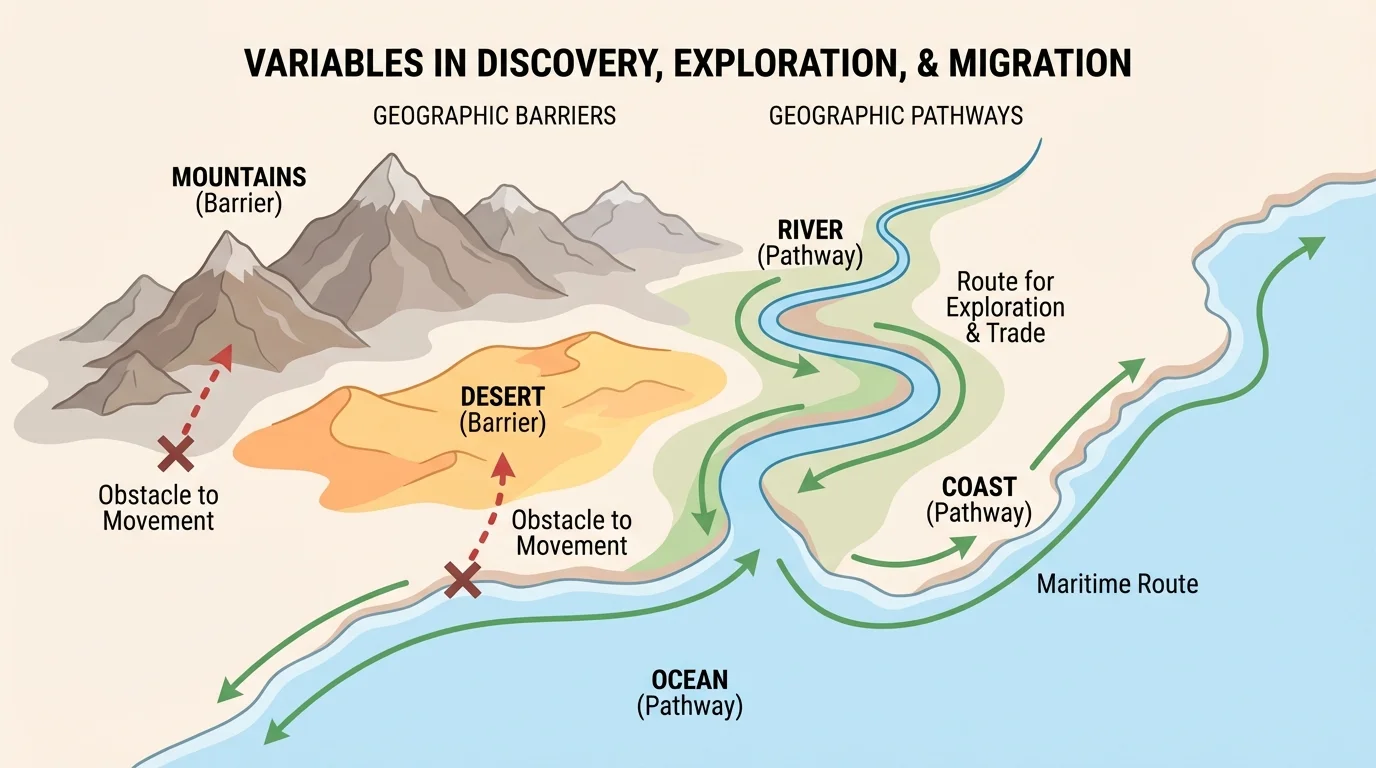
Water is another major variable. Rivers can act like natural highways. The Nile River helped people in northeastern Africa travel, farm, and trade. Coastlines gave sailors guides to follow. Oceans separated continents, but they also connected them once people built ships strong enough for long voyages.
Climate also affects movement. Very cold regions, dry regions, and stormy seas make travel more difficult. Good weather seasons can open routes. Harsh winters can close them. A drought can push people away from their homes, while a mild climate can attract settlement.
Natural resources matter too. People often move toward places with fertile soil, forests, fish, metals, or fresh water. Gold rushes are one example. When gold was discovered in California in 1848, many people traveled there because they hoped to become rich.
Distance is also a variable. A nearby move is usually easier than a move across an ocean. The farther people travel, the more supplies, planning, and skill they need. As we saw in [Figure 1], routes are rarely straight lines. People often bend their paths to follow water or avoid difficult terrain.
Not all variables are natural. Human decisions matter just as much. Leaders, governments, traders, inventors, and families all shape movement. Human goals can encourage exploration and migration even when geography is challenging.
Technology is one key human variable. Better ships, stronger wagons, maps, compasses, and later railroads made travel easier and faster. The compass helped sailors keep direction. Improved ship design allowed longer ocean journeys. On land, roads and bridges opened routes that had once been difficult.
Trade routes are another important variable. People often explored because they wanted faster or safer ways to trade for spices, silk, gold, or other valuable goods. If a land route became dangerous or expensive, rulers and merchants searched for new paths.
Conflict can force movement. Wars, invasions, and persecution can cause migration when people leave to stay alive. At the same time, conflict can also inspire exploration if rulers want to expand power, control territory, or compete with rival nations.
Culture and religion matter too. People may travel to spread beliefs, join family members, or find communities where they feel accepted. Language and traditions can move with people, changing both the migrants and the places they settle.
Human and physical factors work together. A mountain pass may exist in nature, but whether people use it depends on their needs, tools, and knowledge. A sea may seem like a barrier until improved ships turn it into a pathway. Geography sets conditions, and people respond to those conditions in different ways.
Exploration often begins with curiosity, but curiosity is not the only cause. People may explore to find trade routes, claim land, gather resources, spread beliefs, or gain fame. In many cases, rulers paid for voyages because they hoped for wealth or power.
European exploration in the late 1400s is a well-known example. Merchants and monarchs wanted direct sea routes to Asia for trade. Spices, silk, and other goods were valuable. This goal pushed explorers such as Christopher Columbus and Vasco da Gama to sail farther than many earlier Europeans had gone.
Discovery can also come from everyday survival. Long before famous ocean voyages, people discovered new fishing grounds, river crossings, and mountain passes because they needed food, safety, or better land. Many Indigenous peoples developed deep geographic knowledge of their regions through travel, observation, and experience.
Competition is another variable. If one kingdom gains land or wealth, a rival kingdom may try to do the same. This competition can speed up exploration. However, it can also lead to conquest and unfair treatment of people already living in those places.
Polynesian navigators traveled across huge areas of the Pacific Ocean long before modern instruments. They used stars, winds, waves, and bird behavior to guide their voyages.
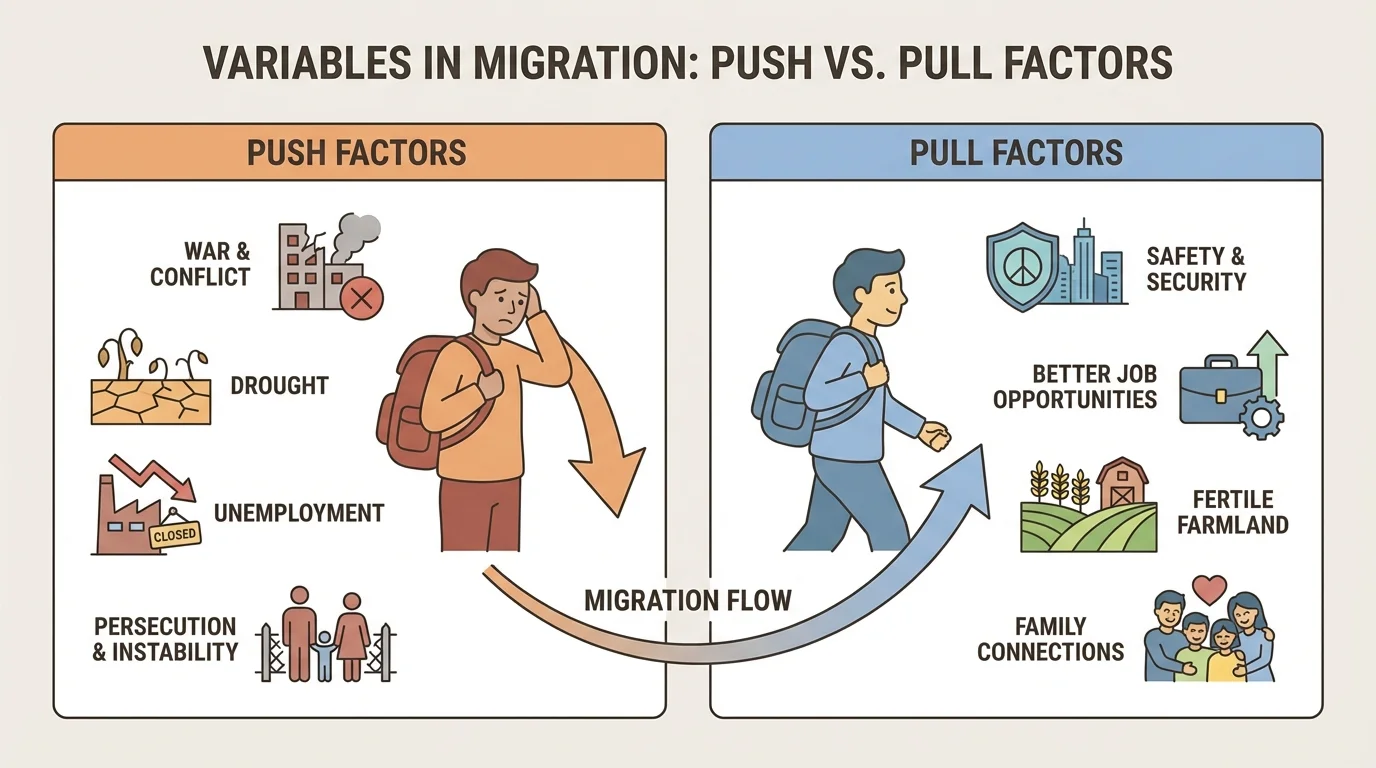
[Figure 2] Push factors and pull factors help explain migration. A push factor is something that drives people away from a place. A pull factor is something that attracts people to a new place. Most migrations include more than one of each.
Common push factors include war, lack of jobs, crop failure, persecution, natural disasters, and shortage of land. If a family cannot grow enough food because of drought, that drought may push them to move. If a town becomes unsafe because of fighting, danger becomes a powerful push factor.
Common pull factors include safety, work, better farmland, education, freedom, and the chance to join relatives. A place with rich soil and open land may attract farmers. A growing city may attract workers. A safer country may attract refugees fleeing conflict.
Some migrations are voluntary, meaning people choose to move. Others are forced. Enslaved Africans taken across the Atlantic did not choose migration; they were forced by a terrible system of slavery. This reminds us that movement can be hopeful for some people and deeply painful for others.
Family ties can also matter. Once some people settle in a new area, they may send letters or messages encouraging others to come. This can lead to chain migration. One move can lead to many more, changing cities, regions, and countries over time.
| Type of Variable | Examples | How It Affects Movement |
|---|---|---|
| Physical | Mountains, rivers, climate, resources | Can block, guide, or attract movement |
| Human | Technology, trade, conflict, laws | Can encourage, organize, or force movement |
| Social | Family, language, religion, community | Can pull people toward familiar or supportive places |
| Economic | Jobs, land, trade goods, wealth | Can create strong reasons to leave or settle |
Table 1. Major categories of variables that influence discovery, exploration, and migration.
When people move, the results can be large and long-lasting. New trade networks may form. New towns and cities may grow. Languages, foods, and ideas may spread. At the same time, conflict may increase when newcomers compete for land or power.
One consequence is cultural diffusion, which means the spread of ideas, customs, and technologies from one group to another. Foods such as potatoes, corn, and tomatoes spread across continents after contact between the Americas and Europe. Religions, music, and styles of clothing can spread in similar ways.
Another consequence is environmental change. As people settle new areas, they cut forests, build roads, plant crops, and use water differently. These actions can improve life for settlers, but they can also harm ecosystems. Movement changes both human systems and natural systems.
Movement can also bring injustice. Indigenous peoples in many regions lost land, freedom, and lives when outsiders arrived. Disease spread by newcomers caused terrible loss in some communities. So, the consequences of exploration and migration include both exchange and hardship.
Governments often change because of movement too. Borders may shift. New laws may be written. Leaders may encourage settlement in a region to increase control. This shows that geography and politics are closely connected.
[Figure 3] Historians compare journeys from different time periods, and a timeline helps us place several well-known examples in order. This lets us see that movement has occurred in many different centuries. Looking at case studies helps us identify which variables repeat and which are unique.
The Vikings explored across the North Atlantic from the late 700s through the 1000s. They used strong ships and knowledge of the sea. Important variables included ship technology, coastal geography, and the search for trade, land, and resources.
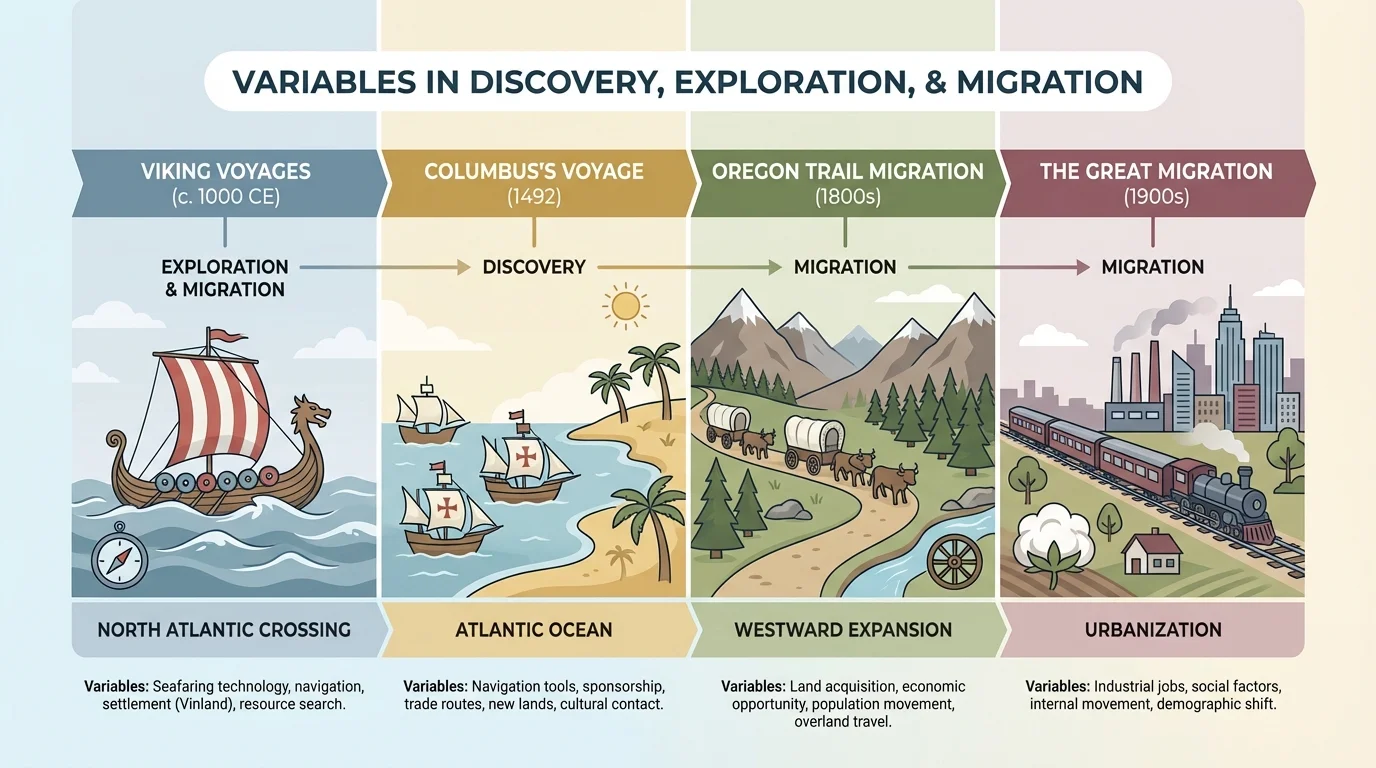
Christopher Columbus sailed west across the Atlantic in 1492 while seeking a route to Asia. Variables included competition between kingdoms, desire for trade, ocean navigation technology, and support from Spanish rulers. His voyage led to lasting contact between Europe and the Americas, with major consequences for Indigenous peoples.
The Oregon Trail in the 1800s drew many settlers west in North America. Pull factors included farmland and opportunity. Geographic variables included rivers, plains, mountains, and weather. Human variables included wagons, guides, trails, and government policies.
The Great Migration was the movement of many African Americans from the rural South to northern and western cities in the United States during the 1900s. Push factors included racism, unfair laws, and limited opportunity. Pull factors included factory jobs and hopes for greater freedom.
Modern refugee movements often happen because of war or environmental disaster. People may leave their homes quickly with few belongings. Here, conflict, safety, international borders, and access to transportation become especially important variables. As shown earlier in [Figure 2], push and pull factors still help explain these modern movements.
Geographers use maps to track routes and barriers. A map can show where mountains slowed travel, where rivers guided settlement, or where ports connected distant lands. Historians use timelines to place journeys in order and compare causes across time.
Maps can answer questions such as: Why did settlers follow rivers? Why did explorers stop at certain ports? Why did some migrations head toward cities while others moved toward farmland? A map helps students connect physical features to human choices.
Timelines answer different questions. Did one event lead to another? Did new technology appear before a burst of exploration? Did conflict increase before a migration wave? Looking back at [Figure 3], we can compare early sea exploration, westward settlement, and city migration across very different time periods.
Case study: Why would a family move?
A farming family lives in an area with little rain. Their crops have failed, but they hear about a region with better soil and more jobs.
Step 1: Identify the push factor.
The drought and crop failure push the family away from their current home.
Step 2: Identify the pull factors.
Better soil, jobs, and a safer future pull the family toward the new region.
Step 3: Add other variables.
If mountains block the route, the trip becomes harder. If there is a railroad, the move becomes easier. Geography and human systems both matter.
This example shows that migration usually has multiple causes, not just one.
The most important idea is that discovery, exploration, and migration are shaped by many connected variables. A river alone does not cause migration. A government order alone does not explain exploration. A drought alone does not tell the full story. To understand movement, students must look at the whole picture.
For example, a group might move because farmland is poor, because conflict makes life unsafe, and because a nearby region offers jobs. Their route may follow a river, avoid a mountain range, and end in a city linked by roads. Each variable adds part of the explanation.
Learning to identify variables helps us become better geographers. It allows us to explain not only what happened, but also why it happened and what changed afterward. Human movement is one of the clearest ways to see the connection between people and places.
"People shape places, and places shape people."
— Geographic principle
When we study past and present movement, we also build understanding of the world today. Cities, languages, trade patterns, and cultural traditions all carry traces of journeys made long ago. Every route on a map tells a story of choices, needs, obstacles, and hope.
