What if you had a busy store, a ship full of goods, and many customers, but very few coins to pay with?
In early America, the colonies were growing quickly, and people were buying, selling, farming, fishing, and trading across the Atlantic Ocean. But even as business increased, colonists often struggled to find enough reliable money. Those problems pushed them to develop better ways to handle trade, savings, and loans. Over time, that need helped lead to the creation of commercial banks.
Early America was shaped by trade. Colonists sold crops, fish, lumber, furs, and handmade goods. They bought tools, cloth, tea, and other products from Britain and other places. Trade connected farms, towns, ports, and distant countries. But trade also brought challenges. If people could not easily pay, borrow, or store money safely, business slowed down. To understand why banks became important, we first need to understand how hard colonial trade could be.
The colonies did not all make the same things. New England colonies were known for fishing, shipbuilding, and trade. The Middle Colonies grew grain and became known as the "breadbasket" colonies. Southern colonies raised cash crops such as tobacco, rice, and indigo. A cash crop is a crop grown mainly to sell for money rather than just to eat at home.
As trade expanded, colonial ports such as Boston, New York, Philadelphia, and Charleston became busy centers of business. Merchants shipped goods from one colony to another and across the ocean. Farmers sold to local buyers. Craftspeople made barrels, shoes, candles, furniture, and tools. This growing economy needed ways to transfer money and make payments, sometimes across great distances.
Trade is the buying, selling, or exchanging of goods and services. Commercial banks are businesses that keep people's money safe, accept deposits, and make loans to help trade and business grow.
Even though the economy was growing, it did not have a smooth system for handling money. A town could be full of products and hard workers, yet still suffer because there were not enough coins or trusted payment methods. That mismatch between a strong trading economy and a weak money system became one of the biggest colonial challenges.
One major problem was a shortage of specie. [Figure 1] shows a busy colonial market where many goods are traded even though only a few coins are available. Specie means real metal money, especially gold and silver coins. Colonists wanted coins because coins were widely trusted. If a person held a silver coin, they knew it had value because of the metal itself.
But coins were often scarce in the colonies. Many coins that came in were used to pay for imported goods from Britain, so they flowed back out again. The colonies often bought more from Britain than they sold to Britain. That meant money left the colonies faster than it came in. People might have plenty of wheat, tobacco, or fish, but very little coin in their pockets.
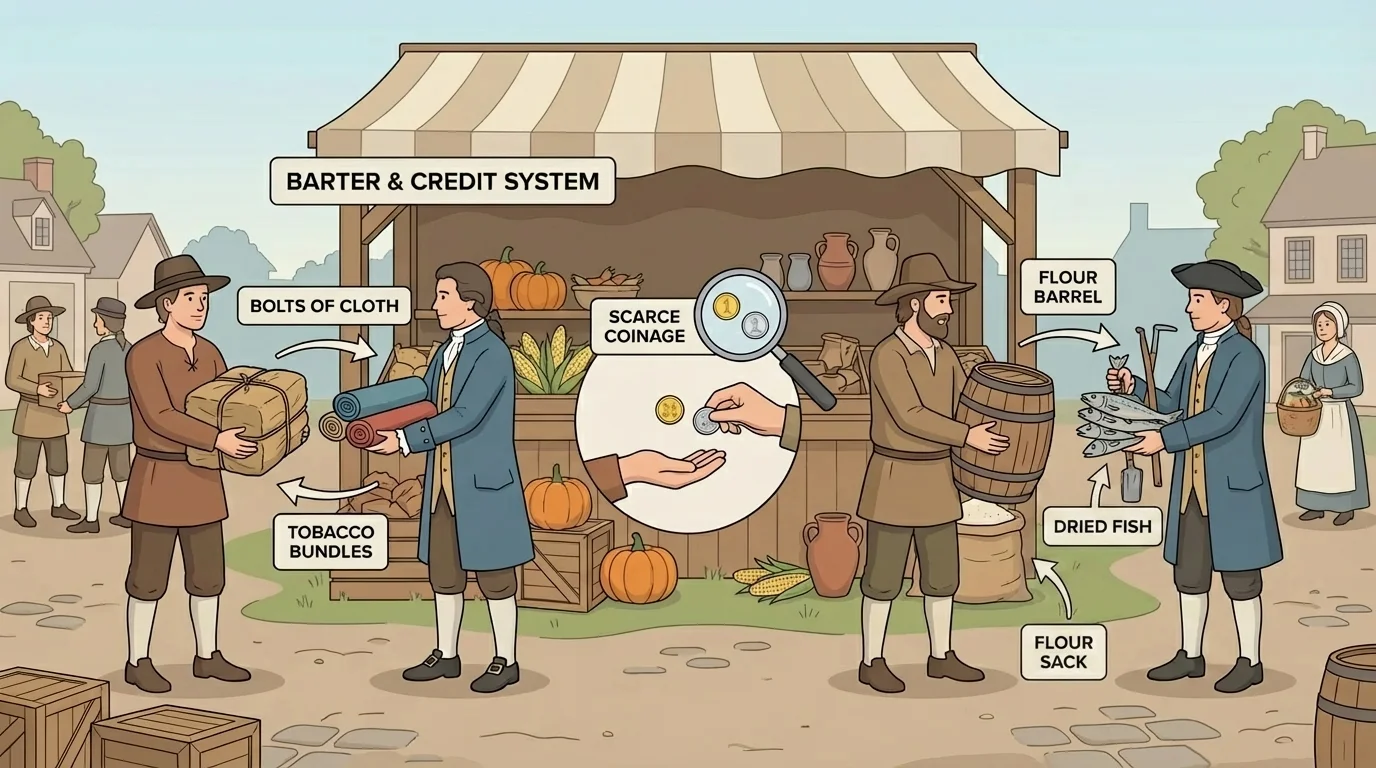
This shortage made everyday business difficult. If a farmer wanted to buy nails or cloth, but had no coins, the farmer needed another way to pay. If a merchant wanted to buy a large shipment of goods, finding enough metal money could be hard. A growing economy needs a dependable money supply, and colonial America often did not have one.
When money is scarce, people can still trade, but trade becomes slower and more complicated. Think of it like a school where everyone wants to trade lunches but no one has a simple set of tokens to make fair exchanges. People must bargain more, argue more, and wait longer. That happened in colonial markets too.
Some historians describe colonial America as a place with plenty of wealth in land and goods, but not enough ready cash. People might own farms, tools, or ships and still struggle to make simple payments.
Later, when banks became more common, they helped solve part of this problem by gathering money in one place and lending it back into the economy where it was needed most.
Because coin was scarce, colonists used many different forms of payment. [Figure 2] illustrates why this could be confusing. In some places people used barter, which means trading goods directly for other goods. A person might trade corn for shoes or firewood for cloth. In other places, certain useful products acted like money.
Tobacco became a kind of commodity money in some colonies, especially in the South. Commodity money is an item that has its own value and is also used for exchange. Colonists also used foreign coins, especially Spanish silver dollars, because those coins were common in Atlantic trade. At times, colonial governments printed paper notes as well.
Having many kinds of money sounds helpful, but it often caused trouble. Different items were worth different amounts in different places. Tobacco might be accepted in one colony more easily than in another. Paper notes might lose value if too many were printed. Foreign coins came in different sizes and values. People had to spend a lot of time deciding what was fair.
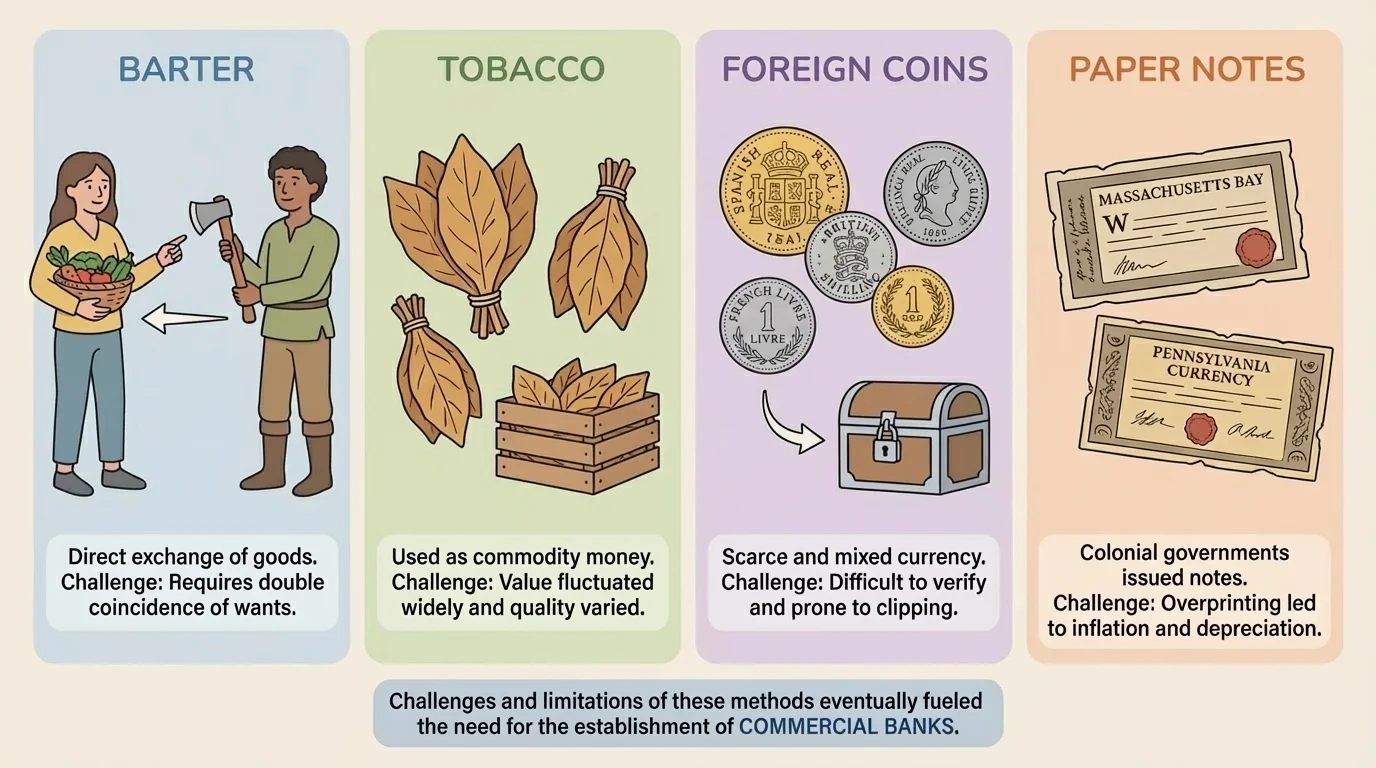
This confusion made trade harder across the colonies. A merchant in Boston and a planter in Virginia might not use the same money system. That problem mattered because colonial trade was becoming more connected. As markets linked together, people needed payment methods that were easier to trust and understand.
We can still see this problem in modern life by thinking about gift cards from different stores. A card from one store may not work at another store. Now imagine if almost everyone used different cards, coupons, goods, or coins. Buying and selling would become messy fast. Colonial trade often felt that way.
| Form of payment | How it worked | Main problem |
|---|---|---|
| Barter | Goods traded directly for goods | Both people had to want what the other offered |
| Commodity money | Useful goods such as tobacco used as payment | Quality and value could vary |
| Foreign coins | Coins from other countries used in trade | Different values caused confusion |
| Paper notes | Printed promises to pay | Could lose value if people stopped trusting them |
Table 1. Different forms of payment used in colonial America and the problems each one created.
Because money was often scarce, many colonists relied on credit. Credit means getting goods, services, or money now and promising to pay later. Shopkeepers allowed customers to buy on credit. Farmers borrowed seeds, tools, or supplies and paid after harvest. Merchants ordered goods and promised future payment after sales were made.
Credit helped the economy keep moving, but it depended heavily on trust. If one person failed to pay, others could suffer too. A merchant who did not get paid by customers might be unable to pay a ship captain. The ship captain might then struggle to pay the crew or buy more cargo. One broken promise could cause trouble for many people.
Why trust mattered in trade
Trade is not only about goods. It is also about promises. In colonial America, people often exchanged written notes, account books, and verbal agreements instead of coins. That system worked only when people believed others would repay their debts. A stronger financial system, including banks, helped make those promises more dependable.
Debt was common, but it could be risky. A bad harvest, a storm at sea, illness, or war could make it impossible to repay a loan on time. Since many businesses depended on future payments, colonial trade was often uncertain. People wanted institutions that could organize lending more safely and clearly.
Commercial banks later helped by recording deposits, making loans, and creating more organized ways to handle credit. As we saw earlier in [Figure 2], colonists already had too many confusing payment methods, so a more orderly system was valuable.
The colonies were part of the British Empire, and that meant British leaders tried to control colonial trade. This system is called mercantilism. [Figure 3] shows how goods moved through Atlantic trade routes under British influence. Mercantilism is the idea that colonies should help the mother country grow richer by supplying raw materials and buying finished goods.
Britain passed laws, including the Navigation Acts, that told colonists where some goods could be shipped and who could carry them. These laws were meant to benefit Britain. Colonists still traded in many directions, including with the Caribbean, but trade rules made business more limited and sometimes more expensive.
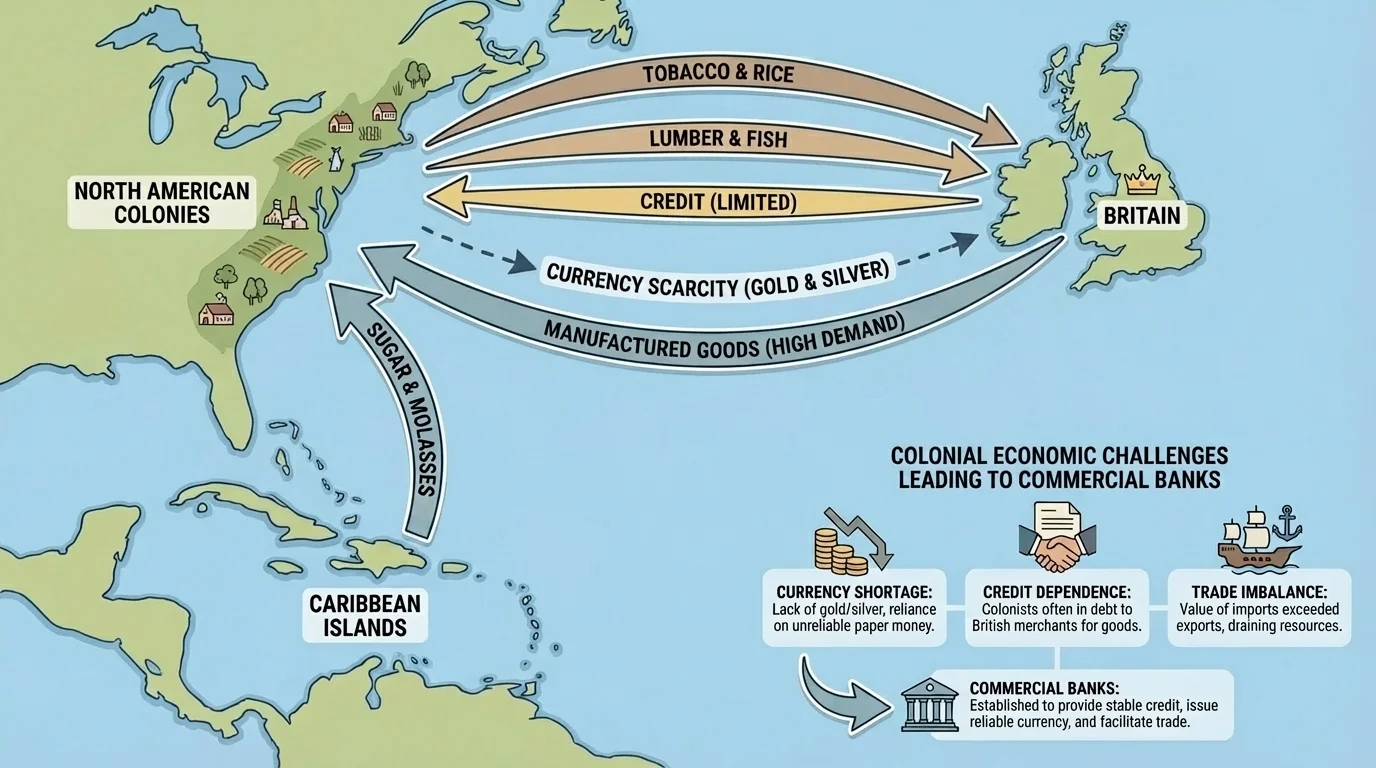
These trade limits made money problems worse. If colonists had fewer chances to trade freely, it was harder to earn enough coin. If they had to rely on British merchants and British shipping rules, payments could take longer and cost more. Colonial merchants often needed credit just to keep trade moving while waiting for ships and payments.
British taxes and rules in the later colonial period added even more tension. Colonists believed they were doing more work and taking more risks while still lacking control over their own economy. That feeling encouraged them to think about building stronger local financial systems.
"No taxation without representation."
— Colonial protest slogan
The slogan was mostly about political rights, but it also reflected economic frustration. Colonists were tired of outside control over trade, taxes, and money. Financial independence became part of the larger desire for self-government.
Trade in early America was not simple or safe. Ships faced storms, pirates, and war. Roads were muddy and slow. Goods could spoil, be stolen, or be delayed for months. A merchant might send a shipment across the ocean and wait a long time to learn whether it arrived safely.
Storing money was also risky. Without banks, people often kept coins, papers, and valuables at home, in shops, or hidden in chests. Fires, theft, and accidents could wipe out a family's savings. A safer place to deposit money would make trade more secure.
Case study: a merchant's problem
A merchant in Philadelphia wants to buy imported cloth from Britain and sell it in the colonies.
Step 1: The merchant needs money before the cloth arrives.
He may not have enough coin on hand, so he asks for credit or a loan.
Step 2: The goods must travel a long distance.
A storm, theft, or delay can stop the sale and delay repayment.
Step 3: The merchant must store earnings safely.
If profits are kept in a shop or house, they could be stolen or destroyed.
This example shows why colonial businesses needed safer saving and borrowing systems.
When banks appeared, one important service they offered was a safe place to keep deposits. That may sound ordinary today, but in colonial times it solved a serious problem.
As colonial towns grew, businesses needed more than day-to-day trading. A shipbuilder might need wood, tools, rope, sails, and workers before the ship could be sold. A mill owner might need money to build equipment. A shopkeeper might want to buy a larger supply of goods before the busy season. These people needed large sums of money ahead of time.
That is where loans became important. A loan is money given with the agreement that it will be paid back later, usually with an extra amount for the lender. Loans can help people start or grow businesses. But in colonial America, finding reliable lenders was not always easy.
Without banks, borrowing often depended on wealthy individuals, family networks, or personal connections. That meant some people could get help while others could not. It also meant lending was scattered and unorganized. An economy grows better when borrowing is more regular, recorded, and widely available.
Trade had already connected the colonies through ports, farms, and markets. The next big step was creating institutions that could support that trade with safer money handling and more dependable lending.
When a bank collected deposits from many people, it could lend some of that money to businesses that needed it. This made money more useful. Instead of sitting hidden in many homes, savings could help ships sail, stores expand, and workshops produce more goods.
A commercial bank accepts deposits and makes loans. [Figure 4] shows this movement of money from savers to borrowers. Commercial banks are called "commercial" because they help commerce, which means business and trade. They do not just store money. They also put money to work in the economy.
In the years around and after the American Revolution, leaders and businesspeople saw that the new nation needed stronger financial institutions. One early example was the Bank of North America, founded in 1781. It helped support trade, government finance, and business confidence.
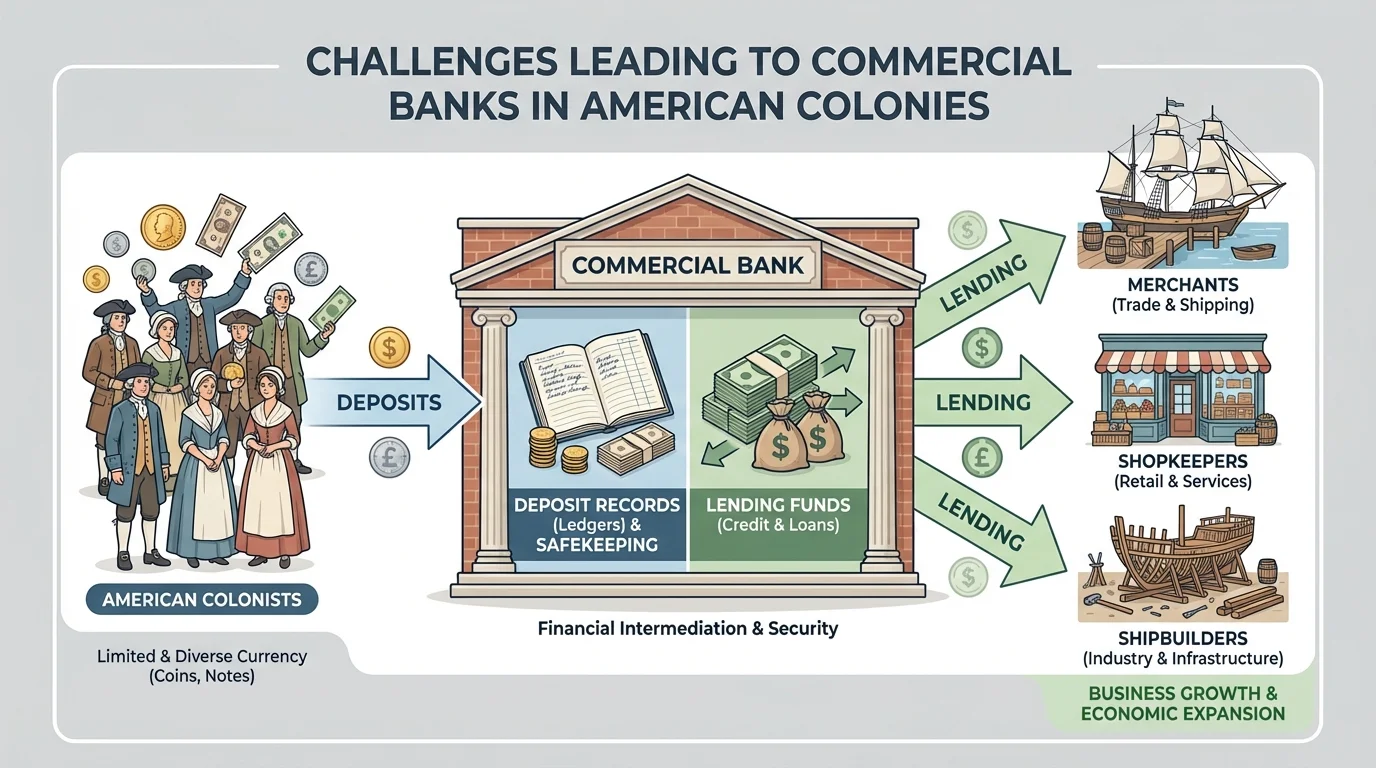
Commercial banks helped in several important ways. They provided safer storage for money. They made loans to merchants and business owners. They issued notes that people could use in payment. They helped organize credit so trade was less dependent on personal promises alone.
Banks also made it easier to gather scattered money from many depositors and direct it toward useful projects. As shown earlier in [Figure 1], the colonies had goods to trade but too few coins moving smoothly through markets. Banks helped by increasing the flow of money and credit through the economy.
That does not mean banks solved every problem. Banks could still fail, and people still needed trust in them. But compared with the older system of barter, scattered coins, risky storage, and informal credit, banks were a major improvement.
Commercial banks helped the United States move from a patchwork colonial economy into a stronger national economy. Farmers, merchants, and manufacturers could borrow more easily. Trade between regions became smoother. Businesses could plan ahead with more confidence.
This mattered because the new nation was expanding. Roads, canals, ports, workshops, and stores all needed investment. Banks helped collect savings and turn them into loans for growth. That made them powerful tools in American economic development.
The story begins with colonial challenges: too little coin, too many kinds of money, heavy dependence on credit, British trade controls, risky storage, and the need for business loans. Those daily problems were not small. They shaped the future of the economy. By trying to solve the difficulties of trade, colonists and early Americans built institutions that changed the country.
