Two people can witness the same event and remember it differently. That surprising fact is one reason history is so interesting. Historians do not simply collect old stories and repeat them. They act like investigators, comparing clues from many places to understand what happened in the past. When studying the Western Hemisphere, which includes North America, Central America, South America, and the Caribbean islands, historians look at accounts, objects, pictures, places, and written records..
The past of the Western Hemisphere is enormous and diverse. It includes the lives of Indigenous peoples such as the Maya, Aztec, Inca, Taíno, and many others. It also includes European exploration and colonization, the Atlantic slave trade, independence movements, migration, trade, and cultural exchange. No single source can tell the whole story. A diary may describe one person's experience. An artifact may show what people used every day. A map may reveal where events happened. A graph may show population change over time. By comparing these sources, historians develop a more accurate understanding of the past.
History is based on evidence. Evidence is information that helps prove or explain something. In history, evidence can come from words, objects, images, or data. If you only used one source, you might get a narrow or mistaken view. For example, if you studied the meeting between Christopher Columbus and the Taíno people using only Columbus's journal, you would mainly see the event through his eyes. But if you also studied Indigenous oral traditions, archaeology, and modern historians' research, your understanding would become much fuller.
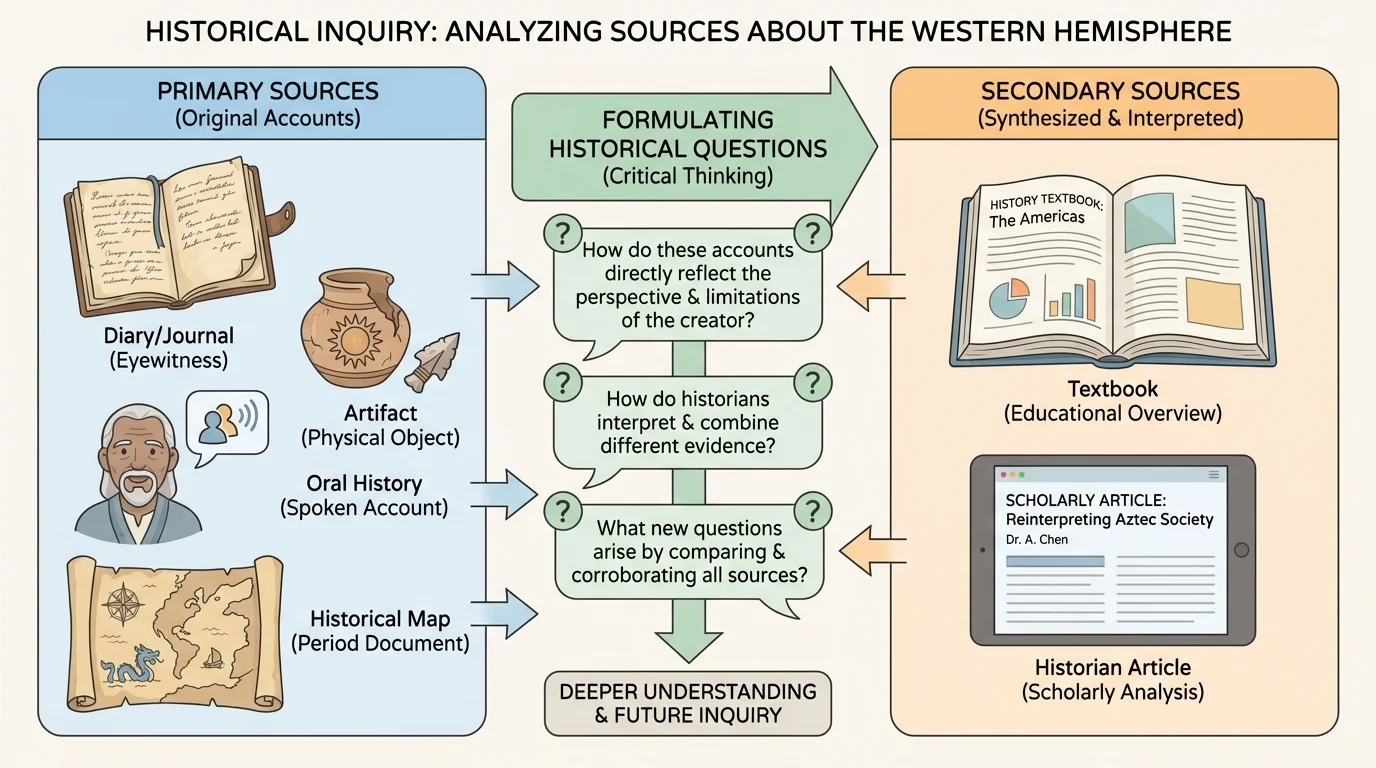
[Figure 1] Using many sources also helps historians notice disagreements. Sometimes sources conflict because people had different goals, beliefs, or positions in society. A soldier, a ruler, a farmer, and a child could each describe the same event in different ways. Historians ask why those differences exist. Those differences are not just problems; they are clues.
Primary sources are materials created during the time being studied or by someone directly connected to it. Secondary sources are created later by people who study, explain, or interpret the past using primary sources and other evidence.
Historians usually sort evidence into two main groups: primary sources and secondary sources. Primary sources might include a letter written by a Spanish explorer, a Maya carving, a Taíno artifact, an eyewitness account of a revolution, or an oral history recorded from a community elder. Secondary sources might include a textbook chapter, a museum article, or a historian's documentary about those events.
A source is not automatically better just because it is primary. A primary source can still be confusing, incomplete, or biased. A secondary source can be very useful because it compares many primary sources and gives background information. Good historians use both kinds.
The Western Hemisphere offers many different source types. Oral histories are spoken memories and traditions passed down in families or communities. These are especially important when people did not record events in written form or when written records left out certain groups. Many Indigenous communities preserve history through stories, speeches, and teachings. Oral histories can reveal beliefs, values, and experiences that official documents ignore.
Art can also be historical evidence. Murals, carvings, pottery designs, and paintings can show clothing, religious beliefs, social roles, and important events. A Maya mural, for example, can help historians study leadership, ceremonies, or warfare. Art must be interpreted carefully because it may be symbolic rather than literal.
Artifacts are objects made or used by people in the past. Historians and archaeologists study tools, jewelry, pottery, weapons, and household items to learn how people lived. A clay pot can reveal what materials were available, what foods were prepared, or what trade networks existed. An object may look simple, but it can answer many questions.
Eyewitness accounts, letters, and diaries give direct personal perspectives. These sources can be powerful because they capture thoughts and feelings close to the time of an event. For example, a revolutionary leader's letter might explain political goals, while a diary from an ordinary person might reveal fear, hope, or confusion during the same event.
Historical sites, whether real or simulated, also matter. A temple ruin, a colonial fort, a plantation, or a battlefield can show how geography shaped events. The size of a structure, the materials used, and its location near rivers, mountains, or coasts can all provide evidence. Even a simulation or reconstruction can help students understand how people moved through a place, although historians must be clear about what is original and what has been rebuilt.
Artifacts and places often work best when combined with written texts. For instance, historians studying the Inca might compare stone roads, quipu records, Spanish descriptions, and modern archaeological research. Each source contributes one part of the story.
Some of the most important histories of the Americas come from sources that were once ignored. Oral traditions, everyday tools, and even food remains have helped historians learn about people whose voices were missing from official government records.
Visual and data sources matter too. Charts, graphs, diagrams, and maps can show patterns that are hard to notice in long paragraphs of text. A graph of population decline after European diseases spread can show sudden change. A trade map can reveal why Caribbean islands became important in colonial empires. A diagram of a city can show how societies organized religion, government, and daily life.
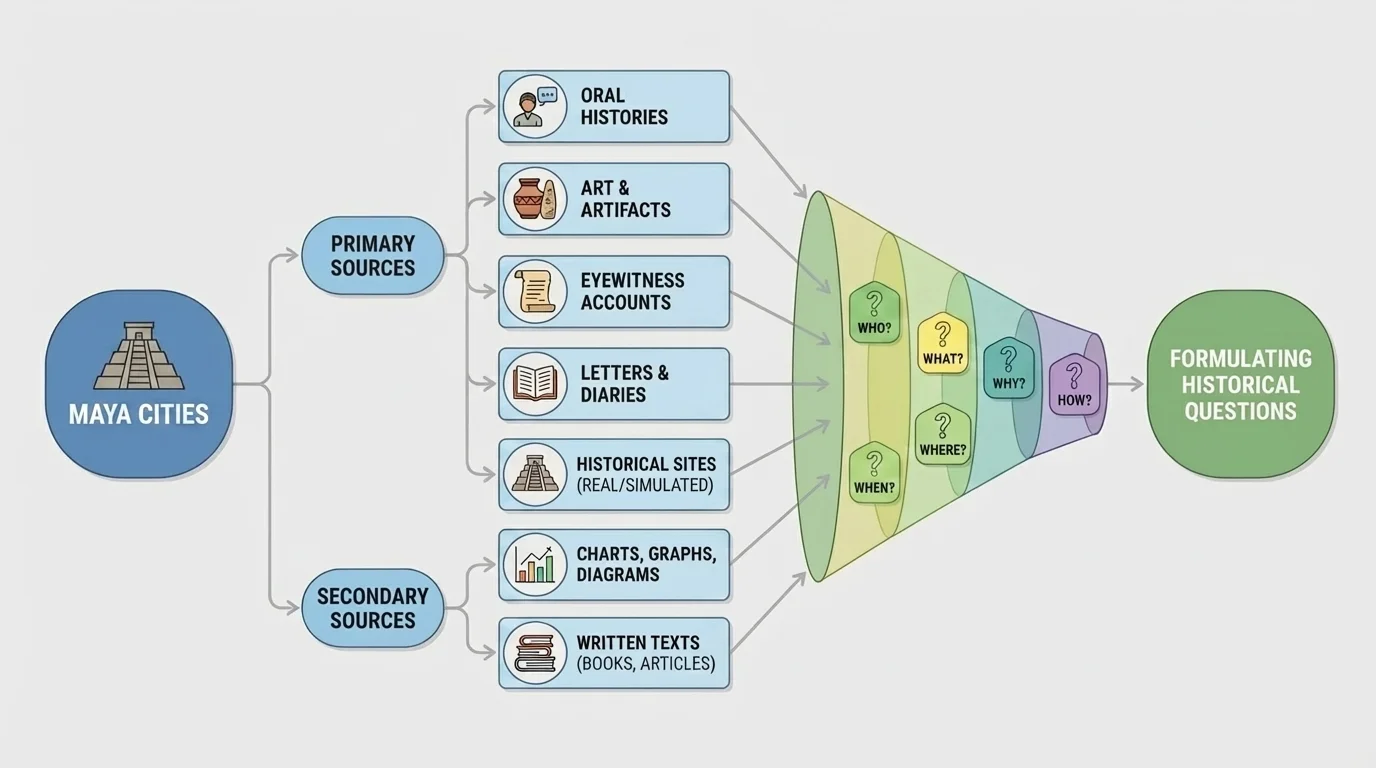
A good historical question begins with curiosity, and it often grows from a broad topic into a focused investigation. Instead of asking something too wide like "What happened in the Americas?" historians ask more specific questions such as: Why did the Maya build large cities? How did geography affect trade in the Andes? How did enslaved Africans resist oppression in the Caribbean? What changed for Indigenous communities after European colonization?
[Figure 2] Strong historical questions are usually open-ended. They cannot be answered with a simple yes or no. They often begin with how or why. They also connect to evidence. If a question cannot be explored with sources, it is difficult to investigate historically.
Here are examples of stronger and weaker questions. "Was Columbus important?" is weak because it is too vague. "How did Columbus's voyage in 1492 affect the Taíno people of the Caribbean?" is stronger because it focuses on time, place, and impact. "Did the Inca have roads?" is weak because the answer is simply yes. "How did Inca roads help the empire govern distant regions?" is stronger because it invites research and explanation.
Turning a topic into a research question
Historians often begin with a broad topic, then narrow it by place, time, and people. A topic like "the Caribbean" becomes more useful when it is shaped into a question such as "How did sugar plantations change life in the Caribbean during colonial times?" This kind of question points directly toward sources that can help answer it.
Question words help historians think clearly. Who was involved? What happened? When did it happen? Where did it happen? Why did it happen? How did people respond? These questions do not compete with each other. They build on each other.
Every source has a point of view. That means it reflects the perspective of the person or group that created it. A Spanish conquistador, an Aztec noble, an enslaved worker, and a modern historian would not describe events in the same way. Their experiences, goals, and beliefs shape what they say.
Historians ask several important questions about each source: Who created it? When was it created? Why was it created? Who was the audience? What information does it include, and what does it leave out? These questions help historians judge how reliable and useful a source may be.
Case study: reading a diary carefully
A colonial official writes in a diary that a settlement is peaceful and successful.
Step 1: Identify the creator and role.
The writer is an official, so he may want to make the colony seem well-managed.
Step 2: Think about the audience.
If the diary or report might be read by a ruler or sponsor, the writer may hide problems.
Step 3: Compare with other evidence.
Archaeology, letters from settlers, and Indigenous accounts may show shortages, conflict, or disease.
The diary is still valuable, but it should not be used alone.
This process of comparing sources is called corroboration. When several sources support the same idea, historians gain confidence. If the sources disagree, historians investigate the reasons for the disagreement. Sometimes one source is mistaken. Sometimes each source shows only part of a larger truth.
Bias does not mean a source is useless. It means the source reflects a particular viewpoint. In fact, bias can help historians learn what people valued, feared, or hoped to achieve.
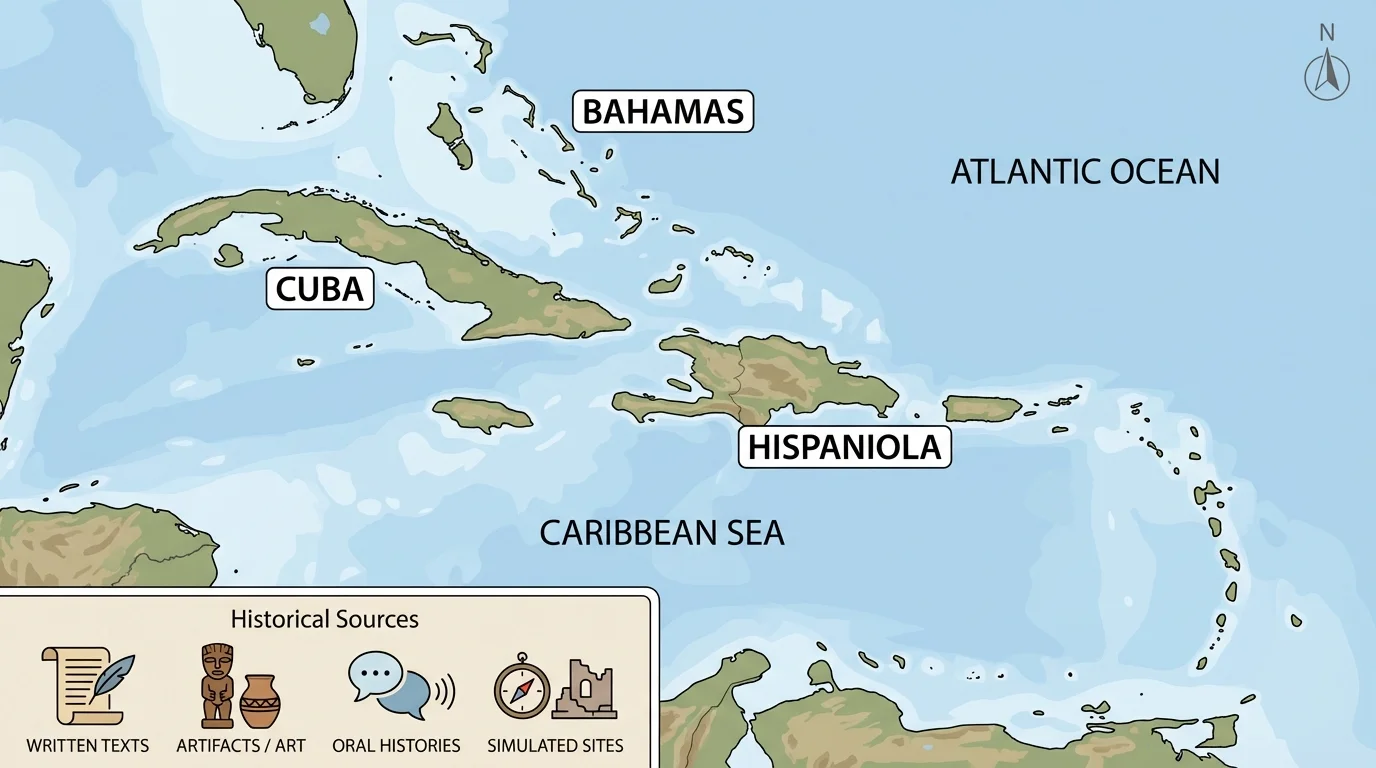
[Figure 3] The early contact between Europeans and Indigenous peoples in the Caribbean took place in a specific region and can be better understood geographically. Suppose historians are studying Columbus's arrival in the Caribbean in 1492. One source is Columbus's journal. It describes the islands, the people he met, and his own plans. But that source alone cannot fully explain the experience of the Taíno.
To deepen the investigation, historians compare Columbus's writing with archaeology from Caribbean sites, accounts recorded later about Taíno culture, maps of the islands, and modern historical studies. This comparison can lead to stronger questions: How did Europeans describe Indigenous peoples, and why? What changes followed contact? Which voices are missing from the written record?
Another example comes from the Maya. Historians might study temple carvings, painted murals, city ruins, codices that survived, and secondary works by archaeologists. A stone carving may show a ruler performing a ceremony. A ruin may reveal how the city was designed. A historian's article may explain how scholars interpret the symbols. Together, these sources can help answer questions about religion, power, and daily life.
A third example involves slavery and resistance in the Caribbean and the Americas. Historians might compare plantation records, runaway slave advertisements, oral traditions, songs, laws, and modern scholarship. Official records often focus on the views of enslavers, while oral histories and cultural traditions may preserve the experiences and resistance of enslaved people. Looking at many sources makes the history more honest and complete.
As seen earlier in [Figure 1], no single type of source is enough on its own. A graph, a law, a diary, and an artifact may each answer different parts of the same question.
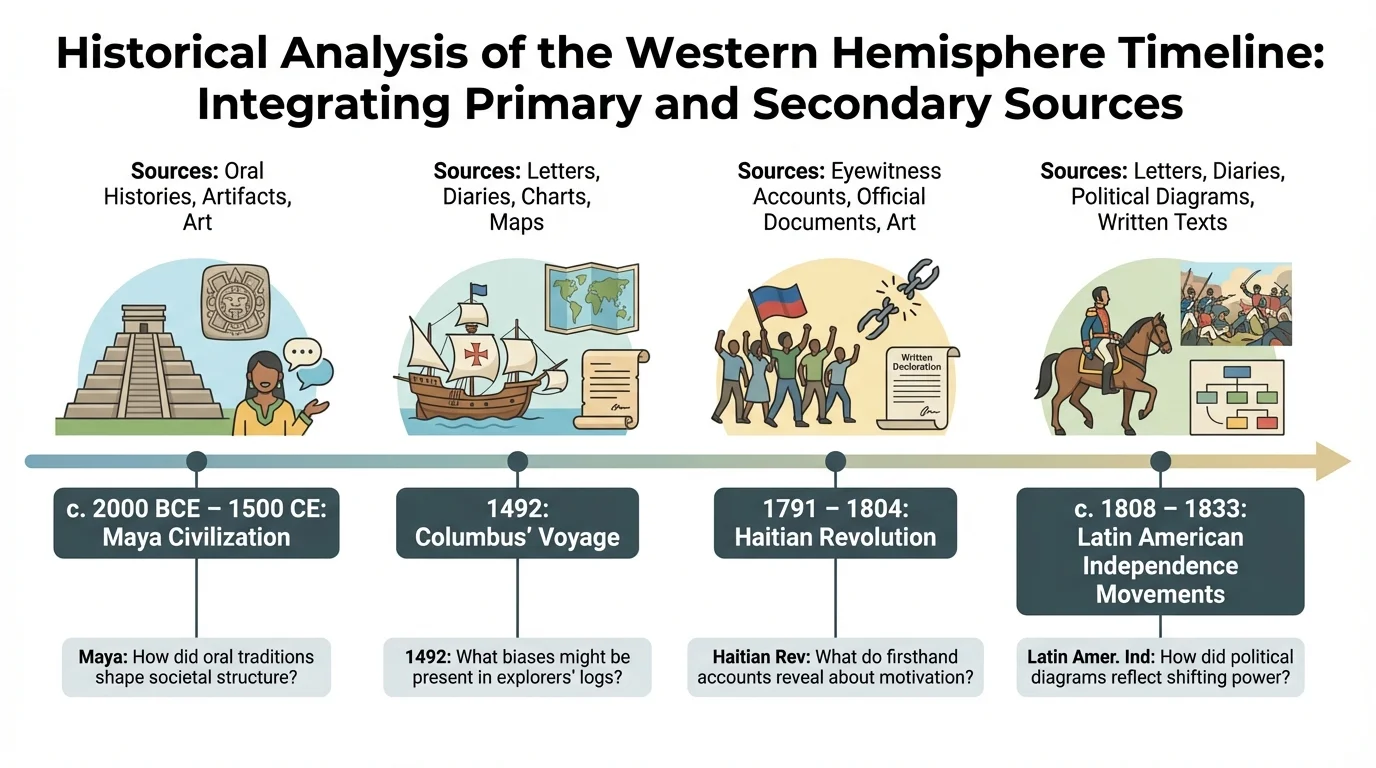
Chronology, or the order of events over time, helps historians explain change and shows how key events in the Western Hemisphere connect across centuries. If you know that the Maya civilization developed long before Columbus's 1492 voyage, you avoid the mistake of thinking Western Hemisphere history began with European arrival. Timelines show sequence, duration, and turning points.
[Figure 4] Maps help answer questions about location and movement. Why were Caribbean islands important? Why did empires compete for coastal regions? Why did mountain ranges shape trade and communication in South America? A map can reveal these answers more clearly than words alone.
Charts and graphs help historians study patterns. A bar graph might show the growth of Atlantic trade. A chart might compare exports such as sugar, silver, or tobacco in different colonies. These sources do not tell the whole human story, but they reveal scale and change.
| Source Type | What It Can Show | Possible Limitation |
|---|---|---|
| Oral history | Memories, traditions, community values | May change over time or reflect one family's perspective |
| Artifact | Daily life, technology, trade | Does not explain itself in words |
| Letter or diary | Personal thoughts and experiences | Only one person's view |
| Map | Location, distance, movement | May reflect political goals of mapmaker |
| Chart or graph | Patterns and trends | May leave out human experiences behind the numbers |
| Secondary source | Background, interpretation, synthesis | Depends on the author's choices and evidence |
Table 1. Comparison of common historical source types, their strengths, and their limits.
Later, when historians connect events like the Haitian Revolution and Latin American independence movements, [Figure 4] helps them see that these events belong to a larger pattern of political change in the hemisphere.
After gathering and comparing sources, historians build an explanation. This explanation should answer a question with evidence, not just opinion. A strong explanation usually includes a clear claim, evidence from multiple sources, and reasoning that connects the evidence to the claim.
For example, a historian might claim that geography strongly shaped the development of civilizations in the Andes. To support that claim, the historian could use maps of mountain routes, artifacts from trade, descriptions of roads, and secondary sources about Inca government. The explanation becomes stronger when the evidence comes from more than one kind of source.
When you read a source, remember to ask both what it says and what kind of source it is. A statement is more useful when you know who created it, why it was created, and what other evidence supports it.
Sometimes historians do not have enough evidence to answer every question completely. That is normal. Good history includes uncertainty when necessary. Instead of pretending to know everything, historians may say that the evidence suggests a conclusion or that scholars still debate an issue.
This careful way of thinking matters beyond history class. People today also need to compare sources, notice bias, and ask good questions when reading news, watching videos, or using social media. Historical thinking helps students become thoughtful citizens.
Studying historical questions in the Western Hemisphere often brings students into contact with major figures and events. The Maya, Aztec, and Inca built powerful societies before European colonization. Christopher Columbus's 1492 voyage marked a major turning point in contact between Europe and the Americas. Toussaint Louverture became a key leader in the Haitian Revolution, one of the most important freedom movements in world history. Simón Bolívar helped lead independence movements in parts of South America.
These figures matter, but historians do not study only famous leaders. They also investigate the lives of farmers, craftspeople, merchants, enslaved people, Indigenous communities, women, and children. Often, the challenge is that these people left fewer written records. That is why oral histories, artifacts, art, and archaeology are so important.
"The past is never dead. It's not even past."
— William Faulkner
That idea fits the history of the Western Hemisphere well. Languages, place names, foods, beliefs, and traditions today are connected to the histories of Indigenous peoples, Africans, Europeans, and later migrants. Asking good historical questions and analyzing many kinds of sources helps us understand those connections with care and respect.
