Why does one country have huge shopping malls, another has strong government control over businesses, and another still depends on fishing, farming, or herding traditions that are hundreds of years old? The answer is not random. Economic systems develop because people must solve the same basic problem: there is never an unlimited amount of everything people want. Every society has to decide what to produce, how to produce it, and who gets it.
The most basic problem in economics is scarcity. Scarcity means people have limited resources but unlimited wants. A society may have rich soil, forests, oil, rivers, or access to the ocean, but it still cannot produce everything for everyone. Because of scarcity, people make choices about food, clothing, shelter, transportation, and technology. Those choices are shaped by resources, culture, history, and government.
[Figure 1] In the Western Hemisphere, which includes North America, Central America, South America, and the Caribbean, economic systems developed in many different ways. Some communities lived in areas with fertile farmland. Others had mountains, deserts, forests, or coastlines. Geography mattered. A coastal society might depend on fishing and trade, while an inland farming society might focus on crops and livestock. If one region had silver, gold, oil, or timber, that changed its economy too.
Human experiences also shaped economic systems. Colonization brought new rulers, trade patterns, and labor systems. Enslavement forced millions of people to work in terrible conditions and changed economies across the hemisphere. Immigration brought skills, ideas, and labor. Industrialization introduced factories and machines. Revolutions and wars changed who held power. All of these events influenced how societies answered economic questions.
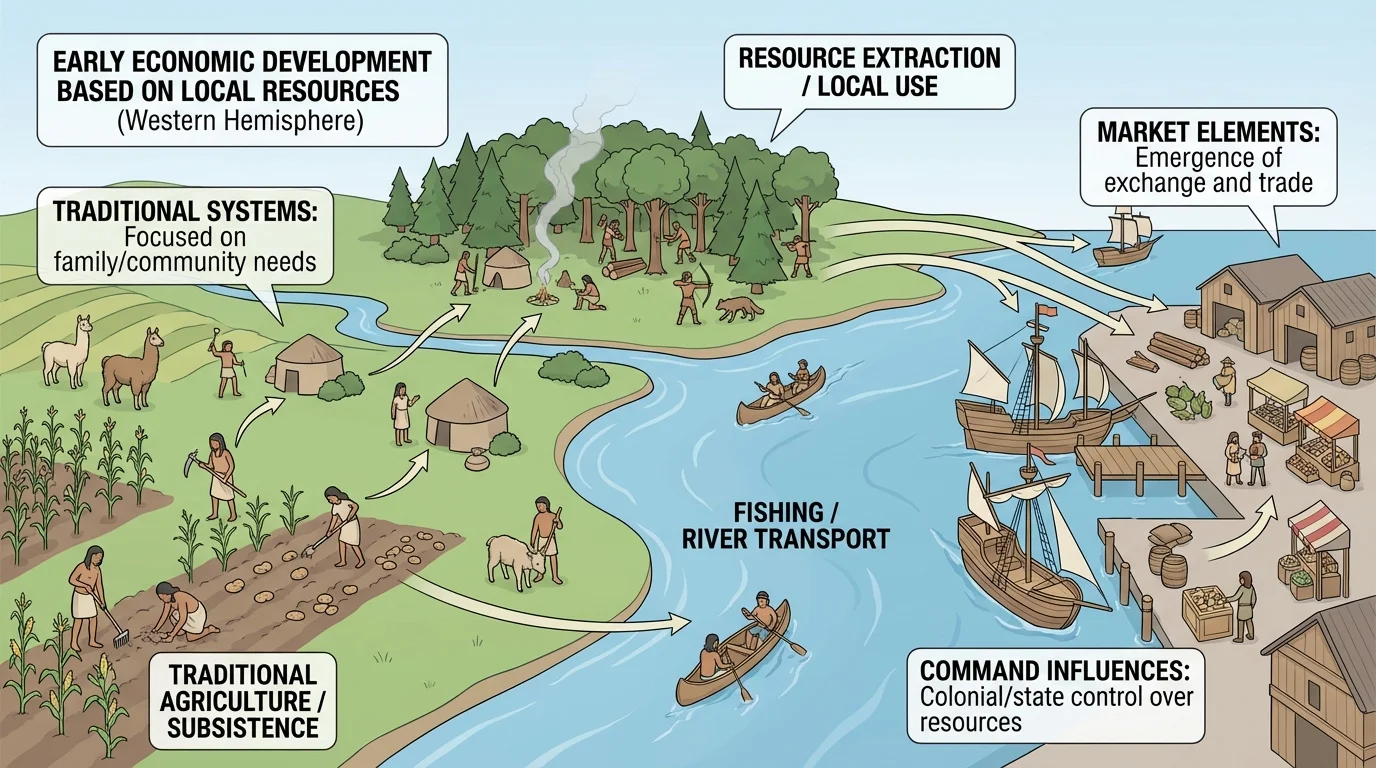
Societal values matter as well. Some societies value keeping traditions. Some emphasize equality and government planning. Others value individual choice, competition, and private business. Many try to balance several values at once. That is why economic systems are not only about money. They are also about what people believe is fair, useful, and important.
Economic system is the way a society organizes the production, distribution, and use of goods and services.
Goods are physical things people buy or use, such as food, shoes, or bicycles.
Services are jobs people do for others, such as teaching, cutting hair, or repairing cars.
Economists often group economic systems into four main types: traditional, command, market, and mixed. These are categories that help us understand patterns. In real life, a country may not fit perfectly into just one type.
A traditional economy depends on customs, habits, and long-established ways of doing things. People often produce what their families or communities have produced for generations. Work may be based on age, gender roles, seasonal patterns, or local knowledge.
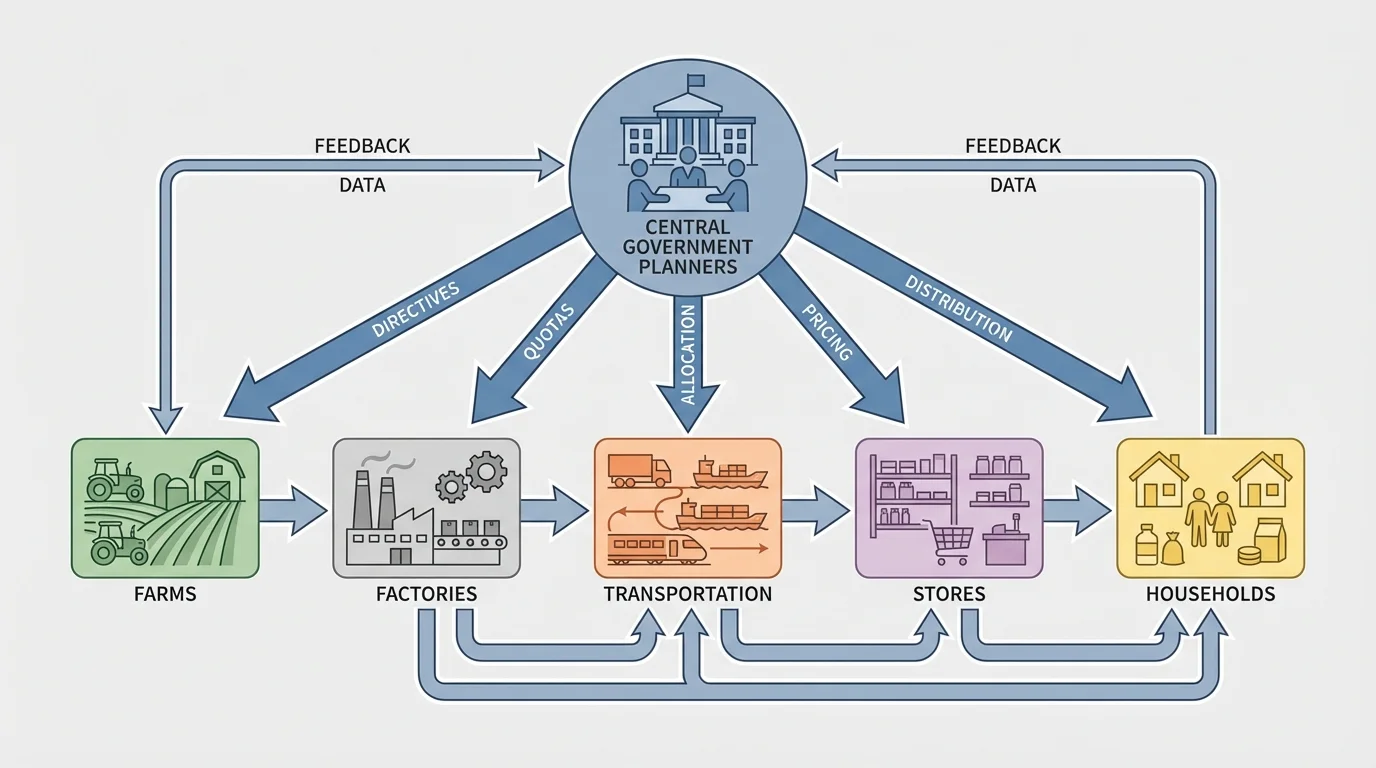
A command economy is organized mainly by the government. Leaders decide what should be produced, how much should be made, what prices should be charged, and who should receive goods and services.
A market economy is based mainly on decisions made by individuals and businesses. People can own property, start businesses, and choose what to buy or sell. Prices are often influenced by supply and demand, which means prices change depending on how much of something is available and how much people want it.
A mixed economy combines features of more than one system, especially market and command elements. Most countries in the Western Hemisphere today have mixed economies.
| System | Main Decision-Maker | Common Features |
|---|---|---|
| Traditional | Families and customs | Customs, local resources, small-scale production |
| Command | Government | Central planning, state control, limited private choice |
| Market | Individuals and businesses | Private property, competition, consumer choice |
| Mixed | Individuals, businesses, and government | Markets with government services and rules |
Table 1. Comparison of the four main economic systems.
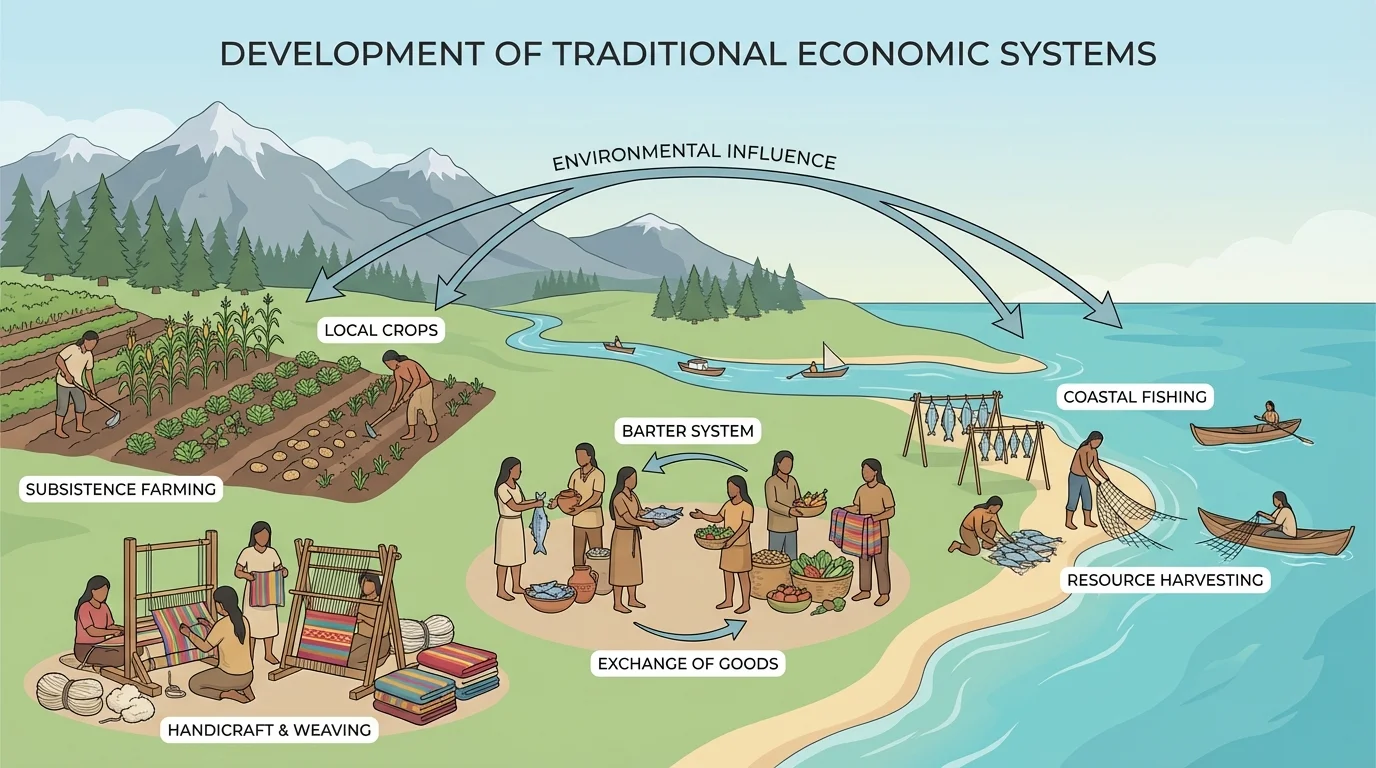
Many of the earliest economies in the Western Hemisphere were traditional. Before European colonization, Indigenous peoples built economies suited to their environments. In some places, communities farmed maize, beans, and squash. In others, they hunted, fished, gathered wild plants, or traded valuable goods such as salt, obsidian, feathers, or pottery. Their economic patterns often matched seasons and geography, as [Figure 2] illustrates.
Traditional economies developed because they worked well with local resources. If a community lived near rivers and lakes, fishing became important. If the land was fertile, farming became central. In mountain areas, people adapted in different ways from people on tropical coasts. Skills and knowledge were passed from one generation to the next.
Traditional systems also reflected values. Communities often emphasized sharing, cooperation, and survival of the group. The goal was not always to make the biggest profit. Instead, the goal might be to meet needs, respect the land, and maintain community relationships.
Even today, some parts of the Western Hemisphere still show traditional economic features. In remote Amazon communities, mountain villages in the Andes, or rural areas of Central America, families may grow crops, raise animals, weave cloth, or trade locally using long-standing customs. These places are not frozen in the past, but tradition still plays an important role.
Traditional economies can provide stability and strong community ties. However, they may also offer fewer choices and can be vulnerable when weather changes, resources become scarce, or outside companies and governments disrupt local ways of life.
Many foods eaten around the world today, including corn, potatoes, tomatoes, and cacao, were first grown or developed by peoples of the Western Hemisphere. Their traditional agricultural knowledge changed global trade and diets.
The relationship between environment and custom remains important. The fishing, farming, and craft-making patterns shown in [Figure 2] help explain why a traditional economy grows differently in a rainforest, a mountain valley, or a coastal island.
Command economies usually develop when leaders believe the government should direct major economic decisions. This may happen after a revolution, during a national emergency, or when a government wants stronger control over land, factories, and trade. In a command system, a central authority plans production and distribution.
[Figure 3] In the Western Hemisphere, Cuba is a well-known example of a country whose economy developed strong command features after the Cuban Revolution in 1959. The government took greater control of industries, land, and trade. It planned many parts of the economy and limited private business for many years.
Why would a country choose this path? Some leaders argued that government planning could reduce inequality, provide jobs, and guarantee access to important services such as health care and education. They believed the state could direct resources toward national goals more fairly than private businesses could.
But command economies can also face serious problems. If the government makes poor decisions, shortages may happen. Workers and business owners may have less freedom to choose jobs or start companies. New ideas and inventions may spread more slowly if there is less competition. When people cannot easily respond to consumer needs, stores may carry fewer goods or lower-quality products.
The planning arrows in [Figure 3] make an important point: when the government stands at the center of decisions, the system can organize resources quickly, but it can also become rigid if leaders do not understand local needs.
Market economies in the Western Hemisphere grew strongly as trade expanded, cities developed, and people gained more freedom to own property and start businesses. A key idea is private property, which means individuals or companies can own land, buildings, tools, and businesses.
In a market system, producers try to sell what consumers want. Competition encourages businesses to improve products, lower costs, or invent something new. Buyers and sellers interact in ways that shape prices and show how many different groups connect in this kind of economy.
[Figure 4] The United States developed one of the strongest market-based economies in the hemisphere. Access to land, rivers, railroads, immigrants, factories, and natural resources helped businesses grow. Over time, banks, stock markets, transportation networks, and technology companies expanded economic activity. Canada also developed a largely market-based economy, supported by trade, resources, and industry.
Market economies developed partly because many people valued freedom of choice. If someone wanted to open a bakery, repair shop, or shipping company, they often could try. Success was not guaranteed, but the chance to compete encouraged innovation. This is one reason market economies often produce many kinds of goods and services.
Still, market economies do not solve every problem on their own. Some people may become very wealthy while others remain poor. Businesses might pollute air or water if there are no rules. Essential services like education, roads, and disaster relief may not be provided fairly to everyone without government action.
The scene in [Figure 4] also reminds us that market economies depend on trust and connections. Businesses need workers, roads, electricity, customers, and laws that protect buying and selling.
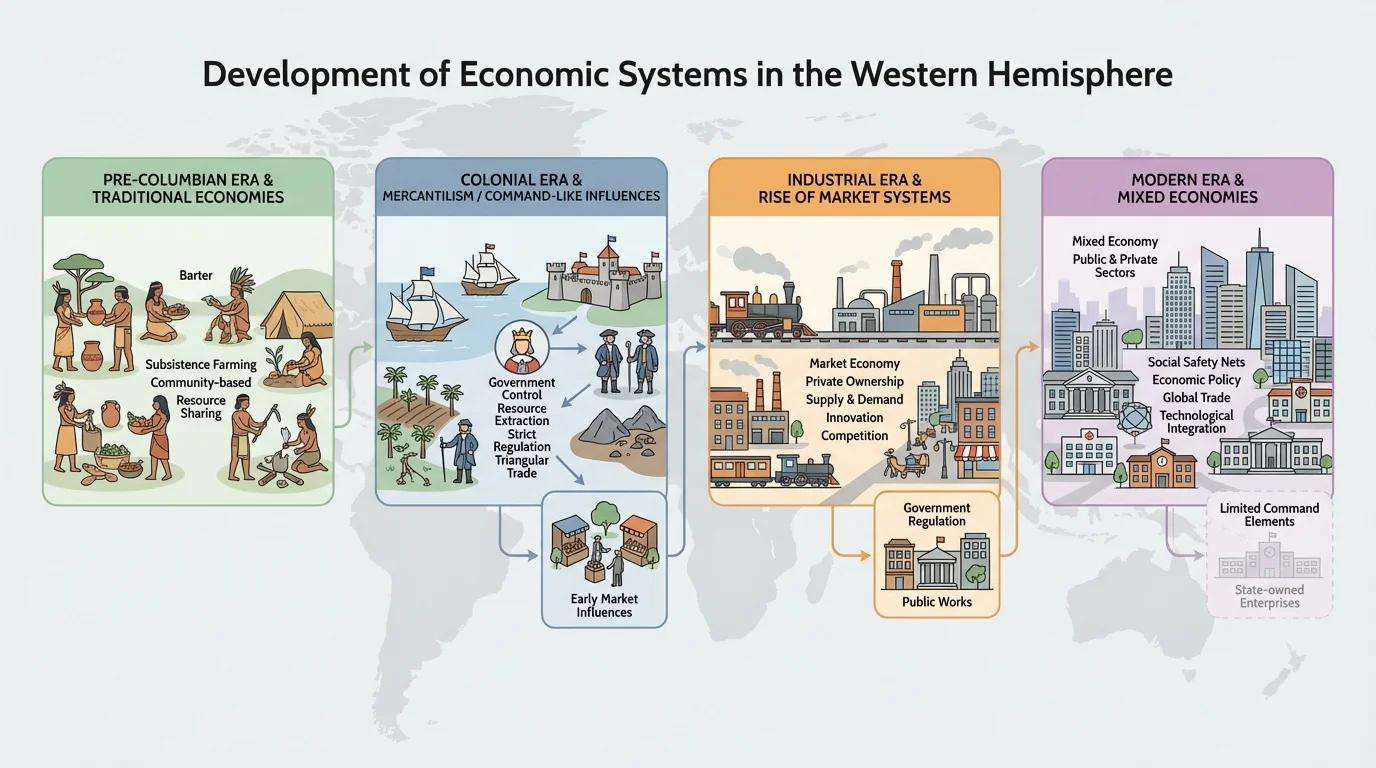
Most countries in the Western Hemisphere today use a mixed economy because pure market and pure command systems both have weaknesses. A mixed system allows private businesses and consumer choice, but it also gives government a role in building roads, funding schools, regulating safety, and helping people during hard times.
[Figure 5] Countries such as the United States, Canada, Mexico, Brazil, Argentina, Chile, and many others have mixed economies. Businesses compete and people buy and sell in markets, but governments collect taxes and pay for public services. Governments may also set rules for wages, environmental protection, and product safety.
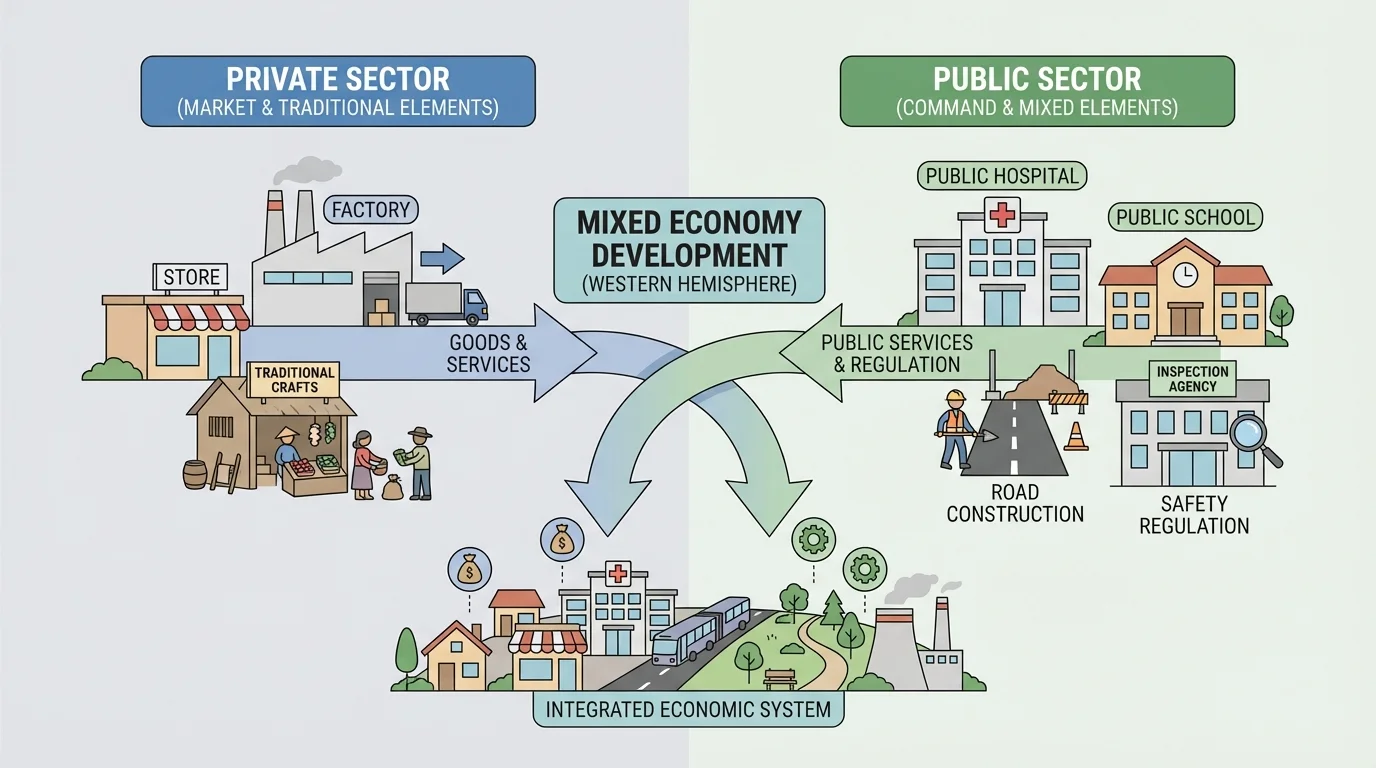
Mixed economies developed because people wanted both freedom and protection. They wanted the energy of markets but also the stability of public services. For example, if a hurricane hits a Caribbean island, government help is often needed to rebuild roads, ports, hospitals, and schools. Private companies alone may not handle such huge tasks fairly or quickly enough.
Different countries mix these elements in different amounts. One country may have more government involvement in health care. Another may allow more private business in transportation or energy. Mixed economies are flexible, which is one reason they are so common.
Why mixed economies are practical
A mixed economy tries to combine the strengths of different systems. Markets can encourage efficiency and invention, while government can provide services people need even when those services are not highly profitable. This helps societies respond to scarcity in more than one way.
The combination shown in [Figure 5] helps explain modern life across the hemisphere: students may attend public schools, families may shop at private stores, workers may earn wages from companies, and governments may inspect food or maintain highways.
No economic system appears out of nowhere. Access to resources strongly affects development. Oil helped shape economies in places such as Venezuela and parts of Mexico. Fertile farmland influenced economies in the Great Plains, the Pampas of Argentina, and many valleys and coastal plains. Forests supported timber industries in Canada, the Amazon region, and other areas. Ports encouraged trade in cities such as New York, Havana, Panama City, and Buenos Aires.
Societal values also matter. If a society values community traditions, it may preserve more traditional practices. If a society values equality above competition, it may support more government control. If a society values entrepreneurship, it may encourage business ownership and investment. Most countries debate these values constantly, and their policies change over time.
Human experiences can shift an economy quickly. Colonization often forced colonies to produce raw materials for European empires. Enslaved labor created plantation economies in the Caribbean and parts of the Americas. Independence movements changed political control but did not always change economic inequality right away. Industrialization brought factories and urban jobs. In the twentieth and twenty-first centuries, globalization and digital technology connected economies across continents.
Case study: how one place can change over time
Consider a Caribbean island economy.
Step 1: In an earlier period, the island may depend mainly on sugar plantations because colonizers want one export crop.
Step 2: After political change, the government may take a larger role in land and business decisions.
Step 3: Later, tourism, remittances from family members abroad, and small private businesses may become important too.
This example shows that economic systems are shaped by history and can change as people face new challenges.
Migration is another powerful influence. When people move, they bring languages, business skills, farming methods, and new ideas. A growing city may shift from agriculture to manufacturing and then to services such as banking, medicine, or software design.
The countries of the Western Hemisphere do not all fit neatly into one category, but we can still compare the main patterns in their economies today.
| Country or Region | System Features | How It Developed |
|---|---|---|
| United States | Mostly market with mixed features | Private business, industrial growth, abundant resources, immigration, government regulation |
| Canada | Mostly market with mixed features | Trade, natural resources, industry, public services, government role in health care |
| Cuba | Strong command features with some changes | Revolution, state planning, government ownership in many sectors |
| Mexico | Mixed economy | Trade, manufacturing, oil, agriculture, tourism, government regulation |
| Brazil | Mixed economy | Agriculture, mining, industry, services, large government and private sectors |
| Rural Indigenous or remote communities | Traditional features within larger national economies | Local resources, customs, community exchange, adaptation to environment |
Table 2. Examples of how economic systems appear in different parts of the Western Hemisphere today.
These examples show that systems often overlap. A country may have private stores and factories but also government-run schools and utilities. A rural area may keep traditional farming patterns while still selling crops in a national market.
Economic systems affect everyday choices in ways students can notice. They influence what products appear in stores, how expensive food is, what kinds of jobs adults have, whether roads and parks are well maintained, and how easy it is to start a business.
In a more market-based setting, families may have many brands and products to choose from, but prices may rise and fall more often. In a more command-based setting, some services may be guaranteed by the state, but there may be fewer choices in stores. In a traditional setting, people may rely more on family labor and local exchange. In a mixed system, life includes both private choices and public support.
Government policies can shape daily life too. Minimum wage laws, safety rules, taxes, and public transportation programs all affect workers and families. These decisions are part of how a mixed economy responds to scarcity and fairness.
Remember that scarcity does not mean a place has nothing. It means there is not enough of every resource to satisfy all wants at once, so choices must be made.
That idea connects every economic system. Whether decisions are made by tradition, leaders, markets, or some combination, societies are always trying to answer the same questions: What should we make? How should we make it? Who should get it?
Economic systems are not fixed forever. A country can become more market-based, more government-controlled, or more mixed over time. New technology, elections, trade agreements, natural disasters, wars, and social movements can all push an economy to change.
For example, a farming region may industrialize. A state-run industry may be opened to private investment. A market economy may add more rules after a financial crisis. A traditional community may begin selling handmade goods online while still keeping older customs.
This is why learning the four types matters. They are tools for understanding the real world, not boxes that trap every country. Across the Western Hemisphere, current economic systems developed from a combination of available resources, shared values, and historical experiences. The result is a region with great variety, where local traditions, government decisions, business activity, and global trade all help shape how people live.
