Take a look around a classroom or home: a backpack may be sewn in one country, a phone may be designed in another, and the metal inside that phone may come from several more. That is not random. It happens because countries often focus on what they can make best, most cheaply, or in the greatest amount. This idea helps explain why the world economy is like a giant web, with each place connected to many others.
Every country faces scarcity, which means there are limited resources but unlimited wants. Countries differ in land, climate, water, minerals, workers, and technology, which helps explain why different places produce different goods. A country with rich soil and warm temperatures may grow tropical crops. A country with large oil reserves may produce fuel. A country with advanced factories and trained engineers may make electronics or cars.
[Figure 1] No country has an unlimited amount of every resource. Some places do not have enough fresh water for certain crops. Some do not have the metals needed for manufacturing. Others may have the resources but not the machines, roads, or trained workers to turn those resources into finished goods. Because of scarcity, countries must make choices about what to produce.
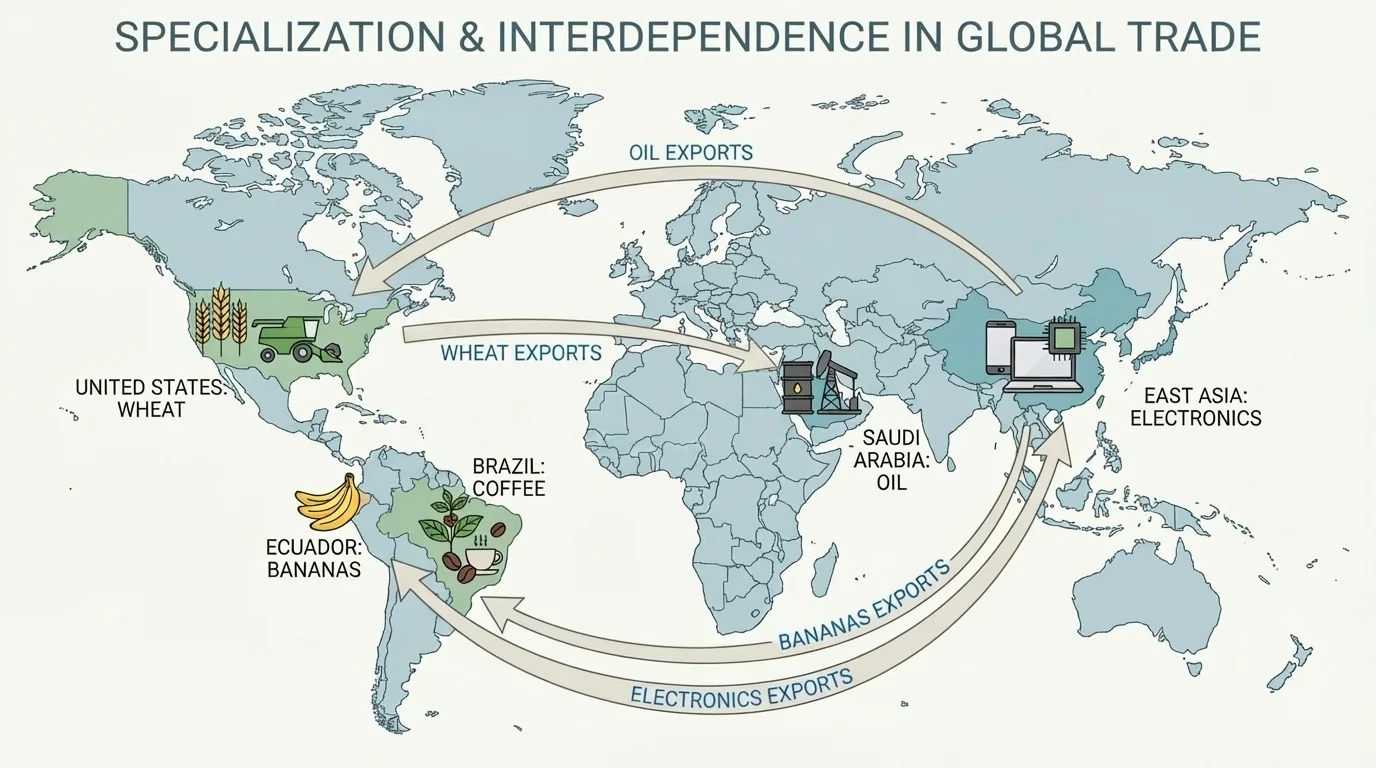
These choices are shaped not only by nature but also by history and human experience. For example, a country may build strong farming traditions over many years, while another develops shipbuilding, mining, or software design. Societies also make decisions based on values. Some governments encourage free trade and private business. Others play a larger role in deciding what gets produced. In all economic systems, however, scarcity forces people and nations to decide how to use limited resources.
Scarcity means there are not enough resources to satisfy all wants. Production is the process of making goods or providing services. Imports are goods and services bought from other countries, while exports are goods and services sold to other countries.
When countries compare what they have and what they lack, trade becomes a practical solution. Instead of trying to do everything, a country may produce more of certain goods and trade for the rest.
One important idea is specialization. Specialization means focusing on making a smaller range of goods or services. A farmer may specialize in oranges rather than trying to grow every crop. A country may specialize in textiles, copper, coffee, computer chips, or tourism.
Another important idea is opportunity cost. Opportunity cost is what is given up when a choice is made. If a country uses land to grow rice, that same land cannot be used at the same time to grow wheat. If a factory makes bicycles, it cannot use those exact resources at that moment to make refrigerators. Every production choice has a trade-off.
Economists also study interdependence, which means people or places depend on one another. In the world economy, countries become interdependent when each one relies on others for needed resources, parts, foods, or finished products. This can happen because of specialization and trade.
A single smartphone can include materials and parts connected to many countries. The design, minerals, chips, screen, battery, assembly, and shipping may all involve different places around the world.
When many countries specialize, regular trade patterns form. A trade pattern is a repeated flow of goods between places. If one country often exports coffee and imports machinery, and another often exports oil and imports food, those repeated exchanges become part of global trade patterns.
Specialization happens at many levels. A person may specialize as a doctor, carpenter, coder, or mechanic. A business may specialize in shoes or bicycles. A country may specialize in products it can make well relative to other products. Once specialization happens, exchange becomes necessary, and [Figure 2] illustrates how two places can focus on different goods and then trade with each other.
Suppose Country A has a warm climate and fertile land, so it grows coffee very well. Country B has advanced factories and many skilled technicians, so it produces electronics very well. Instead of Country A trying to build a huge electronics industry from scratch and Country B trying to grow coffee in an unsuitable climate, each country can specialize and then trade.
Country A can export coffee and import electronics. Country B can export electronics and import coffee. Both countries become better supplied because each uses its resources in a more effective way.
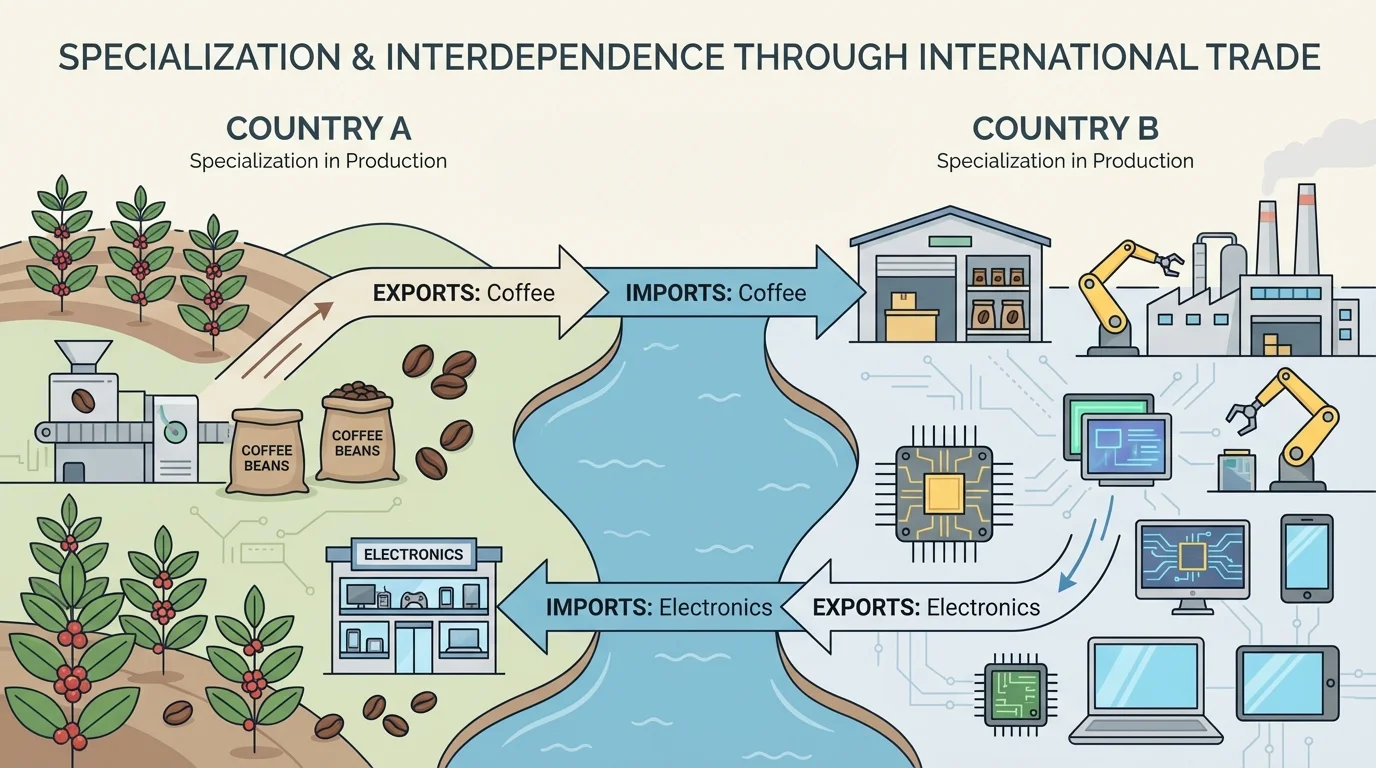
This idea does not mean a country produces only one thing. Most countries make many goods and services. Still, they often produce certain goods more successfully than others. That is why one country may be especially known for cars, another for bananas, another for oil, and another for computer software.
Specialization often increases efficiency. Efficiency means using resources in a way that avoids waste and gets the most output from what is available. When workers or countries focus on certain tasks, they gain experience, improve tools, and organize production more effectively.
Think about a kitchen. If one person tries to mix ingredients, bake bread, wash dishes, and serve meals all at once, the work may be slow. But if different people take on different jobs, the whole kitchen can produce more food in less time. Countries can work in a similar way, although on a much larger scale.
Specialization and lower opportunity cost
A country should often focus more on goods it can produce with less sacrifice. If a country can grow coffee easily but making electronics would require giving up a lot of land, money, and training, then the opportunity cost of electronics is high. Trading allows that country to get electronics from a place where the opportunity cost is lower.
Because of specialization, total production in the world can rise. More coffee may be grown where conditions are ideal. More electronics may be made where factories, ports, and engineers are already in place. Trade then moves these goods to where they are needed.
International trade is the buying and selling of goods and services across national borders. Trade patterns develop when certain products regularly move from places that produce them efficiently to places that want or need them.
Geography is one major cause of trade patterns. Countries with tropical climates often export bananas, cocoa, or coffee. Countries with large grasslands may export wheat or beef. Countries with rich mineral deposits may export copper, diamonds, or iron ore. Climate and natural resources strongly influence what can be produced.
Technology and human capital also shape trade. Human capital means the skills and knowledge of workers. A country with many trained engineers, advanced machines, and strong transportation systems may specialize in aircraft, medical equipment, or computer chips. A country with fewer factories but fertile land may focus more on agriculture.
| Factor | How it affects specialization | Example |
|---|---|---|
| Climate | Determines which crops grow well | Coffee in Brazil |
| Natural resources | Provides raw materials for trade | Oil in Saudi Arabia |
| Skilled labor | Supports complex manufacturing | Electronics in South Korea |
| Transportation | Makes shipping easier and cheaper | Busy ports in Singapore |
| Capital goods | Machines and tools increase production | Car factories in Germany |
Table 1. Major factors that influence what countries specialize in and trade.
Government policies matter too. A government may support roads, schools, ports, and internet systems that help businesses grow. It may lower trade barriers to encourage imports and exports, or it may place tariffs and rules on some goods. These decisions affect what industries expand and how connected a country becomes to the world economy.
Brazil is well known for exporting coffee because its climate, land, and farming experience support large-scale production. Countries that cannot grow enough coffee import it. This creates a trade relationship based on different natural conditions.
Saudi Arabia exports large amounts of oil because it has major petroleum reserves. Many countries import that oil to power cars, buses, factories, and airplanes. When energy-producing countries specialize in oil and other countries specialize in manufacturing or services, they rely on one another.
Case study: Bananas and machinery
Ecuador grows bananas very successfully because of its climate and farmland. A country with colder weather may not be able to grow bananas easily, but it may build tractors or food-processing machines.
Step 1: Ecuador uses land, rainfall, and farming knowledge to produce bananas.
Step 2: Another country uses factories, metal, and skilled workers to produce machinery.
Step 3: The countries trade. One exports bananas; the other exports machinery.
Both countries gain access to goods that would be harder or more costly to produce on their own.
East Asian countries such as South Korea and Japan have become known for advanced manufacturing, including electronics and cars. Their trade patterns developed through education, technology, investment, and strong industrial systems. As with the coffee and oil examples, specialization led to deep economic links with other nations.
The same idea appears in clothing. Cotton may be grown in one country, spun into thread in another, woven into fabric in another, sewn into shirts somewhere else, and then shipped around the world. This layered pattern shows how specialization can happen at many stages of production, not just in final products.
When countries trade, people often get more choices. Stores can sell fruits out of season, shoes from different regions, and electronics made with parts from several countries. Interdependence can also lower prices when goods are produced where it is most efficient to make them.
Trade allows countries to enjoy goods they cannot easily produce themselves. A cold country can still buy tropical fruit. A country without much oil can import fuel. A country without enough farmland can import food. This improves living standards for many people.
Specialization can also help countries earn income. By exporting goods in demand, businesses grow, jobs are created, and governments may collect tax money that can support schools, roads, and health services. As seen earlier in [Figure 2], exchange works best when each side offers something the other side values.
"Trade is not about one side winning and the other losing. It is about exchange when both sides expect to benefit."
Interdependence can spread ideas as well as products. Trade connects inventors, farmers, engineers, and companies. New tools, better methods, and useful knowledge often travel alongside goods.
Interdependence brings benefits, but it also creates risks. When countries depend heavily on imports from other places, a problem in one area can affect many others. One disruption can spread through a supply chain. A drought can reduce crops. A war can interrupt shipping. A storm can close ports. A factory fire can delay important parts.
[Figure 3] If one country specializes in making a key product and then cannot produce it, other countries may struggle to get what they need. This can raise prices and slow production. For example, if a factory that makes computer chips shuts down, companies in other countries may not be able to finish cars, game systems, or appliances.
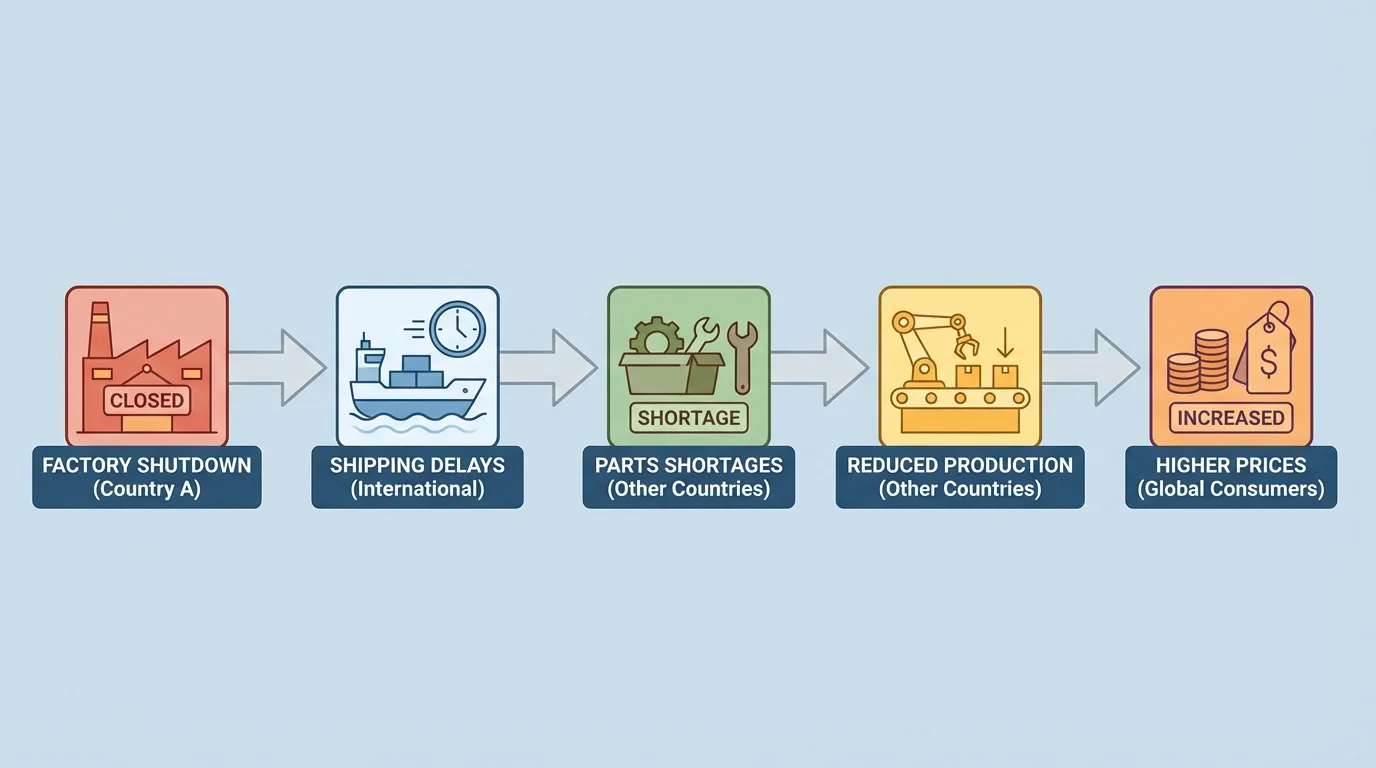
This is why some countries try to balance specialization with security. They may keep some important industries at home, store extra supplies, or trade with several partners instead of relying on only one. Economic decisions are not only about efficiency; they are also about stability and safety.
Resources are limited, and every choice has a cost. That earlier idea about scarcity still matters here: even when trade helps, countries must decide how much to produce themselves and how much to buy from others.
Interdependence can also affect workers unevenly. If imported goods are cheaper, consumers may benefit, but some local businesses may face harder competition. Governments often debate how to protect workers while still allowing trade that helps the wider economy.
Different economic systems handle specialization and trade in different ways. In a market-based system, businesses and consumers make many decisions through buying and selling. In a command economy, the government has much more control over production and trade. Many countries today use mixed systems, combining market activity with government rules and support.
Access to resources matters in every system, but societal values matter too. A country may value self-sufficiency and try to produce more goods at home, even if that is less efficient. Another may value open trade and global connection. Human experiences, such as past shortages, wars, or colonization, can also shape how countries think about dependence on foreign goods.
These choices influence international trade patterns. A country that invests heavily in education and technology may become a center for advanced manufacturing. A country that improves irrigation and transport may expand farm exports. Government choices, natural resources, and human effort all work together.
The food in a lunchbox, the fuel in a bus, the sneakers on a student's feet, and the battery in a tablet are all clues to global interdependence. Specialization may seem like a big economic idea, but it appears in daily life all the time.
When students understand why countries specialize, they can better understand why some products are common, why some prices change quickly, and why events far away can affect local stores. The web of trade is not just about ships and factories. It is about people making choices under scarcity and connecting their work across the world.
Earlier, [Figure 1] highlighted how different regions have different strengths, and [Figure 3] showed why those connections can sometimes create problems. Together, those ideas explain a key truth of economics: specialization can create greater productivity, but it also creates greater dependence on others.
