One of the most powerful ideas in history is this: people do not need to be the largest group to change a government. Again and again, groups with less power, fewer votes, or fewer resources have pushed countries to become fairer. In the United States and across the Western Hemisphere, minorities have shaped laws, voting rights, education, language policy, labor rules, and even ideas about what citizenship means.
In civics, a government is not just a building or a group of leaders. It is a system that makes decisions for a country or community. A civil government is supposed to serve its citizens. But history shows that many citizens had to fight to be heard. Minority groups often faced unfair treatment, yet they still changed government through protest, court cases, writing, organizing, voting, military service, art, religion, and community leadership.
A minority is a group in society that has less power or representation than the majority group. A minority can be identified by race, ethnicity, language, religion, culture, or ancestry. In some places, a group may even be a number majority but still have less political power because of history, wealth, or laws.
Civil government is the system of laws, leaders, and institutions that organizes public life. Representation means people have a voice in government through elected officials or direct participation. Citizenship includes the rights and responsibilities people have in a country.
When we study minorities and government, we are asking an important question: how do citizens shape the systems that govern them? The answer includes long struggles, major turning points, and many brave people who demanded that governments live up to their own ideals.
Governments in the Western Hemisphere include democracies, republics, federal systems, and constitutional systems. These governments often promise rights such as liberty, equality, and participation. But those promises were not always given equally. Minority groups helped expose the gap between a country's ideals and its actual practices.
When minority communities push for change, they often improve government for everyone. For example, voting rights laws created to stop discrimination help protect all voters. Fair labor laws first demanded by immigrant and minority workers can improve working conditions for entire communities. Language access policies can make public services easier for many families to use.
Minority influence is not only political. It is also cultural and social. Music, religion, family traditions, storytelling, foodways, and language can all affect public life. Once people begin to value these contributions, governments sometimes change their laws and institutions to reflect a broader idea of who belongs.
The word "minority" does not always mean a small number of people. In some countries, a group can make up a large part of the population and still have less political power because of long histories of discrimination.
This is why the study of minorities belongs in civics. It helps explain how governments develop over time and how citizens influence that development.
[Figure 1] Long before the United States, Canada, Mexico, or other modern countries existed, Indigenous peoples had their own governments. These systems included councils, alliances, rules, leadership roles, and ways to settle disputes. In North America, the Haudenosaunee, also called the Iroquois Confederacy, built a union of nations with shared decision-making. Some historians believe early American leaders learned from these ideas, especially the importance of unity among separate political communities.
Indigenous governments were not all the same. Some were centralized, while others were based on local communities. Some gave important political roles to clan mothers or councils of elders. This reminds us that government systems can develop in many ways, not just through European models.
When European empires took control of lands in the Americas, Indigenous peoples often lost land, power, and legal protection. Still, they continued to influence government through treaties, negotiations, resistance, and survival. A treaty is a formal agreement between governments or political groups. In the United States and Canada, treaties with Native nations remain important legal documents today.
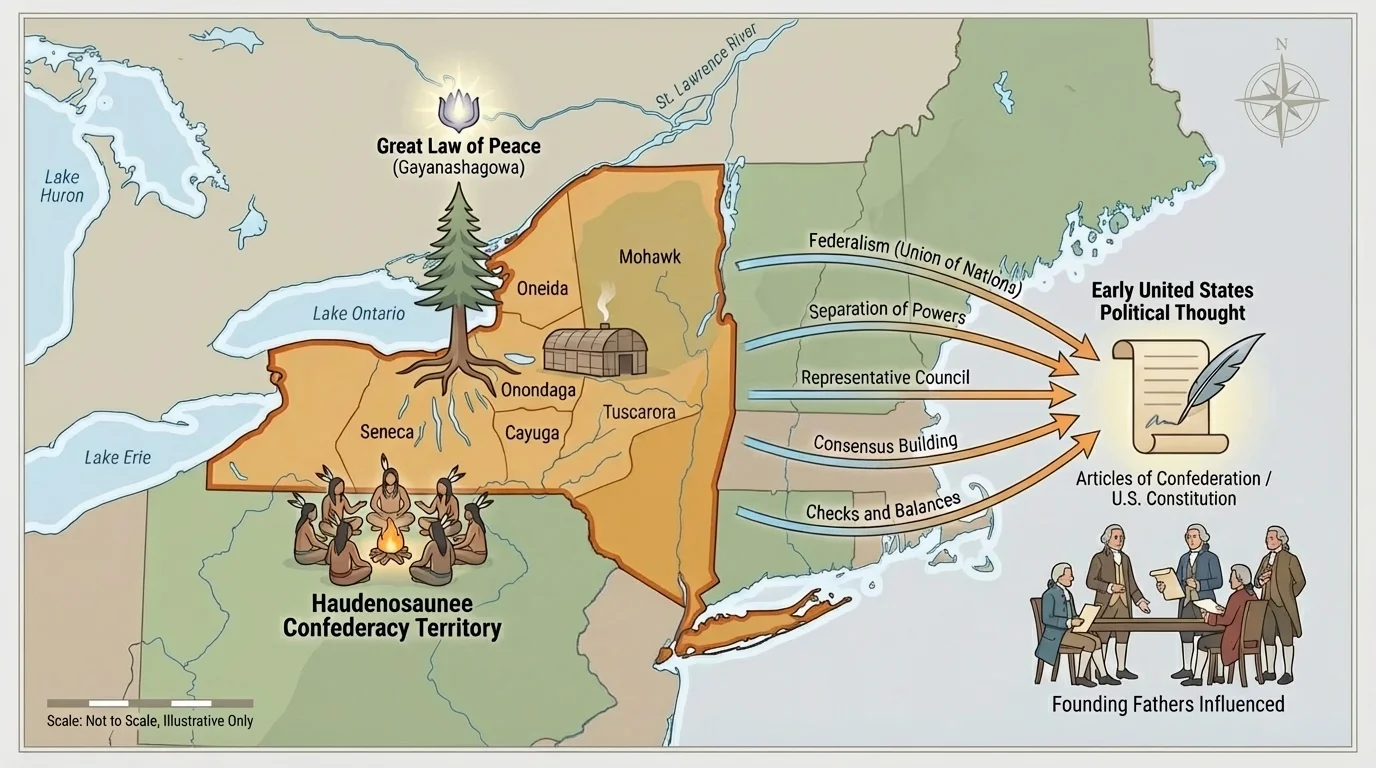
Indigenous activism has also changed modern civil governments. In the United States, Native American groups fought for citizenship, voting rights, religious freedom, and control over tribal lands. In Canada, First Nations, Inuit, and Métis communities pushed for recognition of treaty rights and self-government. In Bolivia and Ecuador, Indigenous movements influenced constitutions and national politics by demanding that governments respect Indigenous languages, traditions, and land rights.
These changes matter because they show that citizens do not only shape government through elections. They also shape it through legal action, community organization, and defense of long-standing rights. The example of Indigenous nations in [Figure 1] helps us see that democratic ideas in the hemisphere have many roots.
Few histories show the power of minority influence more clearly than the history of people of African descent in the Western Hemisphere. From slavery to freedom movements to civil rights campaigns, this struggle stretches across centuries. Enslaved Africans and their descendants did not only suffer under unfair systems; they actively fought to change those systems.
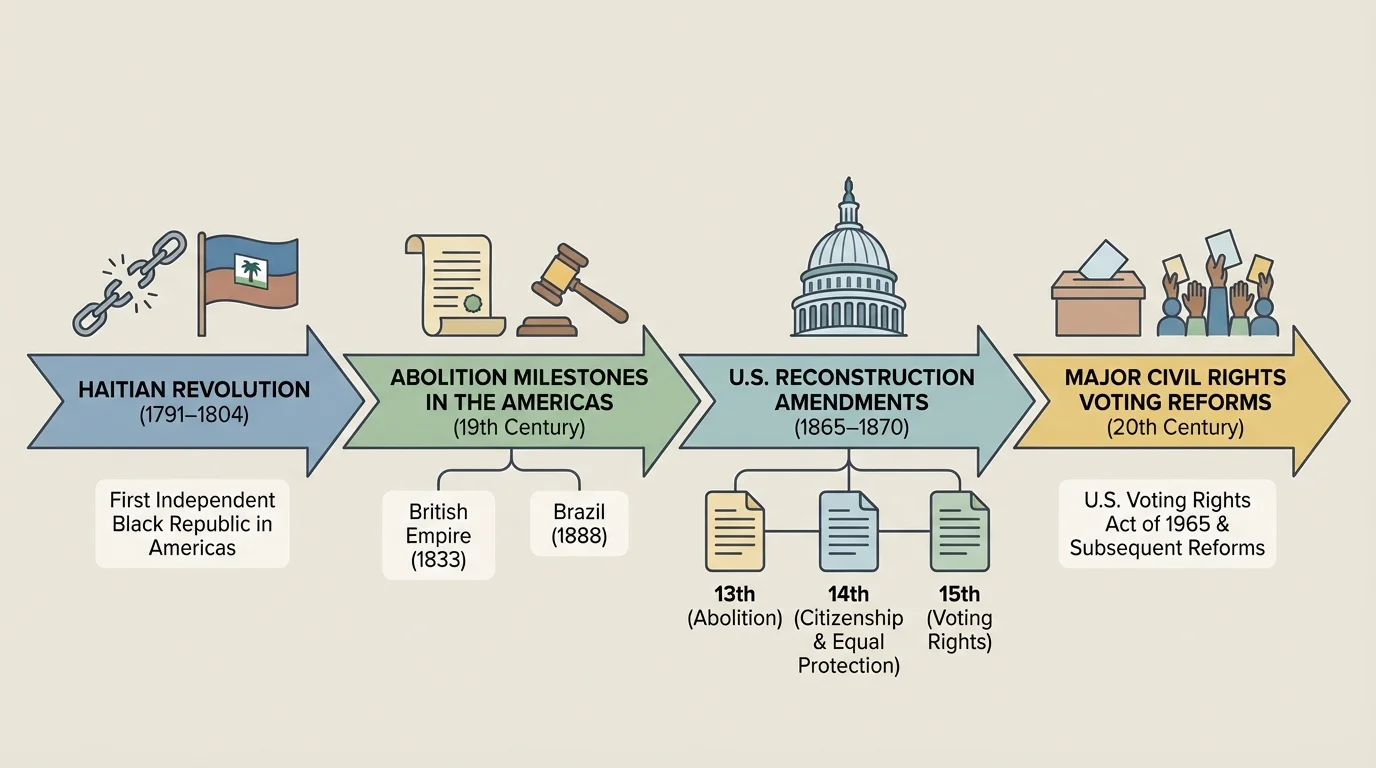
[Figure 2] In the United States, slavery shaped government from the colonial period through the Civil War. Enslaved people resisted in many ways, including escape, rebellion, preserving families, and supporting abolition. Abolition was the movement to end slavery. Leaders such as Frederick Douglass, Harriet Tubman, Sojourner Truth, and many lesser-known activists influenced public opinion and national policy.
After the Civil War, the Reconstruction Amendments changed the Constitution by ending slavery, defining citizenship, and protecting voting rights for men regardless of race. Yet new laws such as poll taxes and segregation still blocked equality. During the twentieth century, the Civil Rights Movement challenged these injustices through court cases, boycotts, marches, speeches, and voter registration drives.
Important figures included Martin Luther King Jr., Rosa Parks, Thurgood Marshall, Fannie Lou Hamer, and John Lewis. Their efforts helped lead to the Civil Rights Act of 1964 and the Voting Rights Act of 1965. These laws changed the relationship between citizens and government by forcing governments to protect rights more fairly.
Across the hemisphere, African descent communities also influenced government. The Haitian Revolution created the first independent nation in Latin America and the Caribbean led by formerly enslaved people. That event shocked the world and proved that enslaved people could overturn an unjust system. In Brazil, Cuba, Colombia, and other nations, Afro-descendant communities pushed for recognition, equal citizenship, and protection from discrimination.
Today, debates about fair policing, voting access, education, and public memory still connect to this history. The long path displayed in [Figure 2] reminds us that governments often change only after repeated pressure from determined citizens.
Case study: The Montgomery Bus Boycott
In 1955, African American citizens in Montgomery, Alabama, protested segregated buses.
Step 1: Rosa Parks refused to give up her seat to a white passenger.
Step 2: Community leaders organized a boycott, meaning people stopped riding the buses.
Step 3: The boycott lasted for more than a year, hurting bus company income and drawing national attention.
Step 4: The Supreme Court ruled that bus segregation was unconstitutional.
This example shows how local citizens can influence government policy through organized, peaceful action.
The boycott also shows that civic action can begin in an ordinary place. A city bus became a space where citizens demanded equal treatment under the law.
Some minority groups are defined by race or ancestry, but others are shaped by gender, religion, or immigrant status. Women were often excluded from political power even when they were half the population. Because they lacked equal rights in many places, women functioned as a politically limited group and organized to change government.
In the United States, leaders such as Susan B. Anthony, Elizabeth Cady Stanton, Ida B. Wells, Alice Paul, and many local activists fought for women's suffrage, or the right to vote. Their work helped lead to the Nineteenth Amendment in 1920. Women in countries across the Western Hemisphere also organized for voting rights, education, and public office.
Immigrant communities shaped government too. Irish, Italian, Chinese, Jewish, Mexican, Cuban, Haitian, and many other immigrants have influenced labor laws, public schools, city politics, and civil rights debates. Sometimes they faced unfair laws that limited immigration, property ownership, or citizenship. By organizing in neighborhoods, unions, churches, and through newspapers, they pushed governments to become more inclusive.
Suffrage movements and immigrant-rights campaigns often worked through petitions, public speeches, legal challenges, and voting once rights were gained. Religious minorities, including Jews, Catholics, Muslims, and others, also strengthened the idea of religious freedom. Their experiences helped define the principle that governments should not force one religion on all citizens.
"The vote is precious. It is the most powerful non-violent tool we have in a democratic society."
— John Lewis
These efforts helped governments better reflect the people they serve. They also taught an important civic lesson: rights that seem normal today were often won through long, difficult campaigns.
Hispanic and Latino communities have had a major influence on civil government in the United States. Their impact includes military service, labor activism, court cases, education reform, bilingual access, and voting-rights efforts. Mexican Americans, Puerto Ricans, Cuban Americans, Dominicans, Central Americans, and other groups have all shaped public life in different ways.
For example, César Chávez and Dolores Huerta helped organize farmworkers to demand better wages and safer working conditions. These efforts linked labor rights to civil rights. They also showed that government policies about workers, agriculture, and public safety affect everyday life.
In schools, parents and activists pushed for fair treatment of Spanish-speaking students and challenged segregation. In elections, Latino voters and community organizations have expanded political participation in cities, states, and national government. As more leaders from these communities were elected, policies began to reflect concerns such as language access, immigration reform, and neighborhood investment.
Cultural influence matters here too. Spanish language media, celebrations, music, food, and family traditions helped shape the public identity of the United States. When government institutions recognize these realities, they often provide translated materials, multilingual ballots, and culturally responsive services. That is one way social and cultural life can affect how government works.
[Figure 3] The Western Hemisphere includes North America, Central America, the Caribbean, and South America. Minority influence took different forms across these regions. Although each country has its own history, many have faced similar questions: Who gets to vote? Which languages are respected? Whose land rights count? Who can hold office? Which cultures are included in the national story?
In Canada, Indigenous peoples and French-speaking communities influenced the structure of government and ideas about rights. In Quebec, language rights became a major political issue. In Mexico, Indigenous communities and reform movements pushed governments to address land, education, and local power. In Bolivia, Indigenous political organizing helped elect leaders who changed national policy and increased recognition of Indigenous identities.
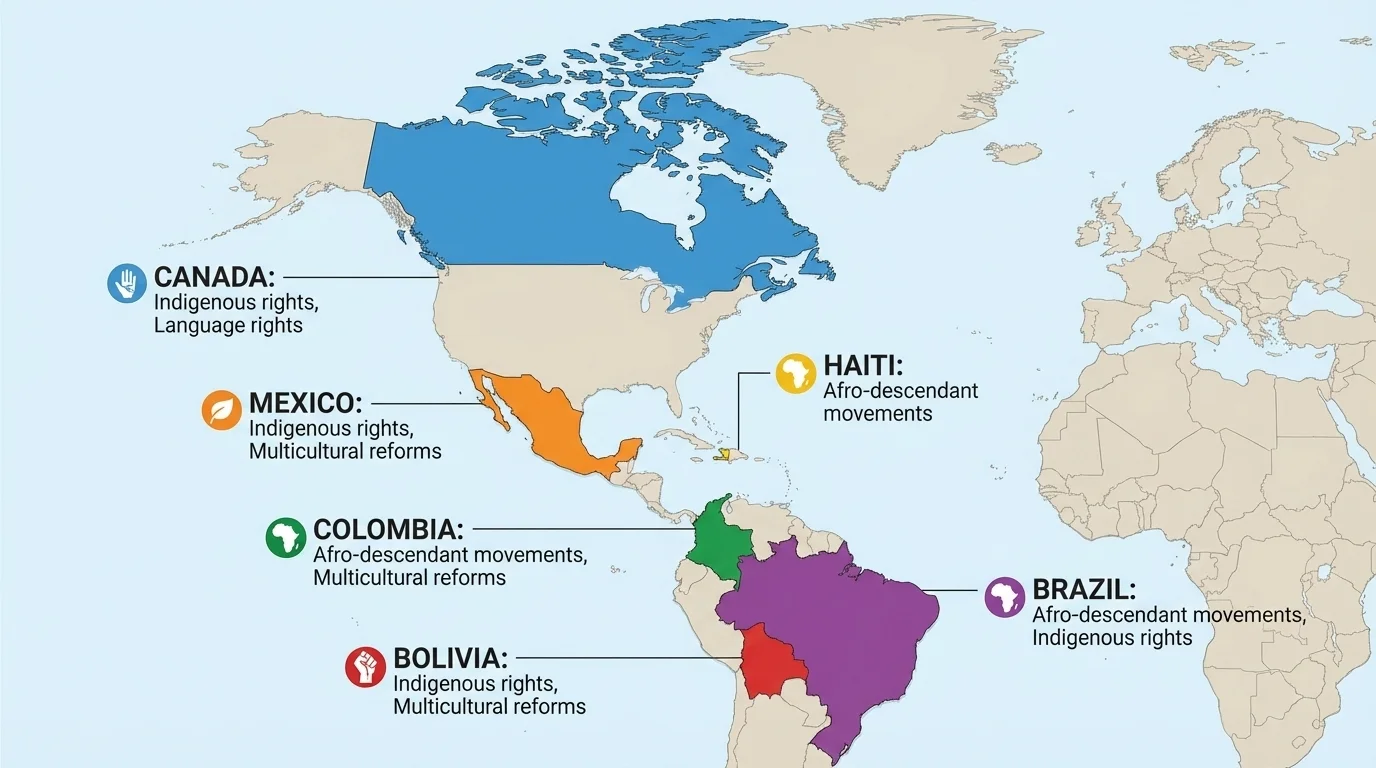
In the Caribbean, the history of colonialism, slavery, and independence shaped governments deeply. Haiti's revolution, for example, transformed ideas about freedom and citizenship. In Brazil and Colombia, Afro-descendant activism encouraged governments to acknowledge racism and pass stronger protections.
Many countries in Latin America now include multicultural or plurinational ideas in public life. Plurinational means recognizing that a country may include several peoples or nations with their own identities inside one state. This idea challenges older models that tried to force everyone into a single culture.
| Country or Region | Minority Group | Government Impact |
|---|---|---|
| United States | African Americans | Civil rights laws, voting-rights protections, expanded representation |
| United States | Native American nations | Treaty rights, tribal self-government, legal recognition |
| Canada | First Nations, Inuit, Métis, French speakers | Language rights, self-government debates, constitutional recognition |
| Haiti | Formerly enslaved people | Independent republic, new ideas about citizenship and freedom |
| Bolivia | Indigenous peoples | Greater recognition in national politics and constitutional change |
| Brazil and Colombia | Afro-descendant communities | Anti-discrimination efforts and stronger public recognition |
Table 1. Examples of minority groups influencing governments across the Western Hemisphere.
Looking across countries helps us notice patterns. Governments often become more democratic when they include more voices. The regional examples on [Figure 3] show that inclusion does not happen in one single way; it grows out of each country's history.
How social and cultural influence becomes political change
Minority communities often begin by building strength in families, neighborhoods, religious groups, schools, and cultural organizations. Those networks can then support petitions, protests, campaigns, lawsuits, and elections. In this way, culture and community life become a foundation for civic power.
This is why songs, newspapers, oral histories, murals, and public celebrations matter in civics. They can help communities preserve identity and organize for change.
Minorities influence government through many methods. Some use court cases to prove a law is unfair. Others organize marches or write speeches that shift public opinion. Some work inside government as elected officials, teachers, judges, or community leaders. Others protect traditions and rights over many generations until governments finally respond.
Governments themselves can change in several ways. They may pass amendments, adopt new constitutions, create civil-rights laws, expand voting access, protect language rights, or recognize local self-government. Sometimes the changes are national; sometimes they begin in a city, state, province, or village.
This process is not always quick. A right may be announced on paper but ignored in real life. That is why participation matters after a law is passed. Citizens must keep watching, voting, speaking, and organizing to make sure governments follow their own rules.
Remember that a democracy depends on participation. Elections matter, but so do court decisions, constitutional protections, community action, and freedom of speech.
When students learn civics, they are really learning how power moves. Minority influence shows that power is not fixed forever. It can be challenged, shared, and reshaped.
Historians and civics students learn about these changes by using primary sources and secondary sources. A primary source comes from the time being studied. Examples include speeches, laws, letters, newspaper articles, photographs, interviews, and court decisions. A secondary source explains the past using research, such as textbooks or history articles.
For example, the text of the Civil Rights Act, a suffrage petition, or a treaty with a Native nation is a primary source. A historian's book explaining those documents is a secondary source. Both are useful, but they do different jobs.
Using sources to study minority influence
A student wants to understand how women influenced voting rights in the United States.
Step 1: Read a primary source such as the Seneca Falls Declaration of Sentiments.
Step 2: Identify what rights the writers demanded and why.
Step 3: Read a secondary source that explains how those demands led to later reforms.
Step 4: Compare the demands in the document with the rights later protected by law.
This process helps students connect ideas, activism, and government change.
Reading sources carefully also teaches an important habit of citizenship: people should look for evidence before making claims about the past or present.
The influence of minorities is still shaping government right now. Debates about voting access, immigration, religious freedom, policing, school curriculum, tribal sovereignty, and language rights are all connected to the longer history of minority participation. Sovereignty means the authority to govern. For tribal nations, sovereignty helps explain why Native nations have a special political status, not just a cultural identity.
Modern governments in the United States and the Western Hemisphere are stronger when they listen to many voices. A government that ignores part of its people is less representative and less just. A government that includes more citizens is usually better able to solve problems fairly.
Students can see the results in everyday life: ballots in multiple languages, holidays that honor civil-rights leaders, elected officials from many backgrounds, legal protections against discrimination, and school lessons that include more than one point of view. These are signs that civil government changes when citizens insist on being seen and heard.
The history of minorities and government teaches that democracy is not finished. It is something people keep building.
