Two people can watch the same event and remember it differently. That is true today after a game, a speech, or a protest, and it was also true hundreds or even thousands of years ago. Historians know that the past does not come to us as a single perfect story. It comes through evidence left behind by real people. To understand what happened, we have to examine that evidence closely and ask whose voice we are hearing, whose voice is missing, and why.
History is not just a list of dates and names. It is an investigation. Historians study evidence from the past and make claims based on that evidence. Some sources were created by people who directly experienced an event. Others were written later by people who studied those earlier materials. Both are useful, but they do different jobs.
When historians analyze sources, they do not simply collect facts. They look for point of view, compare perspectives, and test whether one source matches or challenges another. This is especially important when studying the Eastern Hemisphere, where long histories of empires, trade, religion, migration, and conflict brought many cultures into contact.
Primary source means a source created during the time being studied or by someone directly connected to it. Secondary source means a source created later by someone interpreting or explaining the past. Point of view is the position or perspective from which a source is created, shaped by a person's experiences, beliefs, role, and purpose.
A historian studying ancient Egypt, medieval West Africa, the Mughal Empire, or the Crusades must work like a detective. One source may reveal what a ruler wanted people to believe, while another may reveal what travelers observed, and still another may reveal what archaeology uncovers. None should be accepted without questioning.
Historians often begin by sorting evidence into primary and secondary sources. A soldier's letter from a battle, a merchant's diary, a carved royal inscription, a mosque built during a dynasty, or pottery found at a site can all be primary sources because they come from the period or from direct participants.
A textbook chapter about the Ottoman Empire, a documentary on the Silk Roads, or a modern historian's article about the Gupta Empire are secondary sources. These sources are valuable because they combine many pieces of evidence, explain context, and often compare different viewpoints. But they are still interpretations, not the past itself.
[Figure 1] Primary sources are not automatically more truthful than secondary sources. A king's inscription may exaggerate victories. A diary may include rumors or personal feelings. An eyewitness account may be limited because the witness saw only one part of a larger event. Secondary sources can also differ because historians choose different evidence or emphasize different questions.
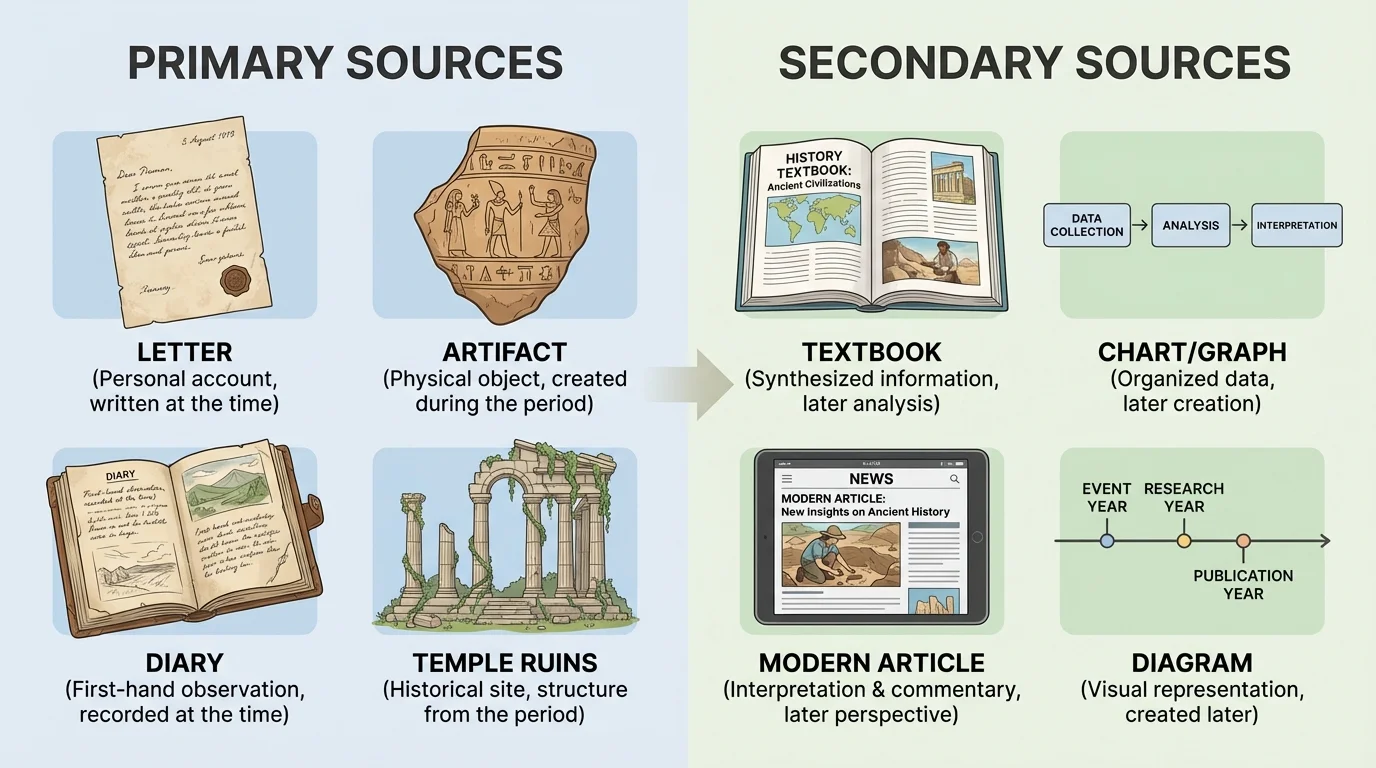
For example, if students study the Black Death in Eurasia, a physician's notes from the time are a primary source. A modern encyclopedia article about the plague is a secondary source. The physician helps us hear a voice from the time period, while the encyclopedia helps organize information from many sources. Good historical analysis often uses both.
Perspective is shaped by who a person is and what role that person plays. A ruler, farmer, soldier, monk, merchant, artist, or traveler may all describe the same event differently. Their wealth, religion, gender, language, social class, and location can influence what they notice and how they interpret it.
Point of view is also shaped by audience and purpose. A speech meant to inspire soldiers will sound different from a private diary entry. A letter to a family member may be more emotional than an official government report. A painting created to honor a ruler may leave out suffering or resistance.
This does not mean sources are without value. It means historians must read carefully. Instead of asking only, "Is this true?" historians also ask, "Why was this made?" "Who was meant to see it?" and "What might the creator want the audience to think?"
Some of the most important ancient sources were made to impress people, not to be fair. Royal inscriptions often celebrated victories and ignored defeats, which is exactly why historians compare them with other evidence.
A source can be biased and still be valuable. In fact, bias often reveals important information. If a ruler's inscription boasts about building roads, temples, or hospitals, it tells us not only what may have happened but also what the ruler wanted people to admire.
History does not live only in books. It appears in many forms, and each form reveals different clues. Learning to read many types of evidence helps historians build a fuller picture of the past.
Art can show clothing, technology, religious beliefs, power, and values. A mural from ancient Egypt may show social rank by size and position. A Persian miniature painting may reveal court life. But art may also idealize the subject. It often shows how people wanted events remembered, not just how events looked.
Eyewitness accounts are powerful because they come from people who were present. A traveler like Ibn Battuta described places across Africa and Asia. His writings help historians understand trade, cities, religion, and daily life. However, eyewitnesses can misunderstand unfamiliar customs or focus on what surprised them most.
Letters and diaries often feel personal. They can reveal fears, hopes, routines, and private reactions. A soldier's letter from a campaign or a merchant's diary from the Indian Ocean trade routes may show daily life more clearly than an official record. Yet these sources represent individual experiences, not everyone's experience.
Artifacts are physical objects from the past, such as coins, tools, pottery, weapons, jewelry, or clothing. Artifacts help historians study people who left few written records. A coin may show a ruler's image and language. A broken jar may reveal trade because the clay came from a different region.
[Figure 2] Historical sites such as temples, ruins, tombs, forts, and cities provide evidence about architecture, religion, defense, settlement patterns, and technology. The remains of Great Zimbabwe, the pyramids at Giza, or the ancient city of Mohenjo-daro help historians ask questions about labor, power, trade, and engineering.
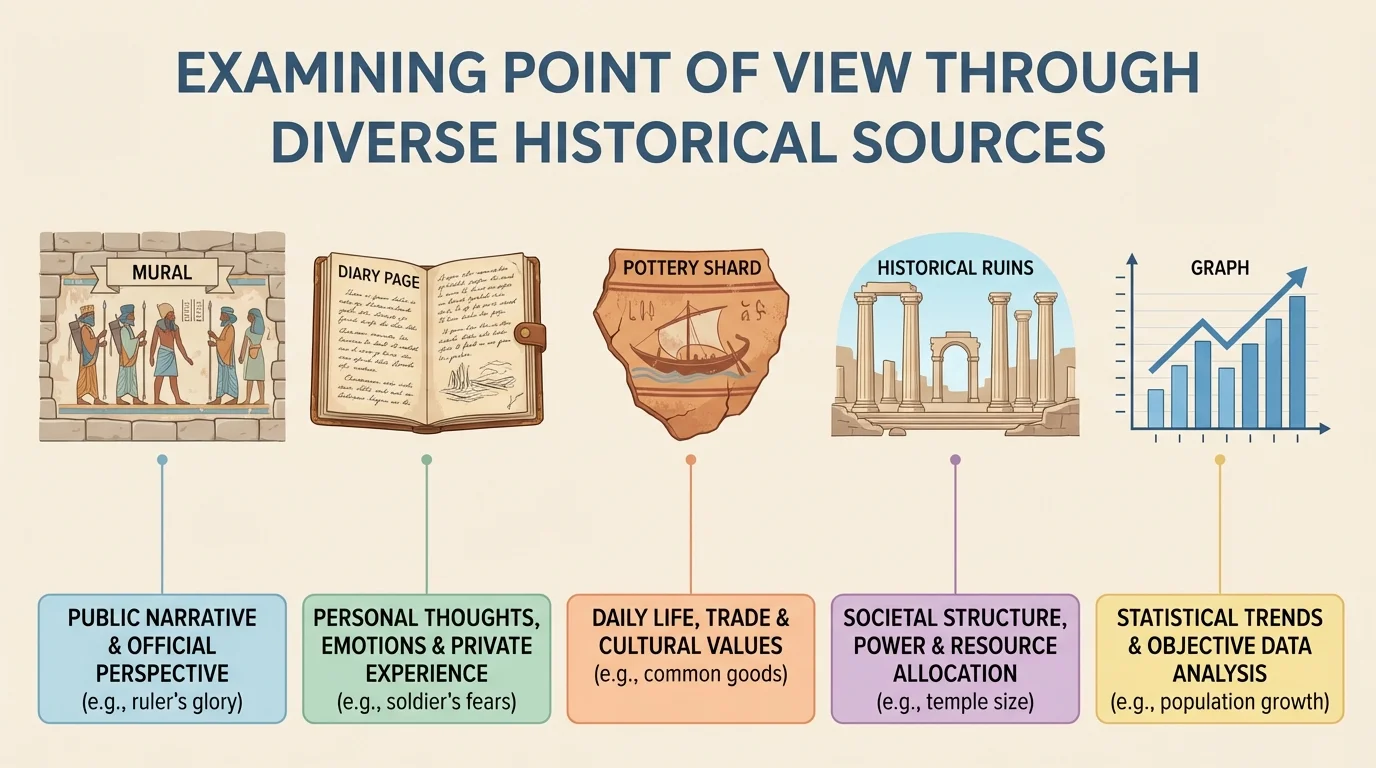
Charts, graphs, and diagrams are especially useful when historians organize information. A graph of population loss during a famine or epidemic can make patterns easier to see. A trade-route diagram can reveal how goods, ideas, and religions moved across regions. These visual sources are often based on collected data, so historians must ask where the numbers came from and whether they are complete.
Written texts include laws, chronicles, religious writings, government records, poems, and histories. A law code can show what leaders wanted to control. A religious text can show beliefs and values. A chronicle can record events, but it may favor one group over another.
When we return later to compare evidence, [Figure 2] remains useful because it reminds us that each kind of source answers different questions. A diary may explain feelings, while an artifact may prove trade connections.
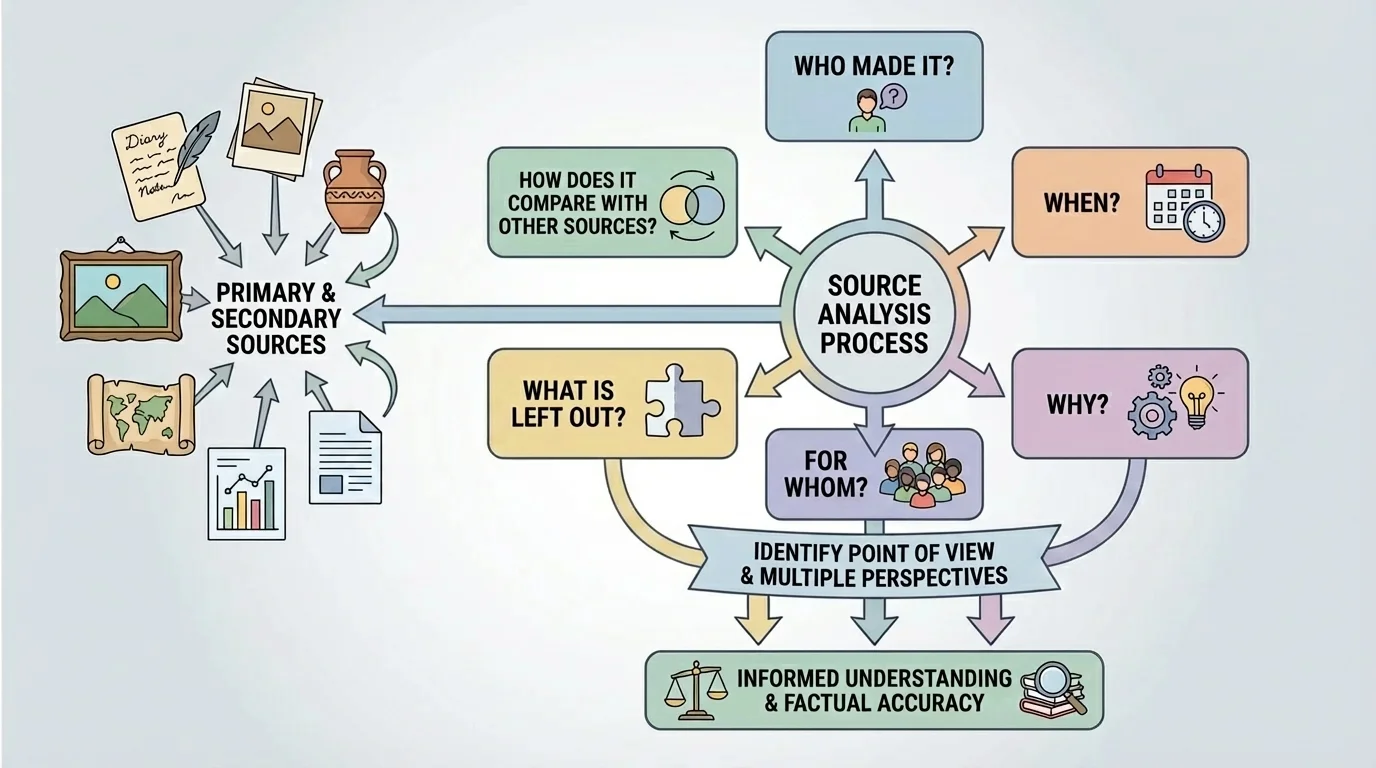
[Figure 3] Historians do not read sources passively. They use a repeated set of questions. This method helps students move beyond simply noticing information to actually analyzing it.
One of the first skills is sourcing, which means identifying who created a source, when it was created, and why. A source made during an event usually gives a different kind of information than one written centuries later. A court historian working for an emperor may praise the emperor more than an outsider would.
Another skill is context. Context means the circumstances around the source: the time period, place, events, and social conditions. A speech calling for war sounds different when we know a kingdom has just been invaded. A tax record looks different when we know a drought had harmed harvests.
Historians also look for bias, meaning a preference or leaning that shapes how information is presented. Bias is not always deliberate lying. It can come from loyalty, religion, fear, pride, or limited knowledge. Recognizing bias helps us understand what a source emphasizes or ignores.
Then comes corroboration, the process of comparing sources to see where they agree or disagree. If an emperor's inscription claims a great victory, historians may compare it with enemy records, archaeology, and later accounts. Agreement across different kinds of sources strengthens confidence. Disagreement raises new questions.
As we continue, [Figure 3] helps organize this thinking: who made the source, when, why, for whom, what is missing, and how it matches other evidence. These questions turn reading into investigation.
Missing voices matter. Many people in history left few written records, including peasants, enslaved people, women in some societies, and conquered groups. Historians try to recover these voices through artifacts, oral traditions, architecture, court cases, tax records, and the writings of others who mentioned them.
If only powerful people left documents, history can become unbalanced. That is why the study of multiple and diverse perspectives is so important. It helps historians challenge incomplete stories and search for evidence beyond the most famous voices.
The Crusades are a strong example of why multiple perspectives matter. These conflicts involved Christian Europeans, Muslim states, Byzantine leaders, local communities, merchants, and pilgrims. Accounts from these groups do not sound the same, and the map of these connected regions helps explain why.
[Figure 4] Some European Christian chronicles described the Crusades as holy missions. They emphasized religious duty, courage, and sacred goals. Some Muslim chroniclers described the same events as invasions that brought violence and disruption. Byzantine sources sometimes showed concern about western armies passing through their territories and pursuing their own goals.
Even the capture of Jerusalem can look very different depending on the source. A European chronicler might celebrate it as victory. A Muslim chronicler might focus on massacre and loss. A later secondary source might compare both accounts and ask how religious belief, military purpose, and audience shaped each narrative.
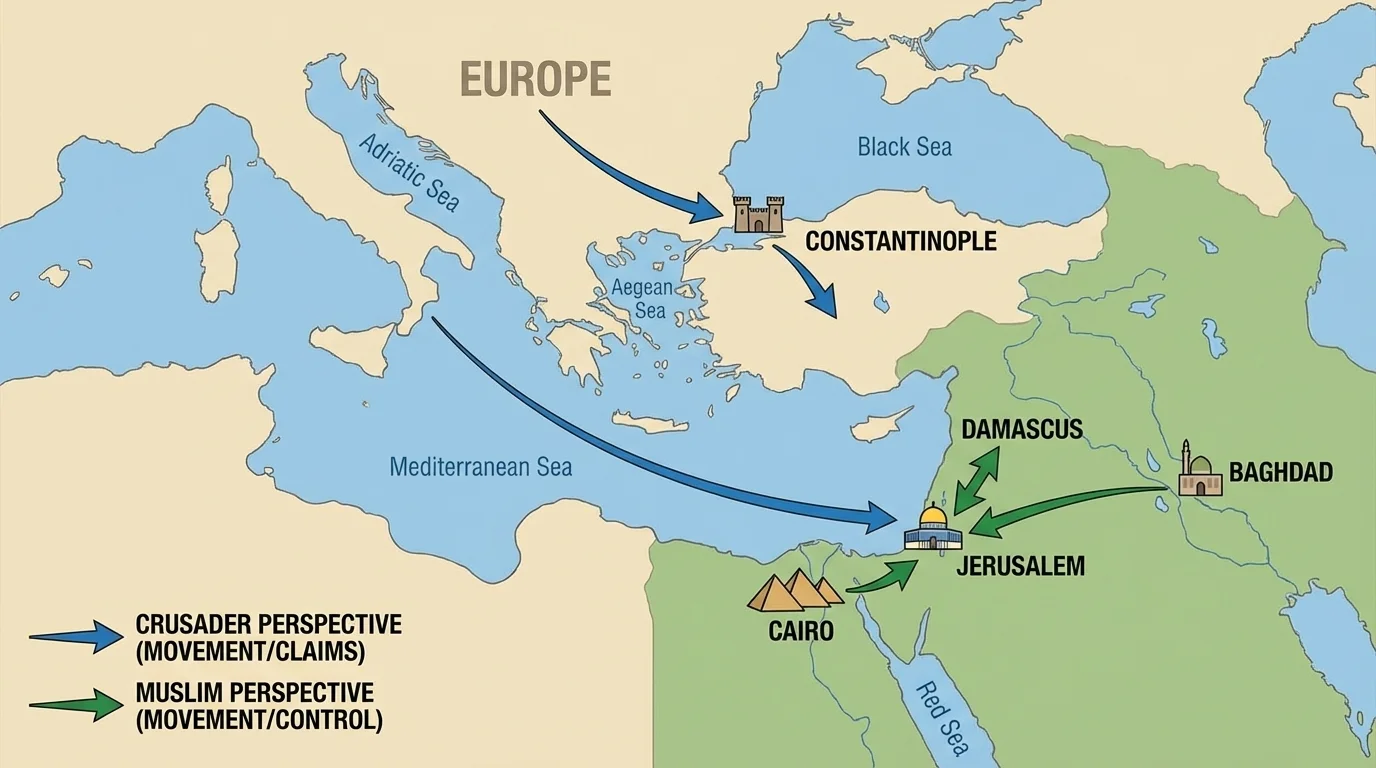
When historians study the Crusades, they do not choose one voice and ignore the rest. They compare religious writings, chronicles, letters, maps, archaeological evidence, and modern scholarship. That comparison reveals not only what happened but also how different societies understood the events.
Later, when students build arguments, [Figure 4] still helps because it reminds us that these perspectives came from different places connected by travel, trade, belief, and war across the eastern Mediterranean.
"History is written by many hands, and each hand leaves a mark."
This idea fits the Crusades well. The event was not experienced in one way, so it cannot be responsibly explained from one source alone.
Another useful example comes from South Asia. Emperor Ashoka of the Mauryan Empire is known partly through inscriptions carved on rocks and pillars. These inscriptions are primary sources because they come from his time and express royal messages directly.
In the inscriptions, Ashoka presents himself as a moral ruler who supports nonviolence, justice, and care for his people after the bloody Kalinga War. That is important evidence, but historians still ask questions. Was he describing all of his government honestly, or was he presenting the image of an ideal ruler?
To answer that, historians compare the inscriptions with archaeology, evidence of roads and administration, Buddhist traditions, and modern historical writing. A secondary source may explain that Ashoka's inscriptions reveal both sincere beliefs and political purpose. They are valuable not because they are perfectly neutral, but because they show what message a ruler wanted spread across a huge empire.
This case also shows why artifacts and sites matter. The pillars themselves, their locations, and the languages used in the inscriptions provide clues about communication, political control, and intended audiences.
Case study comparison
Suppose a historian wants to answer the question: How should we understand Ashoka's rule?
Step 1: Read the royal inscription.
The inscription praises moral government and regret after war. This suggests Ashoka wanted to be seen as an ethical ruler.
Step 2: Add evidence from archaeology and sites.
Pillars placed across different regions suggest organized government and a deliberate effort to reach many audiences.
Step 3: Compare with secondary sources.
Modern historians may agree that Ashoka promoted moral ideas, but they may also argue that the inscriptions strengthened imperial authority.
Step 4: Form a claim.
A strong claim would say that Ashoka's inscriptions reveal both genuine moral messaging and political strategy.
This example shows how the best conclusions often include more than one idea at the same time. History is not always either-or. Sometimes a source can be both sincere and self-serving.
Historians do more than gather facts; they build an argument from evidence. A strong historical claim, or thesis, answers a question in a clear and supportable way.
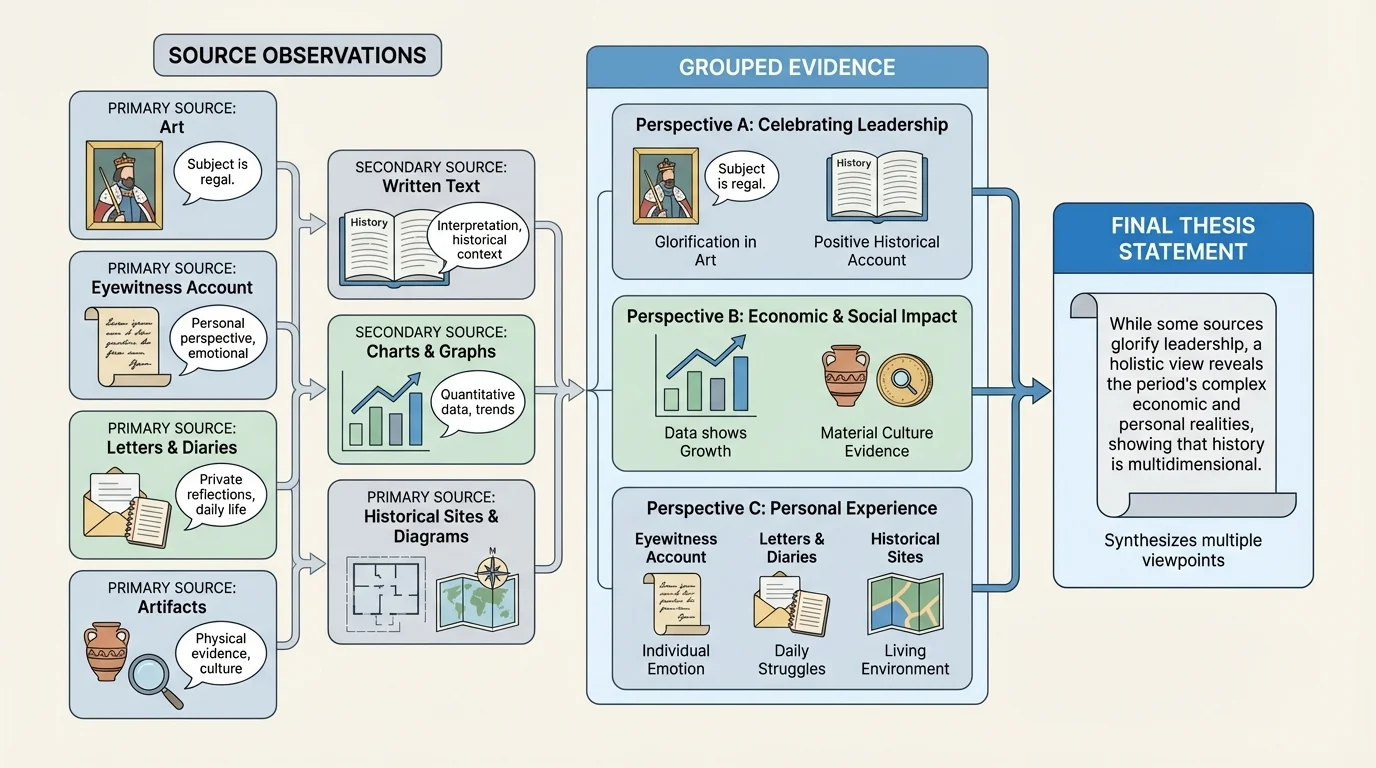
For example, imagine the question: Why are the Crusades remembered differently in different sources? After comparing European Christian chronicles, Muslim accounts, and modern secondary sources, a student might form this thesis: The Crusades are remembered differently because religious beliefs, political goals, and audience shaped how each group described the same events.
That thesis works because it does more than repeat facts. It explains a pattern. It can also be supported with evidence from multiple sources. One source may show celebration, another grief, and another comparison by a historian.
A good thesis is usually specific, arguable, and based on evidence. It should not be too broad, such as "The Crusades were important." Almost any event is important in some way. A better thesis explains how or why.
When organizing evidence, students can group sources by perspective, purpose, or type. Looking back at [Figure 5], the process becomes clear: observe what each source says, sort the evidence into meaningful groups, and then write a claim that those groups support.
| Question to Ask | Why It Matters | Example |
|---|---|---|
| Who created the source? | Reveals role and possible viewpoint | A monk, ruler, merchant, or traveler may notice different things |
| When was it created? | Shows closeness to the event | A diary from the time differs from a book written centuries later |
| Why was it created? | Helps identify purpose | A speech may persuade, while a tax record may document |
| Who was the audience? | Shapes tone and content | A public inscription differs from a private letter |
| What is missing? | Reveals limits and silence | Common people may not appear in royal records |
| How does it compare with other sources? | Tests reliability and reveals differences | An inscription may conflict with archaeology or another account |
Table 1. Key questions historians use to analyze sources and point of view.
One common mistake is assuming that one source tells the whole truth. Every source is limited. Another mistake is confusing firsthand with unbiased. A witness may be close to an event but still misunderstand it.
A third mistake is ignoring missing voices. If a source comes from a ruler, students should ask what ordinary people might have experienced differently. If a painting shows only victory and order, students should ask whether conflict, fear, or resistance is absent.
A fourth mistake is treating secondary sources as if they are just opinions. Strong secondary sources are based on evidence and careful comparison. Historians disagree sometimes, but those disagreements are often useful because they reveal how the same evidence can support more than one interpretation.
Evidence becomes stronger when it is relevant, specific, and supported by more than one source. Historians do not collect details randomly; they select evidence that helps answer a question.
When students read closely, compare carefully, and pay attention to point of view, history becomes more than memorizing information. It becomes a way of thinking. The past is complex, and understanding it requires patience, evidence, and a willingness to listen to more than one voice.
