A border on a map can look like a simple line, but in real life it can represent centuries of migration, trade, belief, war, and memory. Across the Eastern Hemisphere, people have moved into new lands, built cities, spread religions, exchanged inventions, and fought bitter conflicts. The world we see today in Asia, Africa, Europe, and the Middle East was shaped by those interactions. To understand current events, we often have to look backward first.
The Eastern Hemisphere includes a huge part of the world: Europe, Asia, Africa, and Australia. It is home to many of the world's oldest civilizations and to several major religions. It has also been the site of major wars, empires, revolutions, and migration movements. When historians study this region, they do not just memorize dates. They ask how people and cultures influenced one another and how earlier choices still affect life today.
For example, a conflict over water between countries may be linked to old borders. Religious differences may connect to events from more than a thousand years ago. Refugee movements today may have roots in wars or discriminatory policies from decades earlier. History helps us make sense of those patterns.
Migration is the movement of people from one place to another, either within a region or across borders. Settlement pattern means the way people spread out and establish communities. Cultural exchange happens when people share ideas, goods, beliefs, and technologies.
These ideas are central to the study of the Eastern Hemisphere because human movement constantly changed the region. Some groups moved peacefully for trade or farming. Others were forced to move by war, climate problems, or persecution. Wherever people moved, they brought language, food, religion, skills, and customs with them.
People in the Eastern Hemisphere settled where they could survive and prosper. River valleys such as the Nile, Tigris-Euphrates, Indus, and Huang He supported farming. Coastal areas supported fishing and sea trade. Mountain passes, deserts, and steppe lands shaped who could travel where. Over time, these geographic features helped create major routes of movement, as shown in [Figure 1], where trade and migration paths connect distant regions.
One famous network was the Silk Road, a set of land routes connecting China to Central Asia, the Middle East, and Europe. Another was the Indian Ocean trading system, which linked East Africa, the Arabian Peninsula, India, and Southeast Asia by sea. Traders carried silk, spices, gold, and ceramics, but they also carried languages, artistic styles, diseases, and religious beliefs. A merchant might sell cloth in one port and learn a new faith in the next.
Migration also changed settlement patterns. Turkic peoples moved across Central Asia and into Southwest Asia. Bantu-speaking peoples spread across much of sub-Saharan Africa over centuries, bringing farming and ironworking. Arab expansion spread the Arabic language and Islam across North Africa and parts of Southwest Asia. In many places, new arrivals mixed with local populations, creating blended cultures rather than replacing one culture completely.
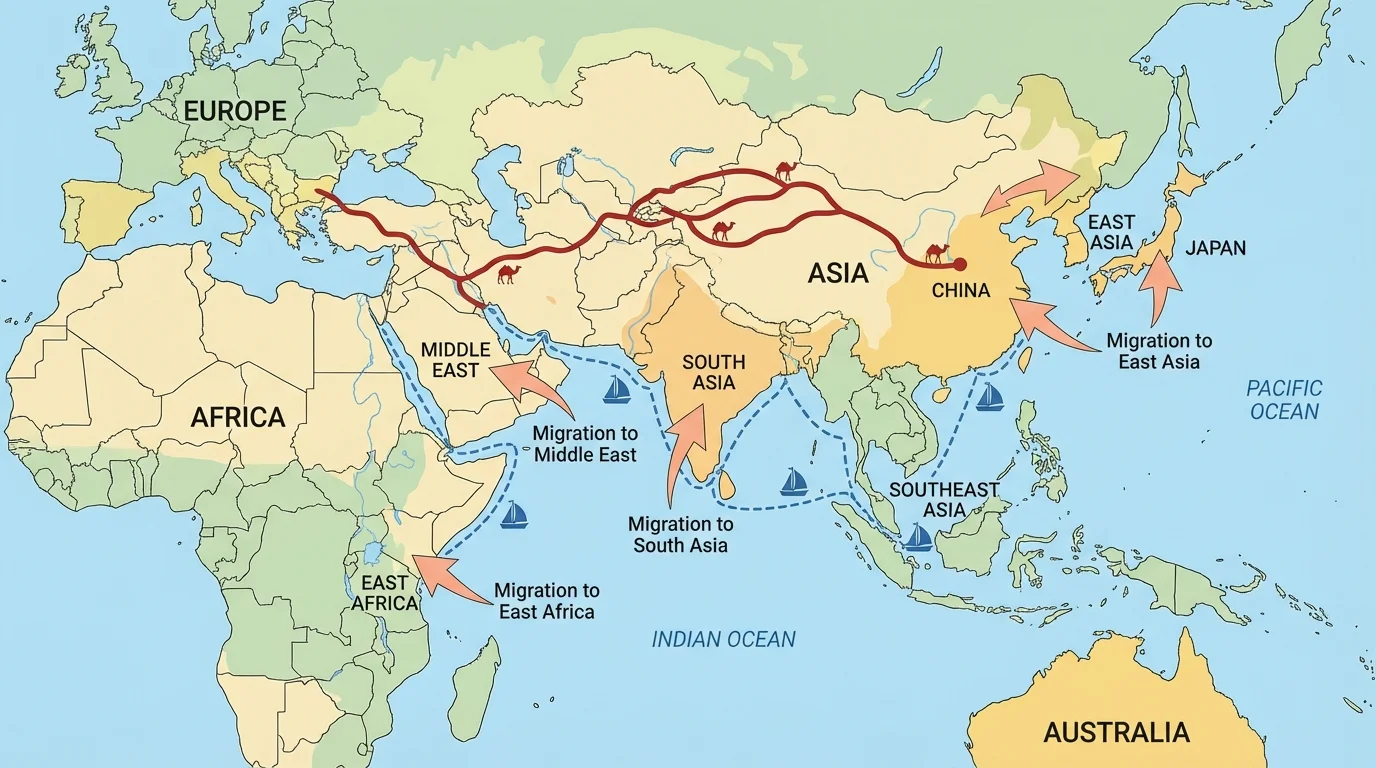
These exchanges brought important contributions. Chinese papermaking and gunpowder spread westward. Indian mathematics, including the concept of zero, influenced many regions. Crops such as bananas and rice moved into new environments and changed diets. Islam spread not only through conquest in some places but also through trade networks, especially in ports around the Indian Ocean.
Settlement was not always peaceful. People often fought over fertile land, river valleys, trade routes, and grazing areas. Geography can create opportunity, but it can also create competition. This pattern appears again and again in Eastern Hemisphere history.
Paper, one of history's most influential inventions, was first developed in China and later spread across Asia, the Middle East, and Europe. That single technology helped governments keep records and helped religions and scholars preserve ideas.
When historians look at migration, they ask both what moved and what changed. People moved, but so did crops, technologies, and belief systems. That is why the trade routes in [Figure 1] matter so much: they were highways of culture as well as commerce.
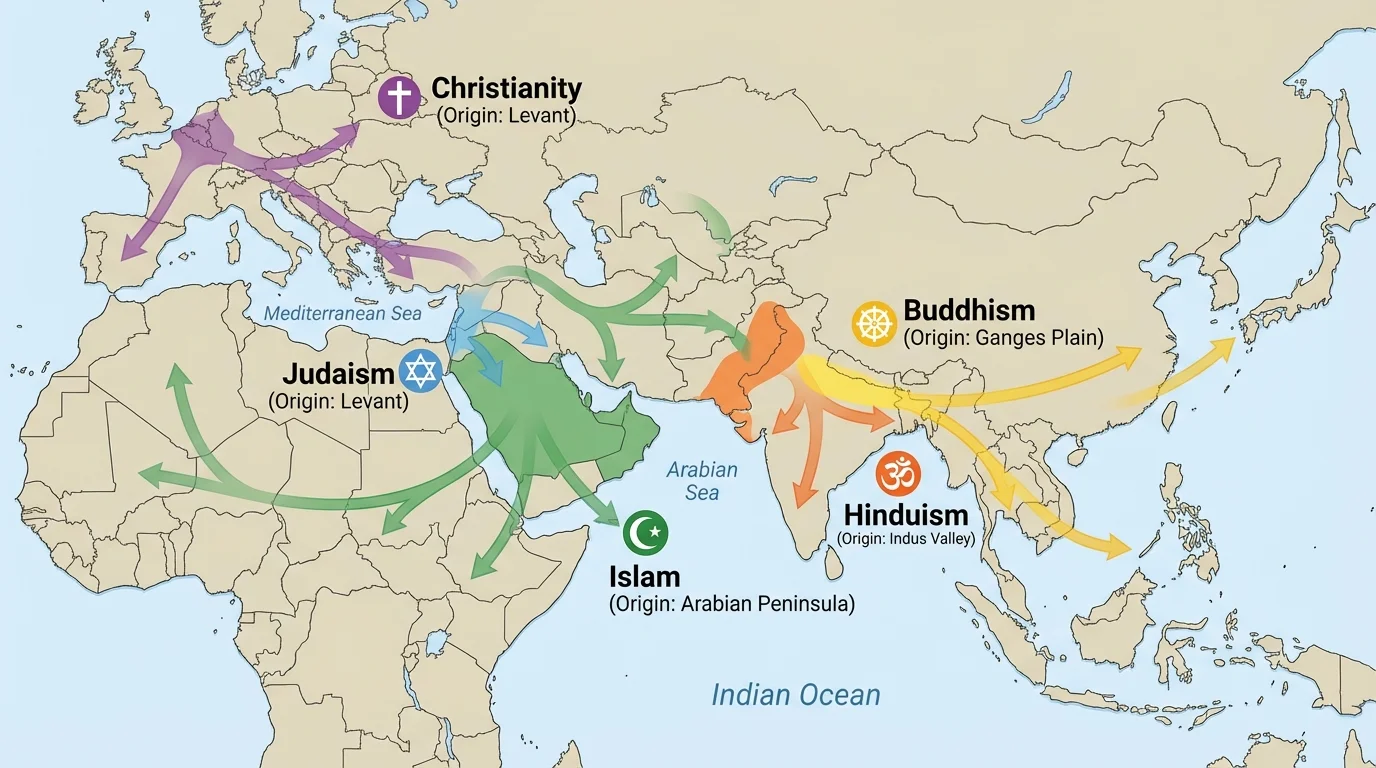
[Figure 2] Several major religions began in the Eastern Hemisphere and spread far beyond their birthplaces. Their origins matter because beliefs shape laws, holidays, art, architecture, ethics, and even political conflict. The pattern of spread across the region helps explain why neighboring societies may share some traditions but differ strongly in others.
Hinduism developed in South Asia over a long period. It has no single founder and includes many beliefs and practices. Ideas such as dharma, karma, and reincarnation became central to Hindu thought. Hindu traditions influenced social life, literature, and art in India and nearby regions.
Buddhism began in northern India with Siddhartha Gautama, known as the Buddha. He taught that suffering is part of life and that people can seek enlightenment by following the Middle Way. Buddhism spread to Sri Lanka, Southeast Asia, Central Asia, China, Korea, and Japan. As it spread, it changed in different places, creating traditions such as Theravada and Mahayana Buddhism.
Judaism began in the ancient Middle East and emphasized belief in one God, moral law, and covenant. Christianity also began in the Middle East, growing from Jewish traditions and the teachings of Jesus. It later spread into Europe, North Africa, and parts of Asia. Islam began in the Arabian Peninsula in the 7th century with the teachings of the Prophet Muhammad. The Qur'an and the Five Pillars became key parts of Islamic life, and Islam spread rapidly across Southwest Asia, North Africa, Central Asia, and beyond.
Why religions spread
Religions spread through trade, migration, missionaries, conquest, and the support of rulers. A king might adopt a religion and encourage its spread, but ordinary travelers, merchants, monks, and families were also powerful carriers of belief.
Religions sometimes connected people across large distances. Muslims from different lands met during pilgrimage. Buddhist monasteries served as centers of learning. Christian and Jewish communities created networks across many regions. At the same time, religious differences could also contribute to tension, especially when rulers used religion to unify some groups while excluding others.
This mixed pattern still matters today. Modern countries in the Eastern Hemisphere often include people of different faiths living side by side. Understanding the roots shown in [Figure 2] helps explain both cultural richness and occasional conflict.
Contact between East and West did not begin in modern times. For centuries, travelers, merchants, diplomats, and armies connected these regions. The Silk Road linked China with lands farther west. The Indian Ocean connected East Africa, South Asia, and Southeast Asia. Encounters between the Byzantine Empire, Islamic caliphates, Mongol Empire, and European kingdoms all changed the flow of goods and ideas.
One important example was the Mongol Empire. Though created by conquest, it unified a vast area of Eurasia for a time and made overland travel safer in some regions. This allowed merchants and travelers such as Marco Polo to move across long distances more easily. Disease also traveled more easily, including the plague, which had devastating effects.
East-West contact produced major contributions. Technologies like the compass and papermaking spread. Artistic designs blended. New foods and crops moved between regions. Yet contact also brought domination and violence. In later centuries, European imperial powers expanded into Asia and Africa, often controlling trade and territory for their own benefit. That history still affects politics and economics today.
"The farther one travels, the more one learns that the world is connected."
— Historical idea reflected in trade and travel accounts
Historians use both primary source and secondary source evidence to study these contacts. A traveler's diary is a primary source because it comes from the time being studied. A textbook chapter about the traveler is a secondary source because it was created later to explain the past.
Not all interactions were peaceful. Across the Eastern Hemisphere, countries and groups have fought over land, water, minerals, trade routes, and political control. Sometimes the issue is who owns a border region. Sometimes the conflict is about access to a river, oil field, or port. Even when resources are limited, the deeper causes often include nationalism, historical claims, and fear.
Water is a major example. Rivers cross modern national borders, so countries upstream and downstream may disagree about dams or water use. Oil and natural gas have also created conflict, especially in parts of the Middle East and Central Asia. Land can hold symbolic meaning too. A region may be valued not only for its resources but also because people see it as part of their national history.
| Type of conflict | Example issue | Why it matters |
|---|---|---|
| Border conflict | Disputed territory between countries | Control of land, identity, security |
| Water conflict | Use of rivers crossing borders | Farming, drinking water, electricity |
| Resource conflict | Oil, gas, minerals, fishing grounds | Wealth, industry, power |
| Ethnic or religious conflict | Groups competing for political control | Rights, representation, safety |
Table 1. Common kinds of conflicts over land, resources, and identity in the Eastern Hemisphere.
These disputes often have long histories. A modern border may have been drawn by an empire or colonial ruler with little concern for local communities. Later generations inherit the conflict. That is why learning history is useful for solving present-day problems: it reveals how today's disagreements developed.
After World War II, the global rivalry between the United States and the Soviet Union affected many countries in Asia. This period, called the Cold War, was not one single battle. It was a long struggle for influence, ideas, and power. Two of the most important conflicts in the Eastern Hemisphere during this era were the Korean War and the Vietnam War.
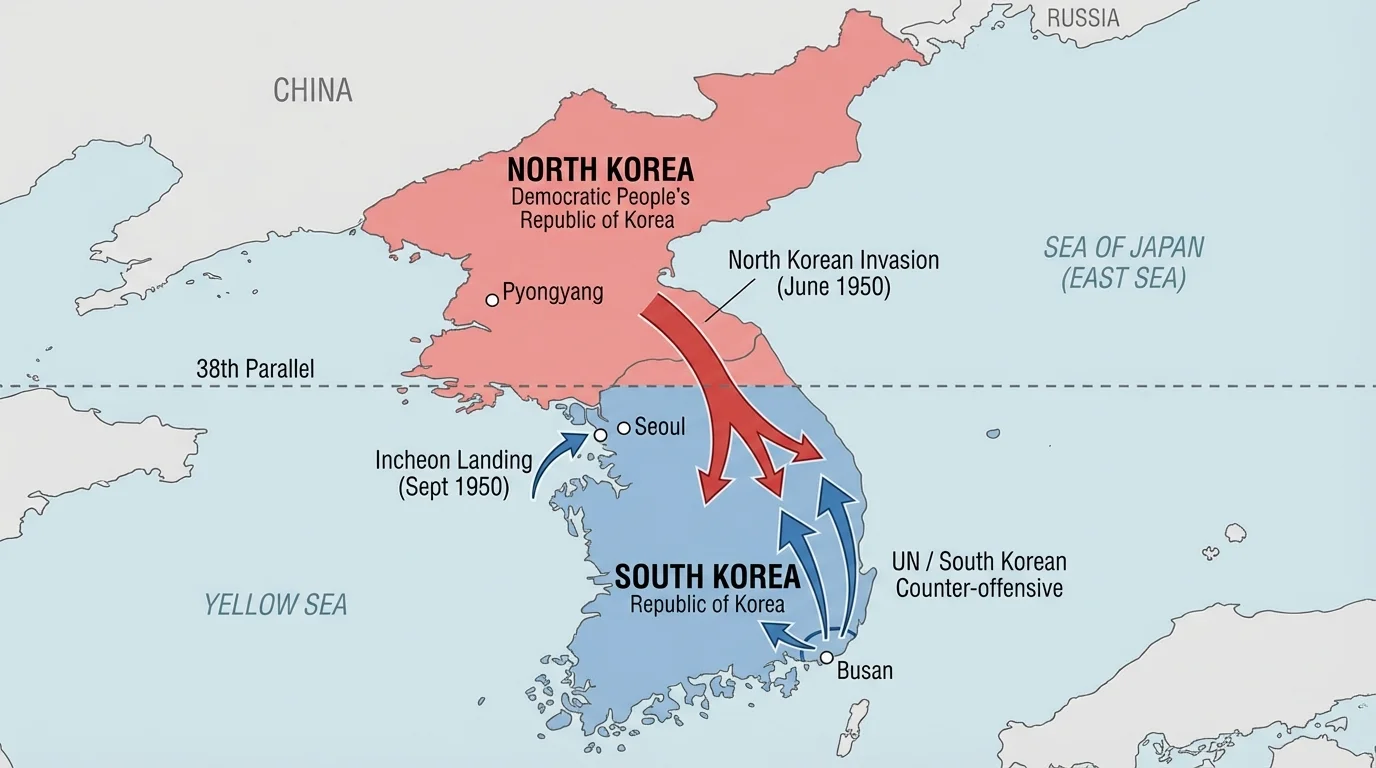
[Figure 3] The Korean War began after Korea, once controlled by Japan, was divided at the 38th parallel after World War II. A communist government formed in the north, and a non-communist government formed in the south. In 1950, North Korea invaded South Korea. The United Nations, led mainly by the United States, supported South Korea, while China supported North Korea.
The fighting was intense and destructive. Cities were damaged, and many civilians were killed or displaced. By 1953, an armistice ended major fighting, but no full peace treaty was signed. Korea remained divided into North Korea and South Korea, a division that still exists today.
Case study: Why the Korean War still matters
Step 1: Look at the historical cause.
Japanese rule ended in 1945, but outside powers divided Korea instead of creating one united government.
Step 2: Trace the conflict.
Competing governments claimed authority, and invasion in 1950 turned division into war.
Step 3: Connect it to today.
The border remains heavily guarded, families were separated, and tensions on the peninsula still affect world politics.
The Vietnam War also grew from Cold War tensions and from resistance to colonial rule. Vietnam had been controlled by France. After World War II, Vietnamese nationalists fought for independence. The country was later divided into communist North Vietnam and non-communist South Vietnam. The United States supported South Vietnam because it feared the spread of communism.
The war involved guerrilla tactics, bombing, and heavy civilian suffering. Many villages were destroyed, and millions of people were killed across Vietnam, Laos, and Cambodia. In 1975, North Vietnam captured Saigon, and Vietnam was united under a communist government. The war left deep scars, including refugee movements, environmental damage, and lasting political memories.
The Korean War and the Vietnam War show that international conflicts often affect ordinary families the most. They also show how local struggles can become part of larger global rivalries. The division seen in [Figure 3] is more than a map feature; it represents a conflict whose consequences continue into the present.
[Figure 4]
Some of the most painful events in the Eastern Hemisphere were not wars between countries but campaigns of violence within countries. The sequence of the Chinese Cultural Revolution and Khmer Rouge rule in Cambodia shows how political movements can turn into widespread fear, persecution, and mass death.
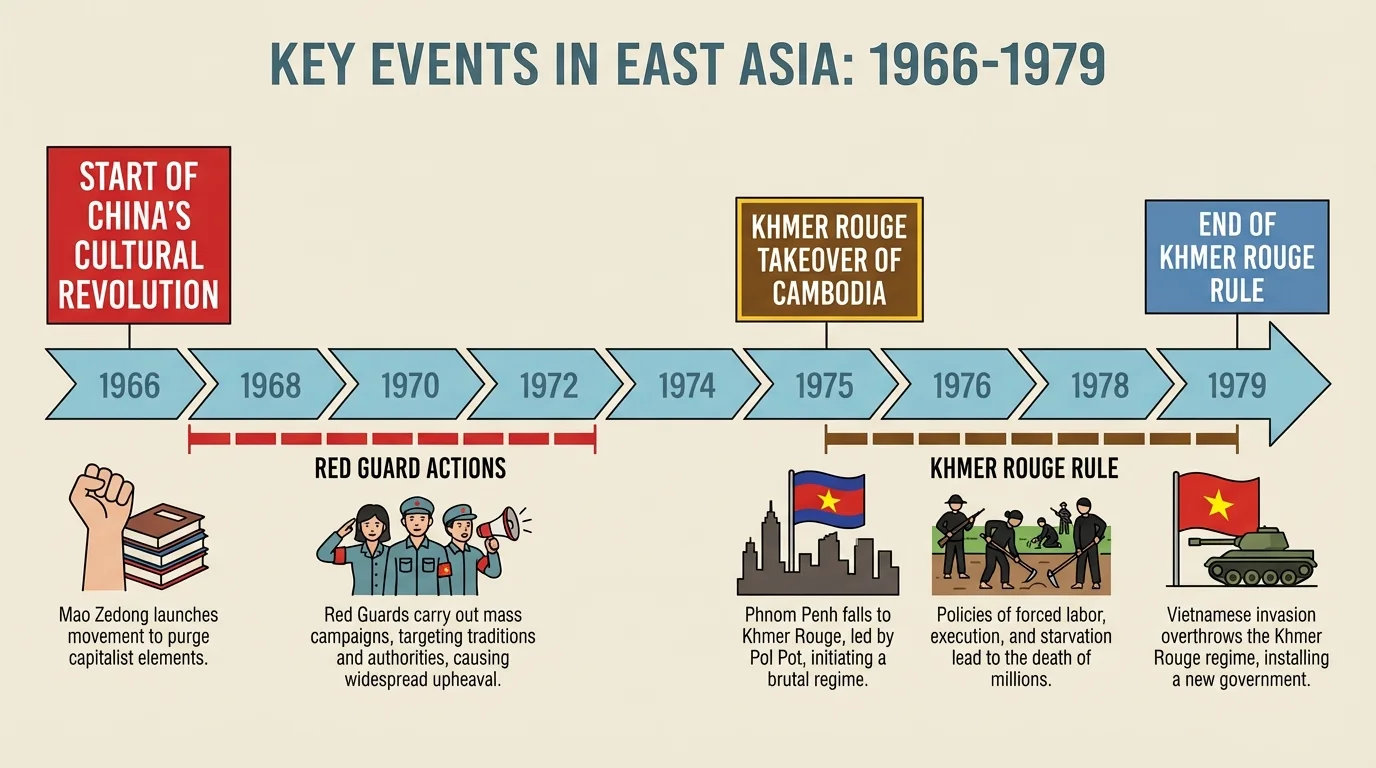
The Chinese Cultural Revolution began in 1966 under Mao Zedong. Mao called on young people to defend revolutionary ideas and remove supposed enemies of communism. Many students joined the Red Guards. They attacked teachers, officials, writers, and others accused of being disloyal or too connected to old traditions. Temples, books, artworks, and historical sites were destroyed.
Discriminatory policies came before much of the violence. People were labeled by class background or family history. Those seen as landlords, intellectuals, or politically suspicious could be humiliated, imprisoned, beaten, or sent away for "re-education." Even children could suffer because of their parents' social category. The goal was supposed to be political purity, but the result was chaos, fear, and broken lives.
The Khmer Rouge took control of Cambodia in 1975 under Pol Pot. They wanted to create an extreme agrarian society with no class differences, no city life, and no independent thinking. People in cities were forced into the countryside. Money, schools, religion, and normal family life were attacked or controlled. Those considered enemies included educated people, religious leaders, ethnic minorities, and anyone suspected of opposition.
This became genocide and mass atrocity. Large numbers of Cambodians died from execution, starvation, overwork, and disease. Ethnic Vietnamese, Cham Muslims, Buddhist monks, and many others were targeted. The discriminatory ideas came first: certain groups were described as dangerous, impure, or disloyal. Once a government teaches that some people matter less than others, violence becomes easier to justify.
When studying acts of violence against groups of people, it is important to notice the warning signs before mass killing begins. These signs often include propaganda, unfair laws, forced labeling of groups, censorship, and the blaming of minorities for larger national problems.
Studying these events is difficult, but necessary. It helps students understand how governments can misuse power and how ordinary people can become involved in harmful systems. It also shows why human rights protections matter. The timeline in [Figure 4] connects these events to a broader period of Cold War instability and revolution.
Many current issues in the Eastern Hemisphere have deep historical roots. Refugee crises may be linked to war, persecution, or state collapse. Border tensions may come from older imperial boundaries. Religious disagreements may reflect events from centuries ago. Economic inequality in some countries connects to colonial rule, trade patterns, or unequal development.
Take the Korean Peninsula as one example. News stories today about missiles, diplomacy, or family reunions make more sense if you know the history of division after World War II and the war that followed. In Cambodia, memorials and trials connected to Khmer Rouge crimes are part of an effort to seek justice and preserve memory. In China, debates about the Cultural Revolution remain sensitive because they touch on state power, memory, and responsibility.
Historical context does not solve every problem by itself, but it helps people ask better questions. Who drew the borders? Who benefited from past policies? Which groups were excluded or blamed? What ideas were used to justify violence? These questions help historians and citizens avoid shallow explanations.
How historians draw conclusions
Historians compare evidence from different sources, look for cause and effect, and place events in context. They know that one event usually has multiple causes, and they try to explain both short-term triggers and long-term background conditions.
When people understand history, they are better prepared to recognize patterns such as discrimination, forced migration, propaganda, and competition over resources. These are not just stories from the past. They remain part of the modern world.
A strong historical explanation is based on evidence, not just opinion. A speech from Mao, a refugee interview, a war photograph, a peace treaty, or a diary from a trader can all help historians understand the past. Each source has limits, so historians compare many kinds of evidence.
For example, a government report may describe a policy in official language, but a survivor's testimony may reveal what that policy felt like in daily life. Both are useful. When studying conflicts and cultural interactions in the Eastern Hemisphere, historians ask not only what happened but also whose voices are missing and why.
This way of thinking is powerful beyond history class. It helps students examine current events carefully, notice bias, and draw informed conclusions. The Eastern Hemisphere's history is full of creativity, exchange, belief, struggle, and survival. Understanding those patterns gives us a clearer view of the present.
