Why do some countries depend heavily on traditions from the past, while others rely on business competition or government planning? The answer begins with a problem every society faces: there is never an unlimited supply of everything people want. Food, water, land, energy, tools, and time are all limited. Because of this, people must decide what to produce, how to produce it, and who will receive it. The way those decisions are made forms an economic system.
The basic problem of economics is scarcity. Scarcity means that people have limited resources but unlimited wants. A community may want more food, better roads, more schools, and more jobs than it can create at one time. Because choices must be made, societies build rules and habits for making those choices.
Those rules and habits can develop slowly over hundreds of years, or they can change quickly during war, revolution, industrial growth, or political reform. In the Eastern Hemisphere, economic systems developed in different ways because places had different climates, natural resources, beliefs, traditions, and historical experiences.
Scarcity is the condition of having limited resources to meet unlimited wants and needs.
Economic system is the way a society organizes the production, distribution, and use of goods and services.
Resources are the natural, human, and capital resources used to make goods and services.
When economists study systems, they often focus on three big questions: What should be produced? How should it be produced? Who should receive it? Different societies answer these questions in different ways, and those answers are closely connected to geography and culture.
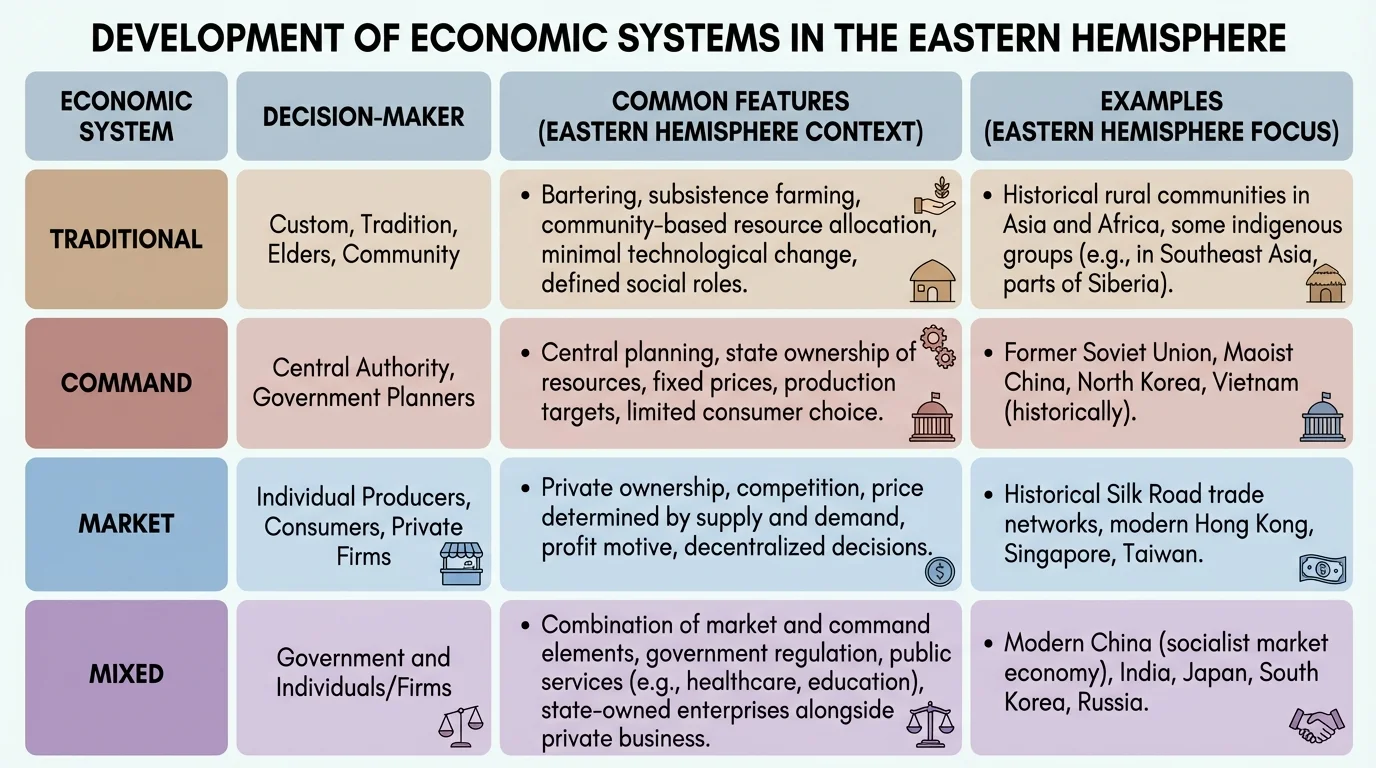
Four major types of systems help us compare how countries organize economic life, as [Figure 1] shows through the different ways decisions are made. These are the traditional economy, command economy, market economy, and mixed economy.
In a traditional economy, people usually make decisions based on custom, family roles, and long-standing community patterns. In a command economy, the government makes most major decisions. In a market economy, businesses and consumers make many decisions through buying and selling. In a mixed economy, both markets and governments play important roles.
No real country fits perfectly into just one category. These four types are models that help us understand patterns. For example, a nation may have family farming traditions in rural areas but also government-owned industries in cities. That means its economy has mixed features.
To understand why these systems developed, we need to look beyond definitions. We need to ask what resources people had, what dangers or opportunities they faced, and what values they believed were most important.
Geography strongly influences economic development, and [Figure 2] highlights why access to rivers, coastlines, fertile land, and minerals matters so much. A society with rich farmland may focus on agriculture. A region with little farmland but valuable oil or metals may build an economy around extraction and trade. A country with major ports may become a center of shipping and commerce.
Across the Eastern Hemisphere, river valleys such as those near the Nile, Tigris, Euphrates, Indus, and Yangtze supported farming settlements. Reliable water and fertile soil made food production possible. When communities could produce more food than they immediately needed, some people could become traders, craft workers, officials, or soldiers. That helped economies grow more complex.
Other regions faced harsh limits. Deserts, mountains, cold climates, and thin soils often made large-scale farming difficult. In those places, people developed systems based on herding, fishing, caravan trade, or highly organized irrigation. Societies had to adapt to the resources they could reach, not the resources they wished they had.
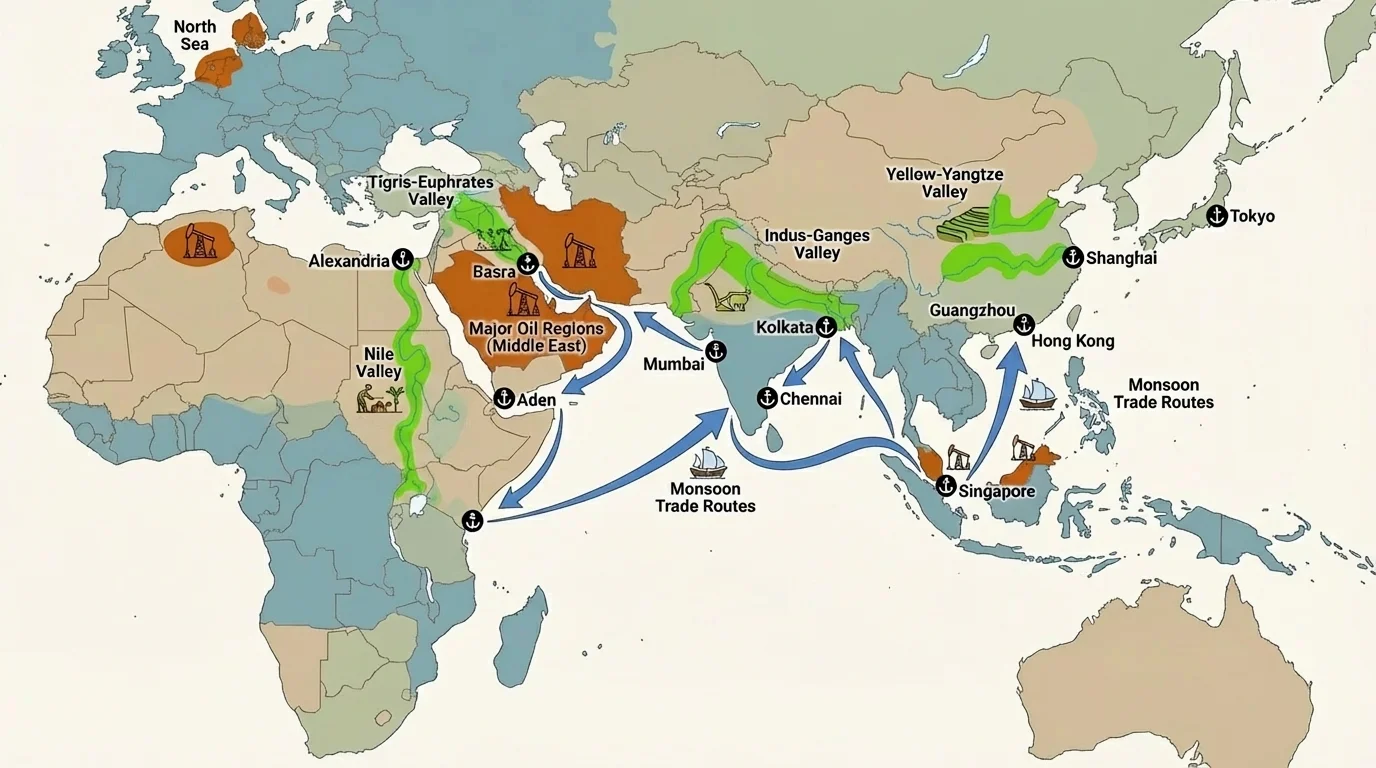
Trade routes also mattered. The Silk Roads connected East Asia, Central Asia, Southwest Asia, and Europe. Indian Ocean trade connected East Africa, the Arabian Peninsula, India, and Southeast Asia. These routes moved silk, spices, gold, salt, ideas, religions, and technologies. Places located along trade networks often developed more market activity because merchants and buyers needed systems for exchange.
Even today, countries rich in oil, natural gas, diamonds, rare minerals, or productive farmland often organize parts of their economies around those resources. Resource access does not decide everything, but it creates powerful opportunities and limits.
A community that practices subsistence farming grows enough food mainly for its own use rather than for large markets.
In earlier times, and in some rural areas today, traditional economies developed this way. People planted crops, raised animals, made clothing, built tools, and traded locally.
Traditional systems often grew in places where families depended closely on land, water, and seasons. Knowledge was passed down through generations: when to plant, how to save seeds, where to graze animals, or how to fish at certain times of year. Decisions were guided by elders, customs, religion, and kinship networks rather than by distant governments or stock markets.
For example, pastoral groups in parts of East Africa and Central Asia developed economic patterns around herding animals such as cattle, camels, sheep, or goats. Their way of life matched the environment. In areas where soil or rainfall made farming less dependable, mobility and animal care were practical choices. In fishing villages across Southeast Asia or the Pacific, traditions often shaped who fished, when they fished, and how catches were shared.
Why traditional economies can last a long time
Traditional economies often survive because they fit local conditions. If a community has learned over centuries how to live in a desert, mountain valley, island chain, or grassland, those customs may be highly efficient for that environment. The system may not produce huge profits, but it can provide stability and a strong sense of identity.
Traditional economies can build cooperation and protect cultural values, but they can also be vulnerable. A drought, flood, war, or disease can hurt communities that depend on a narrow range of resources. Limited access to modern technology, transportation, or health care can also make it harder to respond to change.
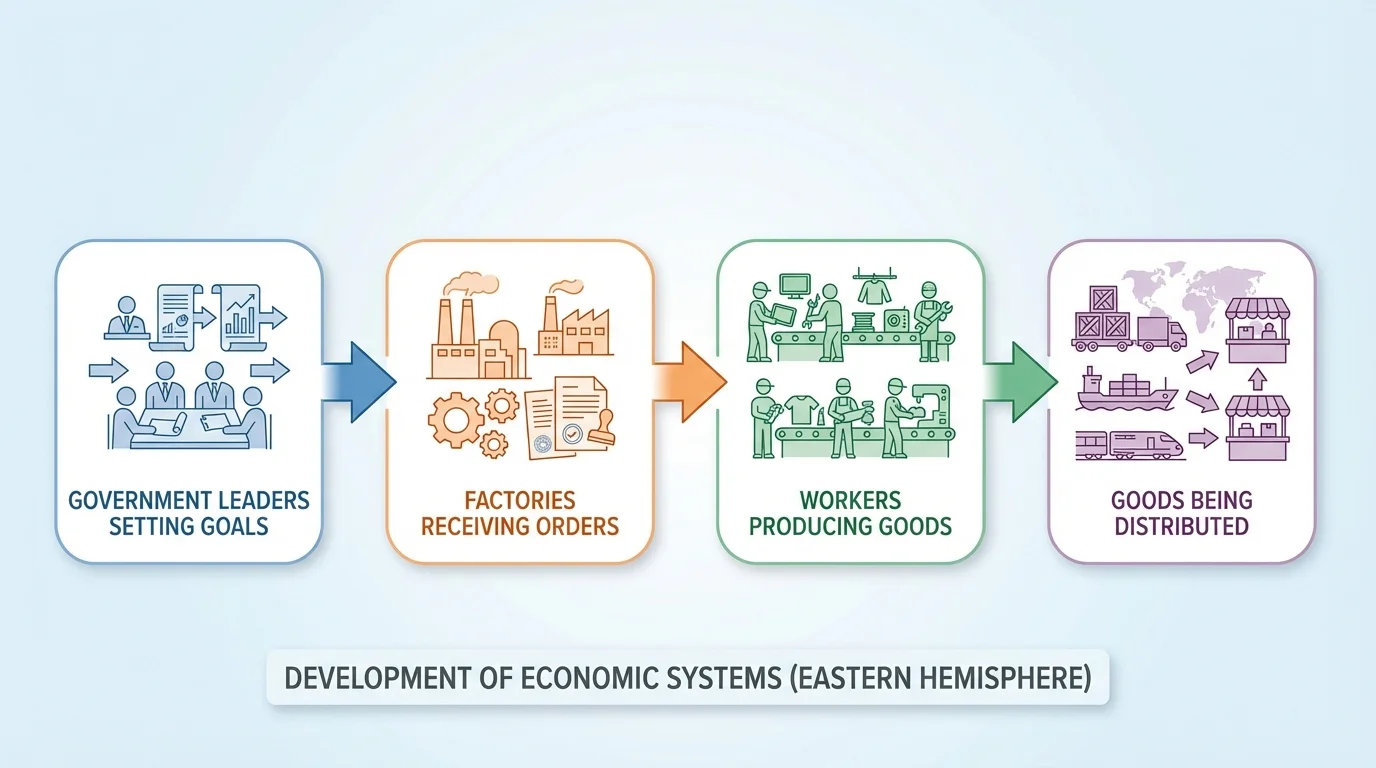
Some governments in the Eastern Hemisphere developed a command economy because leaders believed central control would create order, speed up industrial growth, or spread resources more equally. In a command system, as [Figure 3] illustrates, decisions flow from the top downward. Officials may decide how much steel, coal, grain, electricity, or machinery should be produced.
Command economies often grow stronger during times of crisis. After revolutions, wars, or colonial rule, leaders may fear chaos, foreign control, or deep inequality. A central government may take charge of land, factories, and transportation to direct the economy toward national goals.
The Soviet Union is one of the most famous examples. In the twentieth century, Soviet leaders used central planning to industrialize rapidly. The government set production goals, controlled prices, and decided what factories would make. This system helped build heavy industry quickly, but it also led to shortages, waste, and weak consumer choice because local needs were not always understood by central planners.
China under Mao Zedong also used command methods. The government organized farms and industry through central plans. Leaders hoped this would transform China into a powerful socialist state. Some campaigns changed production on a massive scale, but poor planning and unrealistic targets caused severe hardship, including famine in some periods.
North Korea remains one of the clearest modern examples of a command economy. The state controls much of production and distribution. This gives the government strong power, but it can limit innovation, trade, and consumer access to goods.
Case study: Why a country might choose central planning
A government may turn to command methods after war or revolution.
Step 1: Leaders identify urgent national needs.
They may decide the country needs roads, factories, energy, or military supplies very quickly.
Step 2: The government takes control of key industries.
Instead of waiting for private businesses to invest, the state directs workers and materials where leaders think they are most needed.
Step 3: Results appear, but trade-offs follow.
The country may build infrastructure fast, yet stores may have fewer choices and workers may have less freedom to start businesses.
This helps explain why command systems can seem attractive in emergencies, even though they often create long-term problems.
Command economies developed not only from economic ideas but also from experiences such as invasion, insecurity, class conflict, and the desire for national unity. Human experiences can push governments toward more control.
A market economy develops when individuals and businesses make many economic decisions through voluntary exchange. Prices help signal what people want and what goods are scarce. If many people want a product, businesses may produce more of it. If few people want it, production may shrink.
Market systems often develop strongly in places with active trade, secure property rights, transportation networks, and chances for entrepreneurship. Ports, financial centers, and industrial regions encourage this kind of growth. In the Eastern Hemisphere, cities connected to sea routes and global trade often became centers of market activity.
Japan provides an important example. Although Japanese history includes periods of strong state influence, modern Japan developed a highly advanced economy based on private businesses, manufacturing, technology, and international trade. Limited natural resources pushed Japan to focus on efficiency, skilled labor, and imported raw materials. This shows that a country does not need abundant resources to build a powerful economy if it has education, infrastructure, and trade connections.
Singapore is another striking case. It has very little land and few natural resources, yet its location on major shipping routes helped it become a global trade and finance center. South Korea also transformed from a poorer country into a major industrial and technological economy through education, exports, and business growth.
Singapore became one of the world's busiest port economies despite having very limited natural resources. Its location and strong trade networks mattered as much as raw materials.
Market economies can encourage innovation, efficiency, and consumer choice. However, they can also produce inequality. Some people or regions may gain wealth much faster than others. Without rules, workers may be mistreated, pollution may increase, or essential services may become unaffordable for many families.
The comparison in [Figure 1] remains useful here because market systems answer the three economic questions differently from command or traditional systems. Buyers and sellers play a much larger role in shaping production.
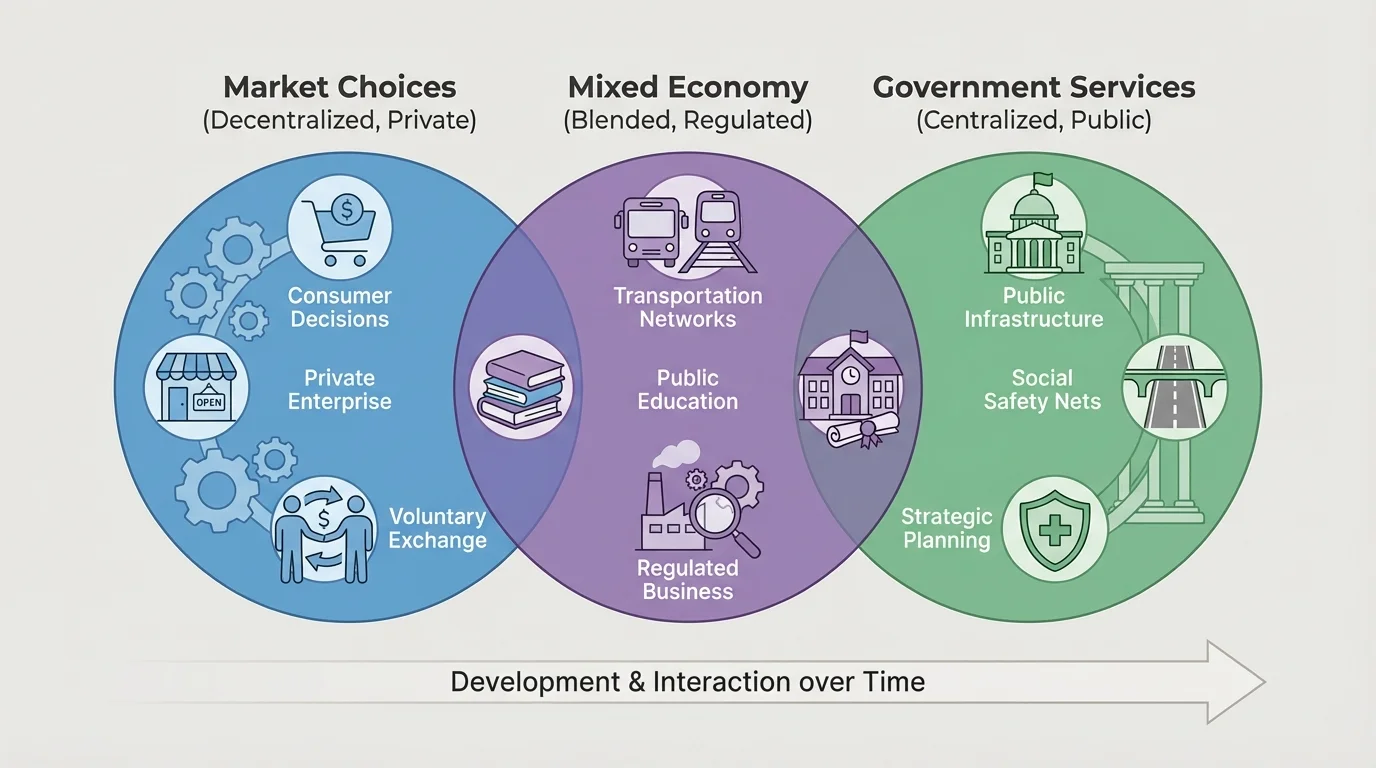
Today, most countries use some form of mixed economy, and [Figure 4] shows why: governments and markets usually work together rather than separately. In a mixed system, businesses may compete and earn profits, but the government still provides services, builds infrastructure, enforces laws, and may regulate industries.
Modern India is a good example. After independence, India used many government planning tools and controlled important industries. Over time, it introduced more market reforms, allowing greater private business growth and foreign investment. Today, India combines market activity with government involvement in transportation, education, agriculture, and public welfare.
China today is also mixed, though in a special way. The government keeps strong political control and influences major sectors, but market activity, manufacturing, investment, and entrepreneurship play huge roles. This blend helped create rapid economic growth, even though the state remains powerful.
In Europe's eastern Mediterranean and other parts of the Eastern Hemisphere, many countries also combine private businesses with government programs such as health care, public transportation, or energy regulation. These choices reflect values about fairness, security, and opportunity.
A mixed economy often develops because countries want the benefits of market energy without accepting all of the risks. Leaders may want innovation and trade, but they also want to reduce poverty, provide education, protect workers, or respond to environmental problems.
Why mixed economies are common
Mixed economies are common because real life is complicated. Markets are often effective at encouraging competition and new ideas, but governments are often needed to build roads, maintain defense, create schools, respond to disasters, and set safety rules. Most nations combine both approaches to handle scarcity more effectively.
As the overlap in [Figure 4] makes clear, mixed systems are not halfway points with fixed percentages. One country may lean more toward markets, while another leans more toward government planning.
Economic systems are not shaped by resources alone. They also reflect societal values such as fairness, stability, tradition, religious duty, freedom, or national power. Different cultures may decide that protecting family land matters more than maximizing profit. Others may decide that rapid industrial growth is worth strong government control.
Human experiences matter too. Colonization changed many African and Asian economies by redirecting land, labor, and trade toward the needs of imperial powers. After independence, many countries had to decide whether to keep export-based systems, nationalize industries, or encourage private investment. War destroyed infrastructure in some places and created opportunities for rebuilding in others.
Famines, depressions, and unemployment also change economic thinking. If people experience severe shortages, they may support more government intervention. If they experience government corruption or inefficiency, they may support freer markets. Economic systems often change because people react to success, failure, or crisis.
"People make history, but not under conditions they choose for themselves."
— adapted idea from Karl Marx
This idea fits economic history well. Leaders and citizens make choices, but they make them under real conditions: drought, geography, trade routes, revolutions, technologies, and past inequalities. Systems develop through both choice and circumstance.
Each system tries to answer the problem of scarcity, but each does so differently. Traditional systems emphasize continuity. Command systems emphasize coordination by the state. Market systems emphasize exchange and competition. Mixed systems try to balance market freedom with public goals.
| System | Main decision-makers | Strengths | Challenges | Eastern Hemisphere examples |
|---|---|---|---|---|
| Traditional | Families, elders, customs | Stability, cultural identity, local knowledge | Slow change, vulnerability to disaster, limited variety | Rural farming, herding, fishing communities |
| Command | Government planners | Fast mobilization, clear national goals | Shortages, weak consumer choice, less innovation | Soviet Union, Mao-era China, North Korea |
| Market | Consumers and businesses | Innovation, competition, variety | Inequality, instability, pollution risk | Japan, Singapore, South Korea |
| Mixed | Businesses and government | Balance of growth and public services | Hard to balance efficiency and fairness | India, modern China, many modern states |
Table 1. Comparison of the major economic systems and examples from the Eastern Hemisphere.
The top-down process shown earlier in [Figure 3] helps explain why command systems can act quickly, while the comparison in [Figure 1] helps show why market systems often offer more choice. Geography also remains important, as shown by the resource patterns in [Figure 2].
Economic systems change over time. New technology can reduce the importance of one resource and increase the importance of another. Global trade can connect once-isolated regions to world markets. Climate change, water shortages, and environmental damage can force countries to rethink farming, energy use, and transportation.
Migration also changes economies. When people move from villages to cities, traditional systems may weaken while wage labor and business activity grow. When countries become more educated and connected online, new jobs appear in finance, software, design, and communication. These changes can shift a country further toward markets, stronger state regulation, or a new mixture of both.
Economic systems are about choices under limits. Earlier studies of geography, culture, government, and history all connect here because economies do not develop in isolation. They grow out of place, belief, and experience.
In the Eastern Hemisphere, no single path explains every country. But a pattern is clear: economic systems developed in response to scarcity, shaped by available resources, guided by societal values, and changed by human experiences such as trade, conflict, colonization, reform, and technological growth.
