Every day, people depend on rules they did not personally write: traffic laws, school policies, court decisions, and public services such as roads, water, and emergency help. That raises an important question: why do people obey laws, participate in their communities, and accept limits on power? The answer is civics. Civics helps explain how people live together, how governments are guided, and what kinds of behavior make a society fairer, safer, and stronger.
A society is more than land and buildings. It is a community of people who share responsibilities, rights, and rules. Governments organize public life, but governments cannot succeed by force alone. They depend on trust, cooperation, and shared values. When citizens act with honesty, respect, and responsibility, public life works better. When leaders and citizens ignore fairness or law, corruption and conflict grow.
This is why studying civic virtues and principles matters. A principle is a basic idea that guides decisions. A virtue is a good quality of character. Together, civic virtues and civic principles shape how people act as members of a community and how governments are expected to behave.
Civic virtues are character traits that help people contribute positively to public life. Citizenship is membership in a country, including rights and responsibilities. Civic participation means taking part in the life of a community or government, such as voting, discussing issues, serving others, or joining public actions. Rule of law means that laws, not individual rulers, govern society, and that everyone is expected to follow the law.
These ideas are connected. Good citizenship often includes civic participation. Civic participation is stronger when people believe laws are fair. Rule of law is more likely to survive when both leaders and citizens practice civic virtues.
One central idea in civics is citizenship. Citizenship usually includes legal membership in a state, but it also has a moral side. A citizen is not only someone who belongs to a country on paper. A citizen is also someone who recognizes duties to others. These duties may include obeying laws, paying taxes, staying informed, serving on juries where that system exists, helping in the community, and respecting the rights of others.
Another key idea is civic participation. This can happen in many ways. Some forms are direct, such as voting in an election or attending a public meeting. Some forms are indirect, such as contacting a representative, signing a petition, volunteering in a local program, or raising awareness about an issue online. Participation does not always look dramatic. Even helping organize a neighborhood cleanup is a civic act because it improves the community.
A third idea is rule of law. Under the rule of law, people are governed by known rules, not by the personal wishes of a ruler. This means laws should be public, clear, and applied fairly. If one person is punished while another escapes punishment just because of wealth, power, or family connections, the rule of law is weak.
Some of the oldest written law codes appeared in the Eastern Hemisphere thousands of years ago. Long before modern democracies, people understood that societies needed agreed-upon rules to reduce violence and settle disputes.
A fourth important idea is the common good. The common good means what benefits the community as a whole, not only one person or group. For example, clean water systems, safe streets, and fair courts help everyone. Citizens and leaders sometimes disagree about what best serves the common good, but the idea reminds people to think beyond personal gain.
Civic virtue includes several important qualities. One is responsibility. Responsible citizens do what they are supposed to do, even when no one is watching. They follow laws, complete public duties, and think about how their actions affect others. If many people ignore responsibility, public systems break down.
Another civic virtue is respect. In a diverse society, people may speak different languages, follow different religions, or hold different opinions. Respect does not mean agreeing with everyone. It means recognizing the dignity and rights of others. Respect makes debate possible without violence.
Honesty is also essential. Citizens need truthful information to make good decisions, and governments need public trust to function. If leaders lie or if false information spreads widely, people may lose confidence in institutions. In modern life, where news travels quickly online, honesty and careful fact-checking are civic responsibilities.
Tolerance and open-mindedness matter because societies include many viewpoints. A person can strongly support one idea while still allowing others to speak. This becomes especially important in countries with elections, political parties, or active public debate.
Courage is another civic virtue. Sometimes doing the right thing is difficult. A person may need courage to report corruption, defend a classmate from unfair treatment, or speak out peacefully when a policy is unjust. Civic courage does not always mean a giant protest. It can mean standing for fairness in everyday situations.
Why virtues matter in government
Laws and institutions are important, but they are not enough by themselves. A constitution can promise rights, yet those rights can still be ignored if leaders are dishonest or if citizens do not care about fairness. Civic virtues give life to civic principles. They help people use freedom responsibly and help leaders use power carefully.
Think about a team sport. The written rules matter, but the game also depends on sportsmanship, effort, and fairness. In the same way, a government may have formal rules, but society works better when people also practice trust, self-control, and respect.
[Figure 1] Citizenship does not look exactly the same in every country. The degree of influence people have in public life depends greatly on the kind of government they live under. In some systems, citizens regularly choose leaders and debate public policy. In others, leaders hold much tighter control over decision-making.
In a democracy, citizens usually have meaningful ways to influence government. They may vote, join parties, criticize leaders publicly, organize groups, and campaign for change. Democracies can differ from one another, but they generally depend on broad participation, protected rights, and regular elections.
In a constitutional monarchy, a king or queen may serve as a symbolic head of state, while elected officials run the government. Japan is an example in the Eastern Hemisphere. Citizens participate through democratic institutions even though the country still has a monarch.
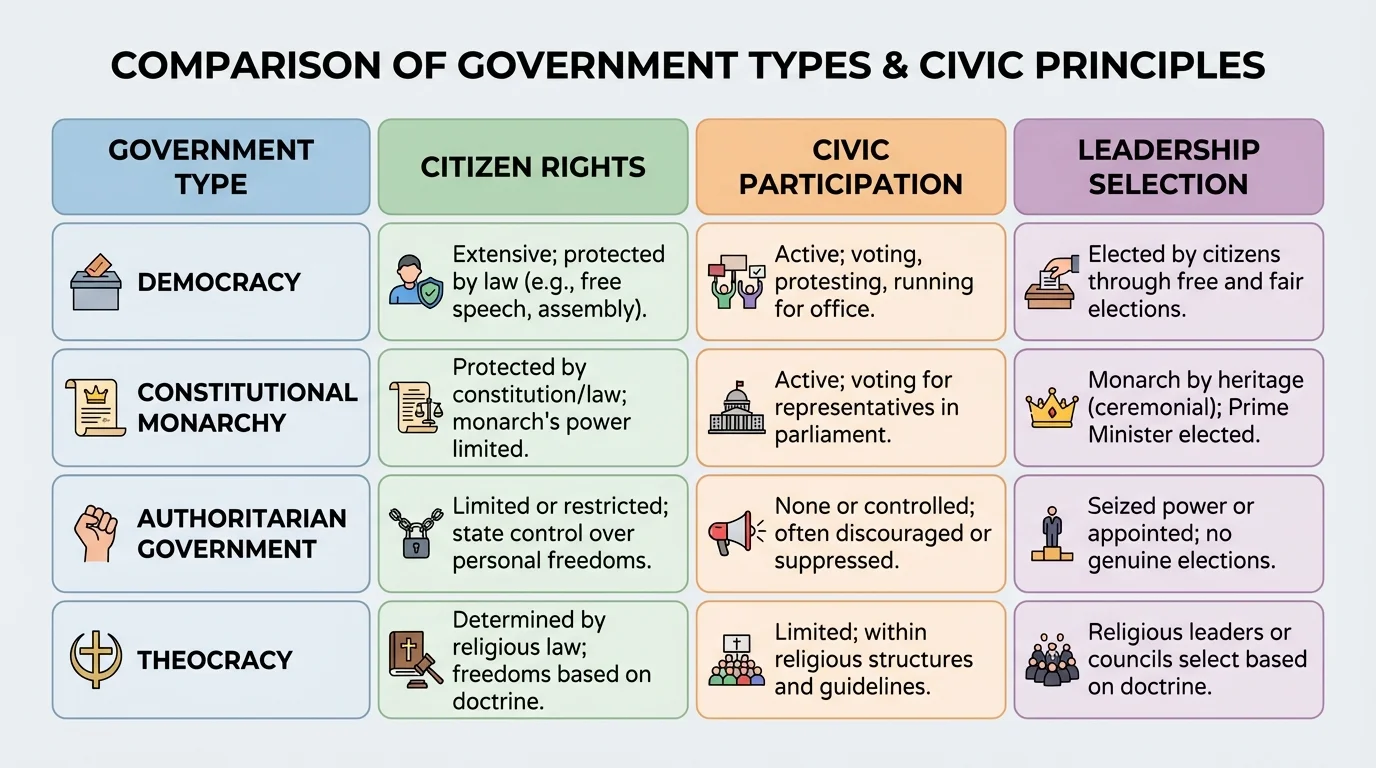
In an authoritarian government, power is concentrated in the hands of one leader or a small group. Elections may be limited, tightly controlled, or not fully competitive. Citizens may have fewer chances to criticize officials, organize independently, or influence policy. Participation may still exist, but it is often restricted.
In a theocracy, religious authority plays a central role in government. Laws may be closely connected to religious teachings, and political participation can be shaped by religious leadership. The rights and responsibilities of citizens may differ depending on the structure of the state and its religious rules.
The comparison in [Figure 1] makes an important point: all governments have citizens or subjects living under authority, but not all systems provide the same opportunities for participation. That difference affects daily life, freedom of expression, and how much influence ordinary people have over public decisions.
People often think civic participation means only voting, but it is much broader than that. Participation includes joining local organizations, discussing public issues, volunteering, reporting community problems, serving in public institutions, advocating for change, and using peaceful protest. The exact form depends on the country and its laws.
In democratic systems, voting is a major form of participation because it allows citizens to help choose leaders. Campaigns, debates, and issue-based groups also play important roles. Students may not yet be old enough to vote, but they can still practice civic participation by staying informed, joining service projects, and discussing issues respectfully.
In some countries, participation happens more through local community service than through open political competition. In others, online spaces have become important places for public discussion. Digital participation can spread ideas quickly, but it also creates problems when false information, insults, or propaganda spread faster than facts.
Case study: Two students, two systems
A student in India and a student in China may both care about air pollution in their cities, but their paths to participation can differ.
Step 1: In India, the student may join a youth campaign, speak at a local meeting, share opinions publicly, or support elected candidates who promise environmental reform.
Step 2: In China, the student may still support environmental improvement, but public criticism of government policy can face tighter limits. Participation may happen through approved channels, school organizations, or local reporting systems rather than open protest.
Step 3: Both students are participating in civic life, but the political system shapes what methods are accepted, encouraged, or restricted.
This example shows that civic participation is real in many societies, but its freedom, risk, and influence are not equal everywhere. Students studying the Eastern Hemisphere should pay attention to both similarities and differences.
[Figure 2] shows how lawmaking, enforcement, and court review help explain why the rule of law is more than simply having rules. A dictator can issue commands, but that alone is not rule of law. Rule of law means laws are created and applied through recognized processes, and they are supposed to limit power rather than serve personal wishes.
A society with strong rule of law usually includes several features. Laws are written and public. Courts can interpret the law. Police or other officials are expected to enforce it fairly. People who are accused of crimes have rights, such as hearings or trials, depending on the system. Leaders are also expected to obey the law.
An important part of rule of law is due process. Due process means that government must follow fair procedures before taking away a person's freedom, property, or rights. This does not guarantee that every outcome is perfect, but it reduces the danger of arbitrary punishment.
Another key idea is an independent judiciary. This means judges and courts are able to make decisions based on law rather than pressure from powerful leaders. When courts are independent, they can protect rights and check abuses of power. When courts are controlled by rulers, the rule of law becomes weaker.
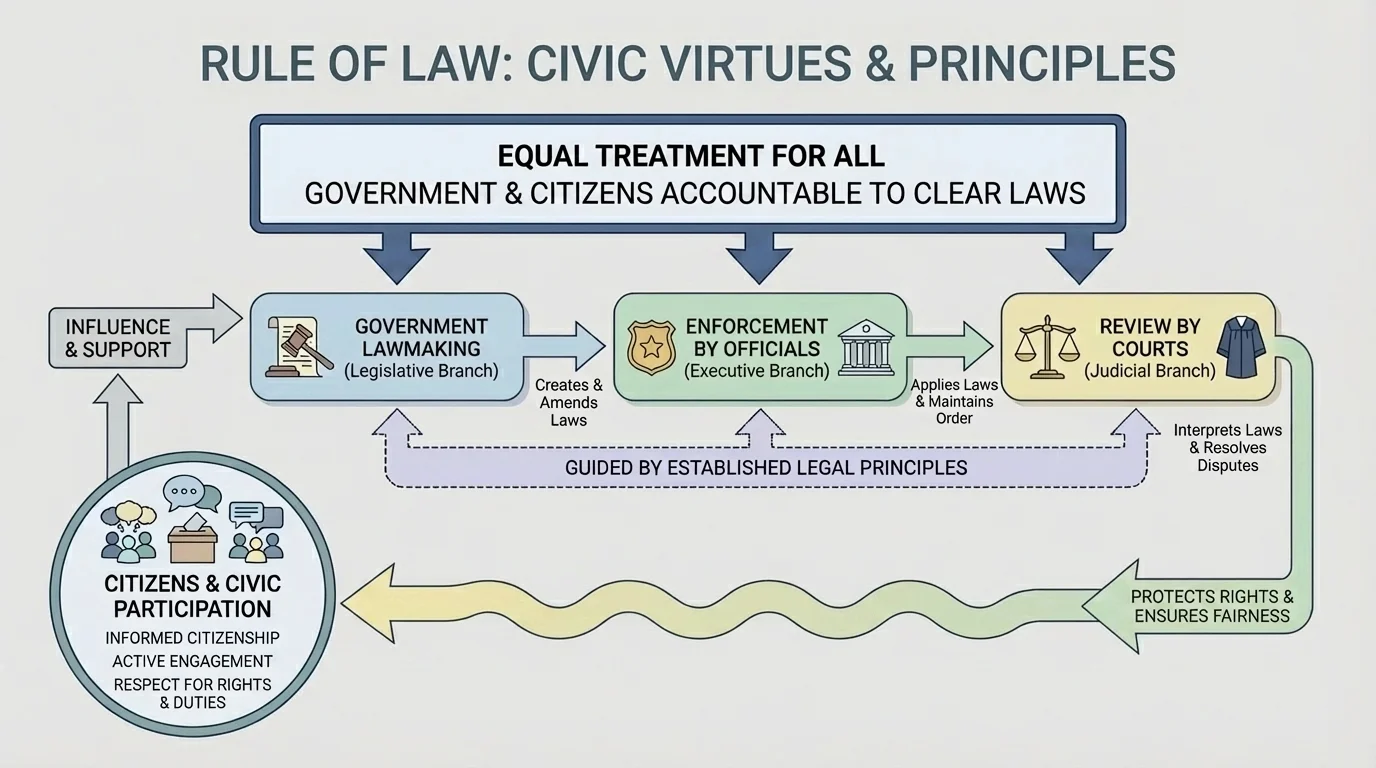
Rule of law affects ordinary life in practical ways. Property is safer when contracts are enforced. People are more willing to start businesses when rules are predictable. Families are more secure when courts can settle disputes fairly. Without rule of law, people may fear that power, not justice, decides outcomes.
We can also understand the rule of law by looking at what happens when it is missing. If a journalist is arrested just for criticizing a leader, if an election result is changed by force, or if a wealthy person can break the law without punishment, public trust falls. As shown earlier in [Figure 2], fair systems depend on procedures and accountability, not just authority.
"No one is above the law."
— A core principle of constitutional government
[Figure 3] This principle sounds simple, but it is powerful. It means government officials, military leaders, and ordinary citizens should all be judged under law. In real life, societies often struggle to fully achieve this ideal, but it remains a major standard for justice.
Looking across the Eastern Hemisphere, several countries illustrate different patterns of citizenship and participation: India, Japan, South Korea, Saudi Arabia, and China. These examples show that civic life is shaped by history, law, culture, and political structure.
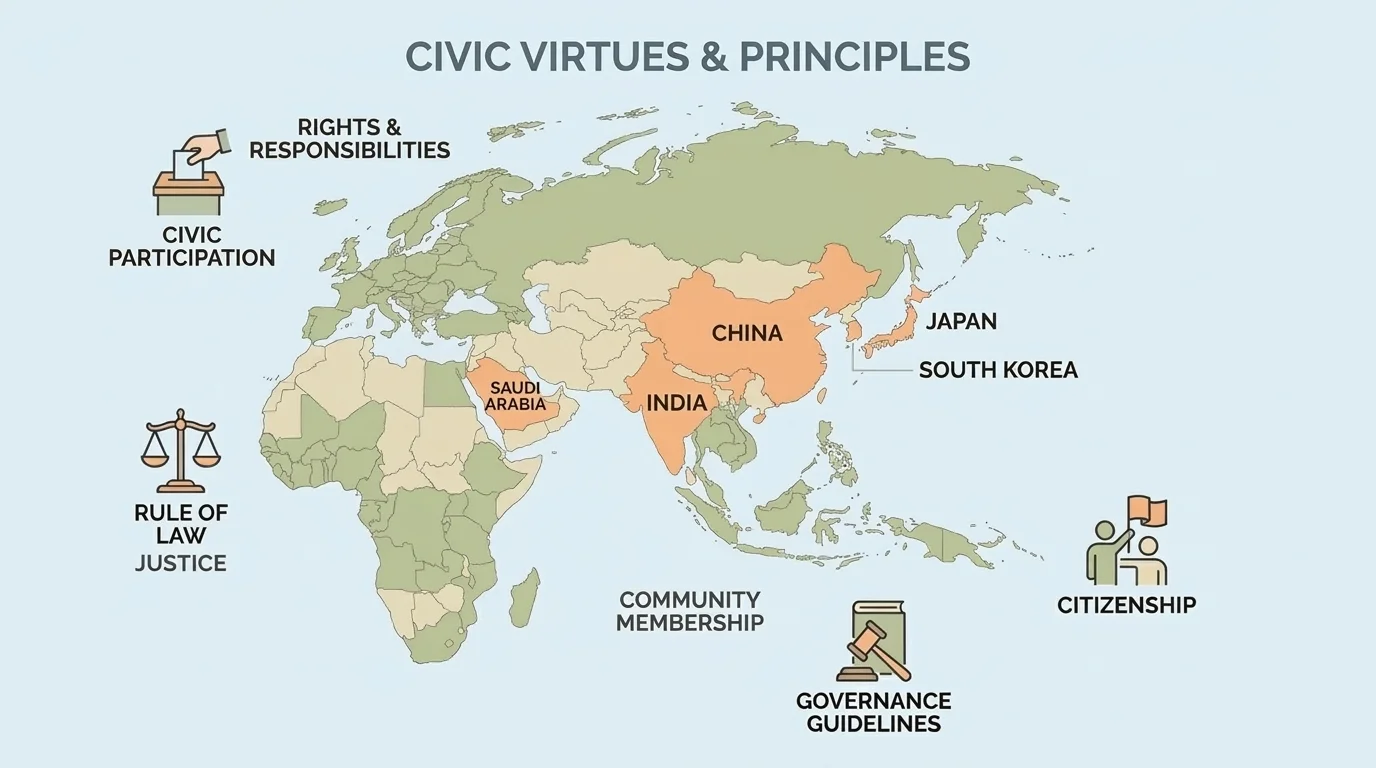
India is the world's largest democracy. Citizens vote in large national elections, political parties compete, and public debate is lively. Civic participation includes elections, protests, community organizing, and court cases. At the same time, India also faces challenges such as political tension, inequality, and misinformation.
Japan is a constitutional monarchy with a democratic government. Citizens elect lawmakers, political parties compete, and civic participation often includes voting, local government activity, and community responsibility. Japan is also known for strong social expectations about duty and public order, which connect to civic virtue.
South Korea is a democracy with high civic engagement. Citizens vote, organize public demonstrations, and use media actively. Peaceful protest has played an important role in South Korean politics, showing that participation can continue between elections, not only on election day.
Saudi Arabia is a monarchy in which political participation is more limited than in democratic systems. Religion has a major influence on law and public life. Citizens may participate in society and community life, but national political influence is structured differently than in countries with broad electoral competition.
China is governed by a one-party authoritarian system. Citizens may take part in local concerns, public campaigns, and approved organizations, but open opposition to the ruling party is heavily restricted. This creates a major difference between participation in China and participation in democracies such as India, Japan, or South Korea.
| Country | System of government | Typical civic participation | Key limitation or feature |
|---|---|---|---|
| India | Democracy | Voting, protests, parties, public debate | Wide participation with social and political challenges |
| Japan | Constitutional monarchy | Voting, local action, civic duty | Monarch is symbolic; elected officials govern |
| South Korea | Democracy | Voting, protests, media activism | Strong public engagement in politics |
| Saudi Arabia | Monarchy with strong religious influence | Community participation, limited national political role | Political participation is more restricted |
| China | One-party authoritarian system | Approved channels, local reporting, state-guided participation | Open opposition is restricted |
Table 1. Comparison of civic participation in selected Eastern Hemisphere countries.
The map reminds us that these countries are all in the Eastern Hemisphere, yet their systems differ sharply. Geography alone does not determine civic life. Historical experiences, revolutions, constitutions, religions, and social traditions all shape how citizenship works.
Civic virtues are not only for adults in government offices. They matter in schools, neighborhoods, sports teams, and online spaces. When students listen respectfully, share responsibility, and solve conflicts fairly, they are practicing the same habits that support larger democratic life.
Modern societies also face new civic challenges. Social media makes it easy to speak, organize, and learn. It also makes it easy to spread rumors, manipulate emotions, or divide people. That is why responsible citizenship today includes checking sources, thinking critically, and refusing to share false claims just because they are popular.
Rights and responsibilities go together. A person may have the right to speak, but that freedom works best when used with honesty, respect, and concern for others. Civic life is strongest when people protect both liberty and responsibility.
There is also a global side to citizenship. People remain citizens of their own countries, but many issues cross borders: climate change, migration, trade, technology, and public health. Understanding different governmental systems in the Eastern Hemisphere helps students see why countries respond differently to the same global problems.
In the end, societies are guided not only by constitutions, elections, or leaders, but also by daily habits of fairness and participation. A government may be powerful, but without civic virtue and rule of law, power can become abusive. A society may be diverse and full of disagreement, but with respect, responsibility, and active citizenship, that diversity can become a strength rather than a weakness.
