One of the most striking facts in history is that huge groups of people—sometimes millions of them—agree to follow the decisions of a relatively small number of leaders. Why? Because every society has to answer hard questions: Who makes rules? Who settles disputes? Who protects the country? Who decides how power is shared? The answers create different kinds of government, and those choices shape everything from freedom of speech to education, taxes, religion, war, and peace.
A government is not just a building or a famous leader. It is a system for making decisions for a country or state. Some governments are built on elections and written laws. Others are based on family inheritance, military force, or one-party rule. Some try to protect individual rights. Others demand obedience above all else. Understanding these systems helps explain why countries in Europe, Asia, Africa, and the Middle East often act differently at home and in world affairs.
Human communities have always needed ways to organize life together. Early villages needed protection from attack, rules about land and water, and ways to settle arguments. As populations grew, ruling systems became more formal. One origin of government is the need for order. Without order, people face constant conflict and uncertainty.
Government is the system or group of people that makes and enforces laws for a country or territory. Power is the ability to make decisions and get others to follow them. Authority is power that people accept as rightful or legitimate.
Governments also provide services. They build roads, support schools, maintain armed forces, and create laws about trade, safety, and public health. In some countries, governments provide a wide range of social services, such as health care or housing support. In others, the government plays a smaller role and leaves more decisions to individuals or businesses.
Another key function is protection of rights—or, in some systems, restriction of rights. A government may protect freedom of religion, speech, and voting. But a government may also censor newspapers, arrest critics, or limit what people can say online. That is why understanding government means looking at both its purpose and its behavior.
Governments differ in structure, and that structure affects daily life. As [Figure 1] shows, power can be centered in one ruler, shared among elected bodies, or limited by a constitution and courts. To compare systems clearly, it helps to ask three questions: Who holds power? How do they get it? What limits their power?
A constitution is a basic set of rules for government. In some countries it is a single written document. In others it comes from several documents, traditions, and court decisions. A constitution often explains the powers of leaders, the rights of citizens, and how laws are made. When government leaders must obey these higher rules, people describe the system as based on the rule of law.
Another important idea is the difference between a state, a nation, and a regime. A state is a political unit with territory, population, and government. A nation is a group of people who share identity, culture, language, or history. A regime is the particular government in power at a given time. Countries can keep the same state while changing regimes, sometimes very dramatically.
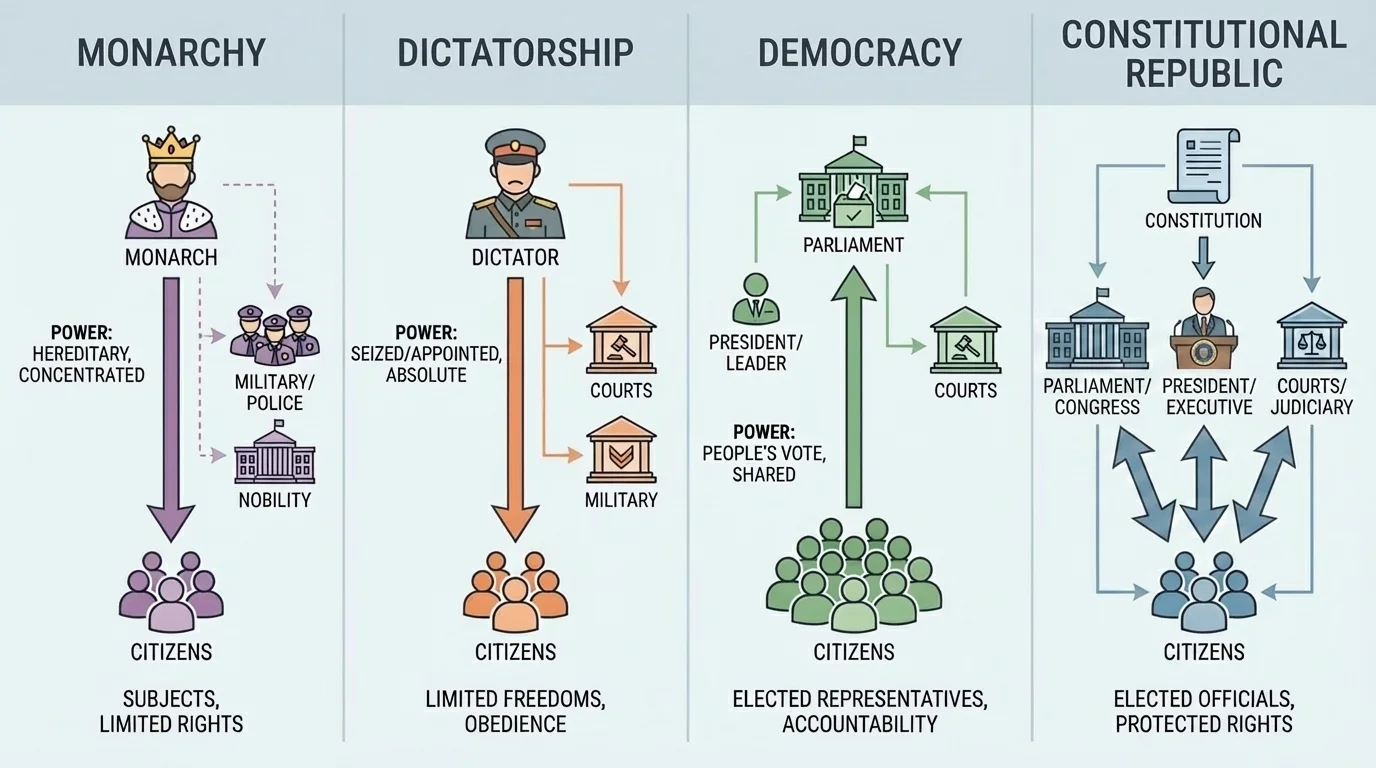
When students hear the word "government," they often think only about leaders. But structure matters just as much as personalities. A fair election in one system might lead to peaceful transfer of power, while in another system elections may be weak, controlled, or completely absent. The same country can also change over time, moving toward more freedom or toward tighter control.
A monarchy is a system in which a king, queen, emperor, or similar ruler holds the top position, usually through family inheritance. As [Figure 2] illustrates, monarchies are not all the same. The two major forms are absolute monarchy and constitutional monarchy.
Monarchies often began in times when military strength, religion, and family dynasties gave rulers legitimacy. If a royal family controlled land, armies, and wealth, people often accepted its rule as natural or even sacred. In many places across the Eastern Hemisphere, monarchies shaped political life for centuries.
In an absolute monarchy, the monarch holds most or all major power. Historically, absolute monarchs could make laws, collect taxes, command armies, and punish opponents with few limits. Saudi Arabia is a modern example of a monarchy in which the royal family holds very strong authority, though even there governance includes ministries, advisers, and legal traditions.
In a constitutional monarchy, the monarch remains head of state, but elected officials and a constitution limit royal power. The United Kingdom and Japan are well-known examples. In these systems, the monarch symbolizes national continuity, while a parliament and prime minister manage most day-to-day governing. This is very different from an absolute monarchy, even though both have kings or queens.
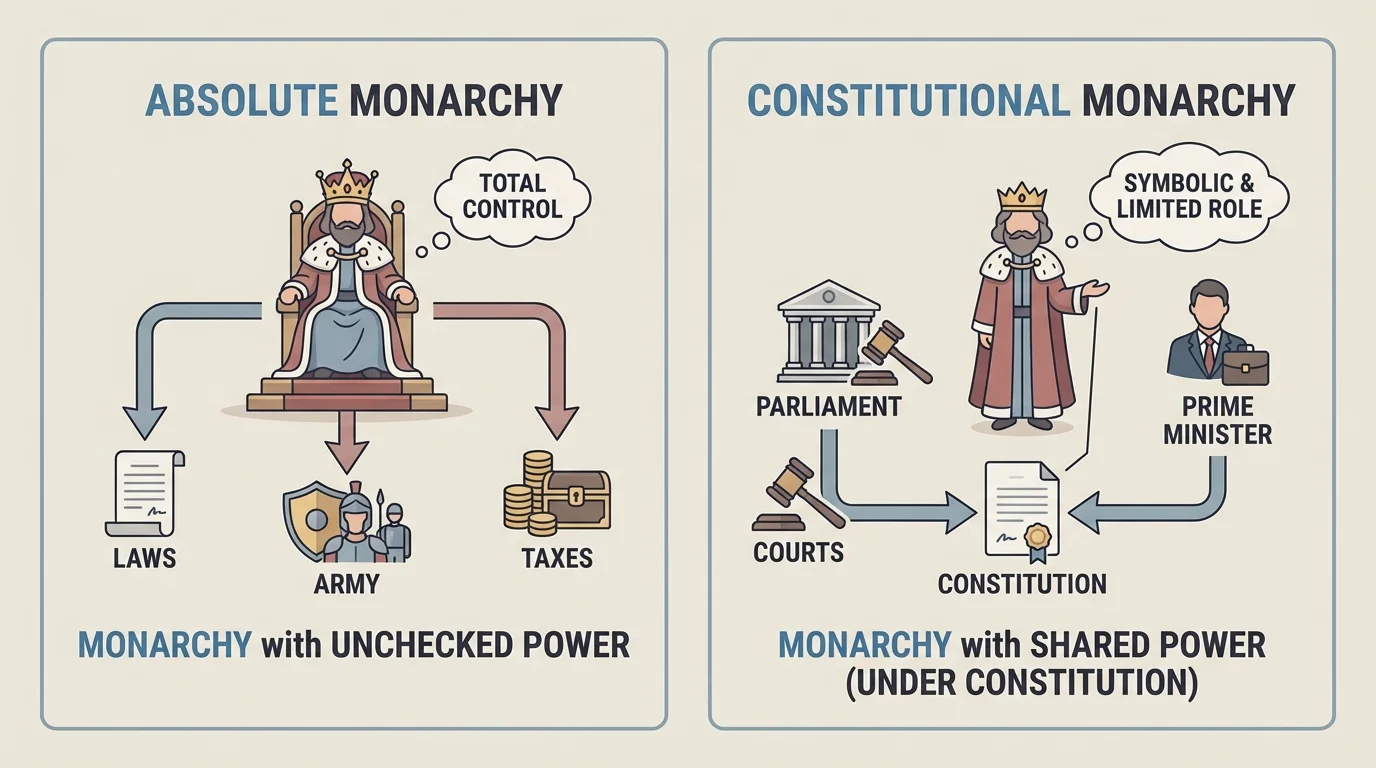
Monarchy survives today partly because it can adapt. In constitutional monarchies, royal families often serve ceremonial roles that support national identity. Later, when we compare systems, we can use [Figure 2] to remember that the title of a ruler does not tell the whole story; limits on power matter more than titles alone.
A democracy is a system in which political power ultimately comes from the people. Citizens may vote directly on issues or, more commonly in large countries, elect representatives to make decisions for them. Democracies are built on ideas such as participation, political equality, majority rule, and protection of minority rights.
Democracy has ancient roots in places such as Athens, but modern democracy developed over centuries through struggles over voting rights, representation, and legal equality. Many democracies began by allowing only a small group to vote. Over time, more people demanded inclusion, and voting rights expanded.
Democracy depends on more than elections. Free elections matter, but a country also needs independent courts, access to information, opposition parties, and protection for critics. If citizens can vote but cannot speak freely, organize, or trust the count, the system is weak or only partly democratic.
A constitutional republic is a form of government in which citizens elect leaders and a constitution limits government power. Officials govern according to law rather than personal rule. In many constitutional republics, power is divided among branches so no one person or group can dominate the whole system.
India is a major example in the Eastern Hemisphere. It is the world's largest democracy and a constitutional republic. Its government includes a written constitution, elected representatives, courts, and a federal structure that divides powers between national and state governments. South Korea is another example of a democratic republic with competitive elections and constitutional limits.
Democracies can still face serious problems, including corruption, misinformation, unfair voting systems, or deep political conflict. Yet the key idea remains that leaders are accountable to citizens and can be removed through legal processes rather than force.
A dictatorship is a system in which one ruler or a small group holds power without meaningful limits from the people. As [Figure 3] shows, these systems differ not only in who rules but in how much of society they try to control. Dictators may gain power through military takeover, revolution, fear, manipulation, or weak institutions.
Authoritarianism describes a system of government that demands obedience and limits political freedom, but it may not try to control every detail of private life.
Totalitarianism goes much further. A totalitarian state seeks to control politics, media, education, culture, and even private beliefs. These regimes often use propaganda, secret police, surveillance, and fear. The goal is not just obedience in public but complete domination of society.
North Korea is often used as a modern example of an extremely authoritarian system with strong totalitarian features. The government tightly controls information, public expression, and political life. In the twentieth century, Nazi Germany under Adolf Hitler and the Soviet Union under Joseph Stalin are major historical examples of totalitarian rule, though they were based on different ideologies.
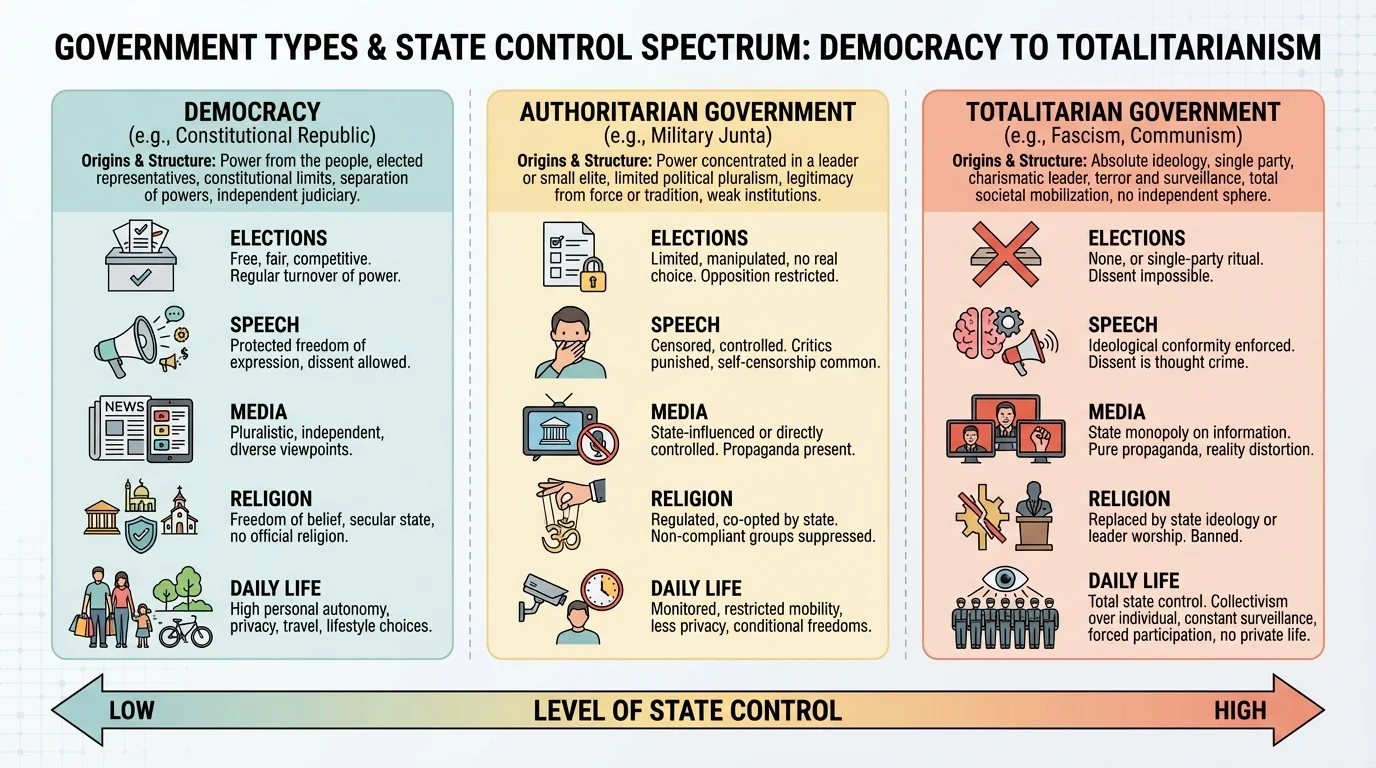
A dictatorship can be military, personal, or party-based. Some dictators rely mostly on the army. Others build personality cults around themselves. Still others rule through a single political party. Looking back at [Figure 3], the important pattern is the growing level of state control as systems move from democratic toward totalitarian.
Some authoritarian governments hold elections, but the elections are not truly free or fair. This can make a country look democratic from the outside even when real power never changes hands.
These systems often claim they are necessary for stability. Supporters may argue that strong control prevents disorder. Critics point out that when leaders cannot be challenged, abuse of power becomes more likely.
These terms are often mixed up, but they are not the same. They are best understood as ideologies, or systems of political and economic ideas, that can shape how governments operate.
Fascism is an extreme authoritarian ideology that values the nation or race above the individual, glorifies military strength, rejects political opposition, and usually centers power in a strong leader. Fascist governments are often totalitarian or near-totalitarian. Mussolini's Italy and Hitler's Germany are the most famous examples. Fascism grew partly out of economic crisis, fear of social change, and anger after war.
Communism is based on the idea that social classes should disappear and property should be held in common rather than privately owned. In theory, communism aims for a classless society. In practice, states that called themselves communist, such as the Soviet Union and Mao-era China, were usually controlled by a single party that claimed to act for the workers. Many became authoritarian or totalitarian.
Socialism is a broader idea. It supports more economic equality and a larger public role in managing resources or services. Some socialist systems operate within democracies, where voters choose leaders and keep civil liberties. For example, many European democracies use socialist ideas in policies such as public health care, transportation, or welfare programs without becoming communist states.
Case study: same goal, different methods
Several governments have claimed they wanted to reduce inequality, but they used very different structures.
Step 1: A democratic socialist-style system allows voters to choose leaders.
Countries such as Sweden have used high taxes and broad social programs while keeping competitive elections, multiple parties, and civil liberties.
Step 2: A communist one-party state concentrates political power.
The former Soviet Union aimed for state control of the economy but also restricted opposition, speech, and independent politics.
Step 3: Compare the results.
Both may talk about equality, but one keeps political competition while the other often does not.
This is why vocabulary matters. A country can have socialist policies without being communist. A dictatorship can borrow socialist language. A democracy can have a monarch. Real governments are often combinations rather than pure categories.
Countries do not govern in isolation. As [Figure 4] shows, governments in the Eastern Hemisphere work with regional and global groups to solve problems that cross borders, such as trade, conflict, migration, climate change, health emergencies, and human rights. Government structure often affects how a country behaves in these organizations.
The United Nations brings together states from around the world. Its agencies address issues involving refugees, education, health, children, and peacekeeping. Regional organizations also matter. The European Union links many European countries through laws, trade, and cooperation. The African Union works on conflict resolution, development, and continental cooperation. Other examples include the Arab League and the Association of Southeast Asian Nations.
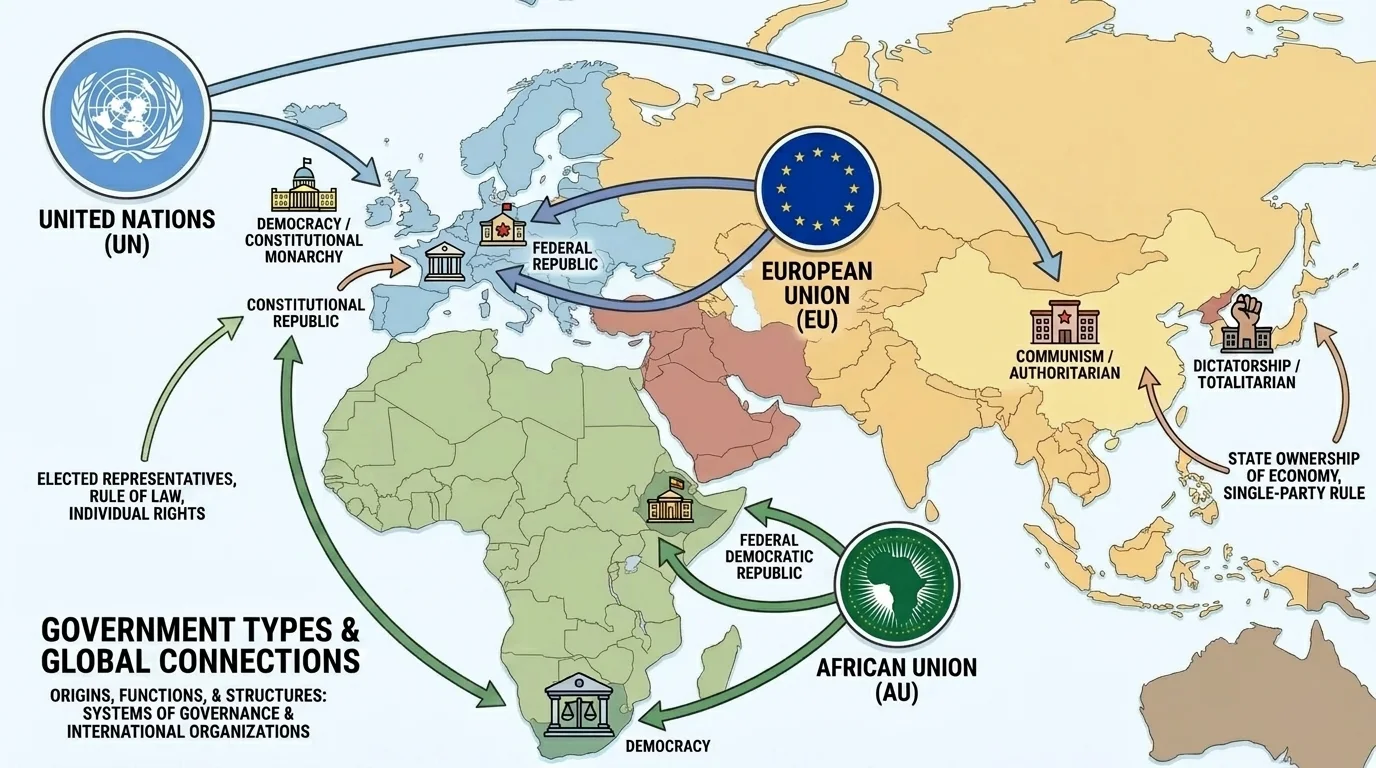
Democratic governments may be more open to criticism from international groups because public debate and elections create pressure. Authoritarian governments may reject outside criticism as interference, especially when human rights are discussed. Yet both democratic and non-democratic states join international organizations when doing so helps security, trade, or influence.
For example, a constitutional republic may use diplomacy, treaties, and parliamentary approval when joining an agreement. A dictatorship may make the same decision through a small circle of leaders. The result may look similar on paper, but the process behind it is very different.
We can return to [Figure 4] to see that geography and government connect. Countries in Europe, Asia, Africa, and the Middle East are part of regional networks, and their internal political systems affect how they cooperate, negotiate, or clash with others.
One useful way to compare governments is to look at origins, leadership, citizen participation, and limits on power.
| System | How leaders gain power | Who holds main power | Citizen role | Common features |
|---|---|---|---|---|
| Monarchy | Usually inheritance | Monarch, sometimes shared with elected bodies | Varies widely | Dynasty, tradition, ceremonial or real power |
| Democracy | Free elections | People through elected leaders | Voting, participation, criticism | Rights, elections, accountability |
| Constitutional republic | Free elections under a constitution | Elected officials limited by law | Voting and civic participation | Rule of law, separation of powers |
| Dictatorship | Force, takeover, manipulation, or one-party control | One ruler or small group | Very limited | Few checks, weak opposition |
| Authoritarian system | Controlled succession or weak elections | Leader, military, party, or elite group | Restricted | Censorship, limited freedoms |
| Totalitarian system | One-party or personal rule | State seeks total control | Forced loyalty | Propaganda, surveillance, ideology |
| Fascist state | Often through crisis, force, and mass mobilization | Dictatorial leader and party | Mobilized but not free | Extreme nationalism, militarism |
| Communist state | Usually one-party rule claiming to represent workers | Communist party leadership | Usually limited politically | State direction of economy, class-based ideology |
| Socialist system | Varies; may be democratic or non-democratic | Varies by country | Varies by system | Greater public role in economy and services |
Table 1. Comparison of major government systems by leadership, citizen participation, and common features.
No chart can capture every detail, but comparison helps reveal patterns. The biggest differences usually involve how power is gained, whether it is limited, and how much voice ordinary people have in public life.
Real countries rarely fit into a single perfect box. A monarchy can be democratic. A republic can become authoritarian. A state may hold elections but still limit press freedom. Another may have a strong constitution on paper but weak courts in practice.
From earlier civics study, remember that laws and institutions matter only if they are actually followed. A written constitution does not automatically create liberty. Courts, elections, civic culture, and citizen action all help make government rules real.
History also matters. Colonization, revolution, religion, geography, war, and economic change all influence government forms. For example, some states adopted strong central governments after conflict, while others built federal systems to share power across large territories or diverse populations.
Studying government is really the study of how humans organize power. That is why this topic matters so much. The structure of government affects whether newspapers can criticize leaders, whether minority groups feel safe, whether elections matter, and whether a nation cooperates peacefully with others.
"The price of freedom is eternal vigilance."
— Commonly attributed to Thomas Jefferson
That quote is a reminder that government is never just theory. It affects real lives. Across the Eastern Hemisphere and the rest of the world, people continue to debate the same big questions: How much power should leaders have? How should they be chosen? What rights must be protected? Different governments answer those questions in different ways, and those answers shape history.
