A person living in ancient Egypt, a trader in India, a buyer in China, and a merchant in medieval Mali all needed things to live, work, and show social status. But they did not buy exactly the same things, and they did not get them in the same way. Some cultures offered fine silk, some offered spices, some offered carved ivory, and some depended on grain, pottery, or metal tools. By studying what people consumed, we learn not just what they owned, but how whole societies worked.
Across the Eastern Hemisphere, consumers depended on businesses of their time: farmers, artisans, merchants, shipbuilders, caravan leaders, scribes, money changers, and market officials. Even though ancient and medieval societies did not have modern shopping malls or online stores, they still had systems of production, trade, and exchange. These systems connected consumers to the goods and services they wanted and needed.
A consumer is a person who uses or buys goods and services. A business is an organization or activity that produces or sells goods and services. In history, businesses often looked like family workshops, market stalls, traveling trade groups, or large merchant companies rather than modern corporations.
Goods are physical items people can own or use, such as grain, cloth, tools, jewelry, spices, or paper. Services are activities people do for others, such as transportation, banking, building, teaching, healing, record keeping, and protection. A farmer selling wheat offered a good. A caravan guide helping move goods across the desert offered a service.
Goods and services are the two basic categories of what consumers obtain in any economy. Goods are objects people can use or trade. Services are actions or work provided to help others meet needs or wants.
When historians compare cultures, they ask questions like these: What basic goods were easy to find?What services made trade possible? Who had access to these things: common people, elites, or both? These questions help us understand wealth, power, and daily life.
Not every consumer had the same choices. Social class, gender roles, age, location, and occupation all mattered. A noble in the Ottoman Empire could afford imported ceramics and expensive fabrics, while a village farmer might mostly use locally made tools and clothing. The difference in available goods and services often reflected how unequal a society was.
The earliest large civilizations in the Eastern Hemisphere developed near river valleys because water made farming easier. Yet even these early societies offered different combinations of goods and services to consumers, as [Figure 1] illustrates through a regional comparison. Geography, local resources, and political organization shaped what people could produce and exchange.
In Mesopotamia, between the Tigris and Euphrates Rivers, consumers relied on grain, wool cloth, pottery, bronze tools, and traded timber from other places. Since Mesopotamia had limited natural resources such as wood and stone, trade became important early. Scribes provided record-keeping services, temple workers organized storage, and merchants transported goods between cities.
In ancient Egypt, the Nile River supported grain farming, papyrus production, linen cloth, and stonework. Egyptian consumers could access bread, beer, fish, flax products, and sometimes luxury goods such as gold jewelry. Services included irrigation management, transportation along the Nile, temple rituals, and large-scale construction. The river itself acted like a transportation highway, making some services easier than in desert regions.
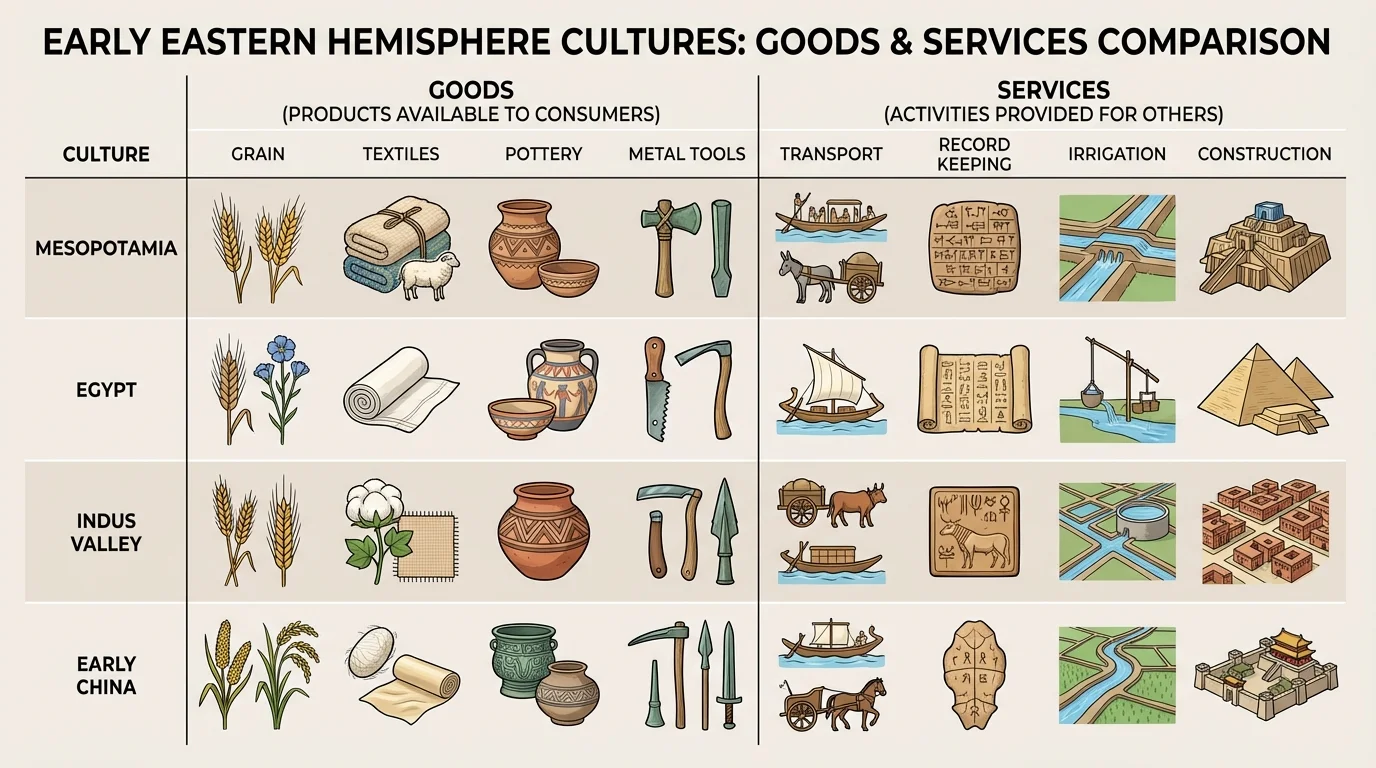
The Indus Valley civilization, centered in cities such as Harappa and Mohenjo-Daro, offered baked bricks, cotton textiles, beads, pottery, and metal tools. Urban planning suggests that consumers also benefited from services related to drainage, construction, and organized city management. Cotton cloth was especially important because the Indus region became one of the earliest centers of cotton production.
In early China, especially along the Huang He, consumers used millet, silk, bronze goods, jade, and later iron tools. Silk was both a useful fabric and a status symbol. Services included bronze casting, road building, military protection, and government record keeping. Chinese rulers often controlled key industries, showing that states could shape what consumers had access to.
These river valley cultures had one major similarity: most people spent much of their income or labor on basic needs such as food, shelter, and simple clothing. But they also had important differences. Egypt depended heavily on the Nile, Mesopotamia on trade for missing resources, the Indus Valley on urban craft production, and China on specialized luxury goods such as silk. Those differences affected both businesses and consumers.
Silk was so valued in ancient China that its production methods were carefully protected. For a long time, other regions wanted Chinese silk but could not easily copy how it was made.
Even at this early stage, consumers were already influencing production. If rulers, priests, or wealthy families wanted certain goods, artisans made more of them. Demand for prestige goods such as decorated pottery, jewelry, or fine cloth encouraged specialization, which means workers focused on one type of product or service.
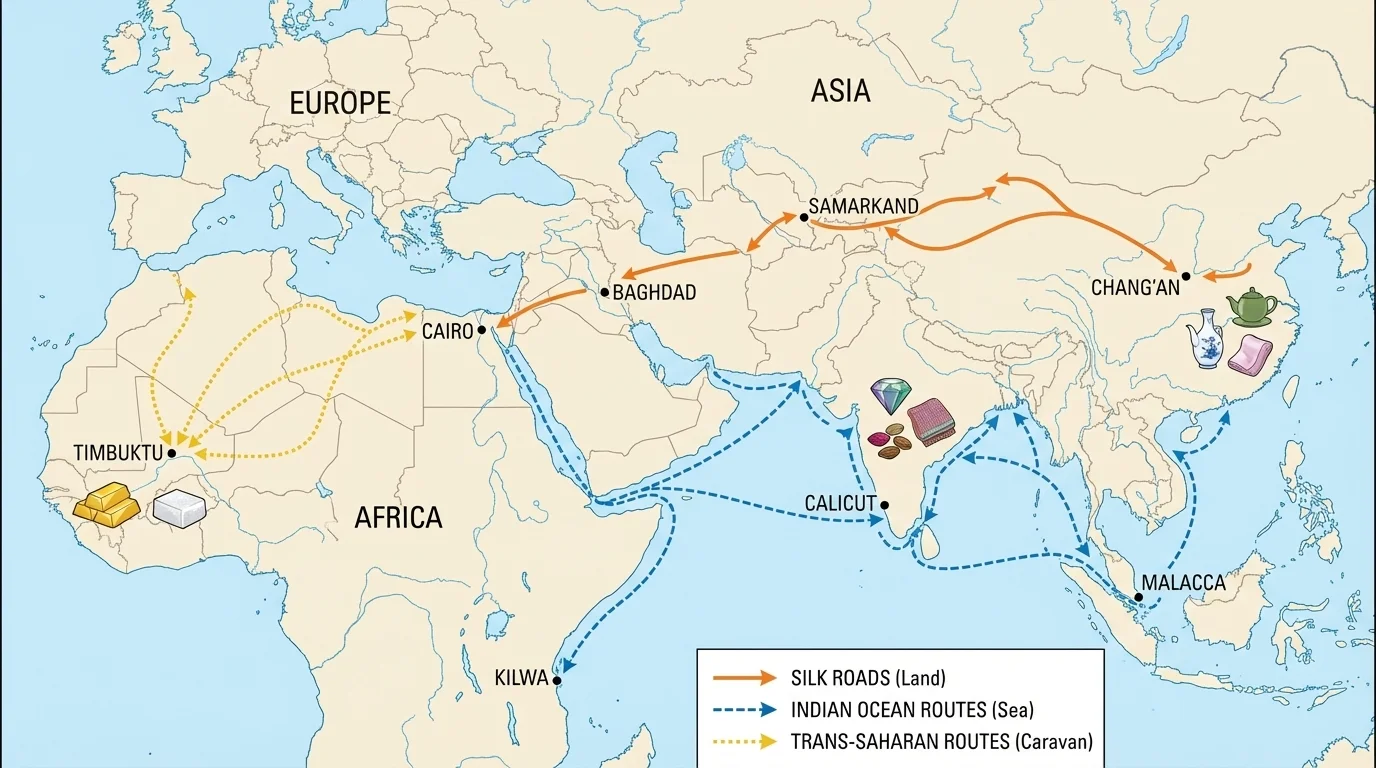
Consumer choices expanded dramatically when long-distance trade networks linked different parts of the Eastern Hemisphere. The major routes, shown in [Figure 2], connected people from regions with very different climates, resources, and tastes. A buyer in one place could now want goods that were produced thousands of miles away.
The Silk Roads were a network of land routes connecting China, Central Asia, the Middle East, and Europe. Chinese silk, porcelain, and paper moved west. Horses, glassware, wool, and precious metals moved east. Along these routes, services became just as important as goods. Caravan guides, animal handlers, innkeepers, translators, and guards all helped trade happen.
The Indian Ocean trade connected East Africa, the Arabian Peninsula, India, Southeast Asia, and China by sea. Traders exchanged spices, cotton textiles, ivory, gold, timber, and ceramics. Sailors used knowledge of monsoon winds, so navigation itself was a valuable service. Port cities such as Calicut, Malacca, and Kilwa became busy centers where consumers could find a mix of local and imported items.
Across North Africa, the trans-Saharan trade routes linked West Africa with the Mediterranean world. Gold and salt were the best-known trade goods, but enslaved people, textiles, books, and manufactured items also moved through these networks. Camel caravan services were essential because the Sahara was dangerous. Merchants depended on guides, water knowledge, and protection.
Trade brought variety, but not equality. Imported goods were often expensive. A village family might use mostly local grain and cloth, while wealthy urban consumers could afford pepper from India, silk from China, or glass from the Middle East. In this way, trade networks widened consumer options but also highlighted social differences.
Trade also spread services and ideas. Banking practices, contracts, bookkeeping methods, and credit systems became more advanced in trade centers. A merchant did not always have to carry all wealth in coins; in some places, letters of credit and trusted financial partnerships made exchange safer. That meant consumers and sellers increasingly relied on systems, not just face-to-face swaps.
Different regions developed their own specialties. In East Asia, especially China, consumers often sought silk, tea, porcelain, lacquerware, and paper. Chinese services included education for government exams, canal transport, metalworking, and large-scale administration. Because China had strong state organization, many economic services were connected to government systems.
In South Asia, consumers could find cotton textiles, spices such as pepper and cinnamon, precious stones, sugar, and fine metalwork. India became famous for cotton cloth, which was desired in many other regions. Services included shipping, temple-centered economic activity, money lending, and skilled weaving. Textile production showed how a local specialty could become an international product.
In the Middle East, cities such as Baghdad, Damascus, and Cairo became centers of commerce. Consumers there could buy carpets, glassware, perfumes, metal goods, books, and luxury fabrics. Services were highly developed, including scholarship, medicine, banking, translation, and trade organization. Urban markets in Islamic societies were often tightly connected to learning and craft production.
In Africa, the goods available to consumers varied greatly by region. East African coastal cities offered ivory, gold, beads, cloth, and imported ceramics from Asia. West African states such as Mali and Songhai became known for gold, salt, leather goods, and books, especially in cities such as Timbuktu. Services included caravan transport, Islamic education, and regional market exchange.
In Europe, especially during the medieval period, consumers bought wool cloth, metal tools, wine, timber, and later more imported goods from Asia and Africa. Services expanded in towns through guilds, shipping, banking, and skilled craft work. European demand for Asian spices and luxury goods later helped push exploration and global trade.
| Region | Common Goods | Important Services | Notable Consumer Pattern |
|---|---|---|---|
| East Asia | Silk, tea, porcelain, paper | Canal transport, administration, metalworking | Strong state influence on markets |
| South Asia | Cotton textiles, spices, sugar, gems | Shipping, weaving, money lending | Textiles reached many foreign consumers |
| Middle East | Carpets, glassware, perfumes, books | Banking, medicine, scholarship, trade management | Urban markets mixed commerce and learning |
| Africa | Gold, salt, ivory, leather, books | Caravan transport, education, market exchange | Regional diversity shaped available goods |
| Europe | Wool cloth, tools, wine, timber | Guild crafts, shipping, banking | Growing demand for imports encouraged expansion |
Table 1. Comparison of goods, services, and consumer patterns in major Eastern Hemisphere regions.
Looking across these regions, one pattern stands out: local goods met everyday needs, while trade goods often satisfied wants, status, or special uses. Another pattern is that services became more complex in cities. As trade grew, people needed more shipping, record keeping, storage, repair, security, and finance.
Consumers and culture are closely connected. People do not choose products only because they are useful. They also choose them because of religion, fashion, social class, climate, and tradition. This is why different cultures often value different goods even when they have access to similar resources.
That cultural side of consumption matters. Tea became especially important in parts of East Asia, while spices held high value in South Asia and beyond. Books and manuscripts were prized in centers of Islamic scholarship. Salt was not just a seasoning; in parts of Africa it was essential for preserving food and survival in hot climates.
What people wanted and what businesses supplied were shaped by several powerful forces, as [Figure 3] shows. Environment affected what could be produced locally. Religion influenced what was allowed, valued, or forbidden. Technology changed how quickly goods could be made or moved.
Environment mattered first. A dry region might produce dates and support caravan trade, while a wet river valley could grow grain or rice. Forested regions supplied timber; grasslands supported herding. Because no place had everything, trade developed. This is one reason consumers in some areas depended strongly on imported goods.
Religion also shaped consumer life. Islamic dietary rules affected food markets. Hindu beliefs influenced attitudes about cattle and food choices in parts of India. Buddhist monasteries could become centers of education and hospitality services. Religious pilgrimages created demand for inns, guides, food sellers, and transportation.
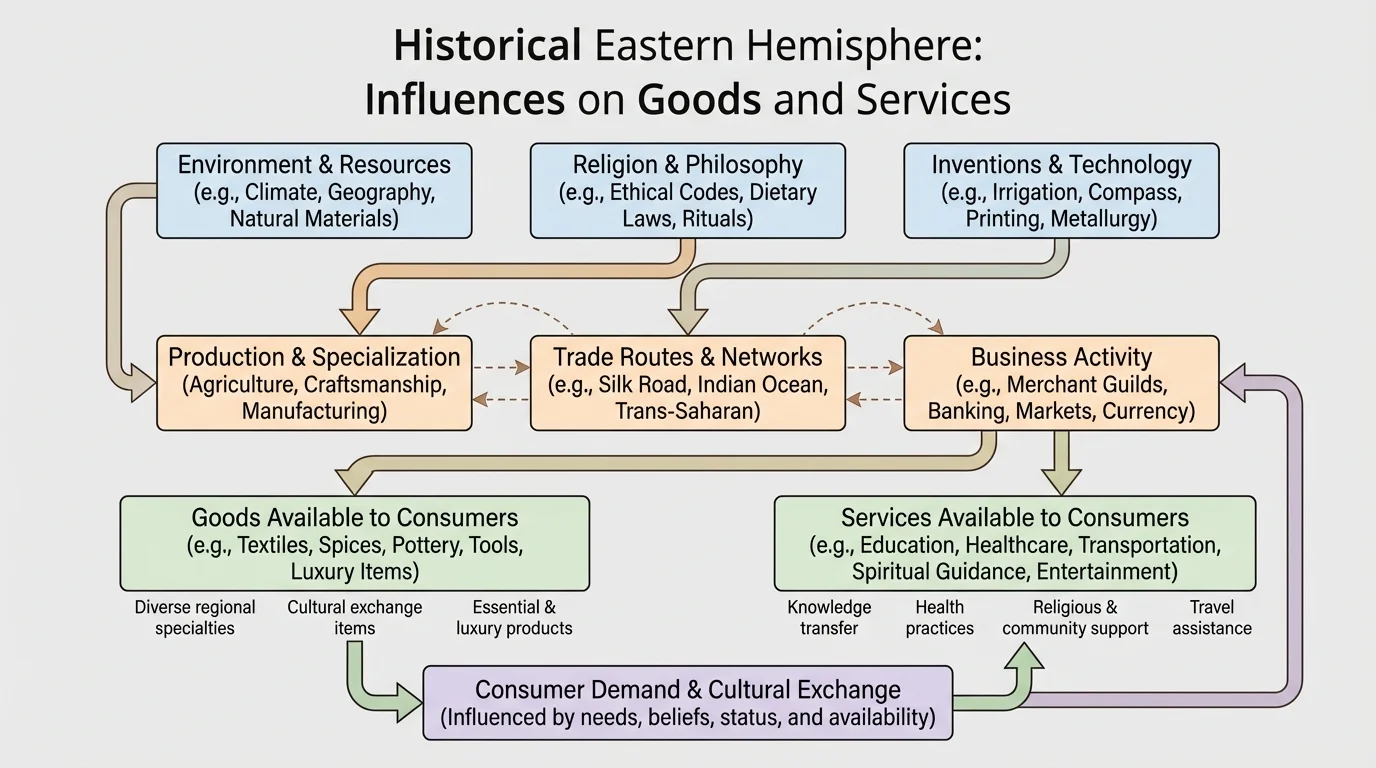
Technology could completely change what was available. The spread of paper made written communication and record keeping less expensive than relying on older materials such as parchment in many places. Better ship designs improved Indian Ocean trade. Iron tools increased farming efficiency, allowing more food production and supporting larger populations. More people meant more consumers and more specialized businesses.
Porcelain from China is a good example of technology shaping markets. It required special knowledge, materials, and firing methods. Because it was durable and beautiful, consumers across the Eastern Hemisphere wanted it. The same idea applies to textile technology: regions with advanced weaving skills could produce cloth that became famous far beyond local markets.
As seen earlier in [Figure 2], trade routes only mattered because geography and technology made movement possible. Monsoon wind knowledge, camel saddles, roads, bridges, and canals all acted like invisible economic tools that connected producers and consumers.
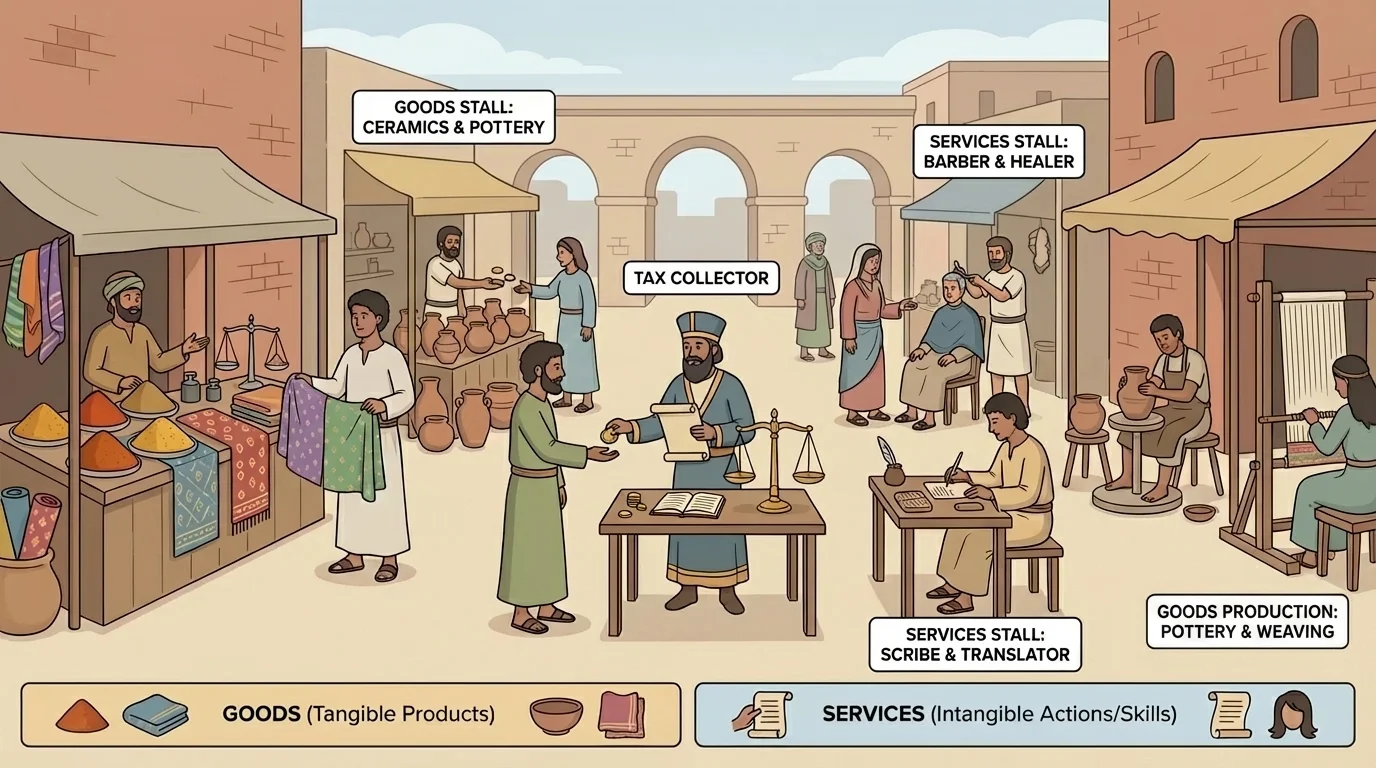
Markets did not run by themselves. They depended on relationships among consumers, merchants, workers, and rulers, a connection made visible in [Figure 4]. In many Eastern Hemisphere societies, governments influenced what could be sold, how trade was taxed, and how markets were organized.
Merchants bought and sold goods for profit. Some worked locally in weekly markets; others traveled long distances. Their success depended on trust, transport, and information. A merchant needed to know where goods were plentiful, where they were rare, and what consumers in each place wanted.
Governments often collected taxes on trade, provided roads or ports, standardized weights and measures, and sometimes issued coins. Standard weights mattered because buyers needed fairness. If one seller claimed a bag of grain weighed one amount and another used a different system, consumers could be cheated. Rules helped markets function.
Coins also made exchange easier than barter in many cases. Instead of trading a goat directly for cloth, a consumer could sell the goat for money and then use the money elsewhere. That flexibility supported larger markets. Some governments weakened trade through heavy taxes or instability, while others encouraged it by protecting routes and cities.
Guilds and craft organizations also mattered, especially in medieval cities. A guild could regulate quality, train apprentices, and protect the interests of workers in trades such as weaving, metalworking, or baking. For consumers, guild standards could mean more reliable products. For businesses, guild membership could bring status and protection.
Primary sources help historians understand these relationships. Merchant letters, tax records, ship logs, travelers' accounts, and market laws reveal what goods were valuable and what services were needed. A traveler such as Ibn Battuta, for example, described the wealth, trade, and urban life of many Eastern Hemisphere regions. Secondary sources, written later by historians, compare such evidence and explain broader patterns.
Case study: A port city consumer
Consider a family living in a busy Indian Ocean port.
Step 1: Identify local needs.
The family needs food, simple clothing, cooking tools, and housing materials. These are usually supplied by nearby farmers, fishers, builders, and artisans.
Step 2: Identify imported wants and specialty items.
The family might also want spices from another region, fine cotton cloth, or Chinese ceramics. These items depend on maritime trade and merchant networks.
Step 3: Identify supporting services.
Ship crews, dock workers, translators, money changers, and market inspectors help make these purchases possible.
This shows that even one household could depend on both local production and long-distance business activity.
Later, when we think again about [Figure 4], we can see that a market is more than a place with goods on tables. It is a system of rules, labor, transport, and trust.
Some things stayed the same for centuries. Most consumers still focused first on food, clothing, tools, and shelter. Local markets remained important even when long-distance trade expanded. Services such as transport, repair, and storage were always necessary.
But important changes also took place. Over time, trade networks grew larger, cities became more specialized, and consumers in major centers gained access to more imported goods. Banking and credit services improved. Technologies spread. Luxury goods that were once rare sometimes became more available to wider groups, though usually not equally.
Another major change was the rising power of commercial cities. Baghdad, Constantinople, Calicut, Malacca, and Timbuktu all became places where many cultures met. In these cities, consumers could encounter products from distant lands. This made marketplaces more diverse and often more competitive.
Still, continuity is just as important as change. A person in medieval Cairo and a person in ancient Mesopotamia both depended on farmers, builders, transport workers, and sellers. The details changed, but the basic relationship between consumers and businesses remained. People needed systems that moved goods and services from producers to users.
From earlier world history study, remember that geography influences how people live. The same idea applies to economics: mountains, rivers, deserts, coastlines, and climate all shape what can be produced, what must be traded for, and which services become valuable.
As seen in [Figure 1], even the earliest civilizations had distinct economic patterns. Over time those differences did not disappear; they became connected through wider networks of exchange.
When we compare goods and services across cultures, we are really asking how societies met needs and wants. Historians look for patterns of production, exchange, scarcity, and demand. Scarcity means people cannot have everything they want because resources are limited. Scarcity helps explain why gold, salt, silk, and spices could become so valuable.
We can also compare luxury and necessity. Grain was a necessity in many societies. Silk or perfumes were often luxuries. But the line was not always fixed. Salt, for example, might seem ordinary today, yet in many historical settings it was absolutely necessary and could be worth a great deal because of limited supply.
Studying consumers also reveals cultural values. If a society spends heavily on temples, books, or ceremonial clothing, that tells us something important about its beliefs. If another invests in roads, ports, or canals, that shows the importance of transportation services. Economic history is really human history viewed through choices, needs, and exchange.
By comparing cultures across the Eastern Hemisphere, we see both diversity and connection. Different societies offered different goods and services based on their environment, beliefs, and skills. At the same time, trade linked them together so that one region's specialty could become another region's prized possession.
