How can one country promise liberty while forcing people from their homes? That question sits at the center of much of United States history. From the early republic through Reconstruction, the nation kept changing: its borders grew, its population shifted, its economy expanded, and its laws evolved. Yet some patterns stayed the same. People fought over land, power, race, citizenship, and who had the right to shape the future. Looking at both the nation and Colorado helps us see that history is not just a list of events. It is a story of choices, conflict, compromise, and consequences.
When historians study continuity and change, they ask two big questions: What stayed the same over time? and What changed? In United States history, one major continuity was conflict over land. Another was the struggle to define freedom and equality. Major changes included the growth of the federal government, the expansion of the country westward, and the end of slavery after the Civil War.
Historians also look for conflict and compromise. A conflict is a serious disagreement, often involving power or resources. A compromise is an agreement in which each side gives up something. Some compromises reduced tension for a while, but many did not solve the deeper problem. In fact, certain compromises delayed conflict rather than preventing it.
Continuity means elements of life that remain similar over time. Change means developments that alter society, government, beliefs, or daily life. Historians often examine both at once because the past is rarely all one or the other.
As the United States developed from the era after the American Revolution through Reconstruction, these ideas can be seen clearly in national policies and in local events in Colorado. The same nation that created democratic institutions also removed Native peoples from their lands. The same country that abolished slavery also continued racial discrimination. These contradictions are essential to understanding the period.
After the American Revolution, the United States became an independent nation, but independence did not solve every problem. Leaders debated how powerful the national government should be, how the economy should work, and how far the country should expand. At the same time, Native nations across North America defended their homelands and sovereignty.
One major source of tension was westward expansion. As [Figure 1] later shows, many white Americans believed the nation should grow. Farmers wanted land. Speculators hoped to make money. Politicians wanted power. But this land was already inhabited by Native peoples with their own governments, cultures, and histories. As settlers moved west, conflict increased.
This is one of the strongest examples of continuity in American history: expansion often brought promises from the federal government, then broken treaties, military force, and displacement. Even when leaders claimed they were acting legally or peacefully, Native communities often paid the price.
The United States made hundreds of treaties with Native nations. Many were later ignored, changed, or violated when American leaders wanted more land or resources.
Primary sources from this era include treaties, speeches, letters, and government laws. Secondary sources, such as textbooks and historical studies, help explain what those documents meant and how they affected different groups. Historians use both kinds of sources to build a fuller picture of the past.
The Indian Removal Act of 1830 marked a major change in federal policy, even as it continued the long-standing pattern of taking Native land. Removal was not a small local event. It was a massive movement of entire communities from the southeastern United States to lands west of the Mississippi River.
President Andrew Jackson strongly supported removal. He argued that moving Native nations would open land to white settlers and reduce conflict. In reality, removal created enormous suffering. The law affected several Native nations, including the Cherokee, Creek, Choctaw, Chickasaw, and Seminole.
Some Native nations resisted in court and through diplomacy. The Cherokee Nation adopted a written constitution and used the American legal system to defend its rights. In Worcester v. Georgia in 1832, the Supreme Court ruled in favor of Cherokee sovereignty in an important way. But the ruling did not stop removal. Federal power and political will overrode justice.
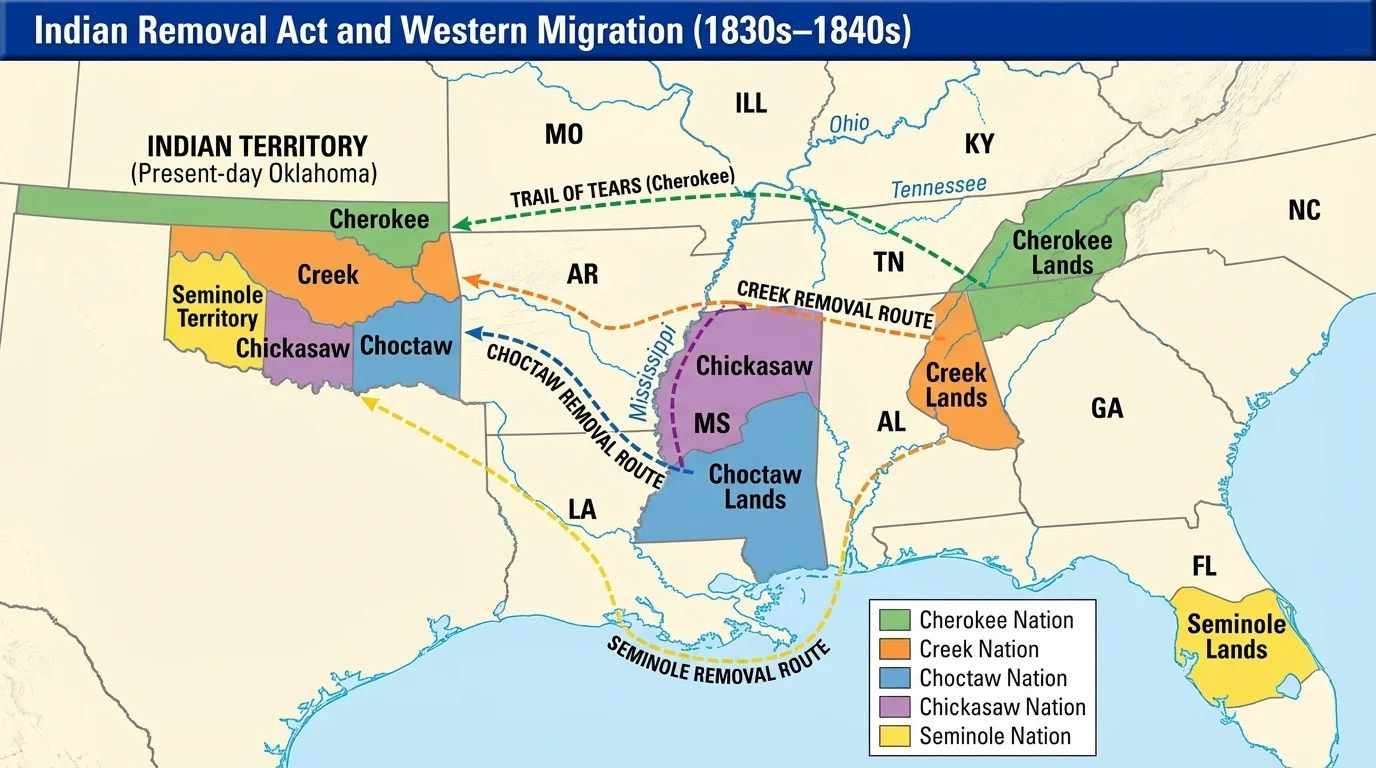
The forced removal of the Cherokee became known as the Trail of Tears. Thousands died from hunger, disease, and exposure during the journey. This event shows how so-called compromise was often unequal. Native leaders sometimes signed treaties under pressure, but those agreements did not reflect free and fair choice.
A useful way to evaluate continuity and change is to compare ideals with actions. The United States continued to describe itself as a land of liberty, yet its policies denied liberty to Native peoples and to enslaved African Americans. The map in [Figure 1] makes clear that removal was national in scale, not an isolated event. It reshaped the country geographically and politically.
Case study: Cherokee resistance
Step 1: The Cherokee Nation tried adaptation and legal action.
Leaders created written laws, published a newspaper, and challenged Georgia's actions in court.
Step 2: The Supreme Court recognized limits on state power.
The Court ruled that Georgia could not simply extend its laws over Cherokee territory.
Step 3: Removal still happened.
This shows that court decisions matter, but political leaders and military force can determine what happens in practice.
The result was a tragic example of how law, power, and expansion collided.
The Indian Removal Act also set a pattern for later western expansion. It showed that the federal government would often place settler demands above Native rights. That pattern matters when we later examine events in Colorado.
By the mid-1800s, the idea of Manifest Destiny encouraged many Americans to believe that expansion across the continent was natural and even justified. This belief was not just about geography. It included ideas about race, culture, economics, and national power.
Colorado became part of this larger story. Before large numbers of American settlers arrived, the region was home to Native peoples including the Cheyenne, Arapaho, Ute, and others. Over time, treaties attempted to define land rights. But as gold discoveries and migration increased, pressure on Native land grew quickly.
The creation of Colorado Territory in 1861 brought even more settlers and soldiers. Tension rose because promises made in treaties did not match what happened on the ground. Some officials demanded more land for mining, ranching, and transportation routes. Native communities faced shrinking territory, hunger, and violence.
How conflict grew in Colorado
Conflict in Colorado developed from a chain of connected causes: migration increased after gold was discovered, settlers wanted land and security, territorial leaders pushed for military action, and Native groups tried to protect their people and resources. Short-term agreements sometimes reduced violence briefly, but mistrust remained because earlier promises had already been broken.
These events show both continuity and change. The setting was different from the Southeast, but the pattern was familiar: federal and territorial authorities negotiated with Native peoples while also allowing settlement to spread into Native lands. Across the nation and in Colorado, compromise often failed because it was built on unequal power.
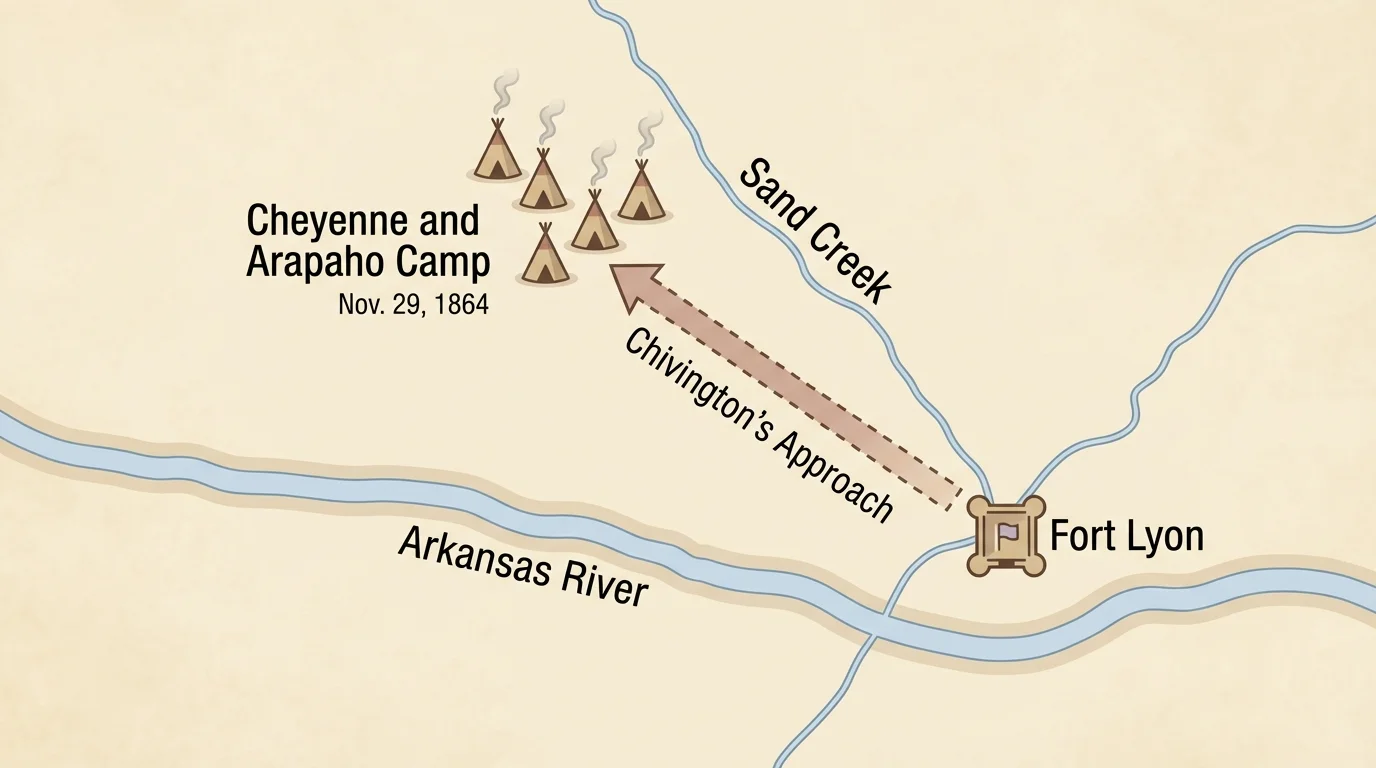
The Sand Creek Massacre is one of the most important and painful events in Colorado history. Location mattered. The attack took place in eastern Colorado Territory near Sand Creek, where a Cheyenne and Arapaho camp had been established under conditions that many in the camp believed offered some degree of safety.
As [Figure 2] helps show, in 1864, during the Civil War, tensions in Colorado were already high. Raids, fear, hunger, and mistrust affected both settlers and Native communities. Territorial governor John Evans and Colonel John Chivington played major roles in the escalating crisis. Some Cheyenne and Arapaho leaders sought peace, including Black Kettle, who believed cooperation might protect his people.
On November 29, 1864, Colorado troops under Chivington attacked the camp at dawn. Many people in the camp were women, children, and elders. Witnesses later reported that soldiers killed noncombatants and committed brutal acts. The event was not a battle between equal military forces. It was a massacre.
Primary sources are especially important here. Testimony from soldiers and officials who saw the aftermath helped expose what happened. One witness, Captain Silas Soule, condemned the attack and described it as a slaughter. His letters and testimony became powerful evidence. Congressional investigations later criticized Chivington and exposed the violence.
The map in [Figure 2] helps explain why this event was part of a broader territorial struggle over space and control. It was not only about one camp. It reflected larger issues: land seizure, military authority, fear among settlers, and the refusal of many leaders to respect Native humanity and treaty obligations.
"It was hard to see little children on their knees have their brains beat out by men professing to be civilized."
— Captain Silas Soule, describing Sand Creek
The Sand Creek Massacre changed Colorado and the nation. It increased warfare on the Great Plains. It damaged trust even further between Native peoples and the United States government. It also remains central to debates about memory, apology, and historical responsibility. Today, the Sand Creek Massacre National Historic Site helps preserve the history and honor the victims.
This event also shows how negotiation could fail in the face of violence. Some Native leaders had tried negotiation. Some federal officials later investigated the violence. Yet those efforts came after irreversible harm. A response made too late cannot undo a massacre.
The Civil War transformed the nation by ending slavery, preserving the Union, and increasing federal power. But it did not end conflict over race, citizenship, or rights. During and after Reconstruction, change was real, yet continuity remained. Formerly enslaved people gained freedom, but discrimination and violence continued. In the West, new military forces also became important. The Buffalo Soldiers were African American soldiers who served in the U.S. Army after the Civil War.
As [Figure 3] shows, in 1866, Congress created several African American regiments, including the 9th and 10th Cavalry and the 24th and 25th Infantry. Native peoples are often said to have given them the name "Buffalo Soldiers," possibly because of their bravery or hair texture, though historians continue to discuss the exact origin. These soldiers served on the frontier, protected routes, built infrastructure, and participated in military campaigns in the West.
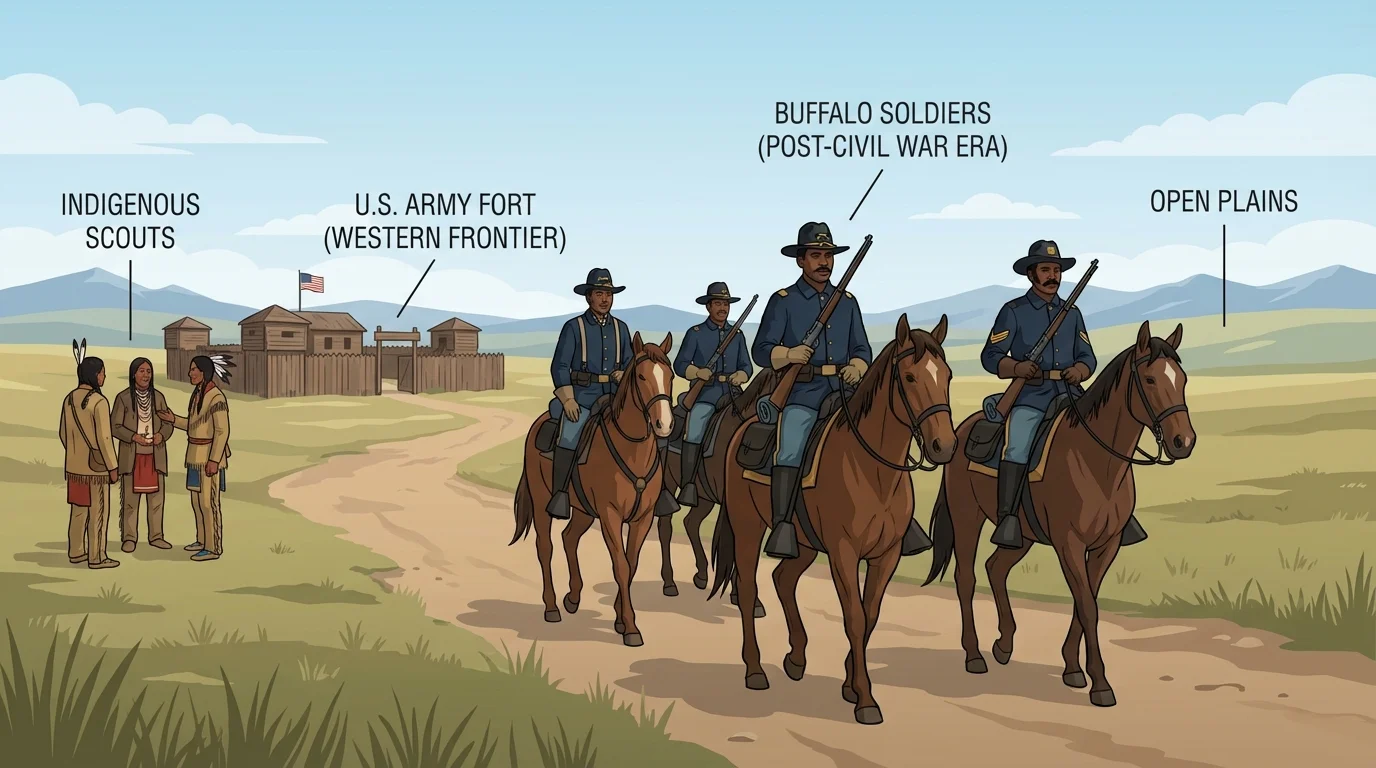
The Buffalo Soldiers represent both change and contradiction. Their service showed a major change because African American men, many of whom had only recently emerged from slavery or the shadow of it, now wore the uniform of the United States and helped defend the nation. At the same time, they served in a military system that often enforced policies against Native peoples.
This is one of the hardest parts of history: groups who faced injustice could also become part of systems that harmed others. Their frontier role requires careful thinking. Their courage and discipline were real. So were the larger policies of conquest and control in which they were involved.
Reconstruction was the period after the Civil War when the nation tried to rebuild the South and define the rights of formerly enslaved people. Amendments to the Constitution ended slavery and attempted to protect citizenship and voting rights, but those gains faced fierce resistance.
Studying the Buffalo Soldiers helps students avoid oversimplified history. Historical figures and groups can be admirable in some ways and connected to harmful systems in others. Mature historical thinking means holding both truths at once.
Across these eras, certain sources of conflict appear again and again: land, race, economic opportunity, political power, military force, and competing ideas of freedom. These were national issues, but they also played out in Colorado in specific ways.
Compromise sometimes reduced tension temporarily. Treaties, court cases, and negotiations could slow violence or create legal limits. But many compromises were unstable because one side had much more power than the other. A treaty is not a true solution if it is ignored. A legal ruling is not enough if leaders refuse to enforce it.
Historical memory is also important. People remember events differently depending on their experiences and sources. For many years, some textbooks softened or ignored the truth about Indian Removal and Sand Creek. More recent scholarship, Native testimony, public memorials, and preserved sites have pushed for fuller and more honest history.
| Event or Era | Main Source of Conflict | Example of Compromise or Response | Historical Importance |
|---|---|---|---|
| Early republic and expansion | Land claims and federal power | Treaties with Native nations | Set patterns for westward growth and broken promises |
| Indian Removal | Settler demand for land | Court resistance and pressured treaties | Forced relocation of Native peoples and national expansion |
| Colorado Territory | Gold rush migration and shrinking Native lands | Local negotiations and temporary camps | Raised tensions that contributed to Sand Creek |
| Sand Creek Massacre | Military violence, fear, and racism | Later investigations by the government | Exposed brutality and deepened Plains conflict |
| Reconstruction and the West | Race, citizenship, and western control | Constitutional amendments and Army service | Showed both expanded rights and continuing injustice |
Table 1. Major conflicts, compromises, and long-term significance from the early republic through Reconstruction.
Looking across the full period, historians can evaluate both continuity and change. There was change in laws, borders, and citizenship. There was continuity in unequal power, racial hierarchy, and repeated struggles over who belonged and who controlled the land. Colorado history is not separate from United States history. It is one clear window into national patterns.
Using primary and secondary sources allows us to move beyond myths. Letters from witnesses, government records, treaty documents, court cases, and modern historical research all help reveal the complexity of the past. The goal is not to make history simpler. It is to understand it more truthfully.
