Your breakfast may have come from more places than you think. Orange juice might come from Florida, bananas from Central America, cereal grains from the Great Plains, and the phone used to check the weather may contain metals mined on one continent, chips designed on another, and parts assembled somewhere else. Trade is not just about ships crossing oceans. It happens whenever people, cities, regions, or countries exchange goods and services because they are different from one another.
Trade happens because no person and no place has everything it wants at the best price. Some places have rich soil. Others have deep harbors, large factories, skilled workers, or important raw materials. These differences become the basis for exchange. When people are free to buy and sell, they often specialize in what they do relatively well and trade for the rest. That idea was important in early American history, when the colonies and later the states grew by producing different goods and exchanging them.
Trade is the exchange of goods and services between people or places.
Specialization means focusing on producing a smaller range of goods or services so production can become more efficient.
Economic freedom is the ability of people and businesses to make choices about work, production, buying, and selling with limited government restrictions.
Trade does not happen only between countries. It also happens regionally within part of a country, and nationally across an entire country. A wheat farm in Kansas trades with a bakery in New York. A lumber company in Oregon trades with a construction business in Arizona. These exchanges happen because places differ in resources, productivity, and costs.
At the center of trade is a simple idea: differences create opportunity. If one place can grow wheat more easily, while another place can build ships more efficiently, both can benefit by exchanging. A place that tries to make everything by itself usually uses time, land, and labor less efficiently.
Economists sometimes describe this with the idea of comparative advantage. In simple terms, a person or place has comparative advantage when it can produce something at a lower opportunity cost than another producer. Even if one country is better at making many things, trade can still help if each side concentrates more on what it does best relative to its other options.
Why differences matter
If Region A can grow 100 bushels of wheat with the same effort that Region B uses to grow 60 bushels, Region A has an advantage in wheat. If Region B can build 10 boats while Region A builds only 4 boats with the same effort, Region B has an advantage in boatbuilding. By specializing and trading, both regions can end up with more wheat and more boats than if each tried to do everything alone.
This idea connects directly to early American history. The British North American colonies had different climates, soils, ports, and work patterns. Free exchange among those regions, and with overseas markets, encouraged growth. Farmers, fishers, merchants, millers, and shipbuilders could earn income by selling what their area produced well.
One major reason trade exists is that places have different natural resources. As [Figure 1] shows, early American regions did not all have the same climate, soil, or coastline. New England had rocky soil, forests, and access to the Atlantic Ocean, which supported fishing, shipbuilding, and trade by sea. The Middle Colonies had fertile farmland, making them strong producers of grain. The Southern Colonies had warm climates and long growing seasons, which helped large-scale crops such as tobacco, rice, and later cotton.
Resources are not only things found in nature. Economists also talk about human resources, such as workers and skills, and capital resources, such as tools, machines, roads, and buildings used to make other goods. A region with iron ore but no furnaces may export raw material. A region with machines and trained workers may import the iron ore and turn it into finished tools.
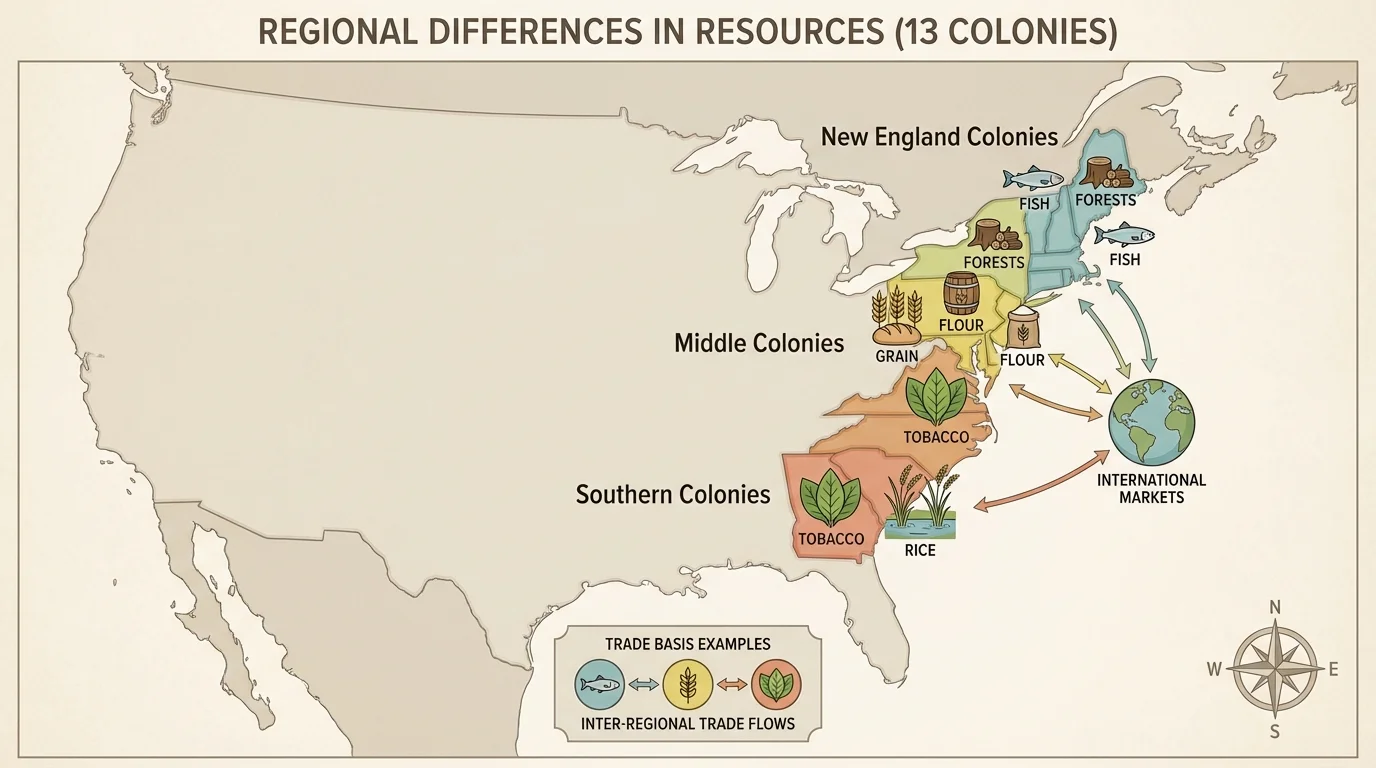
Geography matters at every scale. Regional differences might include mountains in one area and flat farmland in another. National differences might mean one country has oil while another has little energy but many skilled engineers. International differences can involve climate zones, mineral deposits, freshwater access, and population size.
For example, Alaska has rich fisheries and energy resources, while Iowa has rich farmland. Those differences support trade within the United States. Internationally, Brazil's climate supports coffee production, while Saudi Arabia has major petroleum resources. Japan has limited natural resources compared with some larger countries, but it developed strong manufacturing and technology sectors through skill, organization, and trade.
The Middle Colonies were sometimes called the "bread colonies" because they produced so much grain. Their wheat and flour fed people in other colonies and in other parts of the Atlantic world.
When resources are unevenly distributed, exchange becomes useful. A place with abundant timber may trade for goods that require fertile soil or rare minerals. This is one reason trade networks often follow rivers, coastlines, railroads, and highways: moving goods from where they are plentiful to where they are scarce creates value.
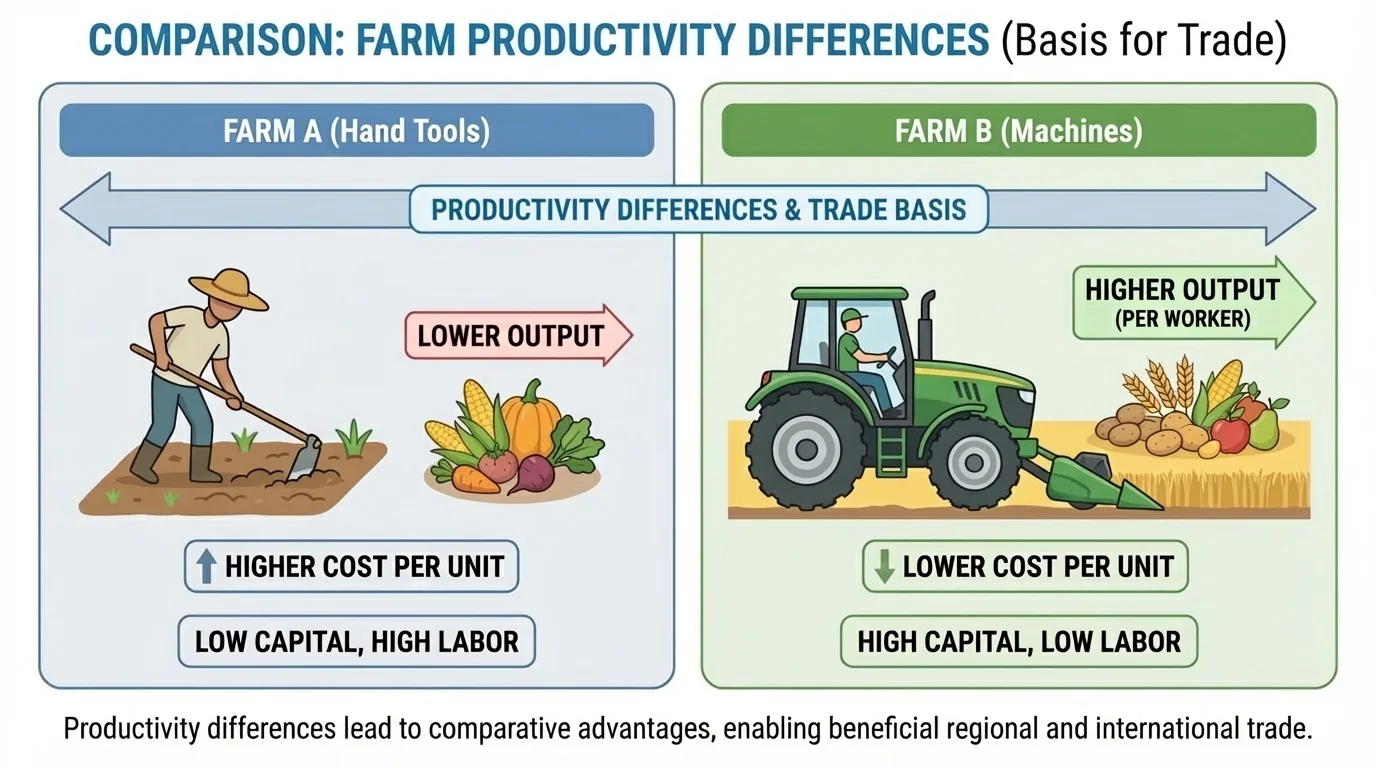
Productivity is the amount of output produced from a given amount of input, such as labor, time, or machinery. As [Figure 2] illustrates, two places can have similar land or similar workers but still produce very different amounts if one uses better tools, better training, or better organization.
If one farm can harvest 1,000 bushels of wheat with 10 workers while another farm harvests 500 bushels with the same number of workers, the first farm has higher productivity. In simple terms, output per worker is higher. That relationship can be written as \(\textrm{productivity} = \dfrac{\textrm{output}}{\textrm{input}}\). A higher value means more is produced from the same effort.
Productivity rises when workers gain skill, when machines save time, and when transportation and communication improve. A blacksmith using hand tools can produce fewer nails than a factory using machines. A farmer near a railroad can get crops to market faster than a farmer who must haul goods by wagon over rough roads.
In early American history, productivity changed as roads, canals, and later railroads improved transportation. Better mills could grind more grain. Better ships could carry goods more efficiently. Merchants could connect buyers and sellers in wider markets. Economic freedom mattered because people had stronger incentives to improve methods, invest in businesses, and seek profit through voluntary exchange.
The same pattern appears today. A factory with robots and computer-controlled machines may produce goods more quickly than a factory relying on older equipment. A country with advanced ports, reliable electricity, and educated workers often produces at lower per-unit cost because productivity is high. This is one reason some countries specialize in electronics, pharmaceuticals, or automobiles.
Productivity example
Suppose Factory A makes 200 shirts with 10 workers in one day, while Factory B makes 120 shirts with 10 workers in one day.
Step 1: Find output per worker for Factory A.
\(\dfrac{200}{10} = 20\) shirts per worker
Step 2: Find output per worker for Factory B.
\(\dfrac{120}{10} = 12\) shirts per worker
Step 3: Compare the results.
Factory A has higher productivity because each worker produces 20 shirts instead of 12.
Higher productivity often helps lower the cost of each shirt and makes trade more likely.
As we saw earlier in [Figure 1], differences in natural resources help explain what places can produce. Productivity helps explain how efficiently they can produce it.
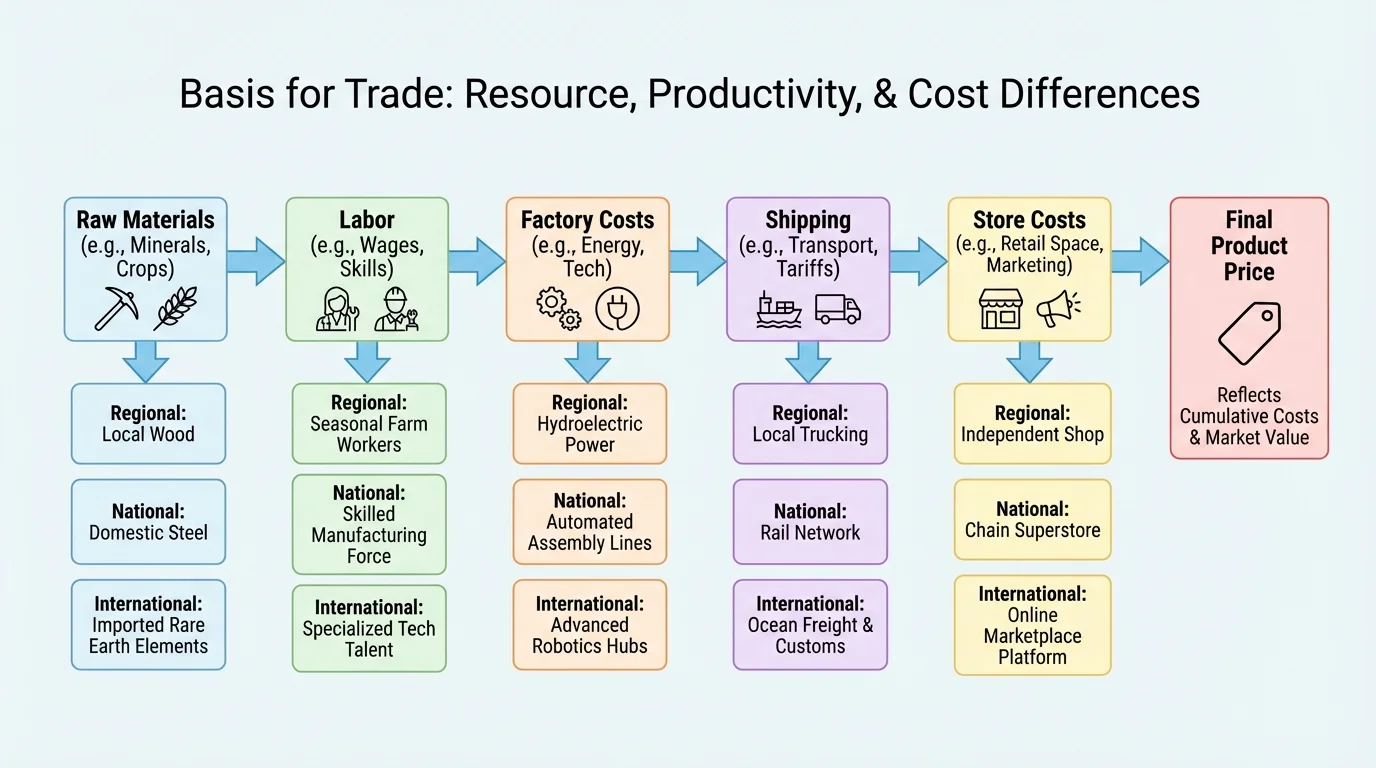
Even if two places can make the same product, they may not do so at the same cost. Cost of production includes spending on labor, materials, energy, land, machines, and transportation. As [Figure 3] suggests, the final price of a good often depends on many connected costs, not just the cost of raw materials.
Labor costs may be lower in one place. Electricity may be cheaper in another. A factory close to a port may pay less to ship goods overseas. Taxes, regulations, weather risks, and distance from markets can also affect total cost. If it costs $8 to make a T-shirt in one country and $5 in another, buyers and sellers have a strong reason to trade, especially if shipping does not erase the savings.
Transportation costs are especially important. Heavy, low-value goods such as gravel or bricks are expensive to move long distances, so they are often produced near where they are used. Lightweight, high-value goods such as computer chips can be shipped farther and still be profitable. That is why some industries are local while others are global.
Changes in transportation can reshape trade. When canals and railroads expanded in the United States, western farmers could send grain to eastern cities at lower cost. When container shipping became common in the modern world, international trade became faster and cheaper. Lower transport costs widened markets and increased competition.
A place may have high wages but still remain competitive if productivity is also high. For example, a worker using advanced machinery may produce so much per hour that the cost per item stays low. That is why cost and productivity must be studied together, not separately.
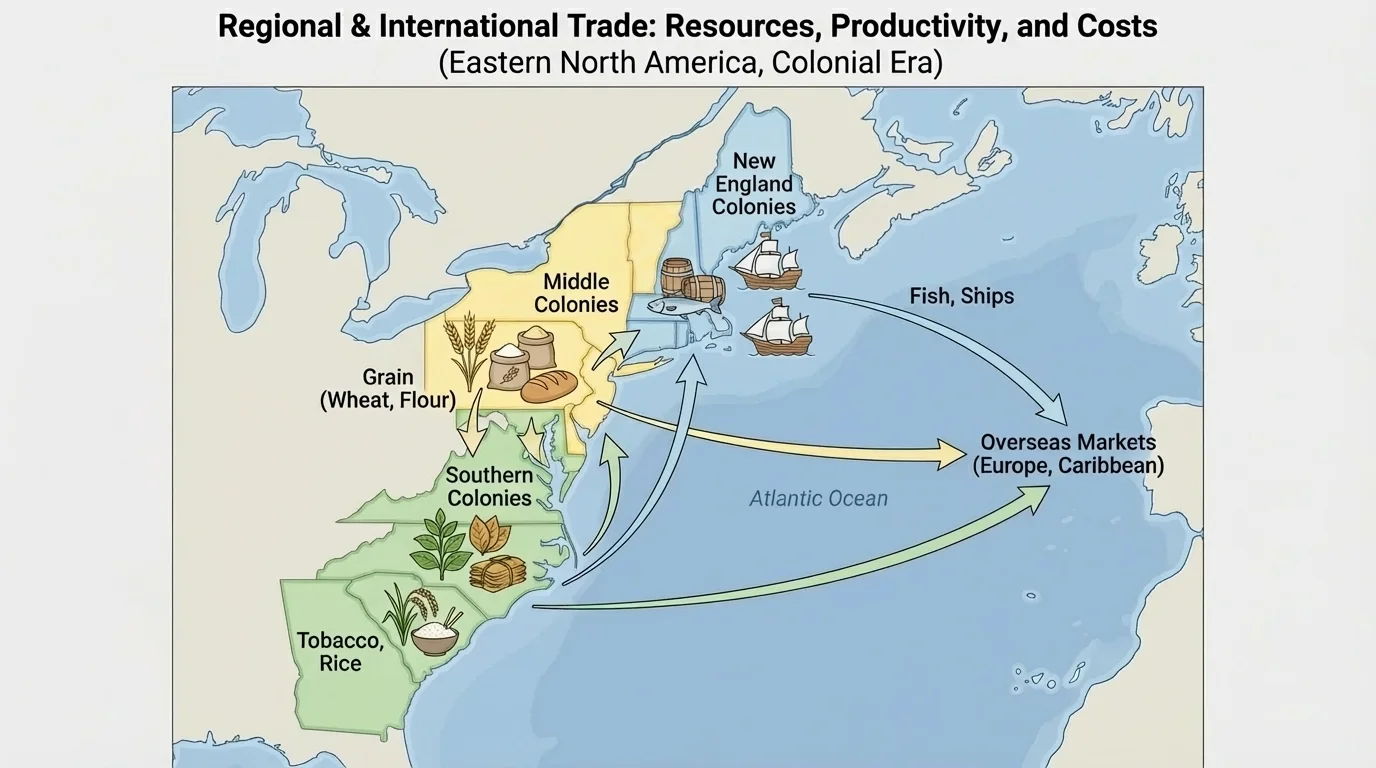
Trade among the colonies is one of the clearest examples of how differences create exchange. As [Figure 4] illustrates, New England, the Middle Colonies, and the Southern Colonies did not produce the same goods in the same way. Their differences encouraged regional trade and linked local economies into a larger market.
New England merchants and fishers sold fish, rum, ships, and manufactured items. The Middle Colonies sold grain, flour, and livestock. The Southern Colonies sold cash crops such as tobacco and rice. Colonists exchanged goods with one another because each region had strengths the others lacked.
This trade helped towns grow. Ports such as Boston, New York, Philadelphia, Charleston, and later many others became centers of buying and selling. Farmers had markets for surplus crops. Merchants earned profits by organizing trade. Shipbuilders found customers. In a broad sense, economic freedom gave people more chances to respond to demand and build wealth through exchange.
Trade in early America also had serious moral and human costs because parts of the colonial economy were connected to slavery. Southern plantation agriculture depended heavily on enslaved labor. This means that while trade encouraged growth, not all participants were free, and not all benefits were shared justly. Understanding early trade requires recognizing both economic development and injustice.
"The wealth of a nation depends on the industry of its people and the freedom of exchange."
— Idea expressed by many early economic thinkers
Later, as roads, canals such as the Erie Canal, and railroads expanded, internal trade within the United States became even more powerful. What began as colonial regional exchange grew into a national market.
National trade means exchange within one country. In the United States, different regions still specialize. The Great Plains produce wheat and corn. Texas produces energy and cattle. The Pacific Northwest produces timber and technology-related goods. California grows fruits, vegetables, and many high-value crops. These products move across state lines every day.
National trade is easier when a country shares one government, one currency, and a connected transportation system. A business in Ohio can order steel from Pennsylvania, computer parts from California, and food products from Wisconsin without crossing international borders. This lowers some barriers and helps create a large domestic market.
Large national markets encourage businesses to expand. If a company can sell to millions of customers instead of only to people nearby, it has more reason to invest in machines, hire workers, and improve efficiency. This pattern helped the United States grow rapidly in the nineteenth century as canals, railroads, and telegraphs connected distant regions.
Earlier studies of geography and history help here: rivers, coastlines, mountain passes, and transportation routes influence where people settle and how trade develops. Economic patterns often follow physical geography.
National trade also reduces shortages. If one state has a poor orange harvest because of weather, oranges can still arrive from another region or from imports through national distribution networks. A connected market helps smooth out local differences in supply.
International trade happens when countries exchange goods and services. A single everyday product may involve several countries, as [Figure 5] shows. Raw materials may come from one nation, components from another, assembly from a third, and consumers from a fourth. Modern trade often works through global supply chains.
The United States imports goods such as coffee, bananas, some clothing, and many manufactured parts. It exports goods and services such as aircraft, soybeans, medical products, software, and entertainment. Countries trade because they have different resources, workforces, technologies, climates, and costs.
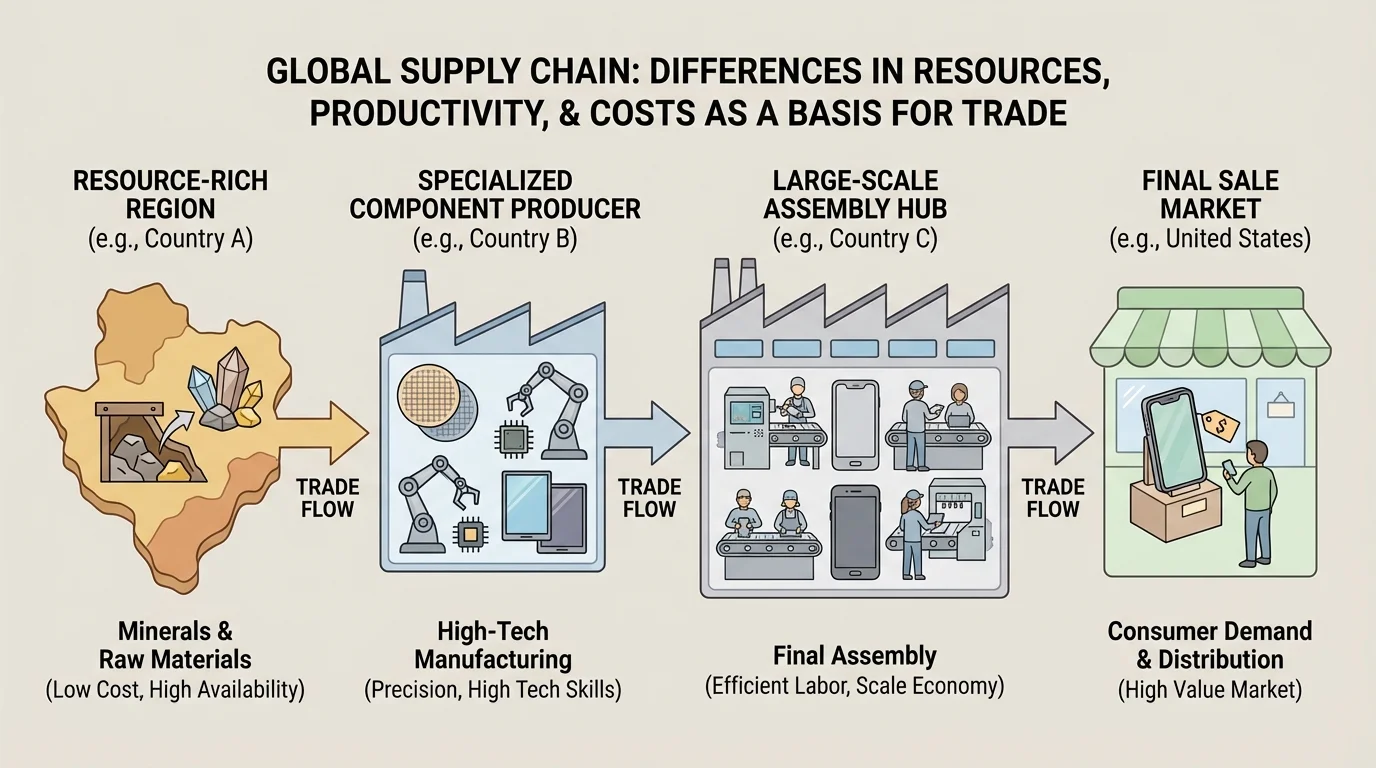
Consider coffee. Coffee grows well in tropical climates, so countries such as Colombia and Brazil can produce it efficiently. Much of the United States cannot grow coffee on a large scale, so importing it makes sense. In return, the United States may export machinery, farm products, or services. This is a practical example of specialization.
Another example is automobiles. A car sold in the United States may include steel from one country, electronic parts from another, design work from another, and final assembly in North America. International trade allows producers to combine the strengths of different places. As we saw in [Figure 3], firms compare total costs, including production and transportation, when deciding where goods should be made.
Imports and exports
Imports are goods and services bought from other countries. Exports are goods and services sold to other countries. When countries trade, each side usually imports some things that are relatively costly to produce at home and exports things it can produce more effectively.
International trade can increase choice for consumers, lower prices, and create jobs in exporting industries. But it can also make some domestic industries face tougher competition. If imports are much cheaper, factories at home may struggle unless they improve productivity or shift to products where they are more competitive.
Trade can bring major benefits. It can increase the variety of goods available, reduce prices, raise incomes, and encourage innovation. It can also help regions recover from local shortages. If one area has drought or crop failure, another region may supply food. If one country lacks a raw material, trade can provide access to it.
However, trade is not automatically perfect or equally beneficial for everyone. Workers in industries facing foreign competition may lose jobs. Places that depend too heavily on one export can face trouble if demand falls. Long supply chains can be disrupted by war, disease, storms, or political conflict. This became very clear in recent years when global shipping slowdowns affected prices and store shelves.
Governments sometimes respond with tariffs, quotas, or trade agreements. A tariff is a tax on imported goods. Tariffs can protect domestic industries, but they can also raise prices for consumers and reduce trade. Supporters of freer trade argue that lower barriers usually allow more specialization and growth. Critics point out that adjustment costs can be painful for workers and communities.
Cost comparison example
Suppose a company can make a backpack in Country A for $18 and ship it for $2, for a total of $20. The same backpack costs $24 to make in Country B with shipping of $1, for a total of $25.
Step 1: Find the total cost in Country A.
$18 + $2 = $20
Step 2: Find the total cost in Country B.
$24 + $1 = $25
Step 3: Compare the totals.
Country A has the lower total cost, so trade or production there is more attractive if quality is similar.
This is the kind of comparison businesses make when deciding where to produce goods.
The goal in studying trade is not just to say "trade is good" or "trade is bad." It is to understand why it happens and how differences in resources, productivity, and costs shape decisions.
Trade is built into daily life. The clothes people wear may use cotton grown in one region, fabric made in another, and design work completed elsewhere. Grocery stores carry foods from nearby farms, distant states, and foreign countries. Streaming services, video games, and apps are also part of trade because services can be bought and sold across regions and nations.
When you look at an object and ask, "Where did the materials come from? Who made it? Why was it produced there instead of somewhere else?" you are thinking like an economist. The answer usually comes back to a combination of resources, productivity, and costs.
That same pattern connects the colonial past to the modern world. In early America, regional differences in land, climate, labor, and transportation created trade among colonies and with overseas markets. Today, national and international differences continue to shape what people produce, what they buy, and how economies grow.
