Look around a typical room and you can spot the global economy almost everywhere: a phone designed in one country and assembled in another, shoes made overseas, fruit shipped from far away, and cars built from parts that cross borders many times. Nations trade because no country produces everything equally well. Yet even though trade can make goods cheaper and more available, governments often step in and limit it. That may seem strange at first. If trade can help people, why would leaders make it harder?
The answer is that trade creates both benefits and pressures. It can lower prices and increase choices for buyers, but it can also create tough competition for businesses and workers at home. Because of that, governments sometimes use special policies to slow down imports or shape trade in ways they believe will help their country. Three common tools are tariffs, quotas, and nontariff barriers.
International trade is the buying and selling of goods and services across national borders. A good might be wheat, steel, shoes, or computers. A service might be banking, shipping, or software design. Countries usually trade because they have different resources, climates, skills, and technology. Brazil can grow coffee well. Saudi Arabia has large oil reserves. Japan has long been known for advanced manufacturing. The United States has major strengths in farming, technology, finance, and many industries.
When countries trade freely, businesses can buy materials at lower costs and consumers can choose from more products. That often leads to lower prices. If one country can make something more efficiently, both sides may gain when they trade instead of trying to make everything themselves.
Free trade means trade with few government restrictions. Imports are goods and services bought from other countries, and exports are goods and services sold to other countries. Domestic producers are businesses that make goods within a country. Consumers are the people and businesses that buy and use goods and services.
Still, free trade is not always politically easy. A shirt made more cheaply in another country may be great news for a shopper, but not for a local factory owner who now faces strong competition. Governments must decide whether to focus mostly on lower prices and open markets or whether to protect certain industries and workers.
Many economists support free trade because it usually increases competition. Competition pushes businesses to improve quality, reduce waste, and lower prices. If companies know buyers can choose imported products, they have a stronger reason to innovate. This can help an economy grow over time.
Free trade also allows specialization. That means countries focus more on producing what they do well and trade for the rest. If a country uses its land, labor, and capital efficiently, it can produce more overall. This is one reason trade has often been linked to economic freedom. When people and businesses have more freedom to buy and sell, markets can expand and new opportunities can appear.
In early American history, trade was a major engine of growth. American merchants shipped tobacco, rice, fish, timber, and later cotton overseas. Ports such as Boston, New York, Philadelphia, and Charleston became centers of business. Farmers, shipbuilders, dockworkers, and traders all benefited when goods moved more freely. Economic freedom, including the ability to trade, helped the young nation build wealth and connect to world markets.
Early American ships carried products across the Atlantic and the Caribbean, helping port cities grow quickly. Trade did not just move goods; it also spread ideas, technology, and investment.
But growth from trade did not mean every person gained in the same way. Different regions and industries often wanted different trade policies. That disagreement is an important reason nations sometimes choose restrictions instead of complete free trade.
Governments restrict trade for several reasons. One common reason is to protect domestic industries. If imported goods are much cheaper, local businesses may lose sales. Leaders may worry that factories will close and workers will lose jobs. To avoid that, they may make imports more expensive or harder to bring in.
Another reason is the infant industry argument. An infant industry is a new or developing business sector that is not strong enough yet to compete with experienced foreign companies. Supporters of protection say a young industry may need temporary help until it becomes efficient and competitive.
Governments may also restrict trade for national security. A country might not want to depend too heavily on foreign nations for steel, computer chips, medicine, fuel, or military equipment. If a conflict or crisis interrupts supply, the country could face serious problems. In those cases, leaders may protect certain industries even if that raises prices.
Some governments use trade restrictions to raise money. Before modern income taxes became common, tariffs were an important source of government revenue. In the early United States, this mattered a great deal because the federal government needed funds to operate and to pay debts.
Trade restrictions can also be a response to unfair behavior. If one country believes another is selling products at unfairly low prices, heavily subsidizing exporters, or breaking trade agreements, it may answer with restrictions of its own. Sometimes these moves are about economics, and sometimes they are also about politics.
Protection versus efficiency
Trade restrictions often protect certain workers and businesses in the short run, but they can make the whole economy less efficient in the long run. This is the central trade-off. Protection can save some jobs or industries, while free trade usually increases total choice and lowers prices. Governments must decide which goal they value more in each situation.
Political pressure matters too. A small group that is strongly affected by imports, such as steel workers or sugar producers, may organize and demand protection. Consumers, who each pay only a little more, may not organize as strongly even though they are more numerous. This can make trade restrictions more likely.
A tariff is a tax placed on imported goods. When a tariff is added, the imported product usually becomes more expensive. If imported shoes cost $40 and a tariff adds $10, the final price may rise to $50. That higher price can make shoes made at home look more competitive.
Tariffs are simple in one way: they do not ban imports completely. Foreign products can still enter the country, but at a higher cost. The government collects revenue from the tariff, and domestic producers may sell more because imported goods are less attractive to buyers.
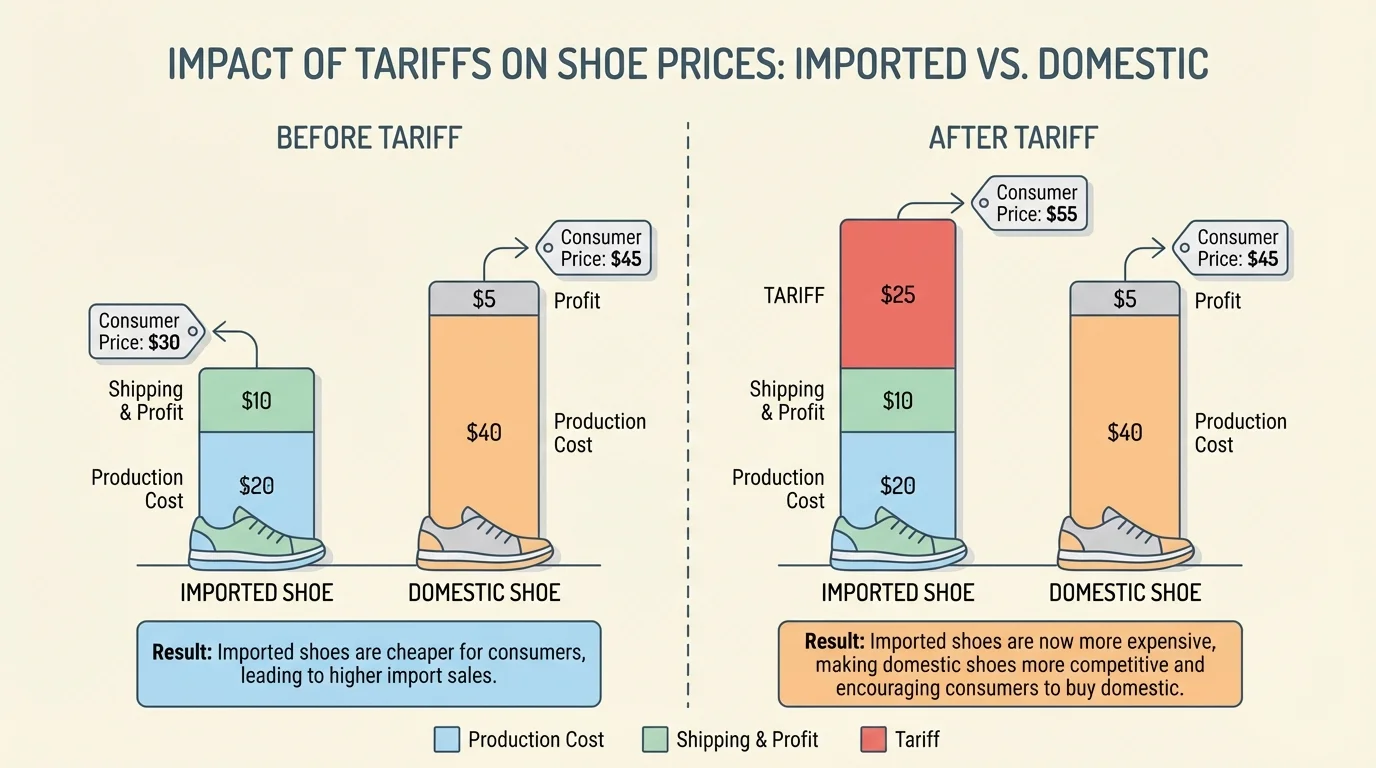
However, tariffs have costs. Consumers often pay more. Businesses that use imported materials may also face higher costs. For example, if a tariff raises the price of imported steel, companies that make cars, appliances, or construction materials may have to pay more too. That can lead to higher prices in many parts of the economy.
Tariffs can also cause retaliation. Retaliation means another country answers with its own tariffs. If Country A taxes imports from Country B, Country B may tax imports from Country A. Then exporters on both sides can suffer.
In the early United States, tariffs were especially important because they brought in money for the federal government. The Tariff of 1789, passed soon after the Constitution took effect, helped raise revenue and also gave some protection to American manufacturing.
A quota is a limit on how much of a product can be imported. When fewer imported goods are allowed into the market, supply becomes tighter. If stores can receive only a limited amount of imported oranges, there may not be enough to meet demand at the old price.
When supply drops but demand stays strong, prices often rise. Domestic producers may gain because they face less foreign competition. Unlike a tariff, which collects tax money for the government, a quota mainly works by restricting quantity.
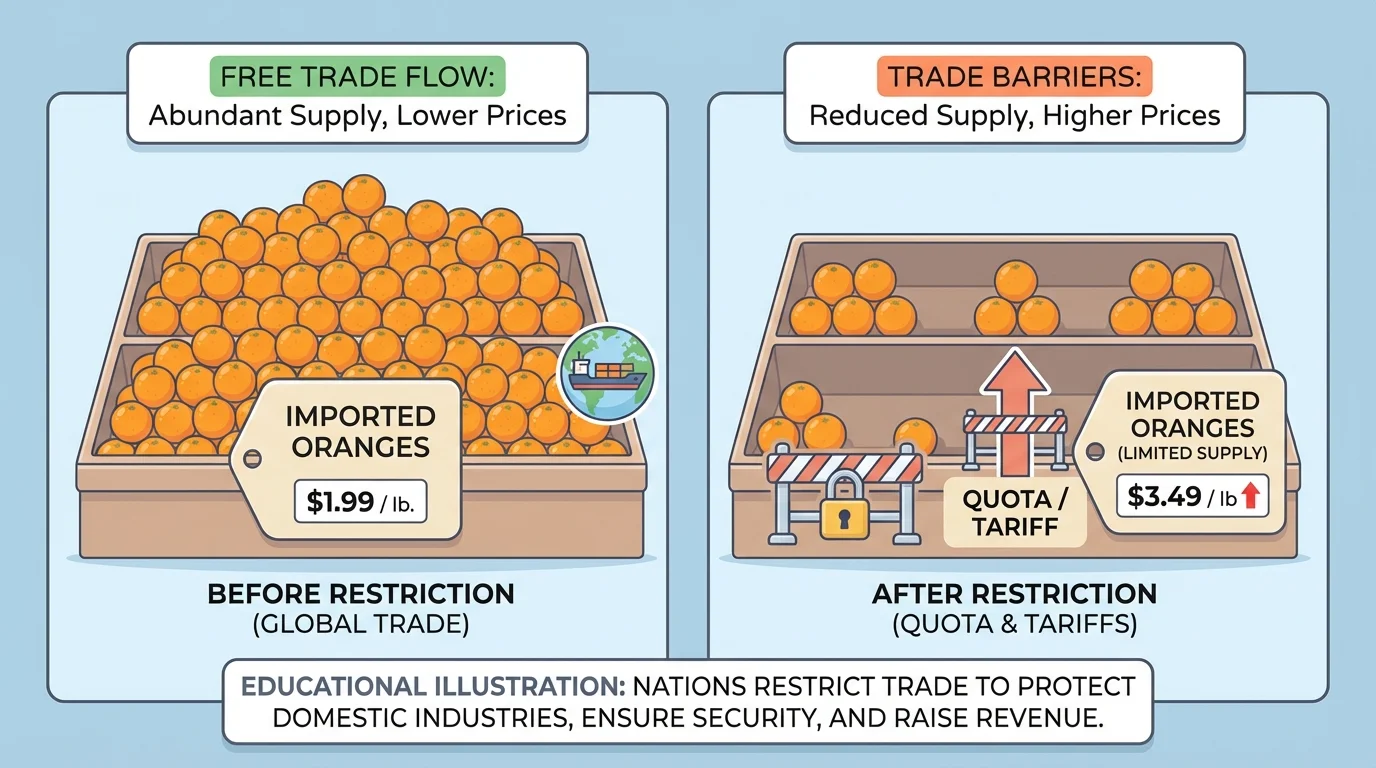
Quotas can strongly protect domestic industries, but they can also create shortages or higher prices. Consumers may have fewer choices. Businesses that rely on imported goods may struggle to get enough supply. A quota can also encourage favoritism if the government decides which companies are allowed to import the limited amount.
One real example involves sugar. The United States has used sugar import quotas. Supporters argue that quotas help American sugar farmers and processors. Critics argue that they raise food prices and hurt companies that use sugar in candy, baked goods, and other products.
The idea shown earlier in [Figure 2] also helps explain why quotas can be powerful: even without a tax, simply limiting the amount available can change the whole market.
A nontariff barrier is any trade restriction that is not a tariff. These barriers can be harder to notice because they often look like rules, standards, or procedures rather than direct taxes. But they can still make trade slower, costlier, or more limited.
Examples include import licenses, product standards, inspections, complex paperwork, safety rules, health rules, and limits based on packaging or labeling. Some nontariff barriers are reasonable and necessary. For instance, food safety inspections can protect people from dangerous products. Car safety standards can save lives. A country has the right to protect health and safety.
The problem comes when rules are designed mainly to block foreign competition rather than truly protect the public. If a country creates extremely difficult paperwork, long delays at ports, or unusual standards that foreign companies cannot easily meet, those rules act like hidden trade barriers.
Case study: A safety rule or a trade barrier?
Suppose a country says imported toys must pass a lead-paint safety test.
Step 1: Ask what the rule is meant to do.
If the goal is to protect children from unsafe materials, the rule may be legitimate and important.
Step 2: Ask whether the same rule applies to domestic producers.
If local toy companies must meet the same standard, the policy is more likely to be fair.
Step 3: Ask whether the process is reasonable.
If the test takes years, costs too much, or is applied only to foreign products, the rule may be acting as a nontariff barrier.
Many trade disputes involve this exact question: is the rule protecting people, or protecting producers?
Another type of nontariff barrier is a subsidy, which is government financial support for businesses. A subsidy is not a border tax, but it can affect trade by helping domestic companies sell at lower prices. An embargo, a complete or nearly complete stop on trade with a country, is another powerful nontariff barrier.
Trade restrictions create winners and losers. Domestic producers that compete with imports often benefit. Some workers in protected industries may keep their jobs or gain better sales opportunities. Governments may gain tariff revenue. But consumers usually face higher prices and fewer choices.
Businesses that depend on imported materials can lose as well. A furniture company may pay more if imported wood becomes costly. A bakery may pay more if sugar imports are limited. A car company may pay more if steel or electronic parts face tariffs. So a policy that helps one industry can hurt another.
| Trade Policy Tool | How It Works | Who May Benefit | Who May Be Hurt |
|---|---|---|---|
| Tariff | Tax on imports raises price | Domestic producers, government | Consumers, businesses using imports |
| Quota | Limits amount of imports | Domestic producers with less competition | Consumers, importers, businesses needing supply |
| Nontariff barrier | Rules, standards, licenses, delays, embargoes | Domestic producers, sometimes public safety | Foreign sellers, consumers, importing businesses |
Table 1. Comparison of major trade restriction tools and their likely effects.
This is why economists talk about trade-offs. A trade-off means gaining one thing while giving up another. A tariff might help a steel mill but raise costs for car makers and buyers. A quota might help farmers in one crop but increase grocery prices for everyone else.
Economic freedom generally means people and businesses have greater freedom to own property, make choices, compete, and exchange goods. Trade policy affects that freedom because restrictions limit who can buy and sell across borders.
Thinking like an economist means asking not only, "Who is helped?" but also, "Who pays the cost?" and "What happens over time?" A policy may look helpful in the short run and still create larger problems later.
[Figure 3] Trade helped shape the early United States through key policy moments and growing port activity. The young nation depended heavily on buying and selling with other countries. Farmers exported crops, merchants ran shipping businesses, and coastal cities grew as trade centers. This connection between markets and opportunity is one reason economic freedom mattered so much in early American history.
At the same time, early leaders debated how open trade should be. Alexander Hamilton favored policies that could strengthen American manufacturing, while Thomas Jefferson often emphasized farming and limited government. These debates were not just about economics; they were also about what kind of nation the United States should become.
One major event was the Embargo Act of 1807. Instead of merely taxing imports, the law sharply restricted American trade with foreign nations in response to British and French interference with U.S. shipping. The goal was to pressure those countries without going to war. But the embargo badly hurt American merchants and many port cities because trade suddenly fell.
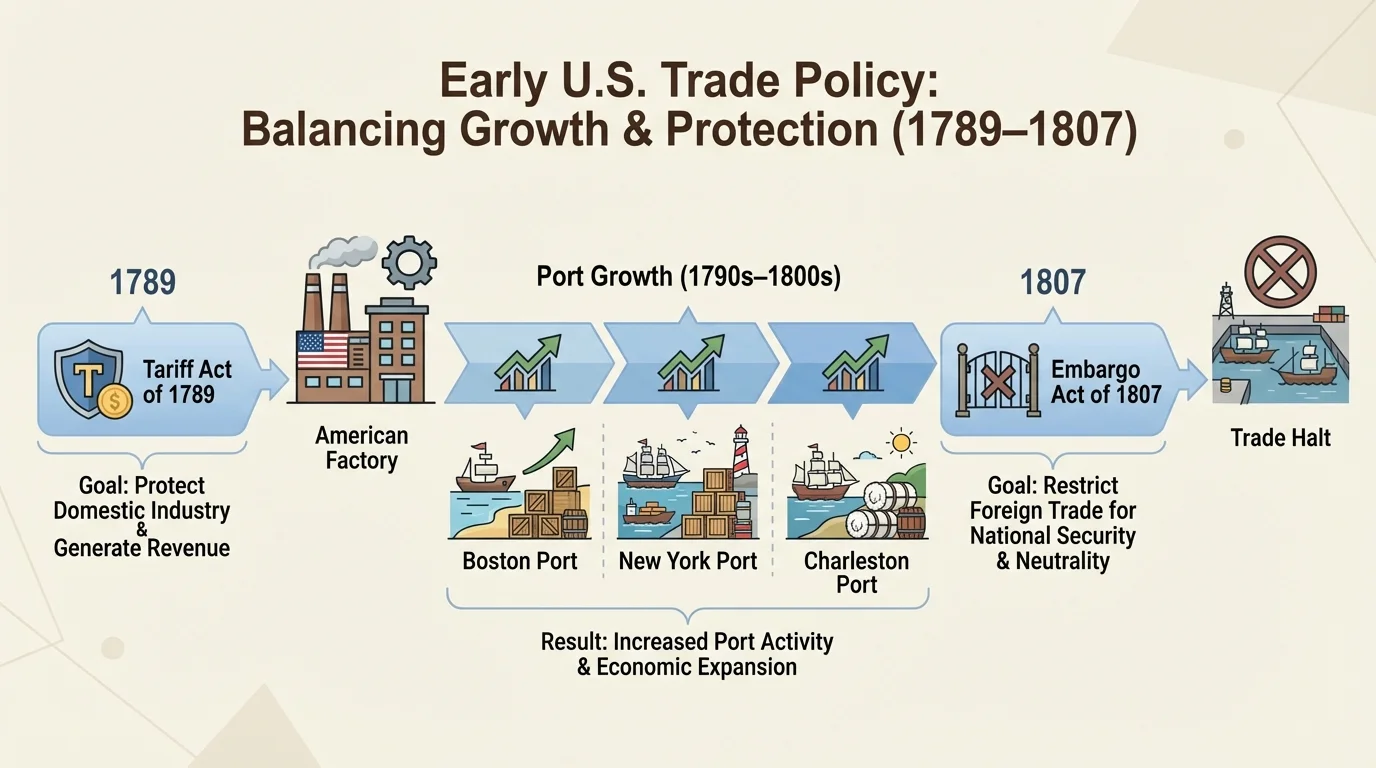
The lesson from early American history is not that trade restrictions are always wrong or always right. It is that they have consequences. Open trade supported growth, especially in shipping and exports, but leaders still used tariffs and embargoes when they believed national interests were at stake.
Later, as the United States industrialized, tariff debates became even more intense. Northern manufacturers often wanted stronger protection. Southern regions, which depended more on exporting crops and importing goods, often preferred lower tariffs. These disagreements show how one policy can affect regions in very different ways.
This sequence makes this clear: early America gained from trade, but it also used restrictions when leaders wanted revenue, protection, or political leverage.
Modern trade disputes still use the same basic tools. Steel tariffs are one example. Supporters say they protect national security and domestic steel jobs. Critics say they raise costs for industries that use steel, such as construction and car manufacturing.
Agricultural trade offers another example. A country may restrict imported crops to protect local farmers. That can help rural communities in the short run, but it may also mean grocery stores charge more and families have fewer choices.
Technology is another major area. Nations may limit imports of advanced computer chips or telecommunications equipment because of security concerns. In that case, trade policy overlaps with foreign policy and defense.
"There are no solutions, only trade-offs."
— A principle often used in economics and public policy
That idea fits trade policy very well. Governments often restrict trade because they want to solve a problem, but every restriction creates new effects somewhere else in the economy.
When judging a trade policy, it helps to ask several questions. What is the government trying to protect? Is the problem temporary or long-term? Are consumers paying much more? Is the policy helping an industry become stronger, or just sheltering it from competition?
Another important question is whether the restriction increases freedom and growth over time or reduces them. Sometimes a short period of protection may help a new industry develop. But if protection lasts too long, businesses may stop innovating because they no longer face strong competition.
Economic growth in early American history was closely tied to enterprise, exchange, and expanding markets. Free trade and economic freedom often encouraged that growth by allowing goods, money, and ideas to move. Yet governments still restricted trade when they wanted revenue, protection, national security, or political leverage. Understanding both sides helps explain why nations continue to debate tariffs, quotas, and nontariff barriers today.
