If citizenship seems like a simple idea, history says otherwise. In the United States, people have spent centuries arguing over a basic question: Who counts as a full member of the nation? The answer has changed again and again through wars, protests, court cases, amendments, and social movements. Sometimes rights expanded. Sometimes they were taken away or blocked. Learning this history shows that citizenship is not just a legal label. It affects voting, belonging, safety, opportunity, and power.
Citizenship means membership in a country, along with certain rights and responsibilities. In the United States, citizenship has included ideas such as legal protection, the right to vote, equal treatment under law, and participation in civic life. But from the beginning, many people lived under U.S. control without receiving full rights. That is why the story of citizenship is also the story of conflict over equality.
Citizenship is legal membership in a nation. Civil rights are protections against unfair treatment by government or others. Suffrage means the right to vote. Equal protection is the principle that the law should treat people fairly and not deny them basic rights because of who they are.
In the early United States, leaders often spoke about liberty, but liberty was not shared equally. Property-owning white men had the most political power. Enslaved Africans were treated as property, not citizens. Most women could not vote. Indigenous nations were treated as separate political communities when convenient, but their land was seized. Free Black people faced restrictions almost everywhere. This gap between national ideals and actual rights appears throughout U.S. history.
The Constitution created a new government, but it did not clearly define national citizenship for everyone. It tolerated slavery, and voting rules were mostly left to the states. In many states, only white men with property could vote at first. Over time, many white men without property gained voting rights, but that expansion did not include everyone else.
One early law, the Naturalization Act of 1790, limited naturalized citizenship to "free white persons." That meant immigrants who were not considered white could live in the United States but still be blocked from becoming citizens. This is a clear example of how race shaped citizenship from the start.
For African Americans, one of the worst legal decisions came in Dred Scott v. Sandford in 1857. The Supreme Court ruled that African Americans, whether enslaved or free, were not citizens of the United States and could not claim the rights of citizens in federal court. The decision also strengthened slavery by limiting Congress's power to stop its spread. Instead of expanding liberty, the ruling narrowed it.
Indigenous Peoples faced a different but equally damaging system. Native nations had their own governments, cultures, and territories long before the United States existed. Yet U.S. expansion pushed tribes off their lands through warfare, broken treaties, and forced removal. The Indian Removal Act of 1830 led to tragedies such as the Trail of Tears. Native people were often treated as obstacles to expansion rather than as equal human beings with rights.
The United States often spoke of freedom while also maintaining slavery and taking Native land. That contradiction is one reason the definition of citizenship became such a major struggle in U.S. history.
Religious minorities also faced barriers. The Constitution barred religious tests for federal office and the First Amendment protected free exercise of religion, yet prejudice still shaped people's lives. Catholics, Jews, Mormons, Muslims, Sikhs, and others have all faced periods of suspicion or discrimination. Legal protections existed, but social acceptance often lagged behind.
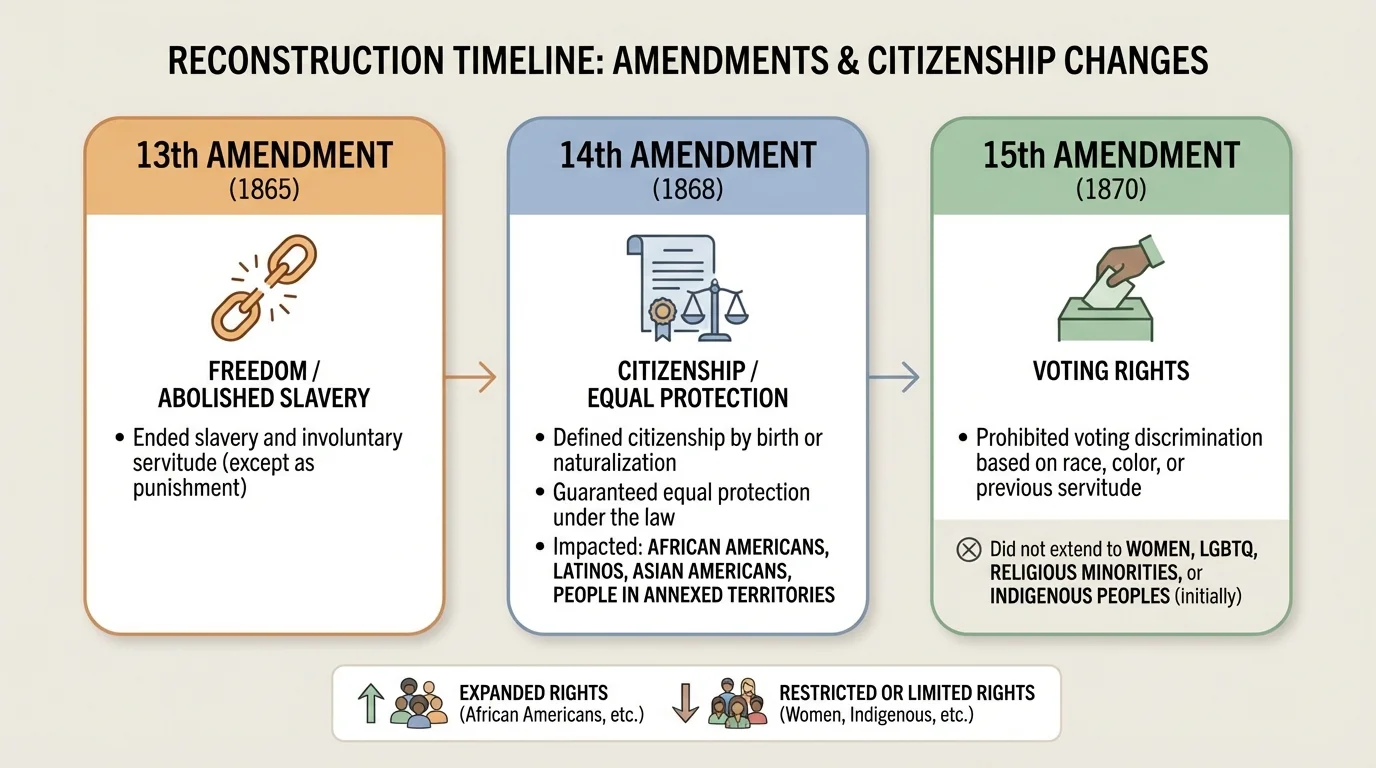
The Civil War transformed the nation. During Reconstruction, the United States rewrote the law to destroy slavery and redefine national membership, as [Figure 1] shows through the three major amendments passed after the war. These changes were some of the most important in U.S. history because they shifted citizenship from a narrow idea shaped by race toward a broader constitutional principle.
The 13th Amendment ended slavery. The 14th Amendment declared that all persons born or naturalized in the United States are citizens and promised equal protection of the laws. The 15th Amendment said that voting rights could not be denied because of race, color, or previous condition of servitude. For African Americans, this was a revolutionary change. People who had been enslaved were now recognized in the Constitution as citizens.
But legal change did not end injustice. Southern states passed Black Codes to control the lives and labor of freedpeople. White supremacist groups used terror and violence to block Black political participation. For a short time, African American men voted and held office in large numbers during Reconstruction. Then a backlash grew stronger.
By the late 1800s, many of the gains of Reconstruction were weakened. Poll taxes, literacy tests, grandfather clauses, intimidation, and violence prevented many Black citizens from voting. This shows a major lesson in civics: a right written in law can still be denied in practice if governments refuse to enforce it.
After Reconstruction, Southern states built the system known as Jim Crow. These laws enforced segregation in schools, transportation, housing, and public spaces. In 1896, the Supreme Court case Plessy v. Ferguson approved "separate but equal," even though separate facilities were almost never equal. African Americans were citizens on paper, but they were denied full access to citizenship's promises.
Asian Americans also faced strong legal restrictions. The Chinese Exclusion Act of 1882 barred most Chinese immigration and became the first major federal law to exclude a specific nationality. Other laws and court rulings kept many Asian immigrants from becoming citizens or owning land. In some places, children of Asian descent were separated in schools, and communities faced hostility and violence.
For many immigrants, citizenship depended on race-based rules. Courts sometimes had to decide whether a person counted as "white" enough to naturalize. That may sound strange today, but it reveals how citizenship was tied to ideas of race rather than simply loyalty or residence.
Religious minorities continued to face tension. Anti-Catholic movements accused Catholics of being loyal to the pope over the nation. Jewish Americans often faced quotas in schools, jobs, and housing. Members of the Church of Jesus Christ of Latter-day Saints were persecuted in the 1800s, and debates over religious freedom appeared again and again. The right to believe did not always protect people from discrimination.
Women were citizens, but for much of U.S. history they did not enjoy the same political rights as men. In 1848, reformers at Seneca Falls issued the Declaration of Sentiments, calling for women's equality, including voting rights. Leaders such as Elizabeth Cady Stanton, Susan B. Anthony, Sojourner Truth, Ida B. Wells, and many others pushed the nation to reconsider who should have political power.
The women's suffrage movement led to the 19th Amendment in 1920, which said voting rights could not be denied on account of sex. This was a major expansion of democracy. Yet it did not solve everything. Many Black women in the South still faced the same racist barriers that kept Black men from voting. Native women were also affected by the fact that many Native people were not yet recognized as U.S. citizens. Some Asian immigrant women remained excluded because naturalization laws were still discriminatory.
Case study: Why the 19th Amendment was important but incomplete
Step 1: The amendment changed the Constitution by protecting voting rights regardless of sex.
Step 2: In practice, state and local officials still used racist laws and intimidation against many women of color.
Step 3: The result was uneven citizenship: some women gained political voice immediately, while others had to keep fighting for decades.
The amendment expanded rights, but equal access still depended on race, location, and enforcement.
Women's rights movements later expanded beyond voting to include access to education, employment, property rights, and protection against discrimination. These changes helped redefine citizenship as more than voting alone. Full participation also meant fair treatment in everyday life.
The history of Native citizenship is especially complex because Native people belonged to sovereign tribal nations before the United States claimed authority over them. As [Figure 2] illustrates, many Native people had to navigate both tribal identity and U.S. law at the same time. The federal government sometimes treated tribes as separate nations, sometimes as dependent groups, and often ignored Native sovereignty when land or resources were at stake.
In the late 1800s and early 1900s, federal policy often aimed to force Native people to abandon their languages and traditions. Boarding schools separated children from their families and tried to erase Native cultures. The Dawes Act divided tribal lands into individual allotments, weakening tribal control and opening land to white settlers.
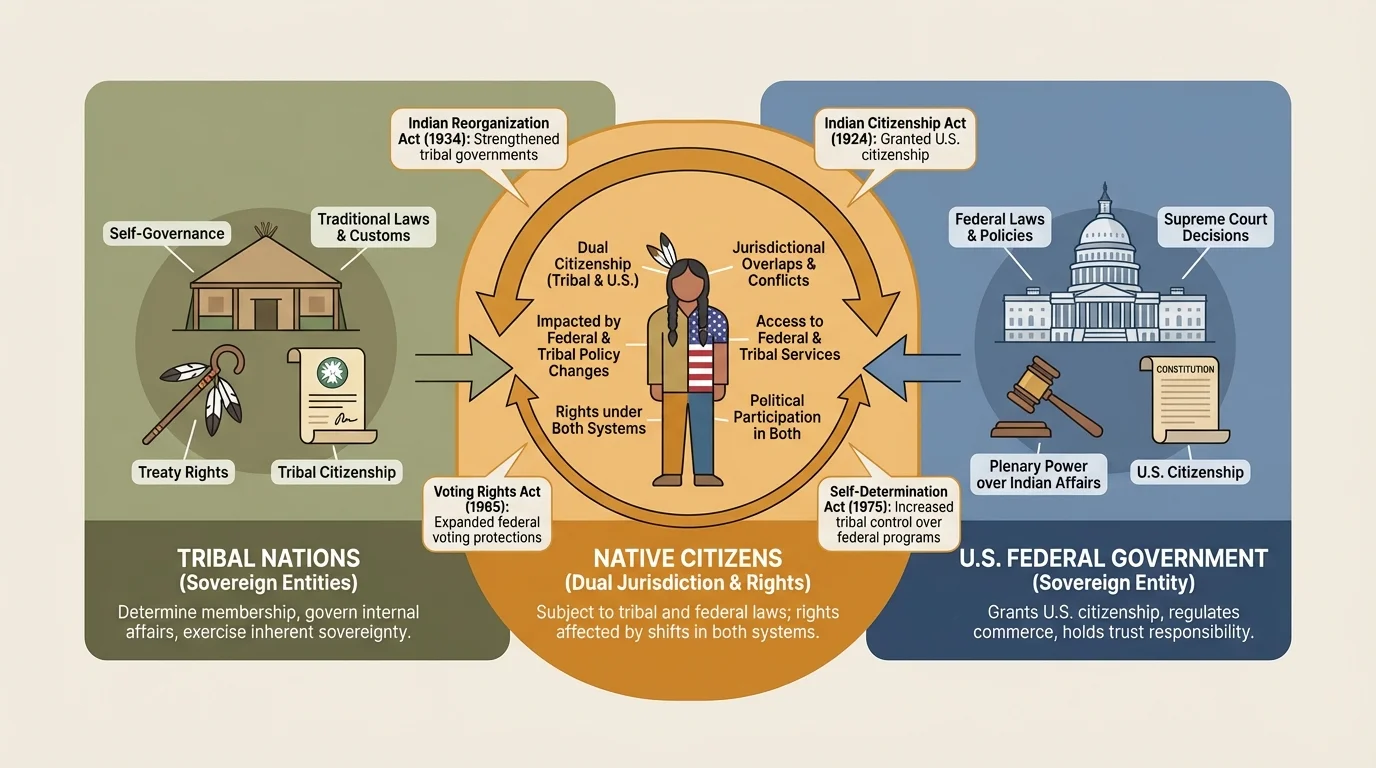
The Indian Citizenship Act of 1924 made all Native Americans born in the United States citizens. But even then, some states still blocked Native voting through residency rules, literacy tests, and other barriers. Once again, legal citizenship did not automatically create equal rights in reality.
Native activism in the 1960s and 1970s pushed for treaty rights, self-determination, education, and control over tribal affairs. Today, Native people are both citizens of the United States and citizens of their tribal nations. That dual identity makes Native citizenship different from most other groups and helps explain why tribal sovereignty remains so important.
Citizenship is also shaped by geography and conquest, as [Figure 3] makes clear. When the United States expanded, it often gained land first and then decided later what rights the people living there would have. That meant some communities became part of the United States without being treated as full equals.
After the Mexican-American War, the Treaty of Guadalupe Hidalgo in 1848 transferred a huge region from Mexico to the United States. Mexicans living in that territory were promised citizenship and rights, but in practice many Mexican Americans lost land through fraud, court battles, and violence. They faced segregation in schools, neighborhoods, and workplaces, especially in the Southwest.
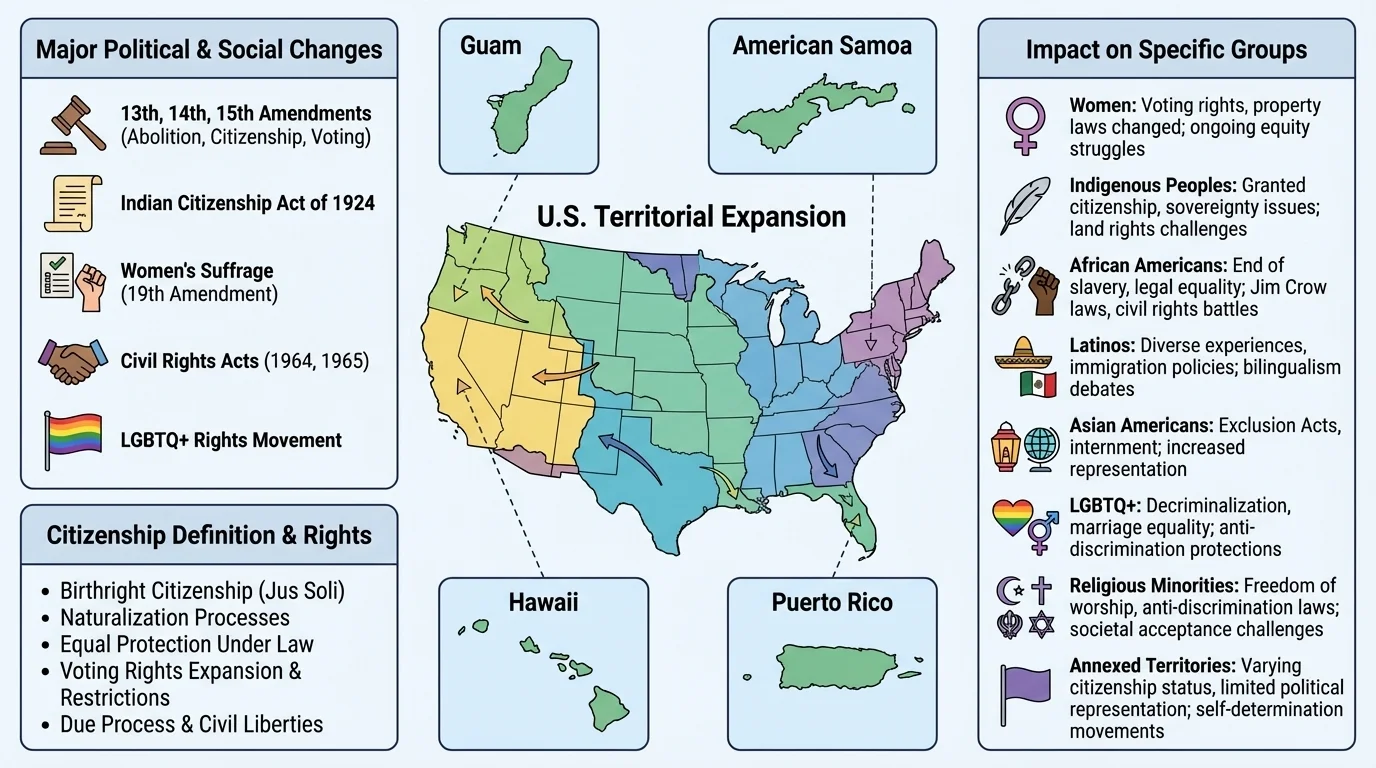
Latino history in the United States includes both citizens by birth and immigrants seeking opportunity or refuge. Puerto Ricans were made U.S. citizens by the Jones Act of 1917, yet Puerto Rico is a territory, not a state. People living there are U.S. citizens, but they cannot vote for president unless they live in a state, and the island has limited representation in Congress.
Other annexed territories reveal more uneven citizenship. Guam and the U.S. Virgin Islands also have U.S. citizenship with limits on representation. American Samoa is different: people born there are U.S. nationals, not automatically full U.S. citizens. The Insular Cases, decided in the early 1900s, said that full constitutional rights did not automatically apply in all territories. That created a system in which people under U.S. control could have fewer rights depending on where they lived.
The Philippines, once controlled by the United States after the Spanish-American War, offers another example. Filipinos were classified in ways that changed over time, and U.S. rule there showed that the nation sometimes acted like an empire while still speaking the language of democracy. For people in annexed territories, citizenship has often been partial, delayed, or unequal.
The mid-1900s brought a chain of connected struggles for rights, as [Figure 4] shows in the sequence of major civil rights victories. These movements challenged segregation, discrimination, and exclusion, and they pushed the nation closer to its promises.
During World War II, Japanese Americans experienced one of the clearest examples of rights being stripped away during a crisis. After the attack on Pearl Harbor, the government forced more than 100,000 people of Japanese ancestry into incarceration camps. Most were U.S. citizens. Their citizenship did not protect them from fear, racism, and government power. Decades later, the U.S. government formally apologized and paid reparations.
The modern Civil Rights Movement attacked segregation and voter suppression. In Brown v. Board of Education in 1954, the Supreme Court ruled that segregated schools were unconstitutional. Activists such as Martin Luther King Jr., Rosa Parks, Ella Baker, Fannie Lou Hamer, John Lewis, and many local organizers used marches, boycotts, sit-ins, lawsuits, and voter registration drives to demand change.
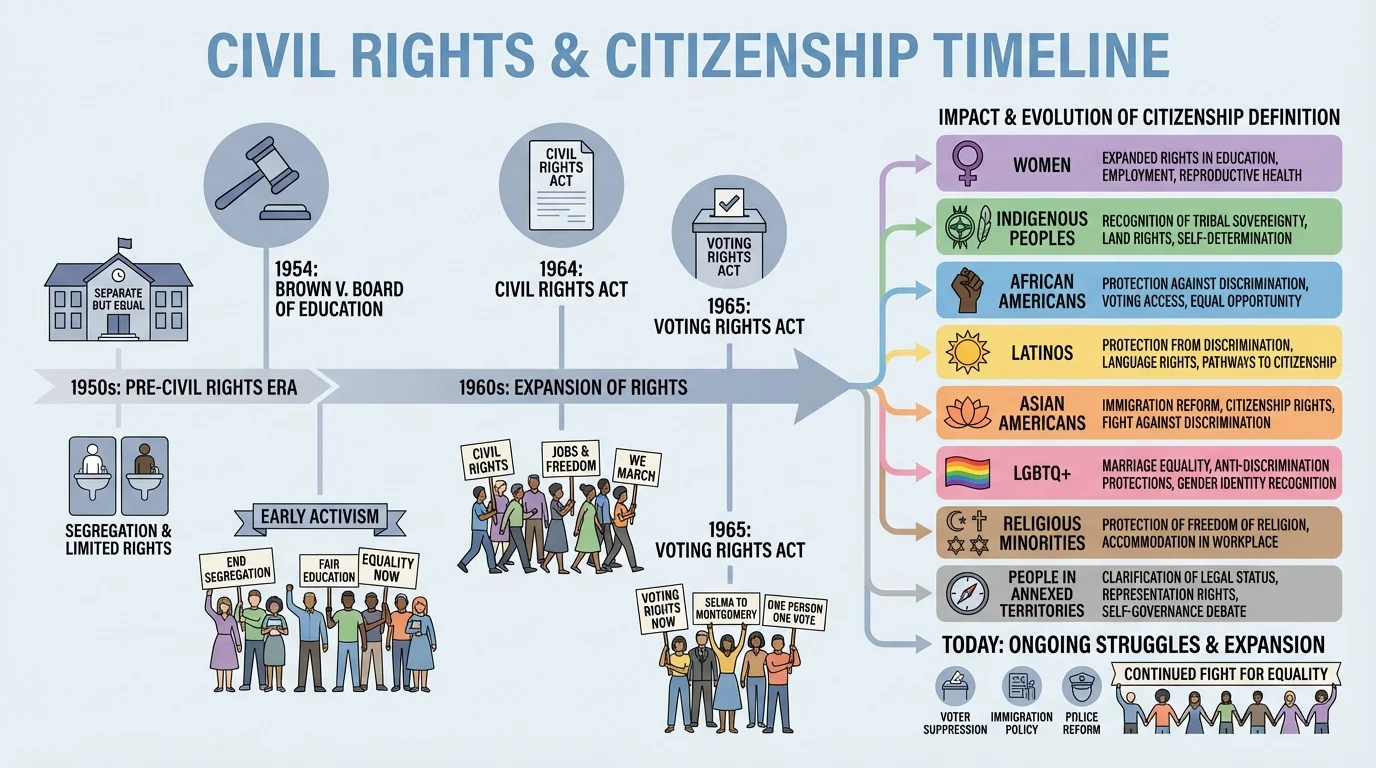
The Civil Rights Act of 1964 banned discrimination in public accommodations and employment. The Voting Rights Act of 1965 attacked barriers that had blocked African American voting for generations. These laws strongly expanded the practical meaning of citizenship for African Americans and influenced many other groups as well.
Latino activists, including César Chávez, Dolores Huerta, and the United Farm Workers, fought for labor rights and fair treatment. The Chicano Movement demanded educational equality, voting rights, and cultural pride. Asian American activists challenged exclusion and pushed for ethnic studies, immigration reform, and reparations for Japanese American incarceration. The Immigration and Nationality Act of 1965 removed old national-origin quotas, changing who could enter the country and broadening the path to membership.
Rights often spread through connected movements. A gain won by one group can create legal ideas, political energy, and public pressure that help others. For example, arguments about equal protection that challenged racial segregation later influenced cases about sex discrimination, disability rights, and LGBTQ equality.
Religious minorities also benefited from broader civil rights protections, though prejudice did not disappear. Muslim, Sikh, Jewish, Hindu, and other communities have continued to defend both religious freedom and equal treatment, especially during times of fear or war when suspicion can rise quickly.
For much of U.S. history, LGBTQ people were criminalized, excluded from jobs, denied family recognition, or treated as mentally ill. Their citizenship existed on paper, but many everyday rights were denied. The Stonewall uprising of 1969 became a major symbol of resistance against police harassment and helped energize the modern LGBTQ rights movement.
Over time, activists won important changes. Courts and lawmakers expanded protections in some places against discrimination in housing, jobs, and schools. In 2015, Obergefell v. Hodges recognized same-sex marriage nationwide. That decision mattered because marriage affects taxes, medical decisions, inheritance, and family status. In other words, it shapes how citizenship works in daily life.
Even so, debates continue over transgender rights, health care access, school policies, military service, and anti-discrimination laws. This reminds us that the meaning of equal protection is still being argued in courts, legislatures, and communities.
"The arc of the moral universe is long, but it bends toward justice."
— Martin Luther King Jr.
The quotation is hopeful, but history also shows that justice does not happen automatically. People organize, vote, argue, testify, march, and challenge unfair laws. Citizenship becomes more meaningful when people use it to defend the rights of others as well as themselves.
Today, questions about citizenship still matter. Debates continue over voting access, voter identification laws, felony disenfranchisement, immigration policy, birthright citizenship, refugee policy, tribal sovereignty, territorial status, and how schools should teach history. Each debate connects to an older question: who gets full inclusion, and who remains at the edge of the nation's promises?
Looking back across U.S. history, a pattern appears. Rights have expanded through constitutional amendments, court rulings, activism, and changing public opinion. But rights have also been restricted by prejudice, violence, and unequal enforcement. Women, Indigenous Peoples, African Americans, Latinos, Asian Americans, LGBTQ people, religious minorities, and residents of annexed territories have all shaped the meaning of citizenship by insisting that the country live up to its ideals.
That history matters because citizenship is not only about legal status. It is also about whether people can truly participate, be heard, and live with dignity. When students learn how citizenship changed, they are really learning how democracy changes—and how it can change again.
