Many rights that seem basic today were once denied to large groups of people. The right to vote, go to school with equal protection, or be recognized as a full citizen did not appear all at once. They were won through years of argument, pressure, courage, and conflict. In U.S. history, people used many different methods to change government and laws, and the results were not always immediate. Some strategies produced fast results but limited change. Others seemed slow but permanently reshaped the country.
Political change happens when people try to influence how power is used. That can mean changing a law, challenging a government action, expanding voting rights, or forcing the nation to confront injustice. Because governments are made of institutions such as legislatures, courts, executives, and voters, change usually takes place through more than one route. People often disagree strongly about who counts as a full member of the political community and what rights that membership should include.
In the United States, the meaning of citizenship changed over time. At first, political participation was mostly limited to white men who met property requirements in many states. Over time, those limits were challenged. Enslaved African Americans, women, Native Americans, immigrants, and young adults all experienced restrictions on rights in different ways. The struggle to expand rights shows that democracy is not automatic; it has to be defended and improved.
Citizenship means legal membership in a nation, along with rights and responsibilities. Suffrage means the right to vote. Litigation is the use of lawsuits and court cases to challenge laws or actions. Civil disobedience is the peaceful refusal to obey laws considered unjust. Amendment means a formal change to the Constitution.
When historians evaluate strategies for political change, they ask several questions. Did the strategy create a law or court ruling? Did it change daily life for ordinary people? Did it last, or was there backlash? Did it only help one group, or did it expand rights more broadly? These questions help us judge results, not just intentions.
The story of U.S. citizenship is a story about inclusion. The country's founding documents used broad language about liberty and equality, but real access to those ideals was limited. Over time, reformers argued that the nation should live up to its own principles. Sometimes they worked through government institutions. Sometimes they protested in the streets. Often, they did both.
One important idea is that legal rights and rights in practice are not always the same. A law may say one thing, while local officials, social customs, or violence enforce something very different. For example, African American men gained voting rights in theory after the Civil War, but intimidation, poll taxes, literacy tests, and terror often blocked those rights in practice. This is why evaluating political strategies requires looking beyond legal words to actual outcomes.
The Constitution did not originally define all Americans as citizens in a clear, equal way. That became one of the nation's biggest political struggles, especially before and after the Civil War.
Another key idea is that one strategy often opens the door for another. A protest may raise awareness, a court case may challenge injustice, a law may provide enforcement, and voters may elect leaders who protect those changes. Political change is usually more like a relay race than a single sprint.
One of the most powerful ways to create political change is to change the Constitution itself. As shown in [Figure 1], the long path of constitutional reform reveals that the expansion of rights happened through major steps spread across many decades rather than through one single event. This is difficult by design, which means amendments are rare, but when they succeed, they can reshape the nation for generations.
After the Civil War, the 13th Amendment ended slavery, the 14th Amendment established birthright citizenship and equal protection of the laws, and the 15th Amendment declared that voting rights could not be denied because of race. These amendments were revolutionary. They redefined who could be recognized as part of the nation and what protections the federal government could enforce.
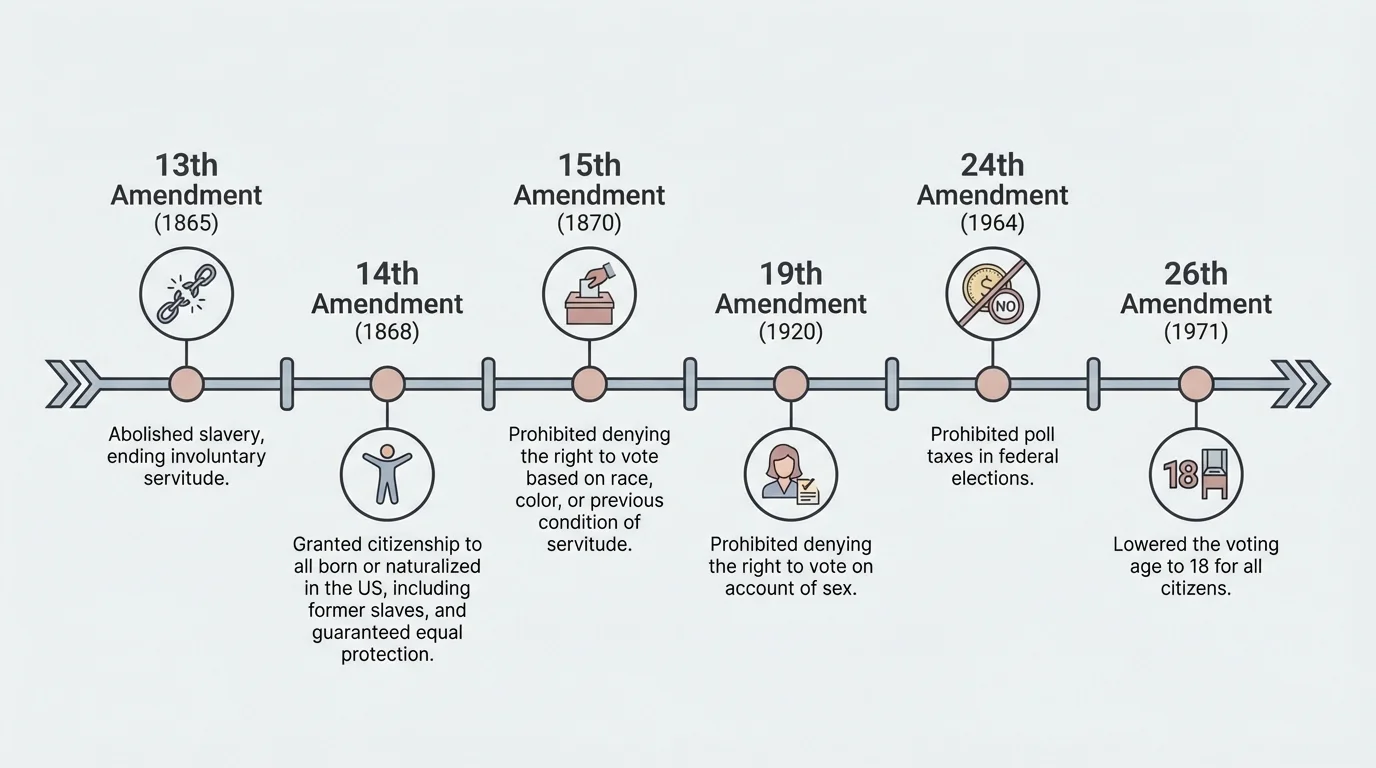
But results were mixed. In the short term, these amendments created the legal foundation for greater equality. During Reconstruction, African American men voted, held office, and helped shape state governments. In the long term, the 14th Amendment became one of the most important tools for later civil rights cases. Yet the immediate gains were weakened by white supremacist violence, weak enforcement, and later court decisions that narrowed protections.
The 19th Amendment, ratified in 1920, prohibited denying the vote on the basis of sex. This was a major success for the women's suffrage movement, which had spent decades organizing conventions, publishing arguments, petitioning lawmakers, and protesting. However, its results were also uneven. Many women of color still faced barriers because of racist state laws and intimidation. The amendment expanded rights, but not equally for everyone at once.
Later amendments continued that pattern of expansion. The 24th Amendment banned poll taxes in federal elections, helping strike at one method used to suppress voters. The 26th Amendment lowered the voting age to 18 during the Vietnam era, based partly on the argument that if 18-year-olds could be drafted to fight, they should be able to vote. These changes show that amendments can produce lasting legal results, but they often come after years of organizing and public pressure.
Case study: Evaluating the 19th Amendment
Step 1: Identify the goal.
The goal was to expand voting rights to women across the United States.
Step 2: Measure the success.
The amendment created national legal protection for women's suffrage, which was a major political victory.
Step 3: Look for limits.
Many Black women, Native American women, Asian American women, and Latina women still faced discrimination, citizenship barriers, or local suppression.
Step 4: Judge the result.
The strategy succeeded in changing the Constitution, but full access to the vote required more struggles afterward.
Amendments are most effective when a broad coalition supports them and when the government is willing to enforce them. Without enforcement, legal victories can remain incomplete. That is one reason later reformers often combined constitutional arguments with court cases, protests, and federal legislation.
Another major strategy is using litigation to challenge injustice in court. As [Figure 2] makes clear through contrasting rulings across time, court decisions can either expand rights or restrict them because judges interpret laws and the Constitution. This strategy is especially important when lawmakers refuse to act.
One of the most infamous examples is Dred Scott v. Sandford in 1857. The Supreme Court ruled that African Americans could not be citizens and that Congress had limited power to ban slavery in territories. The result was disastrous for freedom and equality. It shows that court strategies can fail badly when judges reinforce injustice instead of challenging it.
Later, in Plessy v. Ferguson in 1896, the Supreme Court approved racial segregation under the idea of "separate but equal." In practice, the facilities and opportunities provided to Black Americans were rarely equal. This decision gave legal cover to Jim Crow segregation for decades. It demonstrates that legal institutions do not always move society forward.
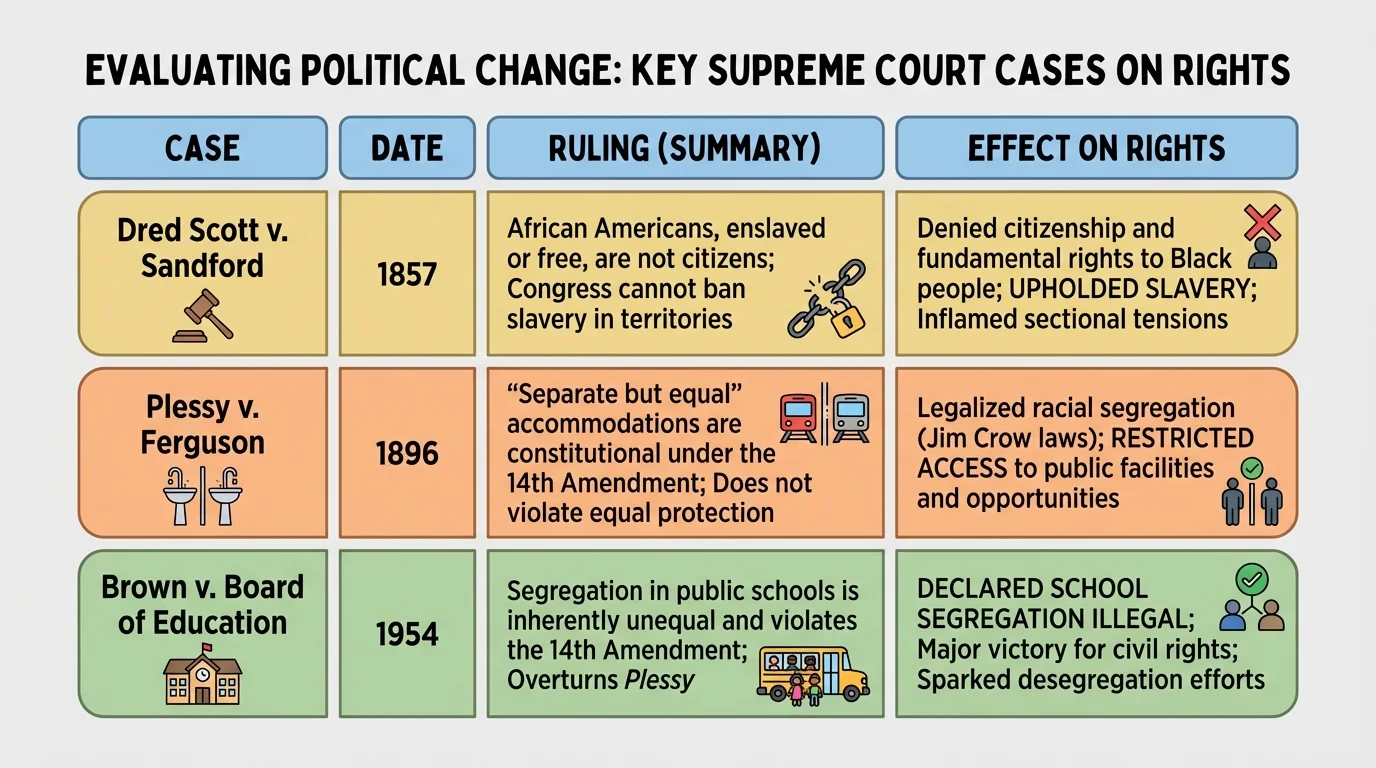
The strategy of court challenges became far more successful in the twentieth century when civil rights lawyers carefully built cases over time. The National Association for the Advancement of Colored People, or NAACP, challenged segregation step by step. This work led to Brown v. Board of Education in 1954, in which the Supreme Court ruled that segregated public schools were unconstitutional. Legally, this was a huge turning point.
However, the results of Brown also show the limits of litigation. The decision changed constitutional interpretation, but many schools did not integrate quickly. Some states resisted openly. Politicians used delaying tactics, and communities sometimes closed public schools rather than desegregate them. A court ruling could declare a right, but without public pressure and federal enforcement, daily life often changed slowly.
The 14th Amendment, first adopted after the Civil War, became crucial in many later cases. That shows how strategies connect across generations. An amendment created legal language, lawyers used that language in court, and later activists pressured the government to enforce court decisions. As seen earlier in [Figure 1], one victory often becomes the foundation for another.
"We conclude that in the field of public education the doctrine of 'separate but equal' has no place."
— Brown v. Board of Education decision, 1954
Litigation works best when reformers can point to strong constitutional arguments, gather evidence, and sustain pressure after the ruling. It is less effective when hostile officials ignore the decision or when courts themselves are unsympathetic.
Some of the most visible political changes in U.S. history came from public action outside government buildings. As [Figure 3] illustrates through scenes like a bus boycott and a sit-in, nonviolent protest can turn local struggles into national moral questions. Protest movements use marches, speeches, sit-ins, boycotts, strikes, and acts of civil disobedience to expose injustice and pressure leaders.
The Montgomery Bus Boycott began in 1955 after Rosa Parks refused to give up her seat to a white passenger. African Americans in Montgomery, Alabama, stopped riding city buses for more than a year. This action hurt the bus system financially, built community solidarity, and drew national attention. The boycott ended with a Supreme Court decision against bus segregation. Here, protest and litigation worked together.
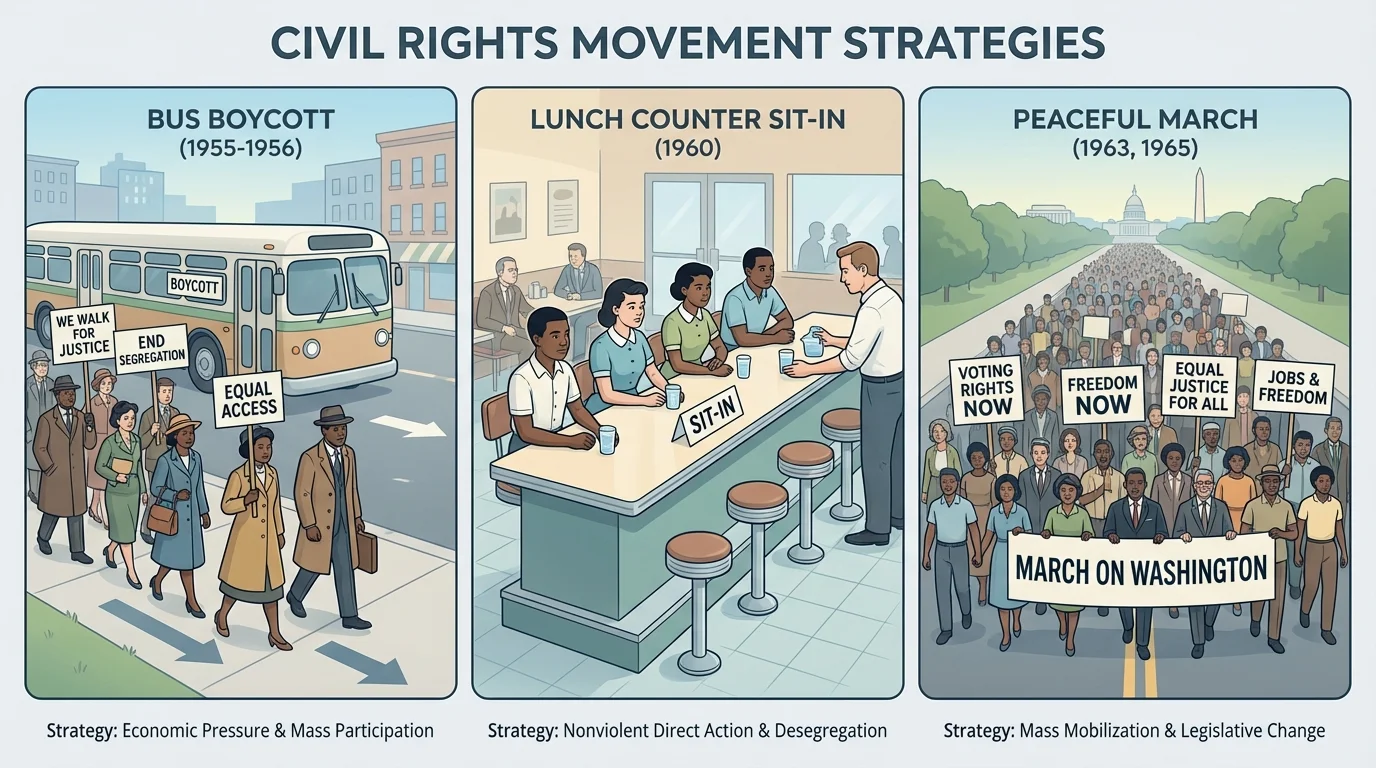
Sit-ins at segregated lunch counters also showed the power of disciplined protest. Students placed their bodies directly in spaces where they were excluded and refused to move. Television and newspapers carried the images across the country. The result was not just sympathy; it was pressure on businesses and politicians. Public protest made injustice impossible for many Americans to ignore.
The 1963 March on Washington is another example. It helped build support for major civil rights legislation by showing the size, organization, and moral force of the movement. The Civil Rights Act of 1964 and the Voting Rights Act of 1965 were not caused by one march alone, but marches and public demonstrations created urgency and national attention that lawmakers could not easily dismiss.
Protest strategies often succeed by changing public opinion. That is powerful because elected officials respond to voters, media attention, and social pressure. Yet protests also have limits. They can be met with violence, arrests, or backlash. Some protests gain attention but fail to produce clear policy results. Others achieve legal change but cannot quickly erase deep prejudice.
Case study: Evaluating the Montgomery Bus Boycott
Step 1: Identify the strategy.
Community members used a boycott, mass meetings, and nonviolent discipline.
Step 2: Identify the immediate result.
The boycott disrupted the bus system and drew national attention to segregation.
Step 3: Connect it to other strategies.
A related court case helped end segregation on Montgomery buses.
Step 4: Evaluate the long-term result.
The boycott helped launch Martin Luther King Jr. as a national leader and became a model for later civil rights activism.
Protest is most effective when it is organized, sustained, and linked to clear goals. The civil rights movement succeeded not just because people marched, but because they also built organizations, trained volunteers, used the media, and pushed for specific legal changes.
Not every political strategy is dramatic. Some of the most effective methods involve long-term organizing: gathering supporters, writing petitions, meeting lawmakers, building alliances, registering voters, and campaigning in elections. This kind of work can seem less dramatic than a march, but it often produces durable results because it turns demands into policy.
The women's suffrage movement used this approach for decades. Activists such as Susan B. Anthony, Elizabeth Cady Stanton, Ida B. Wells, and Alice Paul did not all use identical methods, but they shared the goal of expanding women's political voice. Some focused on state-by-state campaigns. Others lobbied Congress for a national amendment. Some used more confrontational public demonstrations. Their combined efforts helped win the 19th Amendment.
Labor movements also used organizing and coalition building to fight for safer conditions, fair wages, and legal protections. Although labor rights are not identical to citizenship rights, labor activism influenced political participation by showing how ordinary people could pressure government and business together. Reform often spreads from one issue area to another.
During the civil rights era, voter registration drives were especially important. If people could register and cast ballots safely, they could help choose sheriffs, mayors, governors, legislators, and presidents. The Voting Rights Act of 1965 was one of the strongest results of this strategy because it gave the federal government tools to challenge discriminatory voting rules.
Why coalition building matters
A coalition is a group of people or organizations that work together for a shared goal. Coalitions matter because political change usually requires more support than any one leader or group can provide. When students, clergy, lawyers, local communities, and national organizations act together, their influence grows.
Still, organizing has challenges. Coalitions can disagree on goals or methods. Some groups gain more visibility than others. Political victories can also be weakened later if voters elect leaders who oppose reform. That is why rights expansion often requires ongoing participation, not just one successful campaign.
When we compare these strategies, a clear pattern appears: major political change usually comes from several methods working together over time. As [Figure 4] shows through the chain from protest to legal and political action, a protest may create awareness, a court case may create precedent, a law may provide enforcement, and an amendment may lock in change more permanently.
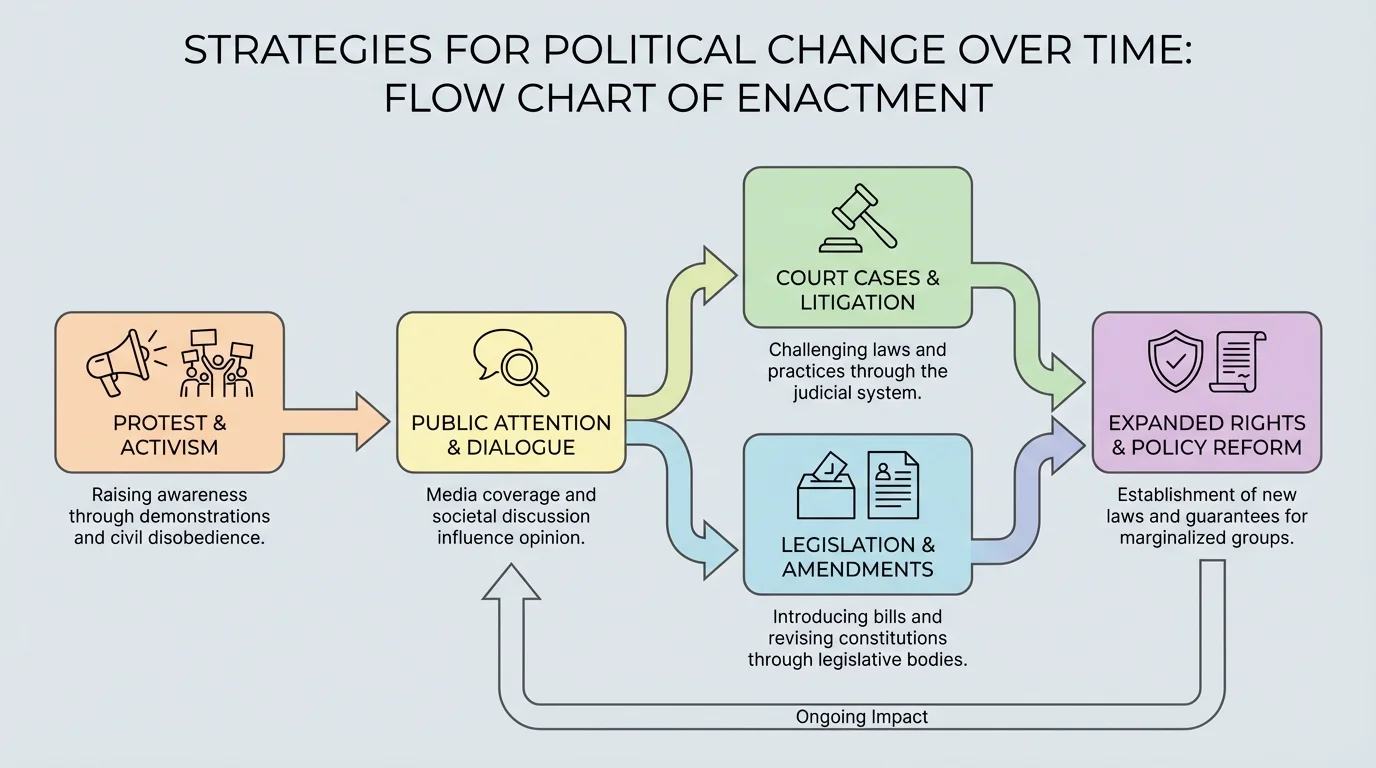
Amendments often create the strongest legal foundation, but they are hardest to achieve. Court cases can open doors, but they depend on judges and can be resisted. Protests can change minds and force action, but they need organization and staying power. Lobbying, voting, and coalition building can turn demands into policy, but they require patience and large networks.
Looking across history, we can evaluate results in both the short term and the long term. In the short term, some strategies produced quick attention but limited change. In the long term, strategies that combined legal action with mass participation tended to achieve more lasting results. The civil rights movement is a strong example: lawsuits, marches, boycotts, church organizing, media coverage, and federal legislation all reinforced one another.
Backlash is also part of the story. After Reconstruction, white supremacist groups and discriminatory laws pushed back against Black political gains. After Brown, many communities resisted integration. After voting rights expanded, some states created new rules that critics argue still burden some voters more than others. Evaluating political change means noticing both progress and resistance.
This is why historical judgment must be careful. A strategy can succeed in one way and fail in another. For example, a court case may create an important principle but have weak immediate enforcement. A protest may not pass a law right away but may inspire future activism. A voting rights law may expand participation dramatically, yet still require later protection. Political change is rarely a straight line.
Earlier examples remain connected. The sequence in [Figure 4] helps explain why no single method was enough by itself. It also explains why expanding citizenship required both legal definition and real access to participation.
The struggle to expand citizenship and rights can be traced through major events and leaders. Frederick Douglass argued powerfully for abolition and equal citizenship. Thurgood Marshall helped lead legal challenges to segregation. Rosa Parks, Martin Luther King Jr., Fannie Lou Hamer, and John Lewis helped use protest and organizing to pressure the nation. Ida B. Wells linked anti-lynching activism, journalism, and voting rights. These individuals mattered, but they were also part of larger movements.
| Period | Strategy | Example | Result |
|---|---|---|---|
| Civil War and Reconstruction | Amendments and federal action | 13th, 14th, and 15th Amendments | Expanded freedom, citizenship, and voting rights in law |
| Late 1800s | Court decisions | Plessy v. Ferguson | Segregation strengthened in law |
| Early 1900s | Lobbying and organizing | Women's suffrage movement | 19th Amendment expanded voting rights |
| 1950s | Litigation | Brown v. Board of Education | School segregation ruled unconstitutional |
| 1950s–1960s | Boycotts, sit-ins, marches | Montgomery Bus Boycott, March on Washington | Built support for civil rights laws |
| 1960s | Federal legislation and voter organizing | Voting Rights Act of 1965 | Stronger enforcement of voting rights |
| 1971 | Constitutional amendment | 26th Amendment | Voting age lowered to 18 |
Table 1. Major periods, strategies, examples, and results in the expansion of rights and citizenship.
Primary sources help historians judge these strategies. Speeches, protest signs, photographs, court opinions, letters, and newspaper articles reveal what people demanded and how others responded. Secondary sources, such as textbooks and historical studies, help explain patterns over time. Both are useful because one shows the moment itself and the other helps interpret its meaning.
Rights can expand through law, but rights must also be protected in practice. When you evaluate change, always ask who benefited, how quickly change happened, and whether the gains lasted.
Understanding political change over time helps explain the United States today. Debates about voting access, equal protection, protest, and citizenship are not new. They are part of a long history in which Americans have argued over who belongs, who has power, and what democracy should mean.
