The United States was founded on words before its government was fully established through institutions. A few pages of writing helped launch a revolution, create a government, protect liberties, and challenge unfair limits on who counted as a full citizen. Those documents still matter today because people continue to argue about their meaning in court cases, elections, protests, and debates over rights. When historians and citizens read these original texts closely, they are doing more than studying the past. They are examining the ideas that still shape public life.
A primary source is a document, speech, letter, law, image, or other piece of evidence created during the time being studied. Primary sources let us hear historical voices directly instead of only reading later explanations. That matters because the exact wording of a document can reveal what people valued, what they feared, and whom they included or excluded.
When studying democratic freedoms, primary sources are especially important. The rights Americans have today are connected to arguments made in earlier generations. By comparing these documents, students can see both continuity, meaning important ideas that stay the same, and change, meaning important developments over time. In U.S. history, the core ideals of liberty and self-government remain powerful, but the definition of who deserves full rights has expanded.
Democratic freedoms are rights and liberties connected to self-government, such as freedom of speech, freedom of religion, due process, participation in government, and equal treatment under the law.
Citizenship is membership in a political community. In the United States, the meaning of citizenship has changed over time as more people gained legal protection and political rights.
One important skill in civics and history is asking not just, "What does this document say?" but also, "Who wrote it, for what audience, and with what purpose?" That kind of close reading helps explain why one document may preserve old principles while another pushes for reform.
The Declaration of Independence, adopted in 1776, announced that the American colonies were separating from Great Britain. Its argument becomes much clearer when we look at its parts, as [Figure 1] shows through the document's structure. It begins with general principles about rights and government, then lists grievances against King George III, and finally declares the colonies to be "Free and Independent States."
The most famous ideas in the Declaration are that "all men are created equal," that people have unalienable rights such as "Life, Liberty and the pursuit of Happiness," and that governments get "their just powers from the consent of the governed." These ideas reflect Enlightenment thinking, especially the belief that rights come from human dignity, not from a king. The document also argues that if a government becomes destructive of people's rights, the people have the authority to change or abolish it.
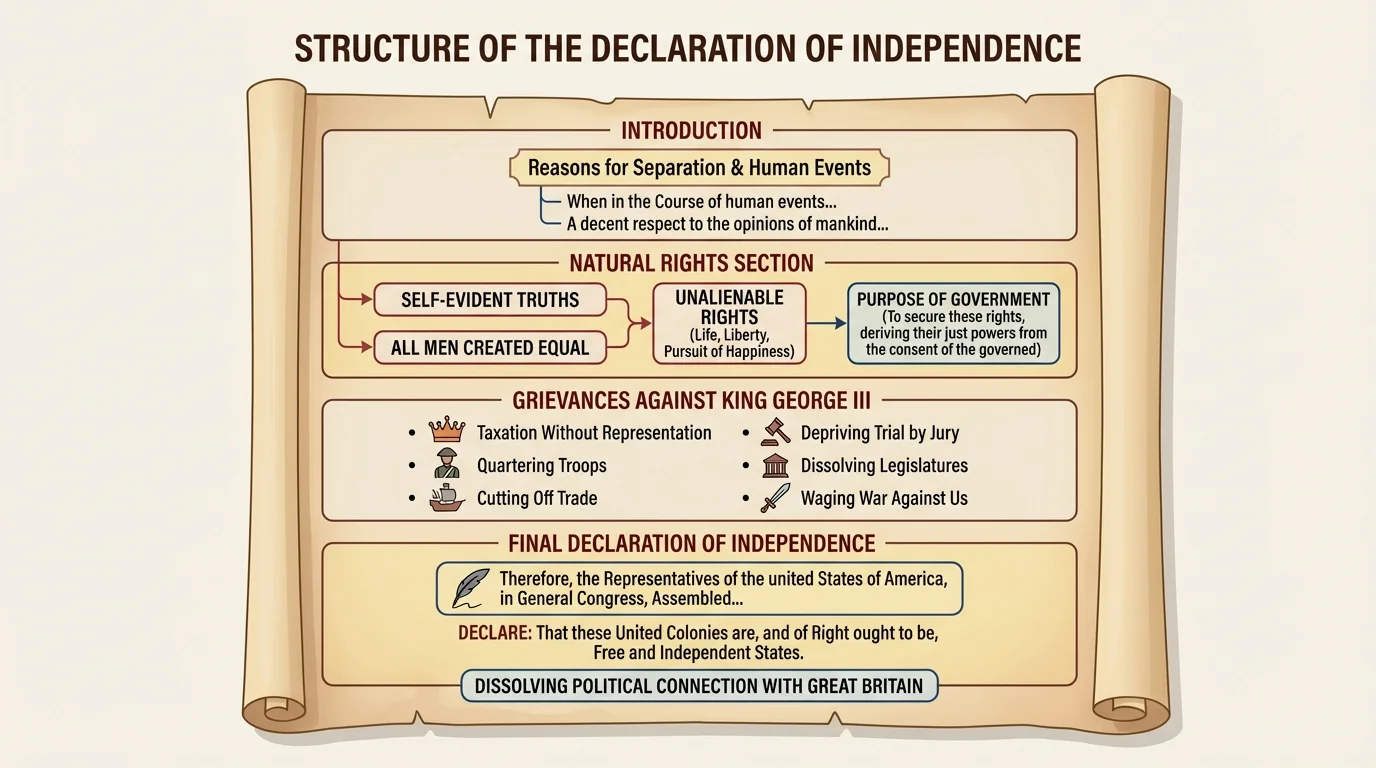
This document strongly supports democratic freedom through the ideas of natural rights and consent of the governed. If government exists to protect rights and depends on the people's consent, then rulers are not above the law. That was a radical idea in a world shaped by monarchy.
At the same time, the Declaration shows the limits of freedom in 1776. Its language about equality was powerful, but it did not create equal rights for everyone. Women could not vote. Enslaved African Americans were denied liberty. Many Native American nations were treated as outsiders or enemies rather than as equal participants in the political community. So the Declaration represents continuity in the nation's commitment to liberty, but it also became a source of change because later reformers used its words to demand broader rights.
Abraham Lincoln, Frederick Douglass, and women's rights activists all returned to the Declaration's language. They argued that the nation had not yet lived up to its founding ideals. In that way, the Declaration served both as a founding statement and as a standard used to criticize injustice.
"We hold these truths to be self-evident, that all men are created equal..."
— Declaration of Independence
This line became one of the most influential statements in U.S. history, not because the nation fully followed it in 1776, but because later generations insisted that it should.
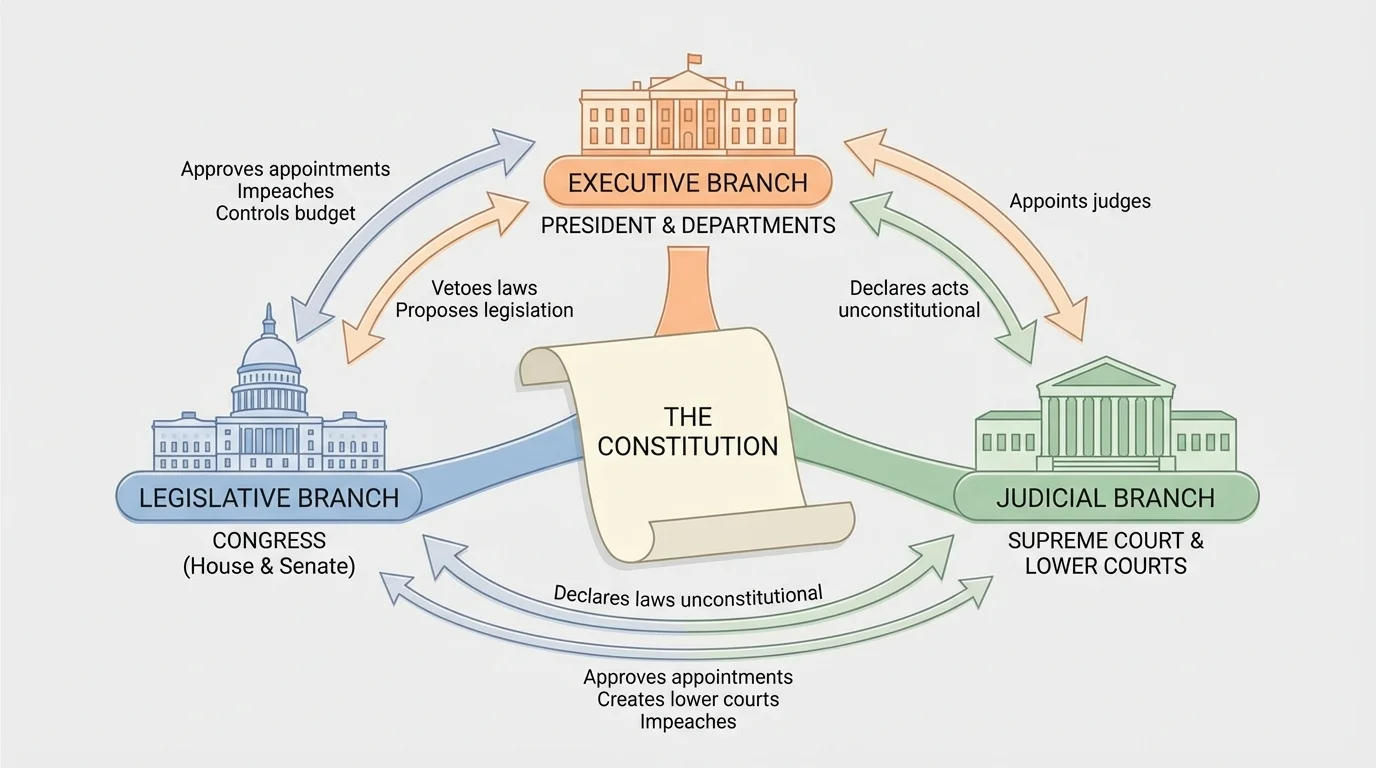
The Constitution, written in 1787, created the framework of the federal government. While the Declaration explains why Americans separated from Britain, the Constitution explains how the new government would work. Its system of institutions and limits, introduced in [Figure 2], was designed to prevent any one person or group from becoming too powerful.
The Constitution establishes three branches: legislative, executive, and judicial. This idea of separation of powers divides authority so that Congress makes laws, the president carries them out, and the courts interpret them. It also uses checks and balances, meaning each branch can limit the others. For example, Congress can pass laws, but the president can veto them, and courts can decide whether laws are constitutional.
Another key idea is federalism, which divides power between the national government and state governments. This balance was meant to create a stronger union than the country had under the Articles of Confederation while still protecting local authority.
As shown in [Figure 2], the branches are connected, not isolated. That design reflects continuity with the founding fear of tyranny: Americans still wanted liberty protected from abuse of power. But the Constitution also introduced change by building a new government that was stronger, more organized, and more flexible than the earlier system.
The Constitution had serious contradictions. Some compromises protected slavery, even while the nation claimed to value liberty. Originally, U.S. senators were chosen by state legislatures, not directly by voters, and voting rights were mostly left to the states, which often limited participation to white men with property. This means the Constitution supported self-government, but only for part of the population.
One reason the Constitution shows both continuity and change is the amendment process. The founders created a way to revise the document without replacing the entire government. That allowed the nation to preserve its basic structure while adapting to new understandings of rights and citizenship. Amendments later ended slavery, defined citizenship, protected voting rights more broadly, and expanded democratic participation.
Why the Constitution can preserve and transform at the same time
The Constitution creates stable institutions that continue from generation to generation. At the same time, Article V allows amendments, which means the nation can respond to major problems and changing ideas. This combination helps explain how the United States keeps core principles such as republican government while also making room for reform.
That flexibility matters. A government with no way to change can become unfair or outdated. A government with no stable rules can become chaotic. The Constitution attempts to balance both needs.
The Bill of Rights, added in 1791, consists of the first ten amendments to the Constitution. Many people supported the Constitution only if specific protections for individual liberty were added. They feared that a strong central government might threaten freedoms people had just fought a revolution to protect.
The Bill of Rights protects several democratic freedoms. The First Amendment safeguards religion, speech, press, assembly, and petition. Other amendments protect people accused of crimes through due process, fair trials, and limits on unreasonable searches and seizures. These rights do not just help individuals; they also support democracy by making it possible for people to criticize government, share ideas, and demand change peacefully.
There is important continuity here. The Bill of Rights carries forward the revolutionary belief that government must be limited and must respect liberty. But there is also change. Instead of simply declaring broad principles, the amendments list specific legal protections. That makes freedom more practical and enforceable.
Over time, Americans have debated who benefits from these protections and how far they reach. Court cases have helped apply many of these rights more fully, including to people who were not always treated equally in earlier periods. So the Bill of Rights is both a product of the founding era and part of an ongoing process of expanding civil liberties.
| Document | Main Purpose | Key Freedom Idea | Limits at the Time |
|---|---|---|---|
| Declaration of Independence | Justify independence | Natural rights and consent | Equality not applied to all |
| Constitution | Create government | Ordered liberty through structure | Many excluded from political power |
| Bill of Rights | Protect liberties | Specific rights against government abuse | Protections expanded unevenly over time |
| Declaration of Sentiments | Demand women's rights | Equality should include women | Women still denied major rights |
Table 1. Comparison of four major documents, their purposes, key freedom ideas, and historical limits.
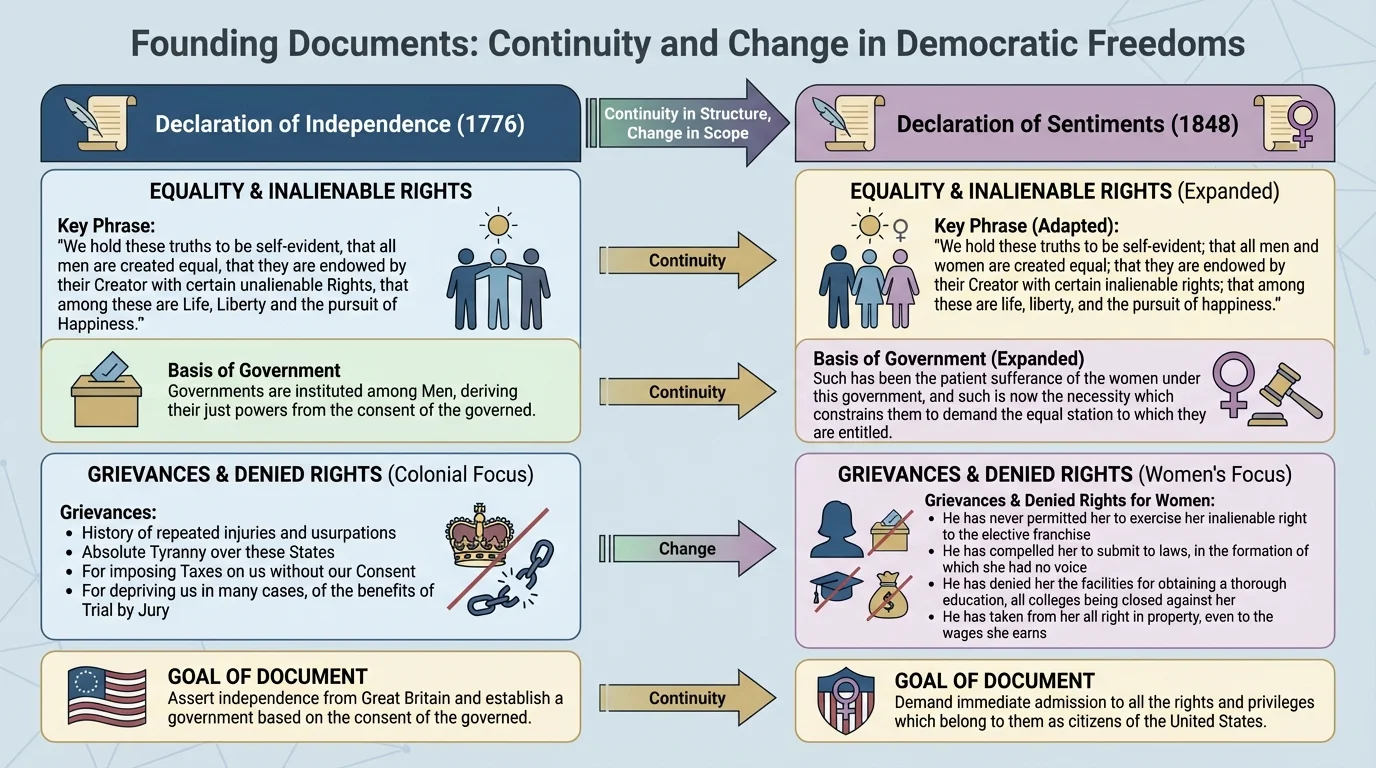
The Declaration of Sentiments was written at the Seneca Falls Convention in 1848, the first major women's rights convention in the United States. The authors, including Elizabeth Cady Stanton, intentionally echoed the wording of the Declaration of Independence. This was a powerful strategy: if the nation believed in equality and consent, then women should not be excluded from those ideals.
[Figure 3] The document begins by changing the famous line to say that "all men and women are created equal." It then lists grievances against the ways men and the law denied women political, social, and economic rights. For example, women had limited property rights in many places, fewer educational opportunities, and no voting rights. By using the structure of the earlier declaration, the authors argued that women's rights were not a separate issue from American ideals. They were part of fulfilling them.
This is one of the clearest examples of change in U.S. history. The Declaration of Sentiments challenged the older, narrower definition of citizenship. It insisted that the promises of liberty and equality should be applied more broadly. Yet it also shows continuity because it relied on founding principles rather than rejecting them. Reformers said, in effect, "The nation already claims to believe these things. Now it must act like it."
Not everyone agreed. Many people in 1848 believed women should remain outside formal politics. That resistance shows that expanding rights is often controversial. Still, the Declaration of Sentiments helped launch a movement that eventually contributed to the Nineteenth Amendment in 1920, which gave women the right to vote nationwide.
Case study: using founding language to demand change
Women's rights activists did not start from scratch. They used the nation's own founding principles to expose contradictions.
Step 1: Identify the original principle.
The Declaration of Independence states that people are created equal and that government derives power from the consent of the governed.
Step 2: Compare it to reality.
Women were governed by laws but could not vote and often had limited legal independence.
Step 3: Make the argument for reform.
If government requires consent, then excluding women from political participation violates the nation's own ideals.
This method of argument became common in many reform movements.
The same pattern appears in other struggles for equality. Activists for abolition and civil rights also used founding documents to argue that rights should apply more broadly than they had in the past.
Looking at these documents together reveals a pattern. The nation's basic language of liberty, equality, and government by consent remains remarkably consistent. That is continuity. Americans repeatedly return to the idea that legitimate government must respect rights and derive authority from the people.
But the meaning of those principles changes over time. In the founding period, rights were discussed in broad terms, yet many people were excluded from full citizenship or political participation. Over time, reformers, lawmakers, and courts expanded the meaning of freedom. This is change.
One major turning point came after the Civil War with the Reconstruction Amendments. The Thirteenth Amendment ended slavery. The Fourteenth Amendment established birthright citizenship and equal protection of the laws. The Fifteenth Amendment barred denial of voting rights based on race. These amendments did not solve every problem, but they transformed the Constitution by applying freedom and citizenship more broadly.
Later changes continued that trend. The Nineteenth Amendment expanded voting rights to women. The Civil Rights Movement challenged segregation and voter suppression. The Twenty-Sixth Amendment lowered the voting age to eighteen. These developments show that democratic freedom in the United States is not fixed once and for all; it is shaped by continuing struggles over who belongs and what rights citizenship includes.
Frederick Douglass, a formerly enslaved abolitionist, praised the principles of the Declaration of Independence while also sharply criticizing the United States for failing to apply them to enslaved people. That combination of respect for founding ideals and criticism of injustice appears again and again in American history.
Even today, debates over free speech, equal protection, privacy, voting access, and citizenship connect back to these earlier documents. The words remain old, but the arguments are still alive.
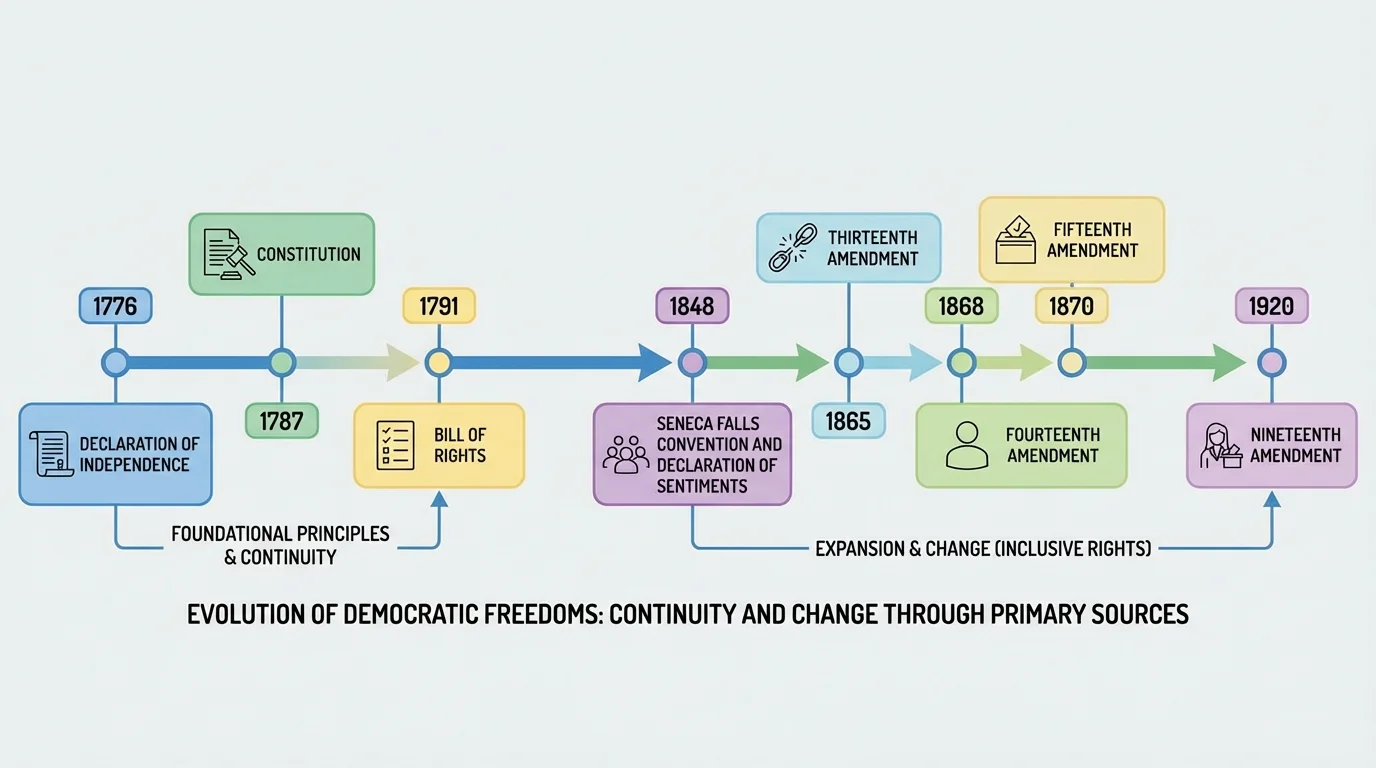
[Figure 4] The story of democratic freedoms did not happen in a single moment. It unfolded across decades in a sequence that begins with the Revolution and continues through reform and amendment. Reading these documents in order helps explain how continuity and change work together in U.S. history.
Important figures include Thomas Jefferson, a main author of the Declaration of Independence; James Madison, often called the "Father of the Constitution" and a key supporter of the Bill of Rights; Elizabeth Cady Stanton and Lucretia Mott, leaders at Seneca Falls; Frederick Douglass, who supported women's rights and demanded equal citizenship for African Americans; and many unnamed activists whose organizing pushed the nation toward reform.
| Year | Event or Document | Historical Importance |
|---|---|---|
| 1776 | Declaration of Independence | States natural rights and justifies independence |
| 1787 | Constitution written | Creates national government |
| 1791 | Bill of Rights ratified | Protects civil liberties |
| 1848 | Seneca Falls Convention and Declaration of Sentiments | Launches organized women's rights movement |
| 1865 | Thirteenth Amendment | Abolishes slavery |
| 1868 | Fourteenth Amendment | Defines citizenship and equal protection |
| 1870 | Fifteenth Amendment | Protects voting rights regardless of race |
| 1920 | Nineteenth Amendment | Protects women's voting rights |
Table 2. Timeline of major documents and amendments connected to democratic freedoms and expanding citizenship.
As the timeline illustrates, later reforms did not erase the founding documents. Instead, they built on them, corrected some of their limits, and pushed their promises further.
When analyzing a primary source, start with four questions. Who wrote it? When? Why? For whom? A revolutionary declaration, a constitution, and a reform manifesto may all use the language of rights, but they serve different purposes.
Next, pay attention to exact wording. If a document says "all men are created equal," ask what that phrase meant at the time and who was left out in practice. If another document changes that wording to "all men and women," that shift is important evidence of change. Historians notice both the similarities and the differences.
Context also matters. The Declaration of Independence emerged from colonial resistance to British rule. The Constitution came after problems under the Articles of Confederation. The Bill of Rights answered fears about centralized power. The Declaration of Sentiments grew out of women's exclusion from political rights. Understanding those settings helps explain why each document emphasizes certain freedoms.
Remember that a primary source does not automatically tell the whole truth by itself. It gives direct evidence from the past, but it must still be interpreted carefully and compared with other evidence.
A strong analysis uses quotations or specific ideas from the source as evidence. It also recognizes both what the document claims and what the society around it actually allowed. That is how historians can explain why the United States has both long-lasting ideals and a long history of struggle over who fully shares in them.
