A single speech at a town meeting, a carefully written letter, or even a student-led campaign can help change laws, school rules, and public opinion. That is one of the most powerful ideas in a democracy: ordinary people are not just ruled by government. They help shape it. In the United States, citizenship has never been a fixed idea. Over time, more groups have gained rights and a stronger voice, and that happened because people pushed, argued, organized, and demanded change.
Democracy depends on both rights and responsibilities. Citizens have rights such as freedom of speech, freedom of the press, freedom of assembly, and the right to petition the government. At the same time, they have responsibilities such as staying informed, respecting the rights of others, voting when eligible, and participating in civic life honestly and peacefully. Civil participation does not mean everyone agrees. It means people use lawful, respectful methods to express disagreement and work toward solutions.
Civic participation is the way people take part in the life of their community and government. It includes speaking out, voting, attending meetings, joining organizations, contacting officials, and helping solve public problems.
Civil discourse is respectful discussion about public issues, even when people strongly disagree.
Citizenship includes membership in a political community along with the rights, protections, and duties connected to that membership.
For students in middle school, civic participation may seem like something adults do. But many important habits begin early. Learning how to check facts, listen carefully, write persuasively, and speak respectfully are all civic skills. A student who presents a concern to a school board is practicing the same democratic habits that adults use when speaking to a city council or state legislature.
When people voice opinions, they help government understand what the public needs. Officials make decisions about schools, roads, health, the environment, and public safety. If citizens remain silent, leaders may hear only from a few powerful groups. Public participation helps balance power. It also reminds leaders that government exists to serve the people.
In the United States, the idea of who counts fully in public life has changed over time. At first, many people were excluded from equal participation, including women, enslaved people, Native Americans, and many others. Expanding rights did not happen automatically. It came through debate, activism, court cases, protests, journalism, and voting. Civic voice is one of the main ways societies become more fair.
"We the People"
— Opening words of the U.S. Constitution
Those three words are short, but they raise a huge question: who is included in "the people"? American history shows that the answer has expanded. That expansion is closely tied to the ways people have demanded to be heard.
People can express views in many lawful and respectful ways, as [Figure 1] illustrates. Civil action can include speaking at a public meeting, writing a letter to an official, signing or creating a petition, publishing an opinion article, joining a peaceful protest, calling a representative, or posting a carefully supported argument online. Different methods work better in different situations.
One common method is contacting elected officials directly. A phone call, email, or letter can be surprisingly effective when it is polite, clear, and specific. Instead of saying, "Fix everything," a stronger message might say, "I support adding safer crosswalks near our school because students cross this road every day." Officials are more likely to respond when citizens explain the problem, provide evidence, and suggest a realistic solution.
Public meetings are another important tool. School boards, city councils, and county commissions often allow citizens to speak during public comment periods. These comments become part of the public record. Speaking at a meeting allows people to present concerns directly to decision-makers and to other community members who are listening.
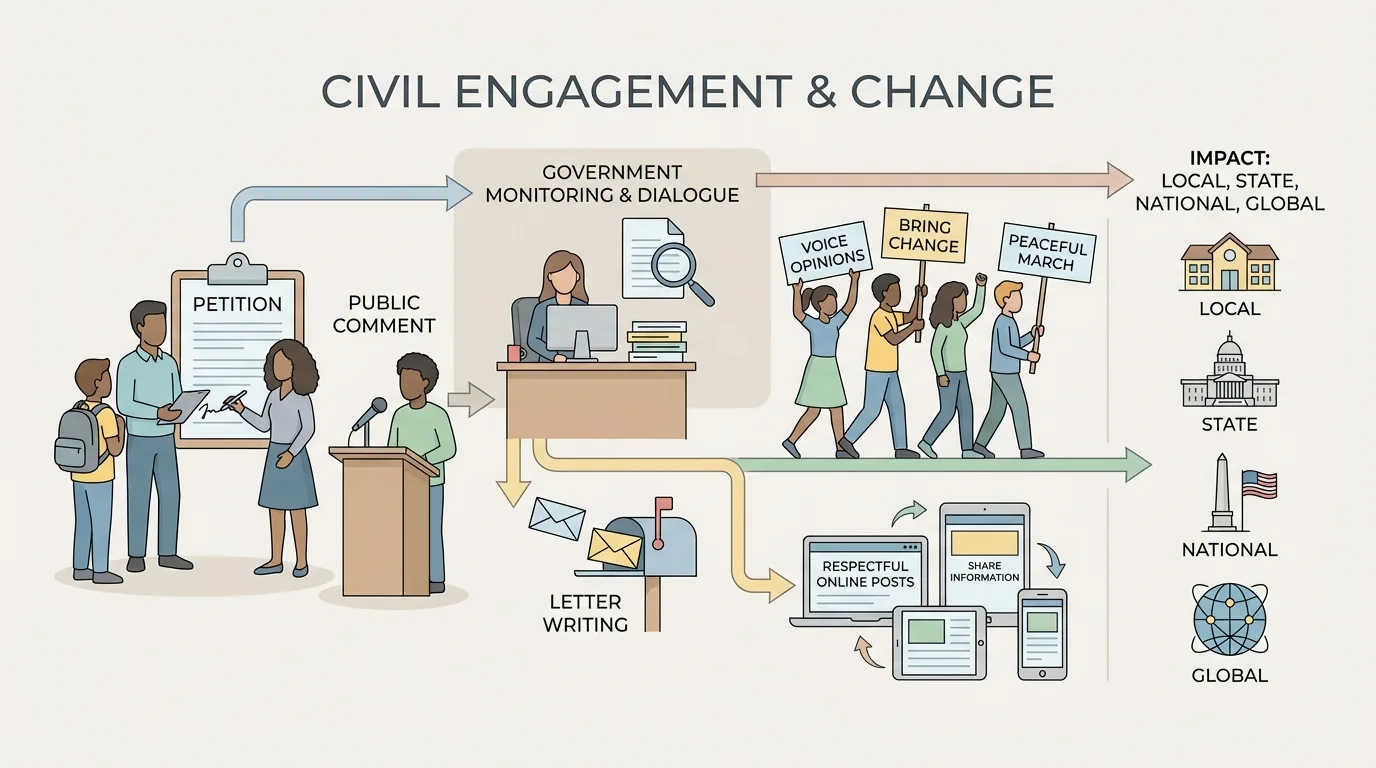
Petitions gather many voices around one issue. A petition does not automatically create a law, but it shows that many people care. For example, if students and parents want healthier cafeteria choices, a petition to the school board may persuade leaders to review the menu. Petitions work best when they are based on a clear request, not just general frustration.
Peaceful protest is another powerful form of civic action. Marches, rallies, and boycotts have played major roles in U.S. history. The key word is peaceful. Civil protest aims to persuade the public and pressure leaders without violence. During the civil rights movement, nonviolent protests helped reveal injustice to the nation and changed public opinion.
Online communication has made civic voice faster and wider. A social media post can reach thousands of people in hours. But speed creates problems too. False claims can spread just as fast. Responsible digital citizenship means checking sources, avoiding insults, and understanding that a post can influence real-world decisions. The same standards of evidence and respect that apply in face-to-face discussion should apply online.
Case study: Turning concern into a civil message
A group of students notices that buses arrive late and some students miss first period.
Step 1: Define the issue clearly.
They identify the problem as repeated bus delays, not simply "transportation is bad."
Step 2: Gather evidence.
They record arrival times for two weeks and interview affected students.
Step 3: Choose a civil action.
They write a respectful letter to the school board and speak during public comment.
Step 4: Suggest a solution.
They ask the district to review routes and add a notification system for delays.
This approach is more effective than angry rumors because it combines evidence, respect, and a realistic request.
Not every opinion deserves equal trust. In civic life, strong arguments rely on facts, credible sources, and logic. If two people disagree about a new law, the better argument is not the louder one. It is the one supported by reliable information and thoughtful reasoning.
Citizens do more than speak; they also monitor government through records, meetings, and public information. In a democracy, government should not operate like a secret club. Many decisions, budgets, votes, and policies are public so citizens can evaluate what leaders are doing.
[Figure 2] One way to monitor government is by attending public meetings or reading meeting agendas and minutes. Agendas tell what officials plan to discuss. Minutes summarize what happened. If a city council plans to vote on a park project or a school board plans changes to curriculum, citizens can learn about those plans before decisions are final.
Another important tool is the public record. Government documents such as budgets, contracts, voting records, and reports can often be requested or viewed by the public. These records help people see how money is spent and whether leaders are keeping promises. Journalists, community groups, and ordinary citizens often use such records to uncover waste, corruption, or unfair treatment.
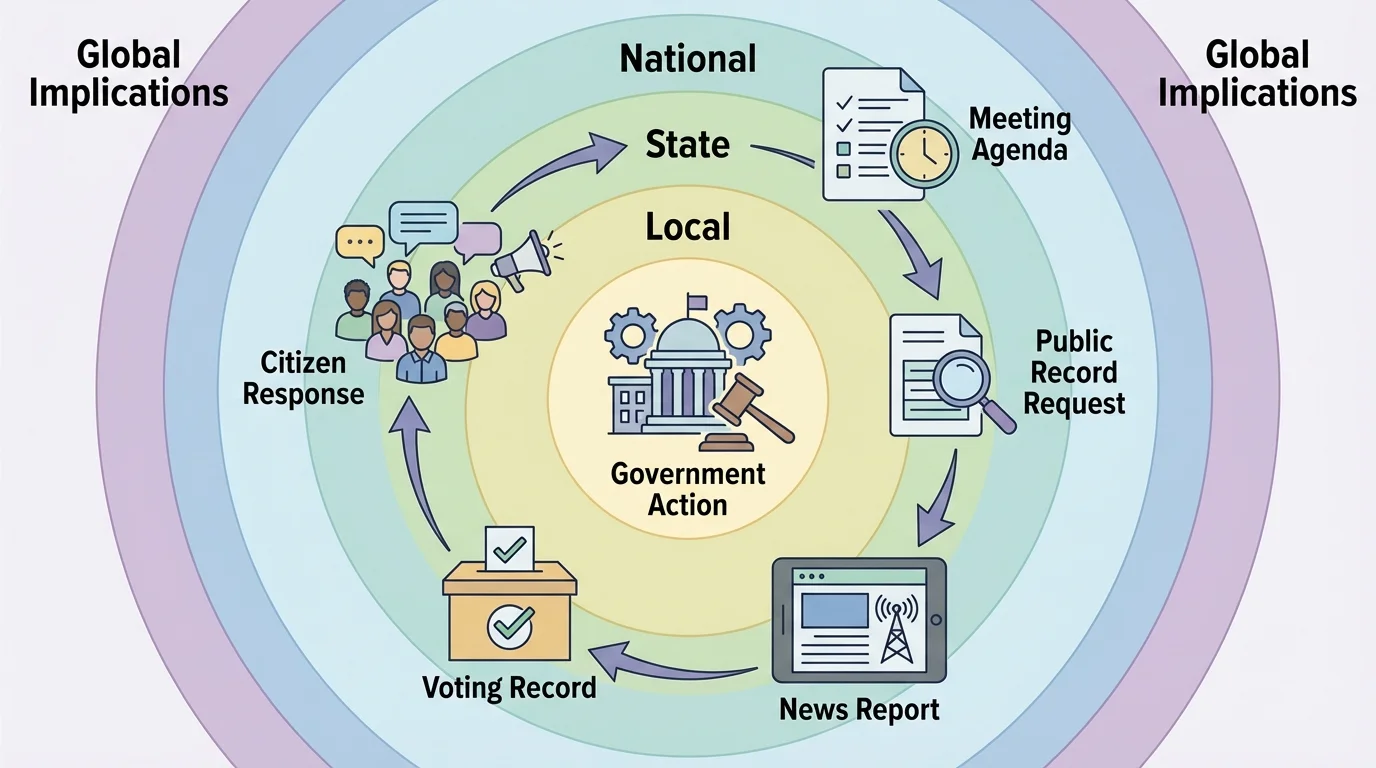
The news media also play a major role. Reporters attend meetings, investigate claims, interview officials, and explain complicated issues to the public. However, not all media sources are equally trustworthy. Responsible citizens compare sources, distinguish between news and opinion, and look for evidence. A sensational headline may attract attention, but it is not enough by itself.
Voting records help citizens judge whether elected officials actually represent their views. During campaigns, candidates make promises. Later, citizens can compare those promises with how officials voted. This is one way accountability works. Leaders know that the public can track their actions and respond in future elections.
Community organizations and watchdog groups also monitor government. Some focus on environmental rules, others on voting rights, education, housing, or police practices. These groups collect information, publish reports, and sometimes bring court cases. As with media sources, citizens should ask whether these groups use credible evidence and explain their methods honestly.
Many local government websites post budgets, meeting videos, agendas, and vote results online. A citizen with a phone or computer can often follow public decisions without even entering city hall.
Monitoring government is not about assuming every leader is dishonest. It is about understanding that power needs oversight. Just as referees help keep a game fair, public monitoring helps keep government accountable.
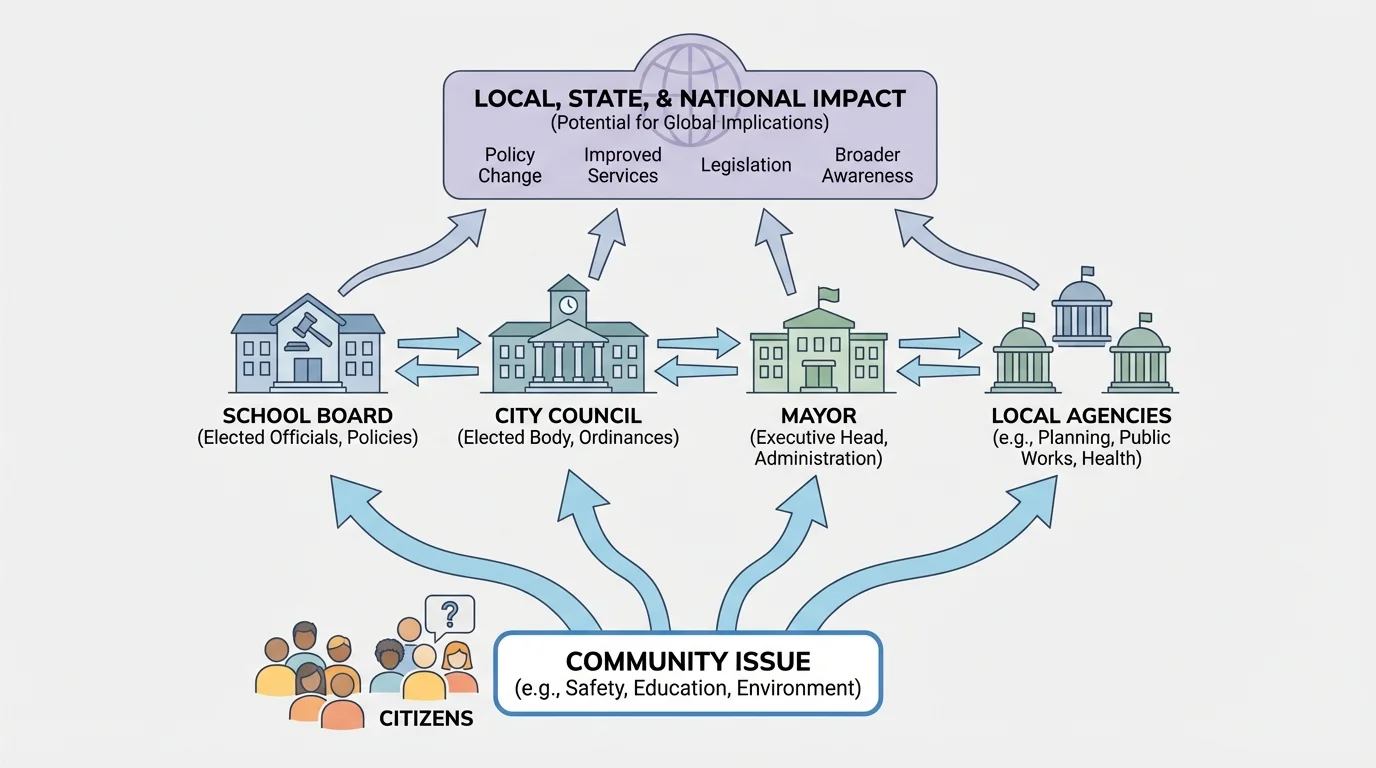
Local government affects daily life more directly than many students realize through the path from community concerns to local decisions. Schools, buses, parks, libraries, zoning, trash collection, and police services often depend on local officials. Because local leaders are close to the community, change can sometimes happen faster at this level than at the state or national level.
[Figure 3] Citizens can bring change locally by attending school board meetings, city council meetings, county commission sessions, and neighborhood forums. They can join advisory boards, volunteer for local campaigns, and meet with officials in person. Since the scale is smaller, individuals may have a greater chance to be noticed.
Suppose a neighborhood lacks a safe sidewalk near a school. Residents might photograph the area, gather traffic data, collect signatures, and ask the city council to fund sidewalk construction. If they continue showing up, following the budget process, and keeping the issue visible, they may succeed. This kind of local action teaches an important civic lesson: change often requires patience.
Students can be especially effective locally because school issues directly involve them. They may speak about lunch quality, library access, mental health support, arts programs, or campus safety. Their experiences are firsthand evidence. When students speak respectfully and knowledgeably, adults often listen.
Local action can also create larger change. A city that adopts stronger recycling programs, protects wetlands, or improves public transportation may become a model for other communities. In that way, a local decision can spread far beyond its original setting.
State governments make laws on education, transportation, voting rules, public health, and many other issues. Citizens influence state government by contacting state legislators, testifying at legislative hearings, joining statewide organizations, and participating in campaigns for governor or other state offices.
Some states allow ballot initiatives or referendums, which give voters a direct role in approving or rejecting certain policies. Even where these are not available, citizens can still influence lawmakers by organizing public support. For example, if families across a state want improved teacher pay or stronger water protection laws, they may form coalitions, contact representatives, and use media to build pressure.
State courts matter too. Sometimes change comes not through a new law but through a lawsuit claiming that a state action is unconstitutional or unfair. Court rulings have changed school funding, voting access, and civil rights protections in different states. This shows that civic action includes legal action as well as protests and elections.
Why different levels of government matter
The same issue can move through different levels of government. A polluted river may involve local water systems, state environmental regulations, and federal law. Effective citizens ask: Who has the authority to act? Then they direct their efforts to the right officials and institutions.
State-level change often requires coordination among many communities. That can make the process slower, but it also allows a successful idea to help millions of people across an entire state.
National change usually involves the largest institutions: Congress, the president, federal agencies, and federal courts. Citizens can contact members of Congress, support national advocacy groups, join broad movements, and vote in federal elections when eligible. National issues often include immigration, civil rights, military policy, environmental regulation, and economic policy.
National movements often grow from local efforts. The civil rights movement, women's suffrage movement, labor movement, and disability rights movement all included local organizing, state campaigns, and national goals. Public pressure built over time through speeches, marches, court cases, newspaper coverage, lobbying, and personal stories.
A major national tool for change is the court system. Landmark court cases have reshaped rights and government responsibilities. When citizens or organizations challenge unfair laws in federal court, the result can affect the entire country. At the same time, court change alone is rarely enough. Lasting change often also needs public support and enforcement.
National media can amplify a cause quickly. When a story becomes widely known, leaders may feel pressure to respond. But media attention can also fade fast. Sustained change usually depends on organized effort, not only one moment of publicity.
Some civic actions begin with a nearby problem but connect to the wider world. Climate policy is a clear example. If a city reduces emissions, protects green space, or improves energy use, that choice contributes in a small way to a global environmental issue. One community alone cannot solve climate change, but many local actions together can matter greatly.
Public health is another example. A local decision about vaccination information, sanitation, or emergency planning can affect the spread of disease. In an interconnected world, diseases do not respect city, state, or national borders. Local health choices can therefore have national and even global consequences.
Technology and social media create global implications too. A video recorded at a school board meeting or local protest can be viewed across the world within hours. That means local civic action can shape international opinion. It also means citizens must think carefully about accuracy, privacy, and fairness before posting.
Human rights issues also show the global connection. When Americans debate voting rights, equal treatment, freedom of speech, or discrimination, people in other countries may watch closely. U.S. civic struggles can influence how other societies think about rights and democracy.
Case study: A local issue with global implications
A coastal town faces frequent flooding.
Step 1: Residents document flood patterns and property damage.
Step 2: They ask local officials to improve drainage, protect wetlands, and plan safer building rules.
Step 3: State agencies become involved because roads and environmental permits are affected.
Step 4: National researchers and policymakers use similar cases to study climate adaptation.
What began as one town's problem becomes part of a much larger conversation about climate, infrastructure, and community safety worldwide.
As with [Figure 3], civic action often starts closest to people's daily lives, but its effects can spread outward in widening circles.
The meaning of citizenship in the United States has broadened over time, as [Figure 4] illustrates through major rights expansions. Early in U.S. history, many people were excluded from full political participation. Through amendments, legislation, activism, and court decisions, more groups gained legal protection and public voice.
After the Civil War, the 14th Amendment established citizenship for people born or naturalized in the United States and promised equal protection of the laws. The 15th Amendment aimed to protect voting rights regardless of race, although many barriers remained. The 19th Amendment expanded voting rights to women. Later, the Indian Citizenship Act recognized citizenship for Native Americans, though full access to voting still faced obstacles in many places.
The civil rights movement pushed the nation further. The Civil Rights Act of 1964 and the Voting Rights Act of 1965 challenged segregation and voter suppression. The 26th Amendment lowered the voting age to 18, based partly on the argument that people old enough to serve in war should be able to vote.
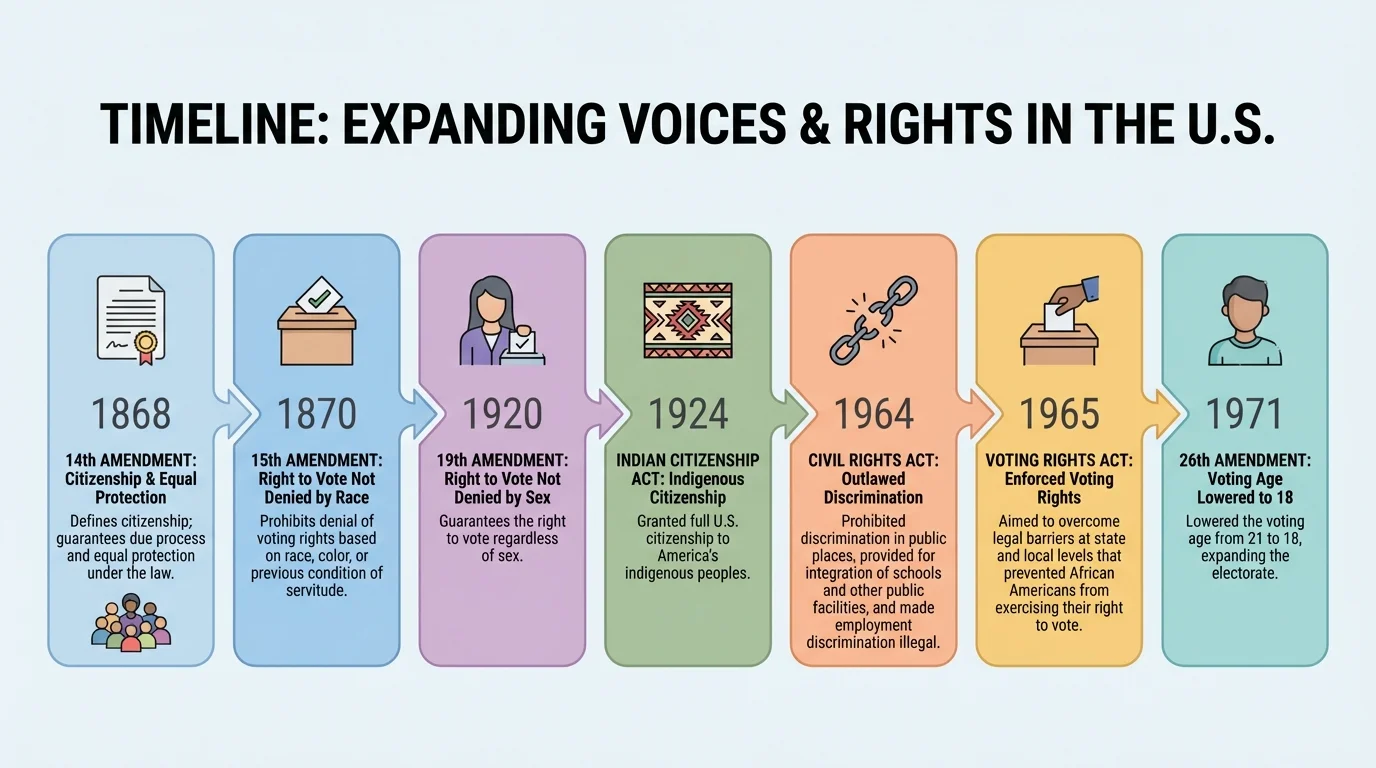
These changes did not simply appear because leaders suddenly decided to be fair. They came from people who organized, marched, testified, wrote, sued, voted, and refused to accept exclusion. The timeline reveals a pattern: citizenship in practice becomes more inclusive when people push the nation to live up to its own ideals.
This history matters today because civic participation is still shaping what equality and citizenship mean. Debates continue over voting access, immigration, disability rights, racial justice, gender equality, and freedom of expression. The story is ongoing, and each generation helps write the next chapter.
| Level | Main targets for action | Common methods | Possible results |
|---|---|---|---|
| Local | School board, city council, mayor, county officials | Public comment, petitions, local campaigns, meetings | Changes to school policy, parks, roads, services |
| State | Governor, state legislature, state agencies, state courts | Testimony, statewide advocacy, lobbying, lawsuits | State laws, education rules, environmental policy |
| National | Congress, president, federal agencies, federal courts | National campaigns, federal voting, court cases, movements | Federal laws, rights protections, nationwide policy |
Table 1. Comparison of civic action at local, state, and national levels.
Being active is not enough by itself. Effective participation is informed, strategic, and ethical. Citizens should identify the issue clearly, learn who has authority over it, gather reliable evidence, choose an appropriate method, and stay respectful even in disagreement.
Advocacy works best when people build coalitions. One voice matters, but many organized voices matter more. Parents, students, teachers, scientists, journalists, business leaders, and community groups may work together even if they do not agree on every issue. Coalitions increase credibility and political strength.
Misinformation is one of the biggest challenges in modern civic life. A false rumor can damage trust and distract from real solutions. Before sharing claims, responsible citizens ask: Who created this information? What evidence supports it? Can it be confirmed by other reliable sources? These habits protect both democracy and community relationships.
Freedom of speech protects the right to express opinions, but it does not remove the responsibility to use that freedom wisely. Rights and responsibilities work together in a healthy democracy.
Effective citizens also understand that losing one debate does not mean giving up. Laws can be revised, officials can be voted out, court cases can be appealed, and public opinion can change. Democratic change is often slower than people want, but that slow process can also protect society from rushed decisions and abuse of power.
When citizens speak civilly, monitor government carefully, and act persistently, they strengthen democracy. They also continue the long American struggle to make citizenship broader, rights more secure, and government more accountable.
