One document written more than two centuries ago still shapes what police can do, how leaders are chosen, what rights students have, and even who counts as a citizen. That document is the U.S. Constitution. It is not just an old paper in a museum. It is the basic law of the land, and it matters because it sets rules for government power and protects individual rights. Without it, leaders could make up rules as they went along, and freedom would depend too much on whoever happened to be in charge.
The Constitution is a written plan for government. It explains how the government is organized, what powers it has, and what limits it must obey. In the United States, the Constitution is the highest law. That means no president, judge, governor, Congress, or state legislature can legally act above it.
A key idea in a constitutional system is the rule of law. The rule of law means that everyone must follow the law, including people in power. A president cannot simply ignore the Constitution because of popularity. A police officer cannot search a home without legal rules. A judge cannot punish someone without due process. In a country based on rule of law, power is limited by written rules, not controlled by personal wishes.
Constitution is the basic plan of government and the highest law of the land.
Rule of law means that laws apply to everyone and that government power must be exercised according to established legal rules.
This idea is important because history shows what happens when governments are not limited. Kings, dictators, and unfair rulers often claim power because they are strong, wealthy, or feared. A constitutional system rejects that idea. It says government gets its authority from the people and must follow agreed-upon rules. That protects liberty and helps create order at the same time.
The Constitution also helps solve a difficult problem: how can a government be strong enough to keep order but not so strong that it destroys freedom? The answer is not to have no government at all. The answer is to create a government with powers, but with limits, responsibilities, and checks.
The Constitution divides power among different parts of government so that no one part becomes too powerful. This system of separation of powers, shown clearly in [Figure 1], divides authority among the branches of government. The legislative branch makes laws, the executive branch carries out laws, and the judicial branch interprets laws. Each branch has its own job, but each also has ways to limit the others.
This system is called checks and balances. For example, Congress can pass a law, but the president can veto it. Courts can decide whether a law breaks the Constitution. The Senate can approve or reject certain presidential appointments. These overlapping powers are not accidents. They were designed to prevent abuse.
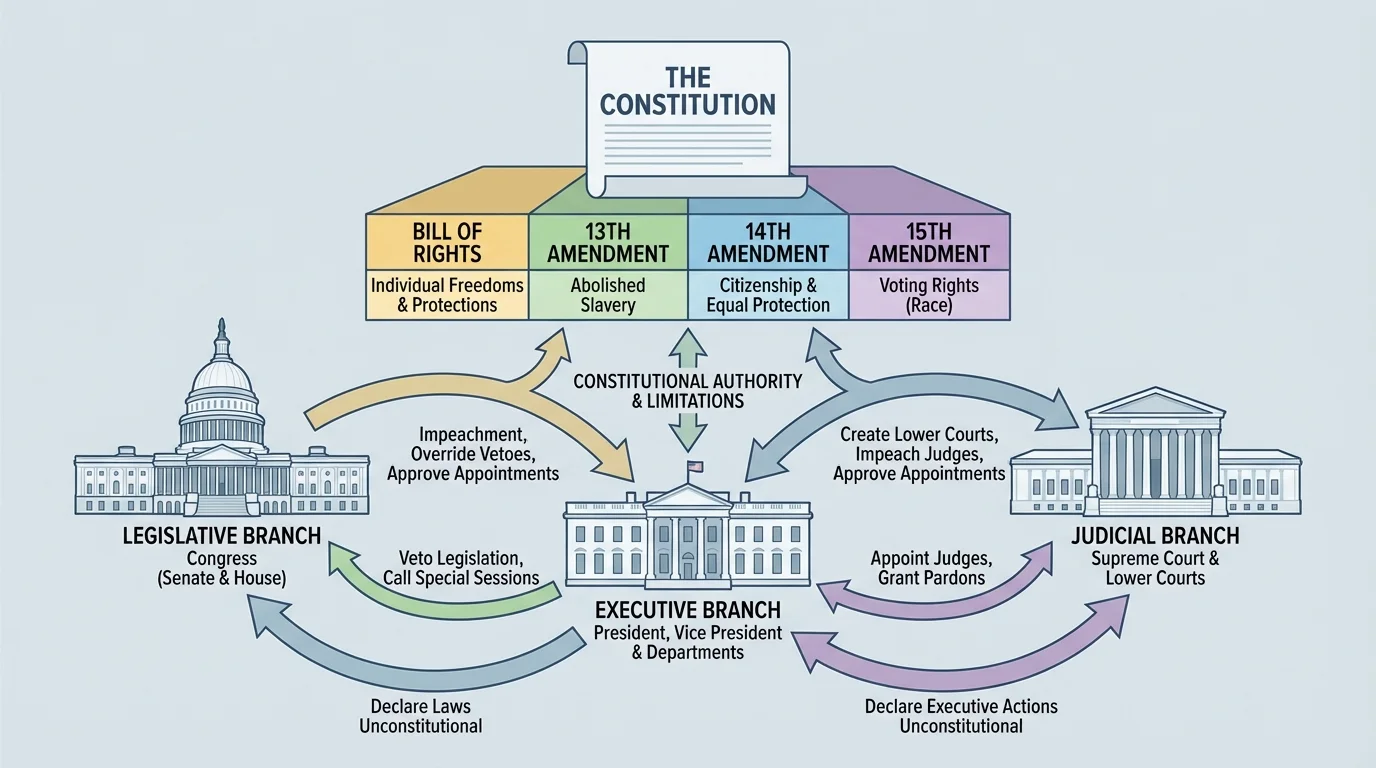
The Constitution also divides power between the national government and the states. This is called federalism. The national government handles issues that affect the whole country, such as declaring war, making treaties, and printing money. State governments handle many local matters, such as education systems, local roads, and state laws. This sharing of power prevents all authority from gathering in one place.
Because the Constitution is written down, people can challenge government actions by asking, "Is this constitutional?" That question matters in court cases, debates in Congress, and everyday discussions. A written Constitution gives citizens a standard to measure government against. Later, when we return to branch power and legal limits, this structure helps explain why one part of government cannot simply dominate the others.
Why limited government matters
Limited government does not mean weak government. It means government power has boundaries. Leaders may enforce laws and protect the country, but they must do so in ways the Constitution allows. This balance protects both order and freedom.
The Constitution was strong, but it was not perfect. It created a framework, yet many people soon argued that it needed clearer protections for individual rights. That demand led to one of the most important additions in American history: the Bill of Rights.
The Bill of Rights is the name for the first ten amendments to the Constitution. These amendments were added in 1791 to protect people from government abuse. These protections, summarized in [Figure 2], cover several kinds of liberty: freedom of expression, privacy, fair legal treatment, and protection from cruel punishment. They make the Constitution stronger because they spell out rights that government must respect.
The First Amendment protects several basic freedoms: religion, speech, press, assembly, and petition. These freedoms matter because they allow people to think, speak, worship, publish, gather peacefully, and ask the government to fix problems. If citizens cannot criticize leaders or share ideas, democracy weakens quickly.
The Fourth Amendment guards against unreasonable searches and seizures. This means the government usually must have a valid reason, and often a warrant, before searching private property. The Fifth Amendment protects due process and says that no person can be forced to testify against himself or herself in a criminal case. The Sixth Amendment guarantees rights such as a speedy and public trial and the help of a lawyer. The Eighth Amendment protects against cruel and unusual punishment.
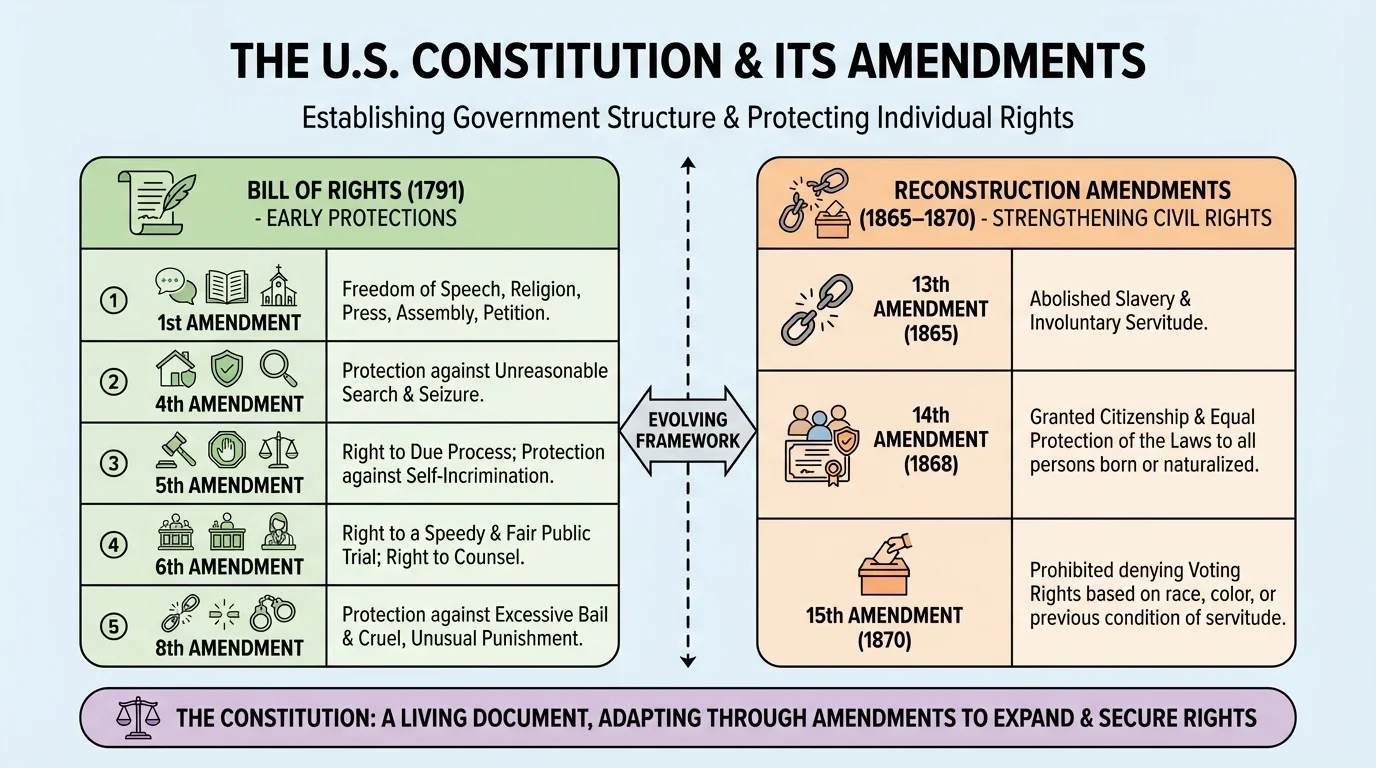
These rights are not just abstract ideas. They affect real life. Freedom of speech protects a student newspaper's opinion piece. Freedom of religion protects a person's right to worship or not worship. Protection against unreasonable searches limits what government officials can do. Due process means the government must follow fair procedures before taking away life, liberty, or property.
Not every amendment in the Bill of Rights appears in daily news, but together they create a shield for personal liberty. They remind the government that individuals are not powerless. Even elected leaders must obey constitutional boundaries. Much later, courts used many of these protections to decide cases involving schools, protests, criminal trials, and free expression. When those rights are tested, these constitutional protections remain central.
Some people originally opposed the Constitution because they feared the new national government would become too powerful. The Bill of Rights helped win support by promising clear protections for individual freedom.
The Bill of Rights was a major step, but the nation still allowed slavery. That contradiction led to a terrible conflict and then to some of the strongest amendments ever added to the Constitution.
An amendment is a formal change to the Constitution. The amendment process is intentionally difficult. A proposed amendment must gain very broad support before it becomes part of the Constitution. This makes the Constitution stable. It cannot be changed easily by temporary anger, sudden trends, or one political group acting alone.
That difficulty is actually a strength. If the Constitution changed every time opinions shifted, it would not provide dependable limits on government. At the same time, the amendment process allows the nation to improve when it recognizes injustice or new needs. In other words, the Constitution is designed to be stable, but not frozen.
Why a hard amendment process can be useful
Step 1: Think about the Constitution as a rulebook for the country.
If the rulebook changed too easily, people would not know what rights or rules would last.
Step 2: Consider major changes in history.
Ending slavery and defining citizenship were changes so important that they needed strong national agreement.
Step 3: Connect stability and justice.
A difficult amendment process protects the Constitution from careless change, but still allows major moral progress.
Some amendments make small adjustments. Others transform the country. The amendments adopted after the Civil War were transformative. They redefined freedom, citizenship, equality, and political participation in ways that still matter today.
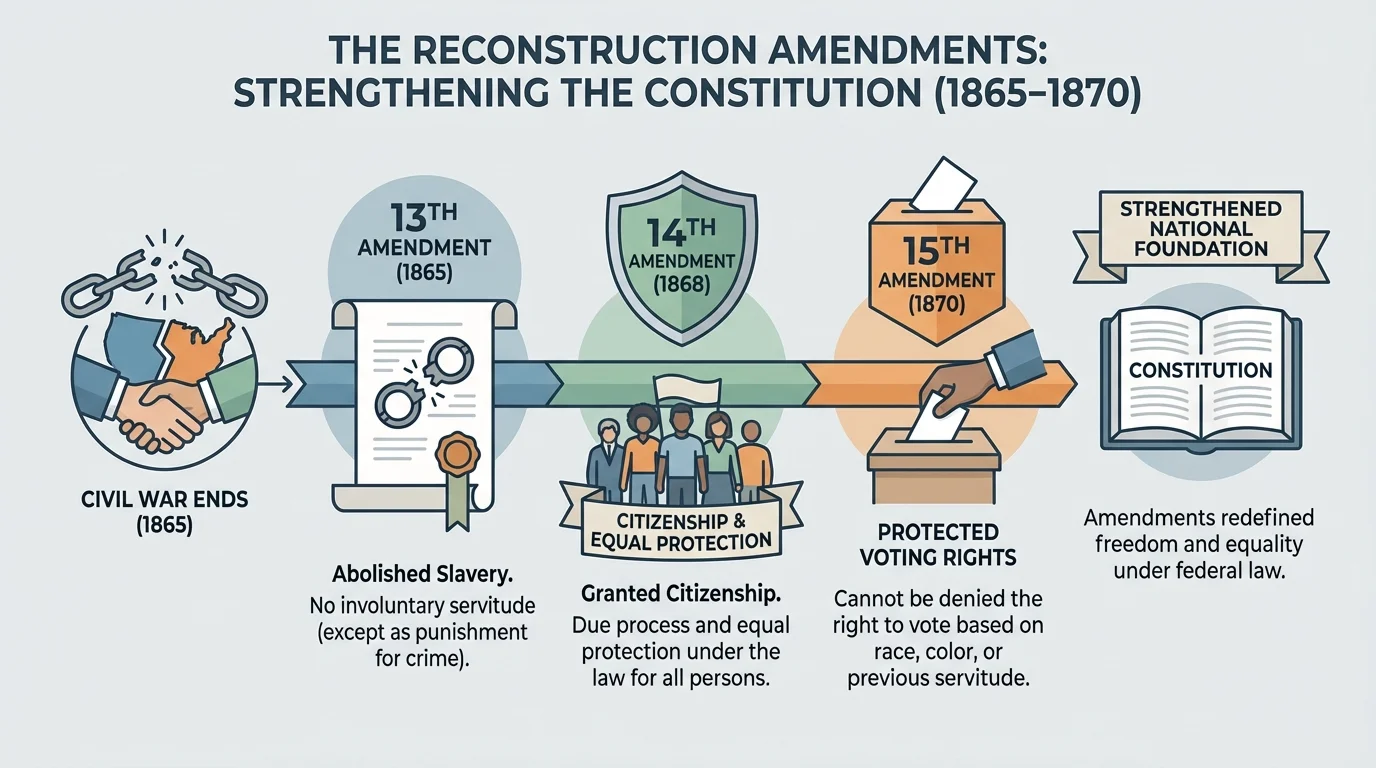
After the Civil War, the United States faced an enormous question: would freedom and equality become real constitutional principles, or would the nation return to old systems of oppression? The answer developed through the Reconstruction Amendments, which are introduced in order in [Figure 3]. These are the 13th, 14th, and 15th Amendments, added in the years after the war.
The 13th Amendment, ratified in 1865, ended slavery in the United States except as punishment for a crime after conviction. This was a turning point in American history. Before this amendment, slavery had been legal in much of the country. After it, slavery was unconstitutional. That was not just a policy change. It was a moral and legal revolution.
The 14th Amendment, ratified in 1868, is one of the most important amendments in the entire Constitution. It declares that people born or naturalized in the United States are citizens. It also says that states may not deny any person due process of law or the equal protection of the laws. This amendment expanded the meaning of citizenship and became a powerful tool for fighting unfair treatment.
The idea of equal protection means the law should not treat people unfairly without a constitutional reason. Over time, courts used the 14th Amendment in cases about segregation, civil rights, marriage, education, and fairness in government action. It is one reason the Constitution remains relevant in modern life.
The 15th Amendment, ratified in 1870, said that the right to vote could not be denied because of race, color, or previous condition of servitude. In simple terms, states could not legally block citizens from voting just because they were formerly enslaved or because they were Black. Voting is a key part of self-government, so this amendment aimed to protect political power as well as personal freedom.
Together, these amendments changed the Constitution in a deep way. The 13th Amendment ended slavery. The 14th Amendment defined citizenship and required fairness and equality under law. The 15th Amendment protected voting rights against racial discrimination. Seen together, as in [Figure 3], they moved the nation closer to its own ideals, even though those ideals were still not fully achieved.
"No person shall ... be deprived of life, liberty, or property, without due process of law; nor deny to any person within its jurisdiction the equal protection of the laws."
— 14th Amendment
These amendments were powerful, but passing them did not instantly end injustice. Many states created new barriers to Black freedom and voting. Violence, intimidation, segregation, and discriminatory laws continued. This shows an important civics lesson: constitutional rights are essential, but people and institutions must still enforce them.
Constitutional rights shape everyday life more than many people realize. In school settings, questions about speech, protest, privacy, and fairness often connect to constitutional principles. In communities, people rely on rights to worship freely, gather peacefully, speak out, receive fair trials, and vote. The scenes in [Figure 4] help connect these rights to real situations rather than treating them as distant history.
For example, if a government official tried to punish a newspaper only because it criticized leaders, that would raise a First Amendment issue. If police searched a house without following legal standards, that would raise a Fourth Amendment issue. If someone were denied a fair trial, that would involve the Fifth and Sixth Amendments. If a state tried to treat one group of citizens unfairly under the law, the 14th Amendment would matter.
Voting rights are another powerful example. The 15th Amendment was a major step, but later history shows that rights can be attacked indirectly. Literacy tests, poll taxes, threats, and violence were used to keep Black citizens from voting in many places. That is why later laws and court decisions were needed to enforce constitutional promises.
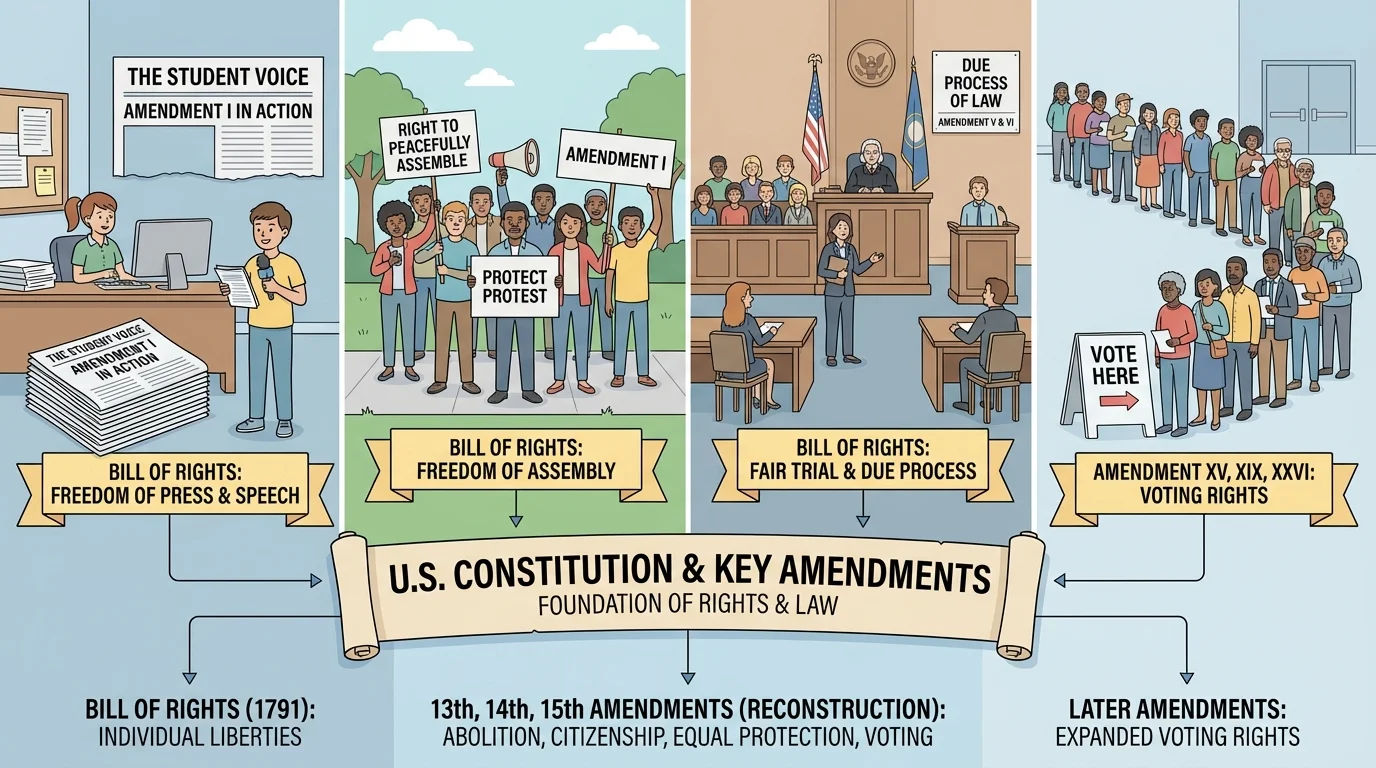
This teaches an important truth about the rule of law: rights on paper are not enough by themselves. Courts must interpret them fairly. Officials must follow them honestly. Citizens must know them and defend them. A constitutional system depends not only on written words, but also on people committed to justice.
Modern debates still connect to these amendments. Court cases about discrimination often rely on the 14th Amendment. Discussions about voting access connect to the 15th Amendment. Questions about speech on social media, student expression, or public protest still trace back to the Bill of Rights. When we see rights in action today, these civic examples help make clear that the Constitution is a living framework for public life.
Government in the United States is based on popular sovereignty, meaning the people are the source of political power. The Constitution turns that idea into a system with rules, limits, and rights.
The strength of amendments like the Bill of Rights and the 13th, 14th, and 15th Amendments comes from both their legal power and their moral importance. Legally, once ratified, they become part of the Constitution itself. That means ordinary laws and government actions must match them. Morally, they express central American ideals: liberty, fairness, equality, and participation in government.
The Bill of Rights is strong because it protects individuals from government overreach. The Reconstruction Amendments are strong because they expanded who was protected and what freedom truly meant. Before these amendments, many people were excluded from the promises of the nation. After them, the Constitution more clearly recognized that freedom and citizenship must apply far more broadly.
They are also strong because they continue to shape later generations. The 14th Amendment especially has been used again and again in landmark cases. It provides a constitutional basis for arguing that the law must treat people fairly. That makes it one of the most far-reaching amendments ever adopted.
| Amendment or Group | Main Protection | Why It Matters |
|---|---|---|
| Bill of Rights | Protects core civil liberties such as speech, religion, press, due process, and fair trials | Limits government power and protects individual freedom |
| 13th Amendment | Ends slavery | Makes human bondage unconstitutional |
| 14th Amendment | Defines citizenship, guarantees due process and equal protection | Expands rights and becomes a foundation for civil rights |
| 15th Amendment | Protects voting rights regardless of race, color, or previous condition of servitude | Strengthens democratic participation |
Table 1. Major constitutional protections discussed in the lesson and their lasting importance.
When students study the Constitution, they are not just studying laws from the past. They are studying the rules that shape power in the present. The Constitution matters because it organizes government, limits authority, and protects rights. The Bill of Rights matters because freedom needs specific protections. The 13th, 14th, and 15th Amendments matter because they pushed the nation to confront injustice and expand the meaning of liberty and equality under law.
