What happens if one leader gets to write the laws, enforce the laws, and decide whether those laws are fair? History gives a clear answer: freedom usually shrinks. The United States system was designed to make power harder to abuse. That can feel frustrating when government moves slowly, but the slowness is not an accident. It is part of a plan to prevent any one person or group from becoming too powerful.
The U.S. Constitution created a government based on the separation of powers. Instead of placing all authority in one office, it divides responsibility among three branches. This design reflects a basic civic idea: people should be governed by laws, not by the personal wishes of rulers. That idea is part of the rule of law, which means everyone, including government officials, must follow the law.
In a constitutional system, power is limited. The Constitution gives government authority, but it also places boundaries on that authority. Those limits matter most during moments of stress: war, protest, elections, public health emergencies, or major social change. It is easy to support limits on power when everyone agrees. The real test comes when people are afraid, angry, or deeply divided.
Constitutional system means a system of government built on a constitution that sets out powers, limits, and rights. Rule of law means laws apply to everyone fairly, including leaders. Separation of powers means government powers are divided among different branches so that no one part controls everything.
Many countries have constitutions, but not all of them enforce limits equally well. In the United States, the three branches are expected to interact constantly. Sometimes they cooperate. Sometimes they block each other. Both actions can be normal parts of constitutional government.
The Constitution divides power among three branches, as shown in [Figure 1], so that lawmaking, law enforcement, and legal interpretation are not controlled by the same people. This is one of the most important protections in American government.
The legislative branch is Congress, which includes the Senate and the House of Representatives. Congress writes laws, approves budgets, declares war, and oversees parts of the executive branch. Because Congress controls funding, it has powerful influence over what government can actually do.
The executive branch includes the president, vice president, cabinet departments, and many federal agencies. Its main job is to carry out and enforce laws. The president also acts as commander in chief of the military, negotiates treaties, and can issue executive orders, though those orders must stay within the law and the Constitution.
The judicial branch includes the Supreme Court and other federal courts. Courts interpret laws, decide disputes, and determine whether government actions follow the Constitution. Judges do not write laws or enforce them directly, but their decisions can strongly shape what government is allowed to do.
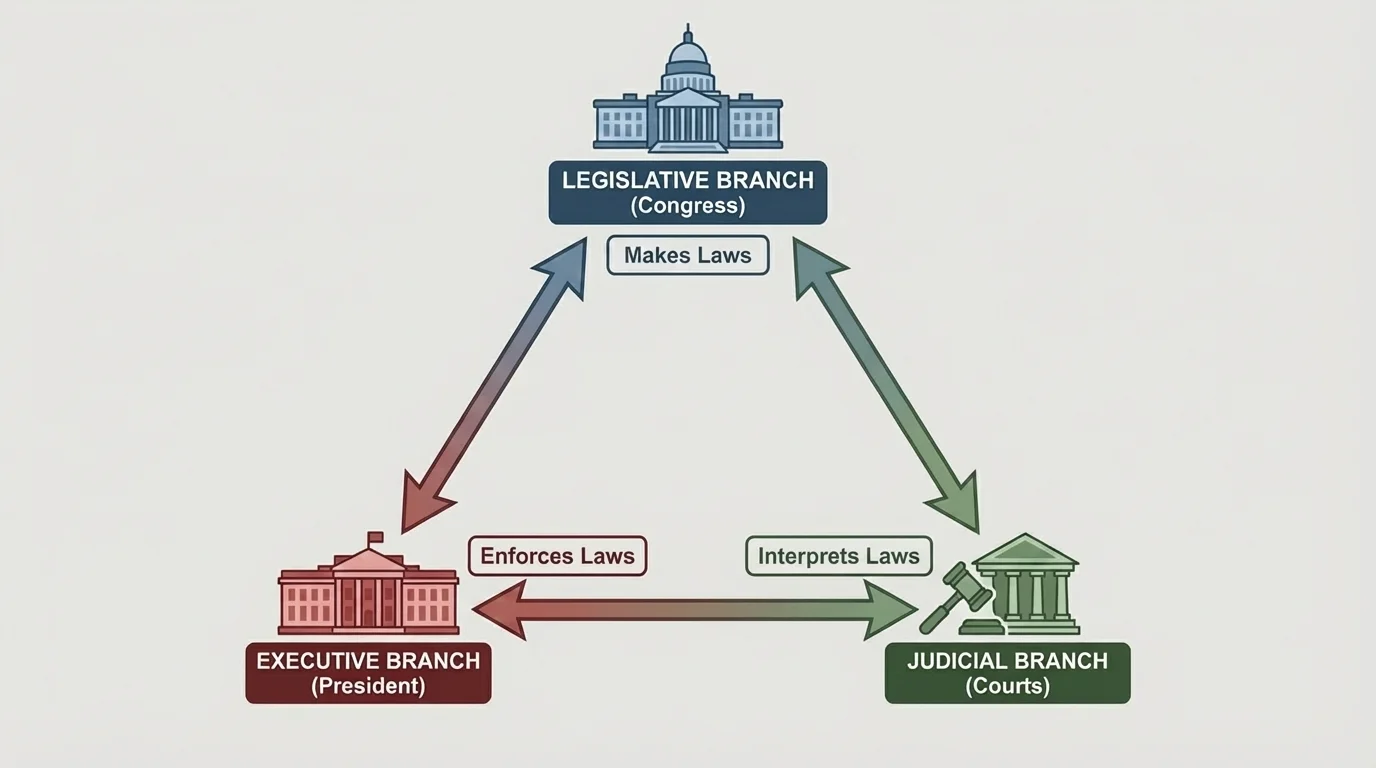
You can think of the branches like parts of a team with different responsibilities. If one part tries to take over the whole game, the system stops being fair. The branch structure is meant to keep decision-making shared, visible, and limited.
At the same time, the branches are not completely separate. They overlap on purpose. For example, Congress passes laws, but the president can veto them. Courts can review those laws. The president appoints judges, but the Senate confirms them. That overlap is where much of civics becomes most interesting.
The Constitution does not contain the phrase checks and balances, but the system is built around that idea. The structure itself creates those limits by giving each branch tools to respond to the others.
The branches are not stacked in a top-to-bottom ranking. They are meant to be different centers of power. That is why students should be careful about saying one branch is always the "most important." At different times, each branch can become especially influential.
Checks and balances, introduced in [Figure 2], are the specific powers each branch has to limit the others. These limits help protect the rule of law because they make it harder for officials to act without review.
Congress can pass laws, but the president can veto a bill. Congress can override that veto with enough votes. The Senate confirms many presidential appointments, including federal judges. Congress can also investigate executive actions and, in serious cases, impeach and remove officials. The House brings impeachment charges, and the Senate holds the trial.
The president can recommend laws, sign or veto bills, appoint judges, and enforce court decisions through the executive branch. A president may also call special sessions of Congress in certain situations and use influence to shape public opinion and policy debates.
The courts can review laws and executive actions. This power is called judicial review. If a court decides that a law or action conflicts with the Constitution, it can strike it down. Judicial review is a powerful reminder that government is limited by a higher legal standard.
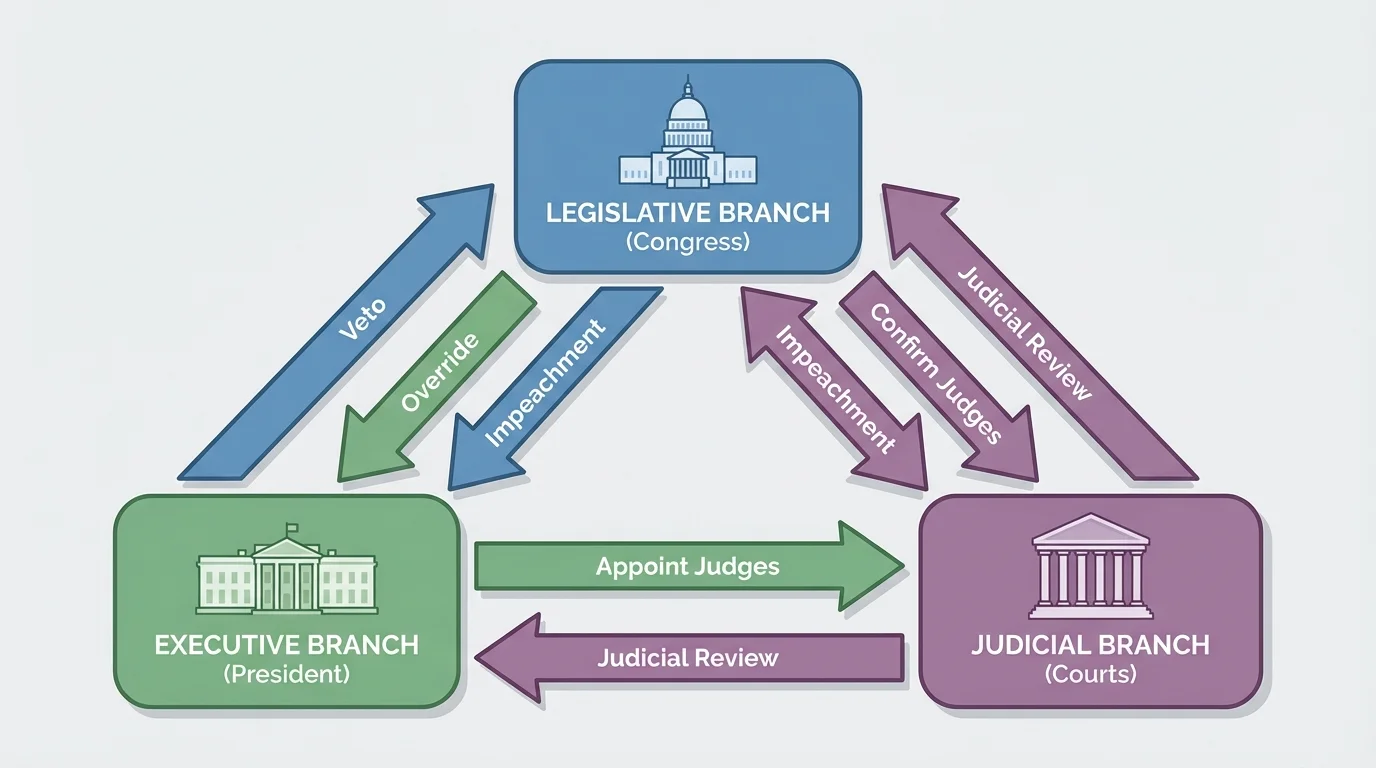
Checks and balances do not guarantee perfect decisions. They do, however, make government actions pass through more than one test. A proposal may be tested politically in Congress, practically in the executive branch, and constitutionally in the courts.
This system also connects directly to fairness. Under the rule of law, officials cannot simply do whatever seems useful in the moment. They must act through lawful procedures. Even a popular leader must follow legal limits. Even a policy supported by many voters can still be unconstitutional.
Why slowing down power can protect freedom
People often complain that government takes too long. Sometimes that criticism is fair. But in a constitutional system, speed is not the only goal. The branch system is designed to force discussion, review, and accountability. When major decisions affect rights, property, voting, or public safety, taking time can help prevent abuse and mistakes.
Later historical examples make this clearer. In both scandals and reform movements, the rule of law becomes real only when institutions are willing to act. A constitution on paper means little if branches refuse to check one another.
The Watergate scandal, shown in [Figure 3], is one of the clearest examples of branch interaction in U.S. history. In 1972, men connected to President Richard Nixon's reelection campaign broke into the Democratic National Committee headquarters at the Watergate complex. The break-in itself was serious, but the greater constitutional crisis came from efforts to hide what had happened.
Congress investigated the scandal through hearings. Journalists uncovered important facts, but congressional oversight turned those discoveries into formal public inquiry. At the same time, the executive branch was under pressure because the president and his aides were accused of misuse of power, obstruction of justice, and abuse of government agencies.
The judicial branch became crucial when the dispute reached the Supreme Court in United States v. Nixon. The Court ruled that the president had to turn over tape recordings related to the investigation. This decision rejected the idea that a president could withhold evidence simply by claiming unlimited executive privilege.
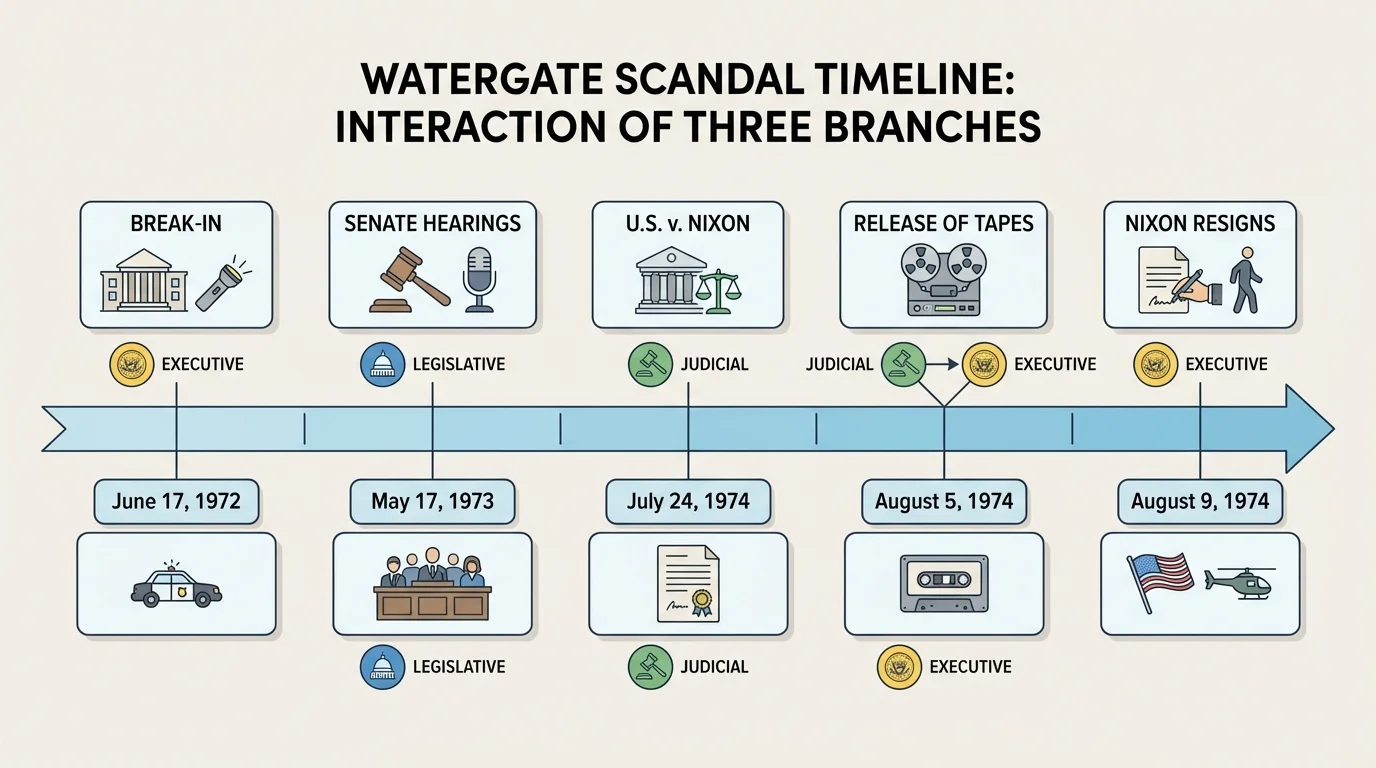
After the tapes were released, support for Nixon collapsed. Facing likely impeachment by the House and possible conviction in the Senate, he resigned in 1974. No tanks rolled through Washington. No coup took place. Instead, the constitutional system handled a major abuse of power through investigation, court rulings, and lawful transfer of authority.
Watergate matters because it shows that no official is above the law. Congress investigated. Courts ordered evidence released. The presidency itself changed hands peacefully. As we see again in [Figure 2], checks and balances are not just theory from a textbook; they become most important when leaders are tempted to ignore limits.
"No person in this country is so high that he is above the law."
— Idea affirmed in U.S. constitutional practice
Primary sources from Watergate include the White House tapes, Senate hearing transcripts, and the Supreme Court's opinion in United States v. Nixon. Secondary sources include history books and documentaries that interpret those events. Both kinds of sources matter. Primary sources show what people said and did at the time, while secondary sources help explain the broader meaning.
The struggle for civil rights shows a different kind of branch interaction. Instead of focusing on one scandal, it reveals a long process in which all three branches played major roles, as shown across time in [Figure 4]. This is important because constitutional change often happens step by step rather than all at once.
In 1954, the Supreme Court decided Brown v. Board of Education, ruling that racial segregation in public schools was unconstitutional. That was a major judicial action. The Court interpreted the Equal Protection Clause of the Fourteenth Amendment and declared that "separate but equal" schooling violated the Constitution.
But court decisions alone do not automatically change society. In Little Rock, Arkansas, in 1957, state officials resisted integration. President Dwight D. Eisenhower responded by sending federal troops to enforce the Court's ruling and protect Black students entering Central High School. This is a powerful example of the executive branch enforcing judicial decisions.
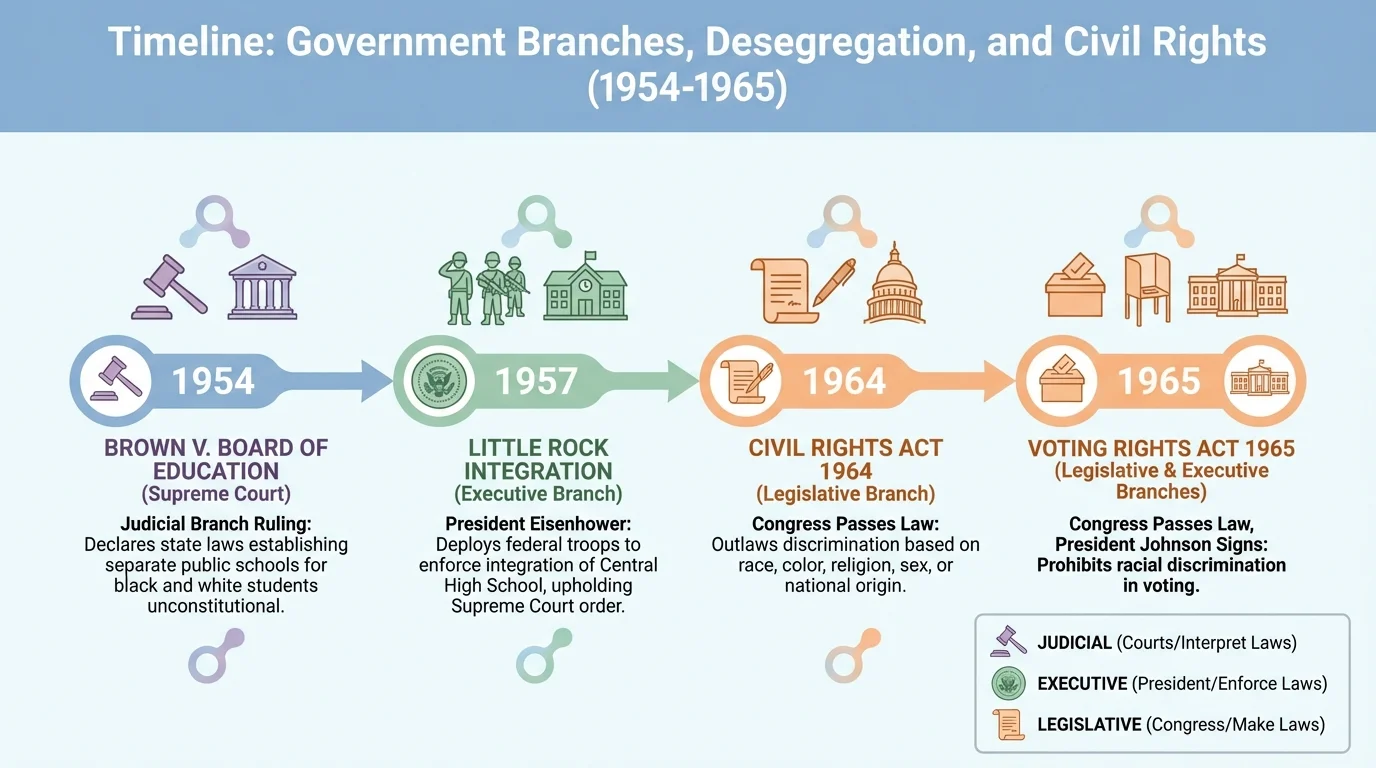
Congress later added another layer of change by passing the Civil Rights Act of 1964 and the Voting Rights Act of 1965. These laws addressed discrimination in public accommodations, employment, and voting. Here the legislative branch turned constitutional principles into specific national rules and enforcement tools.
This civil rights story shows why branch interaction matters. Courts can identify rights. Presidents and agencies can enforce those rights. Congress can create stronger legal protections. When one branch acts alone, change may be limited. When branches act together within the Constitution, change can become broader and more lasting.
Case study: Applying branch interaction to school desegregation
A student asks, "If the Supreme Court already ruled segregation unconstitutional, why were other branches still needed?"
Step 1: Identify the court's role.
The judicial branch interpreted the Constitution and declared segregation in public schools unlawful.
Step 2: Identify the executive role.
The executive branch enforced court rulings when states resisted, including the use of federal authority in Little Rock.
Step 3: Identify the legislative role.
Congress passed broader civil rights laws that gave the federal government clearer tools to prevent discrimination.
The result was not instant equality, but a stronger constitutional response than any one branch could have produced alone.
The civil rights movement also reminds us that citizens push government to act. Protesters, students, lawyers, writers, clergy, and community leaders helped create the pressure that led courts, Congress, and presidents to respond.
Knowing the branches is not just about the past. Current problems often become arguments about which branch has authority and what the Constitution allows. If you follow the news, you are often really watching separation of powers in action.
One modern example is immigration policy. Congress writes immigration laws, but presidents and federal agencies decide how to enforce them. Courts then review whether executive actions follow the Constitution and existing law. When presidents act without new legislation, people often debate whether they are using legitimate executive power or bypassing Congress.
Public health emergencies provide another example. During crises, governors, presidents, agencies, legislatures, and courts may all become involved. Questions can include mask rules, vaccine policies, business closures, school operations, and emergency spending. These issues are difficult because leaders must balance safety, liberty, and legal authority.
Technology also creates new constitutional problems. Social media, surveillance tools, and artificial intelligence raise questions about privacy, free speech, and regulation. Congress may consider new laws. Executive agencies may enforce current rules or propose regulations. Courts may decide whether those actions violate constitutional rights.
Student-related issues can connect too. Consider a dispute over student speech online. A school district may set rules, but those rules must still respect constitutional protections. If a case reaches court, judges interpret rights. If lawmakers believe rules are unclear, legislatures may try to write clearer laws. The same basic system appears at different levels of government.
Earlier civics learning about rights and responsibilities matters here. Rights are powerful, but they are protected through institutions, procedures, and evidence. Knowing your rights also means understanding which branch has the power to define, enforce, or review them.
Modern branch conflict can seem messy, but not every disagreement is a crisis. Sometimes conflict means the system is doing its job. As the flow in [Figure 2] shows, the branches are expected to question one another, especially when decisions affect constitutional rights.
Students sometimes assume that if branches are fighting, government is broken. Sometimes it is. But often, disagreement is a sign that no single branch can easily dominate. That tension can protect liberty. A president may want quick action. Congress may demand debate. Courts may require constitutional limits. The result can be slower, but it can also be safer for freedom.
This does not mean all gridlock is good. Delays can leave real problems unsolved. Budgets can stall. Appointments can go unfilled. Important legislation can fail. Citizens may become frustrated. Still, constitutional government values limited power as well as effective action. Democracies must balance both goals.
Watergate shows that conflict can stop abuse. The civil rights era shows that coordinated action can advance justice. Contemporary issues show that arguments over power continue because new problems keep testing old constitutional principles. The same framework remains useful even when the details change.
Many of the biggest Supreme Court cases begin with ordinary people, local disputes, or lower-court disagreements. A constitutional issue does not have to start in Washington to affect the entire nation.
That is why civic knowledge is practical, not just academic. When you hear that a court blocked a policy, that Congress refused funding, or that a president issued an executive order, you can ask better questions: Which branch is acting? What power is it claiming? What legal limit applies? Who can check it?
Citizens are not a formal branch of government, but they are essential to how the system works. Voters choose lawmakers and presidents. Citizens may serve on juries. They read news, speak publicly, petition officials, and join movements that influence public policy. If citizens do not pay attention, branch interaction can become harder to understand and easier to manipulate.
Strong citizenship also requires careful use of sources. Primary sources such as court opinions, speeches, laws, executive orders, and hearing transcripts reveal what officials actually said and did. Secondary sources help explain those materials, but students should learn to ask who wrote a source, what evidence it uses, and whether it separates fact from opinion.
When citizens understand constitutional government, they are better able to evaluate claims like "the president can do anything in an emergency" or "the Supreme Court makes laws" or "Congress is powerless if a president disagrees." Those statements are too simple. In reality, power is shared, limited, and constantly tested.
As [Figure 3] and [Figure 4] both demonstrate in different ways, historical turning points often depend on whether institutions follow the law when pressure is highest. That is the real importance of the three branches: they are not just names to memorize, but tools for protecting liberty, resolving conflict, and adapting constitutional principles to new challenges.
