One of the biggest ideas in civics sounds simple at first: people in the United States have rights. But the moment you ask a harder question—Can the government ever limit those rights?—things get much more complicated. A student may have free speech rights, but a school may still stop speech that seriously disrupts learning. A person may value privacy, but police may search in some situations. A tribal nation may govern its own land and people, yet federal law can still affect what happens there. These are the kinds of tensions that make civics real.
In daily life, laws are everywhere. They shape what happens at school, online, on roads, in courts, and in communities. Most of the time, we barely notice them. But when a law limits what someone wants to do, the question becomes whether that limit is fair, legal, and constitutional. That is where the study of rights and liberties matters.
A constitutional system tries to protect freedom while also maintaining order. If there were no limits at all, one person's freedom could harm another person's rights or safety. On the other hand, if government had unlimited power, freedom could disappear. The tension between liberty and law is not a mistake in the system. It is one of the system's main challenges.
Individual rights are protections and freedoms that belong to each person, such as freedom of speech, religion, and due process. Civil liberties are basic freedoms that government must not take away without strong legal reasons. The rule of law means that everyone, including leaders and governments, must obey the law, and that laws must be applied fairly and consistently.
In the United States, these rights are connected to the Constitution, the Bill of Rights, later amendments, court decisions, and other laws. Rights are not just ideas; they are enforced through legal systems. At the same time, no right exists in complete isolation. Rights exist within communities, and communities create laws.
The Constitution limits government power. That is a major reason it matters so much. It does not simply organize government; it also tells government what it cannot do. For example, government generally cannot punish people just because it dislikes their opinions. It cannot deny people equal protection of the laws. It cannot take away liberty without legal process.
Still, the Constitution does not mean that every action is protected in every setting. For example, the government usually cannot ban an opinion, but it may regulate the time, place, and manner of some speech. You may believe what you want, but religious freedom does not always allow actions that violate laws protecting health or safety. Rights are powerful, but they are not unlimited.
This is where the idea of constitutional system becomes important. A constitutional system does two things at once: it protects liberty and creates lawful ways to settle disputes. It depends on judges, lawmakers, executive officials, and citizens all following agreed rules instead of using raw power.
Remember that the Constitution creates a federal system, which means power is divided. National government has certain powers, states keep many powers, and tribal nations have important powers of self-government. Understanding divided power helps explain why legal conflicts can be complicated.
Because power is divided, two legal questions often appear at the same time, as [Figure 1] helps show: Does a person have a right here? and Which government has authority here? Sometimes the answer is clear. Sometimes it is contested for years in court.
The United States has more than one source of law, and their powers can overlap. National law comes from the U.S. Constitution, Congress, federal agencies, and federal courts. State law comes from state constitutions, legislatures, governors, agencies, and courts. Tribal law comes from the governments of federally recognized tribes, which are sovereign political communities with powers of self-rule.
The national government handles issues such as immigration, national defense, and treaties. States handle many matters involving education, local safety, property rules, and elections. Tribal governments may regulate membership, certain court systems, land use, and community matters within their jurisdictions. However, these powers do not sit in neat boxes all the time. They may overlap, especially on reservation land, in criminal cases, or when both individual rights and sovereignty are involved.
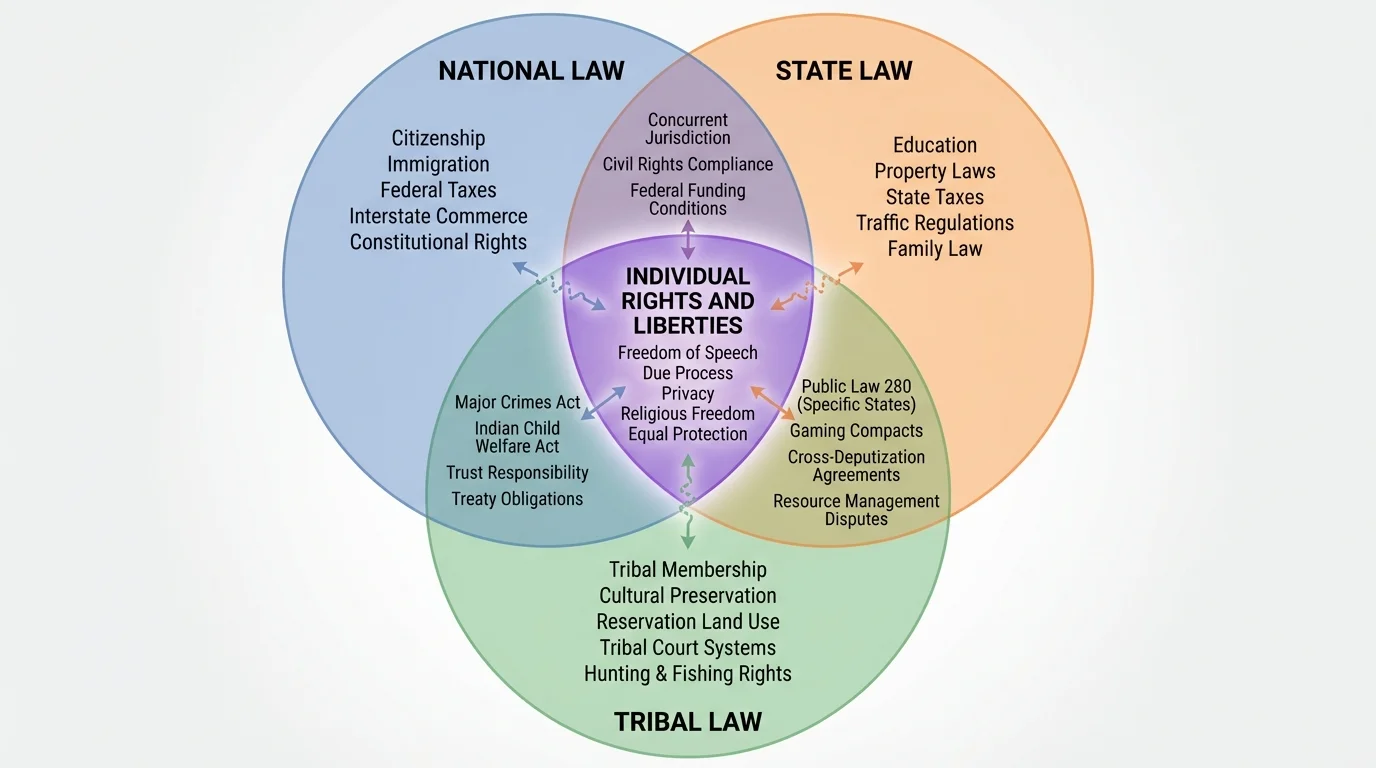
For example, a public school policy usually involves state and local authority, but students still have federal constitutional rights. A case on tribal land may involve tribal authorities, but it can also involve federal law depending on who is involved and what happened. That overlap creates tension because different governments may have different goals, traditions, or legal rules.
Jurisdiction means the legal authority to make decisions and enforce laws in a certain place or over certain people or issues. When people disagree about which government has jurisdiction, the conflict is not only about rights; it is also about power.
Tribal nations existed long before the United States was formed. Their sovereignty is not something states created. It is a political reality recognized through history, treaties, federal law, and court decisions.
This matters because tribal nations are not just clubs or local neighborhoods. They are governments. That makes tribal law different from school rules, city rules, or private group rules.
Conflicts between rights and laws often happen in several major areas. One is civil liberties such as speech, press, assembly, and religion. Another is privacy, including searches of lockers, backpacks, phones, or homes. Another involves equal treatment, such as whether a law unfairly targets a group of people.
Take free speech. In general, people have the right to express opinions, even unpopular ones. But there are limits. Threats, some forms of harassment, and speech that creates major disruption in certain settings can be restricted. In school, students have rights, but schools also have the job of protecting safety and maintaining an environment for learning.
Religious liberty can create another tension. People may hold and express religious beliefs freely, but questions arise when religious practices conflict with other laws. For example, if a law is designed to protect public health, can someone claim a religious exemption? Sometimes yes, sometimes no. Courts often look closely at whether the law is neutral, whether it targets religion, and whether the government has a very strong reason.
Privacy also creates difficult questions. People generally have protections against unreasonable searches and seizures. Yet the meaning of "reasonable" changes with context. Schools may search students under rules different from those used by police searching homes. Phones raise even more questions because a single device can contain photos, messages, locations, and years of personal information.
Why rights are limited at times
A right can be limited when government has a legitimate purpose, such as protecting safety, preventing violence, preserving order, or guarding the rights of others. The key issue is whether the limit is lawful, necessary, and fair rather than arbitrary. In a constitutional system, the government cannot simply say, "We want control," and stop there.
That is why the rule of law matters. If limits are based on clear rules, fair procedures, and constitutional principles, they are more likely to be legitimate. If limits are based on favoritism, fear, or prejudice, they are more likely to violate rights.
Tribal sovereignty means that tribal nations have the right to govern themselves in many internal matters. This can include making laws, running courts, managing services, and deciding membership rules. For many Native nations, sovereignty is tied to identity, history, land, treaty rights, and survival as a people.
Tensions can arise because individual rights and collective self-government do not always point in the same direction. For example, a tribal nation may have its own membership rules based on its laws and traditions. An individual may disagree with those rules, but the tribe may argue that controlling membership is part of its sovereign power. In that case, the issue is not just personal fairness; it is also political independence.
Another area of tension involves criminal justice and public safety. Suppose a crime happens on reservation land. Which government responds—the tribe, the state, or the federal government? The answer may depend on where the event happened, whether the people involved are tribal citizens, and the type of offense. Those questions can affect both community safety and the rights of the accused.
The overlap shown earlier in [Figure 1] helps explain why these disputes can become so complex. The same event may raise questions of sovereignty, constitutional rights, and jurisdiction all at once. In some cases, federal law supports tribal authority. In other cases, federal law limits it. States may have little authority in one setting and much more in another.
| Level of law | Main source of authority | Examples of powers | Possible tension with individual rights |
|---|---|---|---|
| National | U.S. Constitution and federal law | Citizenship, treaties, civil rights, federal courts | How far federal power can go in limiting speech, privacy, or liberty |
| State | State constitutions and state law | Education, policing, elections, health rules | Whether state laws unfairly burden rights or treat groups unequally |
| Tribal | Tribal sovereignty, tribal constitutions, traditions, and laws | Membership, local governance, tribal courts, some land and safety matters | How self-government and individual claims are balanced within tribal jurisdiction |
Table 1. Comparison of national, state, and tribal sources of law and their possible tensions with individual rights.
These issues require respect for both rights and sovereignty. Ignoring individual protections can be unjust. Ignoring tribal self-government can also be unjust. Constitutional democracy often requires people to hold two truths at once, as [Figure 2] helps explain.
When legal conflicts arise, courts often move through a series of questions. What right is being claimed? What law or action is limiting it? Which government has authority? What public interest is being protected? Is the limit too broad, unfair, or unsupported by law?
Judges do not just ask whether a law exists. They ask whether the law is constitutional. A law passed by a legislature can still be struck down by a court if it violates the Constitution. That idea is essential to the rule of law because it means government must follow higher legal principles.
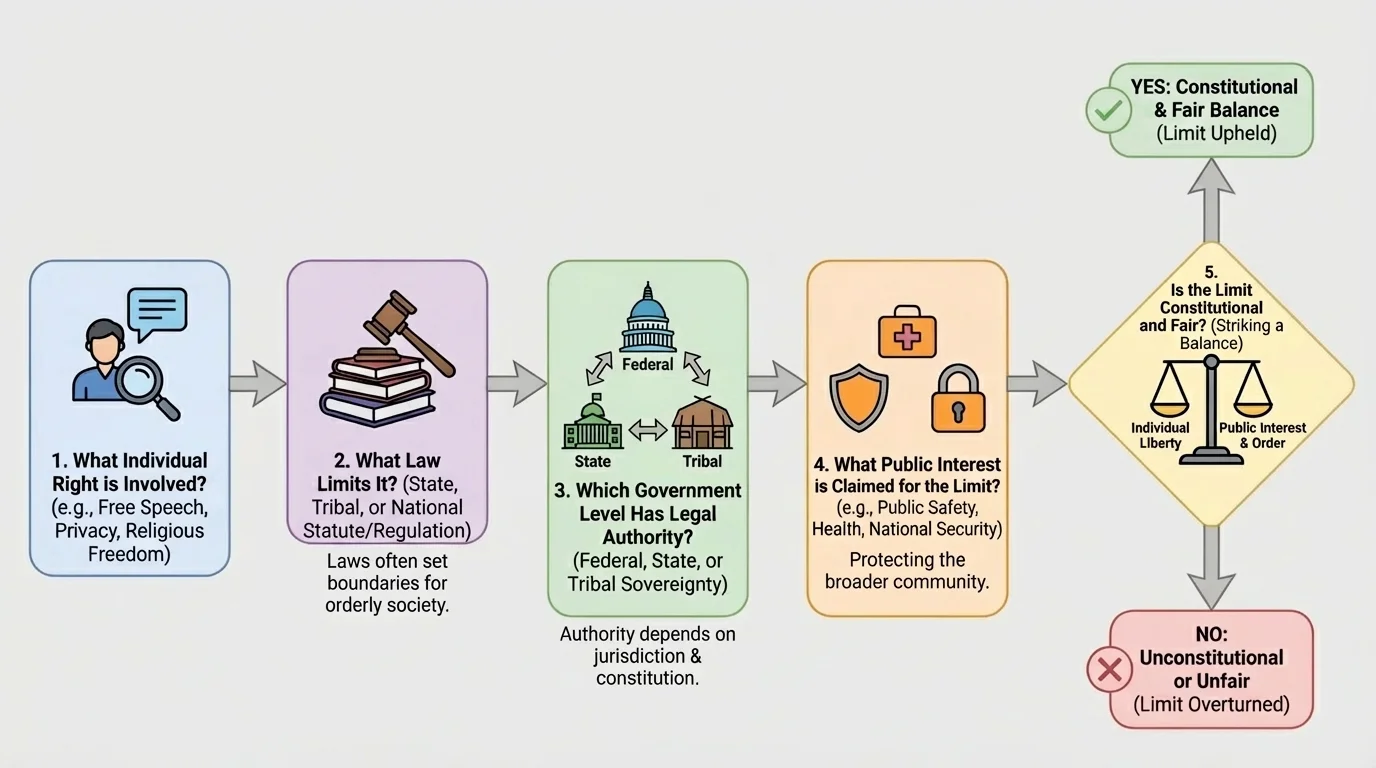
Balancing does not mean guessing. Courts use legal reasoning, precedent, constitutional text, and facts. They may examine whether a law targets a specific viewpoint, whether it applies equally, whether it serves an important public purpose, and whether it goes farther than necessary.
This is why two cases that seem similar can have different outcomes. A speech restriction aimed at preventing immediate violence may be treated differently from a restriction aimed at silencing criticism. A search based on clear legal rules may be upheld where a random or discriminatory search is rejected.
"The accumulation of all powers, legislative, executive, and judiciary, in the same hands, may justly be pronounced the very definition of tyranny."
— James Madison
The quote matters because separated powers help protect liberty. Legislatures make laws, executives enforce them, and courts interpret them. If one group controlled everything, rights would be much easier to abuse. This becomes clearer in concrete situations, as [Figure 3] shows.
These tensions become easier to see in concrete situations through school speech, privacy, and reservation law. Real cases show that rights are not abstract words; they affect what people can actually say, believe, and do.
One famous example involves student speech. Students wore black armbands to protest war. School officials suspended them, but the Supreme Court ruled that students do not "shed" their constitutional rights at the schoolhouse gate. At the same time, schools can still restrict speech that substantially disrupts education. The tension is clear: schools are not free-speech-free zones, but they are not exactly the same as public parks either.
Another example involves searches. A school may search a student's belongings if there is reasonable suspicion of a rule violation. That standard is lower than what police usually need for a home search. Why? Because schools are responsible for student safety and order. Still, school officials cannot search in a completely random or excessive way without justification.
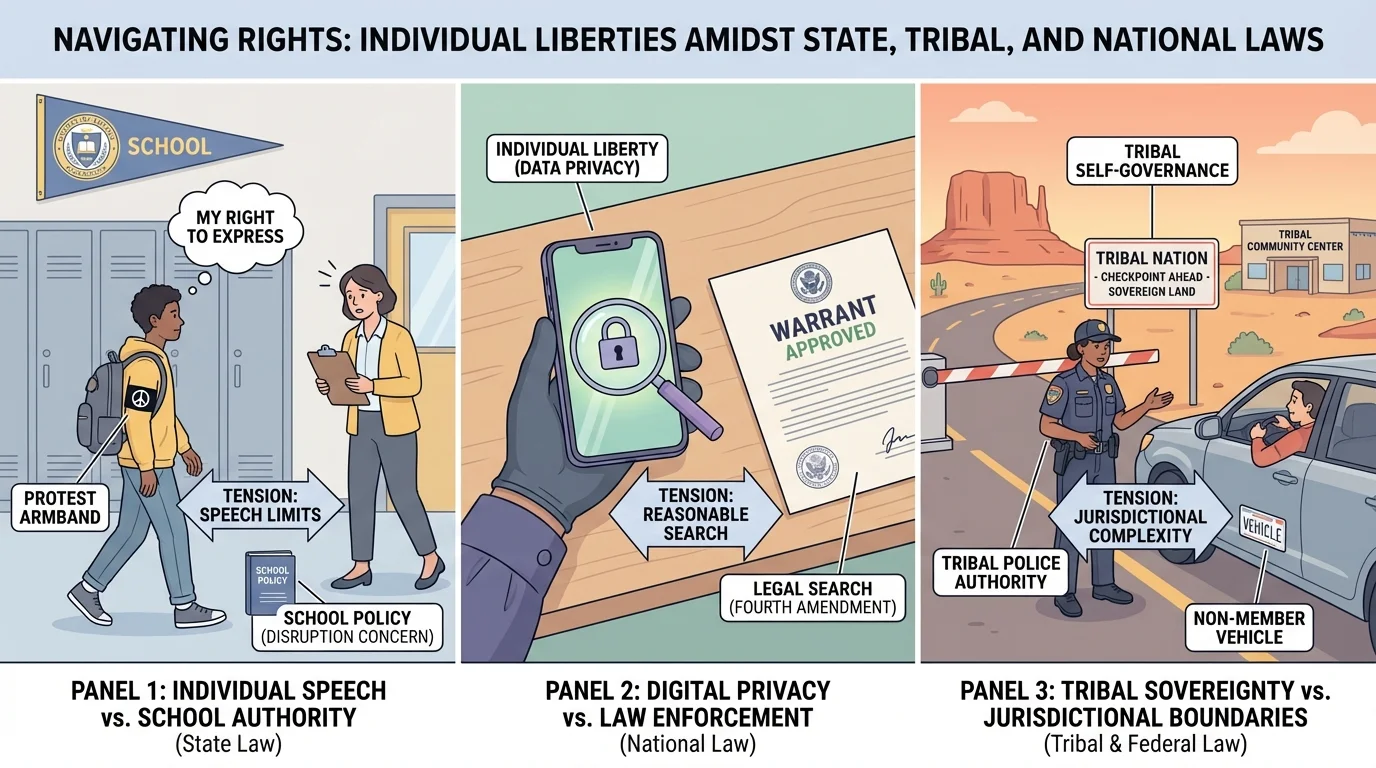
Phone privacy is an especially modern issue. A phone can reveal where someone has been, who they talk to, what they read, and what they believe. Because of that, courts often treat phone searches more carefully than searches of simple objects. The law keeps adapting as technology changes.
Case study: balancing speech and order at school
A student posts a political message online after school hours. Some students argue about it the next day, and a few classes are distracted.
Step 1: Identify the right involved.
The student is claiming freedom of speech.
Step 2: Identify the government interest.
The school claims it must maintain order and protect learning.
Step 3: Ask whether the disruption is serious enough.
If the speech causes substantial disruption, the school may have more power to act. If the disruption is minor and the punishment targets a viewpoint, the student's rights may be stronger.
Step 4: Consider fairness and scope.
A narrow response to a real problem is more likely to be lawful than a broad punishment of political opinion.
This example shows that courts often focus on facts, setting, and the actual effect of the speech.
Tribal jurisdiction provides another strong example. Suppose a traffic stop happens on reservation land. The identity of the driver, the location, and the law involved may all matter. Tribal police authority, state authority, and federal law may interact. A legal answer that seems simple from far away can become highly complex on the ground.
As we see again in [Figure 2], balancing requires asking several linked questions instead of only one. And the scenes in [Figure 3] remind us that these conflicts happen in ordinary places—schools, roads, and on personal devices—not just in courtrooms.
A system based only on authority can become oppressive. A system based only on unlimited personal freedom can become chaotic and unsafe. Constitutional government tries to avoid both extremes. It uses law to protect liberty, and it uses liberty to limit law.
That balance is never perfectly settled. New technologies create new privacy issues. Public emergencies can increase pressure for stronger government action. Demands for justice can expose laws that were unfairly applied. Tribal nations continue to defend sovereignty while individuals continue to assert personal rights. Democracy depends on working through these tensions openly and lawfully.
Due process is one of the most important protections in this balancing act. It means the government must follow fair procedures before taking away life, liberty, or property. Even when government acts for a strong reason, it must act through lawful steps.
Citizens play a role too. People should understand their rights, respect the rights of others, and evaluate laws carefully. A free society does not survive just because rights are written down. It survives because people insist that power be exercised under law.
