One court decision can change what students may say at school, how police may act, or whether a law is fair to everyone. That is a powerful idea: words written by judges can shape daily life for millions of people. In a constitutional democracy, citizens need more than opinions. They need evidence, careful thinking, and a clear understanding of how rights and responsibilities work together.
Every community faces hard questions. Should a school limit certain kinds of speech to prevent disruption? How much privacy should students have in their backpacks or phones? What happens when one person's freedom seems to clash with another person's safety or equality? These are not just legal questions. They are also questions about civic responsibility, fairness, and the kind of society people want to build.
To answer these questions well, citizens use a variety of resources. They read the Constitution, study laws, examine court decisions, compare news reports, and look at historical evidence. Strong civic thinking means asking not only, "What do I want?" but also, "What is just?" and "What helps the whole community?"
Civic responsibility means the duties people have as members of a community and a country, such as obeying laws, staying informed, respecting others' rights, and participating in public life.
Individual rights are freedoms and protections that belong to each person, such as freedom of speech and equal protection under the law.
The common good means the benefit and well-being of the whole community, not just one person or one group.
These ideas often support one another, but sometimes they pull in different directions. A person may claim a right, while a school or government argues that a rule protects order or safety. Learning civics means studying how democratic systems handle that tension.
The rule of law means that everyone must follow the law and that government power is limited by law. In the United States, the Constitution is the highest law. Government officials do not get to act only on personal preference. Their power comes from the Constitution and the laws made under it.
This matters because the rule of law, as shown in [Figure 1], protects people from unfair or unlimited power. It helps make sure laws are applied through known procedures, that courts can review government actions, and that citizens can challenge laws they believe violate their rights. The system is not perfect, but the rule of law creates a framework for resolving conflict without violence.
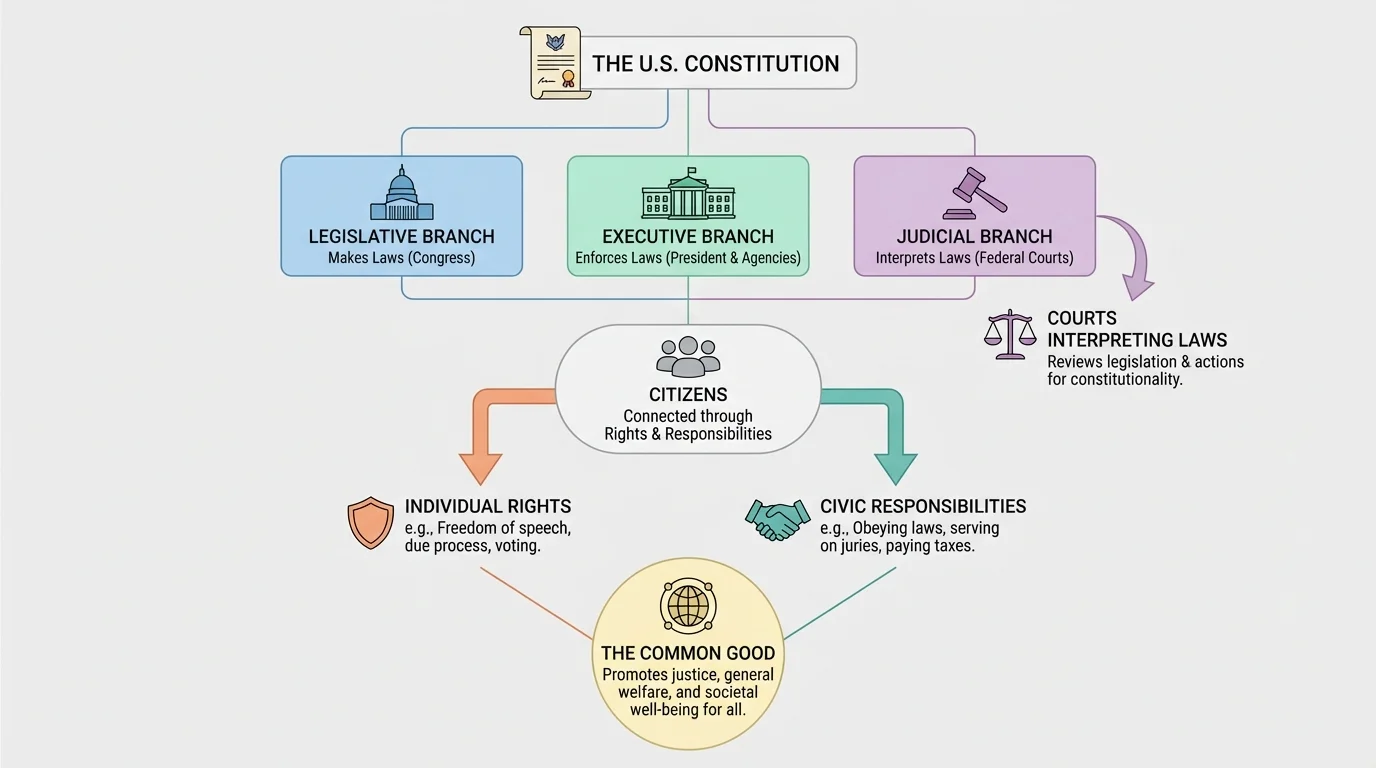
In a constitutional system, the government has limited powers. The Constitution gives powers to different branches and places checks on them. Congress makes laws, the president carries them out, and courts interpret them. This separation helps prevent any one branch from becoming too powerful.
The Constitution also protects certain rights. The Bill of Rights and later amendments place limits on what government may do. For example, the First Amendment protects speech and religion, while the Fourteenth Amendment helps protect equality and due process. These rights do not remove all rules, but they create boundaries government must respect.
Why the rule of law matters
When citizens trust that laws apply fairly, they are more likely to resolve disagreements through courts, elections, and debate instead of force. The rule of law supports both freedom and stability. Without it, rights become uncertain and power can become arbitrary.
The same basic structure in [Figure 1] helps explain why court decisions matter so much: courts do not make policy the same way lawmakers do, but they do decide whether laws and government actions fit the Constitution.
When investigating a civic issue, students should compare different kinds of evidence. One source rarely tells the whole story. A strong investigation uses both primary sources and secondary sources.
Primary sources, as shown in [Figure 2], are direct evidence from the time or event being studied. In civics, these include the Constitution, amendments, Supreme Court opinions, speeches, letters, laws, photographs, interview transcripts, and government records. Secondary sources explain, interpret, or analyze those original materials. Examples include textbooks, history articles, documentaries, and news analysis.
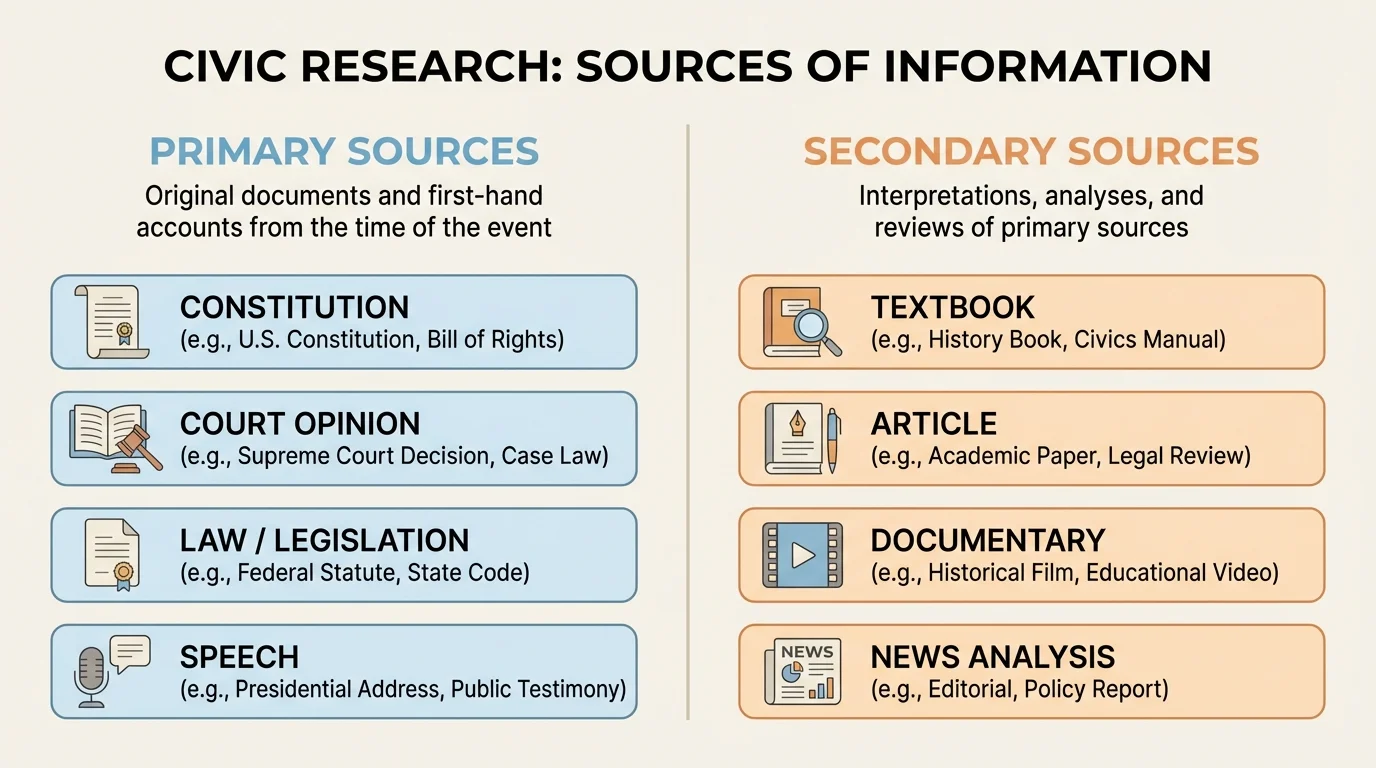
Different resources answer different questions. A Supreme Court opinion tells what the justices decided and why. A news report may explain public reaction. A historian may place the case in a larger historical context. Data from surveys or government reports can show how the issue affects real people.
Using several types of sources helps citizens avoid weak conclusions. If a person reads only one article or listens to one speaker, it is easy to miss important facts. Comparing sources can reveal where evidence agrees, where interpretations differ, and where bias may appear.
| Resource | What it helps you learn | Possible limitation |
|---|---|---|
| Constitution or amendment | The legal foundation and exact wording of rights | May require interpretation |
| Supreme Court decision | How the Constitution was applied in a real case | Can be complex and technical |
| Law or school policy | The rule people must follow | Does not always explain the bigger debate |
| News report | Current events and reactions | May focus on speed over depth |
| Historical article | Background and long-term significance | Written after the event, so it is an interpretation |
Table 1. Common civic resources, what they reveal, and their limits.
Supreme Court decisions often become famous by a short case name, such as Tinker v. Des Moines. The full written opinion can be much longer than the brief sentence students usually hear in class.
Citizens who evaluate issues carefully ask, "Who created this source? Why was it created? What evidence does it use? What might be missing?" Those questions are just as important when reading a social media post as when reading a textbook.
A Supreme Court decision does more than settle one disagreement. Because the Court interprets the Constitution, its rulings can guide lower courts, schools, police departments, and public officials across the country.
The Court usually hears cases, as shown in [Figure 3], after lower courts have already ruled. The justices review written arguments, hear oral arguments, and then issue opinions. The majority opinion explains the Court's official decision. A justice who agrees with the result for a different reason may write a concurring opinion. A justice who disagrees may write a dissenting opinion. Even dissents can become important later if future courts adopt their reasoning.
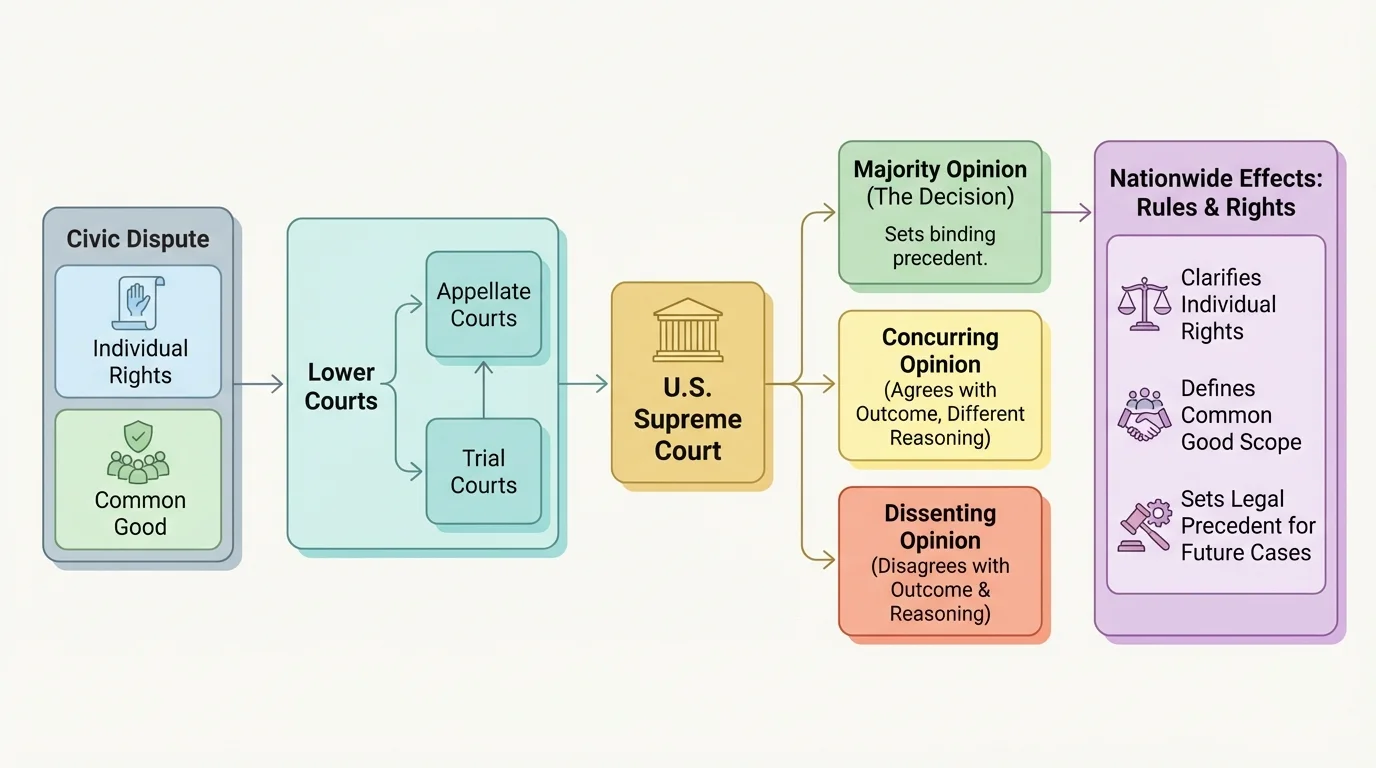
This process is tied to judicial review, the power of courts to examine laws and government actions and decide whether they fit the Constitution. Judicial review helps enforce limits on government and protects rights when citizens believe those limits have been crossed.
Not every question becomes a Supreme Court case, and not every disagreement is constitutional. Still, major civic conflicts often involve constitutional ideas such as free speech, equal protection, privacy, religion, and due process. That is why court decisions are such valuable resources for understanding civic life.
"The Constitution is the guide which I never will abandon."
— George Washington
The process in [Figure 3] also reminds us that law develops over time. One case can build on earlier decisions, respond to changing conditions, or redefine how a right is understood in schools and communities.
When students evaluate a civic issue, it helps to move through a clear process instead of jumping to a quick answer. First, identify the issue and the people involved. Second, determine which rights, responsibilities, or public interests are in conflict. Third, gather evidence from different sources. Fourth, compare the arguments. Finally, make a judgment supported by evidence.
For example, if a school limits a student protest, you would ask: What right is being claimed? What rule is being enforced? Why does the school say the rule is needed? What does the Constitution say? What have courts decided in similar situations? What outcome best protects both liberty and order?
Questions to ask about any civic issue
Step 1: Identify the constitutional idea.
Is the issue mainly about speech, equality, privacy, religion, voting, or due process?
Step 2: Identify the competing interests.
What individual right is at stake, and what claim is being made about safety, fairness, order, or the common good?
Step 3: Examine the evidence.
Use laws, court rulings, historical facts, and trustworthy reporting.
Step 4: Evaluate consequences.
How might each possible decision affect different people now and in the future?
This kind of reasoning helps citizens avoid oversimplified answers. In civics, important questions often involve trade-offs. A careful answer recognizes both principles and consequences.
The issue in Tinker v. Des Moines was whether students could wear black armbands to school to protest the Vietnam War. School officials feared disruption and suspended the students. The students argued that wearing the armbands was a form of speech protected by the First Amendment.
As shown in [Figure 4], in 1969, the Supreme Court ruled in favor of the students. The Court said students do not "shed their constitutional rights to freedom of speech or expression at the schoolhouse gate." At the same time, the Court also said schools may limit speech that would materially and substantially disrupt school operations. So the case did not mean students can say anything at any time. It created a standard for balancing expression and school order.
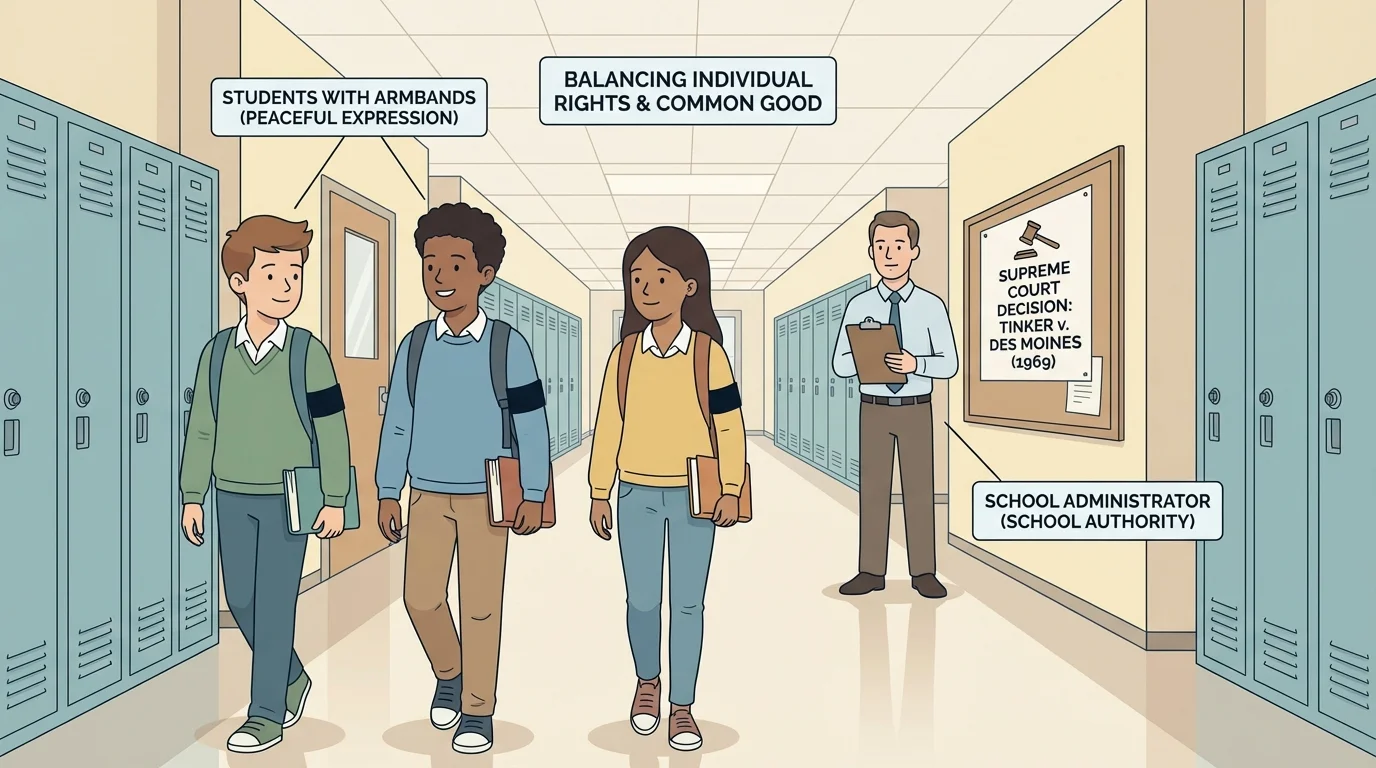
This case shows how civic responsibility and individual rights connect. The students had a right to express a political opinion peacefully. The school had a responsibility to maintain a safe learning environment. The Court had to weigh both concerns.
Tinker is still important today. Suppose students post messages online after school hours, organize a walkout, or wear clothing with a message. School leaders and courts may ask whether the expression is political, threatening, disruptive, or connected to the school environment. The standard from Tinker remains part of that discussion.
Evaluating the Tinker case
Step 1: Identify the right.
The main right is freedom of speech and expression.
Step 2: Identify the civic responsibility.
Students should express views without harming others or stopping the school from functioning.
Step 3: Consider the common good.
A school serves the whole community by protecting learning, safety, and respectful disagreement.
Step 4: Make a judgment.
Peaceful symbolic speech deserves strong protection unless there is real evidence of serious disruption.
Later debates about student expression often return to the same scene we see in [Figure 4]: a simple act of expression can raise big constitutional questions when public institutions set rules for everyone.
Another important case is New Jersey v. T.L.O. from 1985. A student was searched by school officials who suspected she had violated school rules. The case asked whether students have Fourth Amendment protections against unreasonable searches at school and, if so, how those protections work in a school setting.
The Supreme Court ruled that students do have privacy rights in school, but those rights are balanced differently than in many adult settings. School officials do not always need the same level of proof that police would need outside school. Instead, school searches must be reasonable under the circumstances. That means the search must be justified at the start and not excessively intrusive.
This case shows that rights are real, but context matters. A school has a strong duty to protect safety and order. At the same time, students are still individuals with constitutional protections. The Court tried to strike a balance between privacy and the school's responsibility to act quickly when rules or safety may be at risk.
Questions raised by this case continue today with lockers, backpacks, and especially phones. Phones can contain private messages, photos, and location information. As technology changes, courts and schools keep facing new versions of old constitutional questions.
Rights in the Constitution are not usually absolute in every setting. Courts often examine context, competing interests, and the government's purpose when deciding how a right applies.
To evaluate a search issue fairly, students should examine the exact facts: Who conducted the search? What evidence existed before it happened? How intrusive was it? Was the goal discipline, safety, or criminal investigation? Careful civic reasoning depends on those details.
The idea of equal protection became central in Brown v. Board of Education in 1954. The case challenged racial segregation in public schools. For years, the doctrine of "separate but equal" had been used to defend segregation, even though separate schools were deeply unequal in practice and in meaning.
As shown in [Figure 5], the Supreme Court ruled that segregated public schools are inherently unequal and violate the Equal Protection Clause of the Fourteenth Amendment. This decision was historic because it rejected legally enforced school segregation and helped energize the broader Civil Rights Movement.
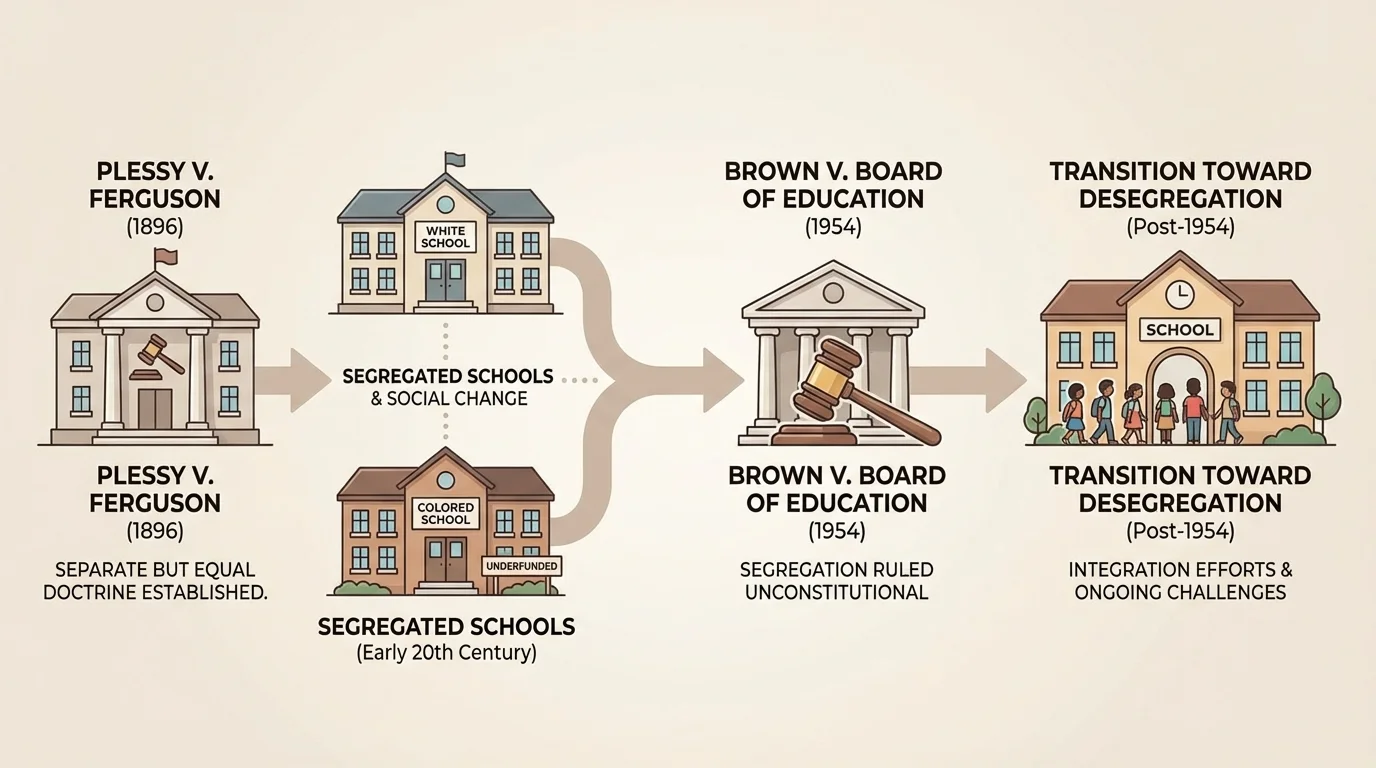
Brown demonstrates how a Supreme Court case can affect the common good. The ruling did more than decide one dispute. It challenged a system that harmed children, denied equal dignity, and weakened democracy itself. A society cannot claim to treat people as equal citizens while separating them by race in public institutions.
This case also teaches that the common good is not just about order or convenience. Sometimes the common good requires changing unjust traditions. Protecting equal rights strengthens the entire constitutional system because it makes citizenship more real for everyone.
When later citizens and leaders debated fairness in schools, they often returned to the constitutional principles shown by [Figure 5]: equal protection is not only a legal phrase but a standard for judging whether public institutions treat people with justice.
These court cases are not just about the past. They connect to everyday decisions. Students show civic responsibility when they express opinions respectfully, learn the facts before sharing claims, and consider how their actions affect others. Adults show it by voting, serving on juries, following laws, and participating in community problem-solving.
Suppose a town debates whether to limit protests near a hospital, whether to monitor student social media posts for threats, or how to create fair school discipline policies. In each case, people must weigh rights and the common good. Those debates are stronger when participants use evidence instead of rumors and constitutional reasoning instead of anger alone.
Rights and responsibilities work together
A constitutional democracy depends on both. Rights protect people from unfair government action. Responsibilities help people use freedom in ways that support a safe, informed, and fair community. One without the other weakens democracy.
Civic responsibility also includes listening. In a free society, disagreement is normal. People may support different policies while still respecting the same Constitution. Strong citizens can disagree sharply and still follow lawful procedures, examine evidence, and treat others as fellow members of the community.
Not all sources are equally reliable. A viral post may spread faster than a court opinion, but speed is not the same as accuracy. Citizens should look for evidence, check whether claims are quoted fairly, and compare reports from more than one trustworthy source.
Bias does not always mean a source is useless, but it does mean readers should be alert. A source may emphasize facts that support one viewpoint and ignore facts that complicate it. Reading a Supreme Court decision directly can help citizens move beyond slogans and see the actual reasoning of the Court.
| Question | Why it matters |
|---|---|
| Who created this source? | Helps identify expertise, purpose, and possible bias |
| What evidence is used? | Shows whether claims are supported |
| Is the source primary or secondary? | Clarifies whether it is original evidence or interpretation |
| What viewpoints might be missing? | Prevents one-sided conclusions |
| How does it compare with other sources? | Helps test accuracy and completeness |
Table 2. Questions citizens can ask when evaluating civic sources.
Careful evaluation is a civic habit. It protects both individual freedom and the common good because poor information can lead to unfair decisions. A constitutional democracy works best when citizens are informed, thoughtful, and willing to test claims against evidence.
Studying Supreme Court decisions helps students see that citizenship is not passive. People shape public life when they challenge unfair laws, defend rights, fulfill duties, and use trustworthy sources to make judgments. That is how constitutional principles become real in everyday life.
