Why can two people working with the same tools earn very different incomes? A big part of the answer is not the tools at all. It is what each person knows, what skills each person has practiced, and how well each can solve problems. Those abilities are a kind of wealth called human capital. Unlike money in a wallet, human capital travels with a person. It grows when people learn, train, practice, and adapt.
Human capital is the value of a person's knowledge, skills, habits, health, and experience that helps that person produce goods, provide services, and earn income. In a market economy, people make choices about what to buy, what to learn, and what jobs to pursue. Those choices affect not only individual lives but also the growth of businesses and communities.
Human capital is the collection of useful knowledge and skills a person gains over time. It can be developed through schooling, training, practice, work, and experience.
Market economy is an economic system in which buyers and sellers make many decisions about production and trade. Prices, competition, and consumer demand help guide those decisions.
Human capital matters because it increases productivity. Productivity means how much useful work or output can be produced in a certain amount of time. A trained carpenter can build faster and more accurately than a beginner. A merchant who understands trade routes, prices, and customer needs can make better business decisions than someone with no experience. When many people in a society improve their human capital, the economy often becomes stronger.
Human capital is different from physical capital. Physical capital includes tools, machines, buildings, and equipment. A printing press is physical capital. Knowing how to run the press, read, write, edit, and sell books is human capital. Strong economies need both.
In early American history, as [Figure 1] illustrates, many people developed skills through daily life rather than long years of formal schooling. In colonial communities, children often learned by helping on farms, in family shops, or in small businesses. Skills were passed from parents to children and from masters to young workers. Knowledge was practical: planting crops, repairing tools, sewing clothes, making barrels, keeping accounts, or trading goods.
Schooling existed, but it was not equally available to everyone. In some New England towns, more children attended school because reading was valued for religion and community life. In other places, especially in rural areas, education was limited. Many young people spent more time working than studying. This meant that human capital often developed through direct practice instead of formal classes.
One major path was the apprenticeship. A boy, and more rarely a girl, might be placed with a skilled craftsperson such as a blacksmith, printer, shoemaker, or cabinetmaker. In exchange for labor, the apprentice received food, shelter, and training. Over several years, the apprentice learned the trade step by step. This system helped communities train workers without large schools.
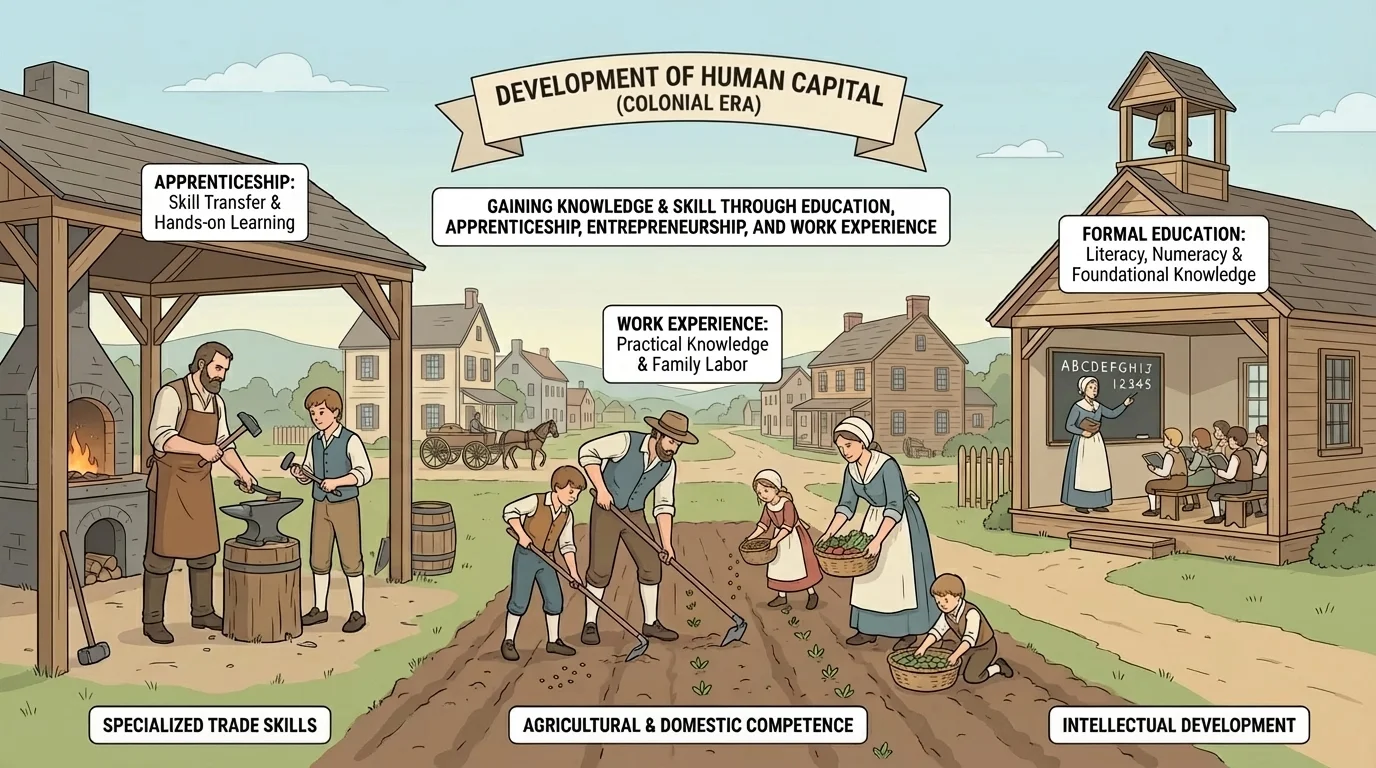
Early Americans also built human capital through trade and household work. A shopkeeper learned how consumer demand changed with seasons and prices. A farmer learned weather patterns, crop rotation, and bargaining. An artisan learned how quality affected reputation. In all of these cases, experience acted like a teacher.
However, access to human capital was unequal. Enslaved Africans were often denied educational opportunities even though they developed many advanced agricultural, craft, and survival skills under cruel conditions. Women contributed heavily to households and local economies, but they were often excluded from formal education and many professions. Native American communities had rich systems of teaching and knowledge, especially about land, trade, and survival, but colonization disrupted these systems. So, the story of human capital over time includes both growth and inequality.
Benjamin Franklin is a famous example of human capital growth in early America. He began as an apprentice printer and later became a writer, inventor, scientist, diplomat, and entrepreneur.
As the colonies became an independent nation, people increasingly recognized that education and skill-building could strengthen the economy. A population that could read contracts, calculate prices, understand laws, and learn trades was better able to participate in a growing market economy.
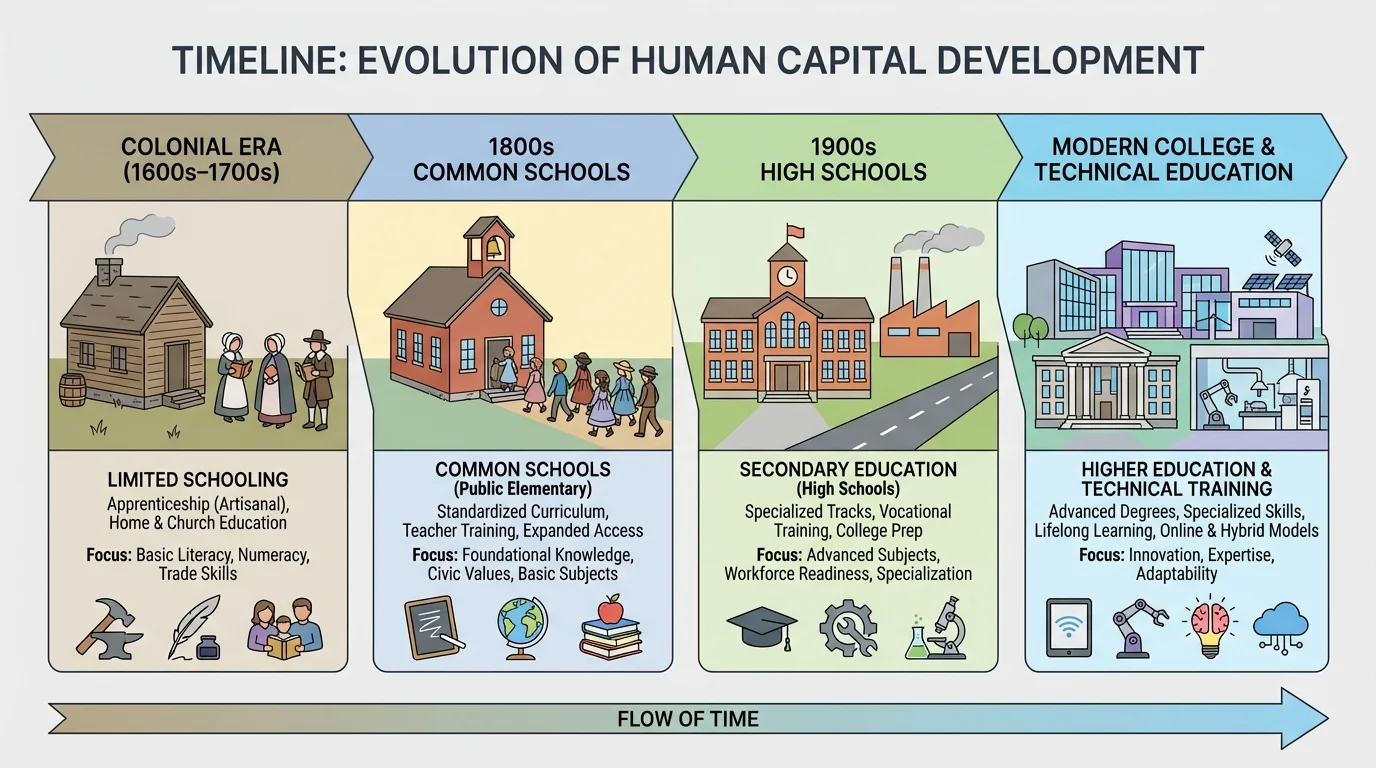
Over time, formal education expanded, and this widened the ways people could build human capital. As [Figure 2] shows, the path moved from limited colonial schooling toward broader public education, high schools, colleges, and technical programs. This change mattered because schools teach more than facts. They also build reading, writing, mathematics, discipline, communication, and problem-solving.
In the early republic, leaders such as Thomas Jefferson and Horace Mann argued that education was important for citizenship and economic success. During the 1800s, the growth of common schools increased access to basic education. Literacy and numeracy helped people read newspapers, compare prices, understand contracts, and participate in public life. These are economic skills as well as civic ones.
By the late 1800s and 1900s, industrial growth increased the demand for specialized knowledge. Factories, transportation systems, banks, and offices required workers who could handle machines, records, schedules, and calculations. High schools and colleges became more important. Later, technical schools and community colleges created additional pathways.
Education also changes the kind of work people can do. A person who learns bookkeeping can help run a store. A person who studies engineering can design bridges or machines. A person who studies medicine can improve public health. Human capital often becomes more specialized over time as economies become more complex.
The spread of education did not happen instantly or equally. Laws, segregation, poverty, distance, and discrimination limited access for many groups. Still, compared with early American history, modern societies offer many more ways to gain education. Online courses, libraries, career programs, and public schools allow students to build human capital in ways that would have been impossible for most colonial children.
Why education increases economic opportunity
Education can raise human capital because it teaches general skills that apply in many settings. Reading helps people learn from books, manuals, and digital sources. Mathematics helps people budget, measure, compare, estimate, and analyze data. Communication helps people work in teams and serve customers. These skills make workers more flexible when jobs and technologies change.
Education also affects consumer decisions. A person with stronger financial knowledge can compare prices, understand interest, read product information, and make better spending choices. In a market economy, informed consumers and skilled workers both help resources move more efficiently.
Even as schools expanded, apprenticeship remained important. Not every useful skill is learned best from a textbook. Many trades depend on repeated practice under expert guidance. Carpenters, electricians, plumbers, mechanics, chefs, and many other workers learn by doing tasks in real situations.
This form of learning combines observation, correction, and repetition. A beginner may first watch, then assist, then perform a task with supervision, and finally work independently. That process builds confidence as well as competence. In early America, this method was common because communities needed skilled workers immediately and had fewer formal institutions.
Modern apprenticeships continue the same basic idea, but they are often more organized. They may include classroom instruction, safety training, and certification. In some careers, internships and job-shadowing play a similar role. The method has changed, but the principle remains: experience can convert knowledge into skill.
Case study: Learning a trade across time
A colonial apprentice printer and a modern automotive technician student both build human capital through guided practice.
Step 1: The learner begins with basic tasks.
The printer apprentice sorts type and prepares ink. The technician student identifies tools and safety rules.
Step 2: The learner practices under supervision.
The apprentice sets pages for printing. The student performs simple maintenance with an instructor nearby.
Step 3: The learner gains independence.
The apprentice can complete jobs for customers. The student can diagnose and repair problems more confidently.
In both cases, human capital grows through repetition, feedback, and increasing responsibility.
Learning by doing is especially powerful because mistakes become lessons. A carpenter who measures incorrectly learns the importance of precision. A merchant who orders too much of one product learns about demand. Experience turns abstract ideas into practical judgment.
Entrepreneurship is another major way human capital develops. An entrepreneur moves through a cycle of ideas, production, sales, costs, taxes, and reinvestment. A person who starts a business must learn how to spot opportunities, manage risk, attract customers, calculate costs, and adjust to competition. That learning builds powerful economic skills.
As [Figure 3] shows, early American merchants, shopkeepers, printers, and craftspeople were often entrepreneurs. They had to understand what consumers wanted, how much people were willing to pay, and how taxes or trade rules affected profits. For example, British taxes on imported goods before the American Revolution shaped consumer behavior. Some colonists boycotted taxed goods and bought alternatives. Business owners had to respond to those choices.
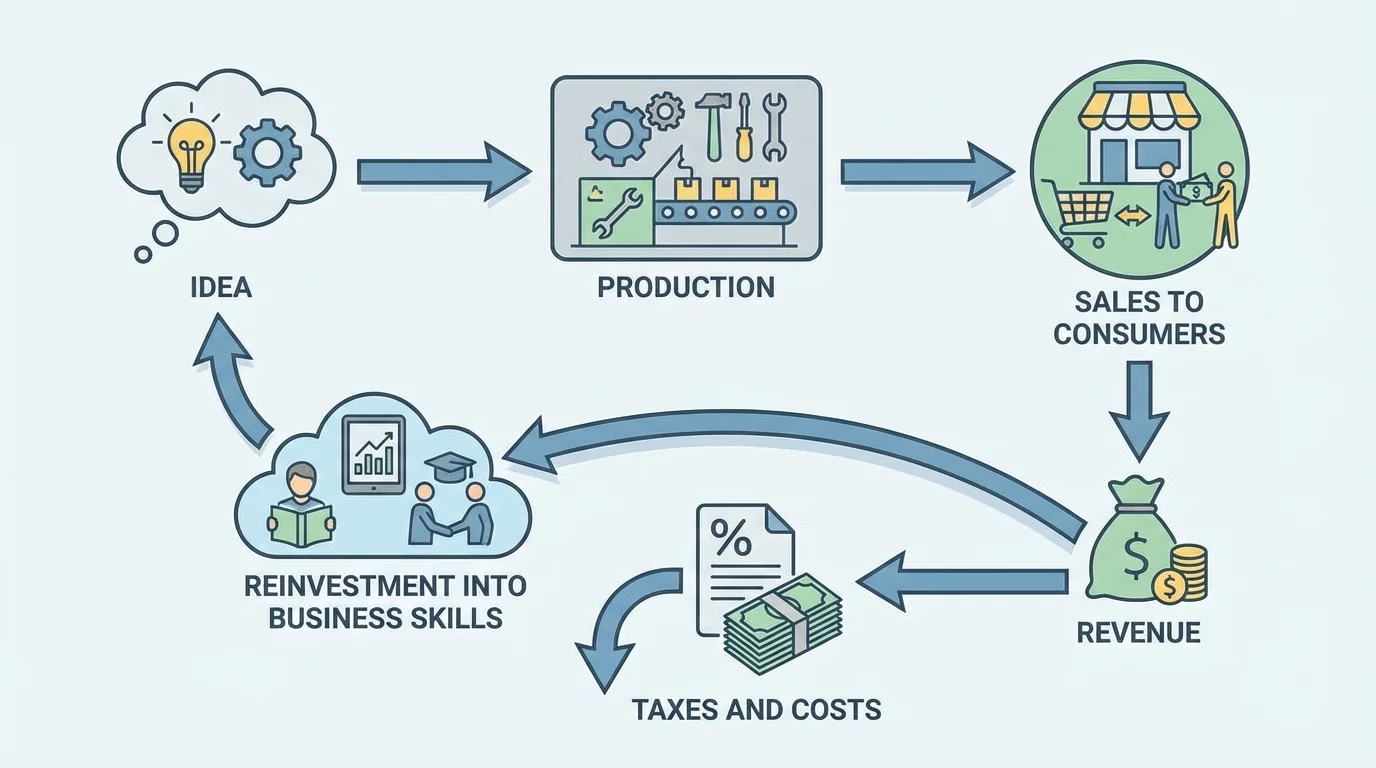
Entrepreneurship builds human capital because it forces people to combine many abilities at once. A business owner must communicate clearly, keep records, plan ahead, solve problems, and make decisions under pressure. If customer demand changes, the owner must adapt. If taxes rise, the owner must recalculate prices or cut costs. If a new competitor appears, the owner must improve quality or service.
Taxes are part of the economic environment in which human capital develops. Governments use taxes to raise money for roads, schools, defense, and other public needs. In early American history, taxes on goods and trade could influence what consumers bought and how businesses operated. Today, taxes still affect take-home pay, prices, and business expenses. Understanding taxes is itself part of financial literacy and economic human capital.
Consumer decisions matter too. In a market economy, businesses succeed when they meet consumer needs. Entrepreneurs learn from what people buy, avoid, or compare. A baker learns which bread sells best. A phone app designer studies what users want. A clothing business watches trends and price sensitivity. Consumer choices send signals, and entrepreneurs gain knowledge by responding to those signals.
Consumers are not just buyers. Their choices help shape what producers make, how much they charge, and what kinds of skills workers need. When consumers value speed, quality, or lower prices, businesses train workers differently.
Entrepreneurship can also create human capital for others. A successful business may train employees, teach customer service, or introduce new technologies. In that way, one person's learning can spread across a whole workplace.
Not all human capital comes from school or formal training. Much of it develops through work experience. A person may start with basic tasks and, over time, learn how to manage projects, lead teams, use software, handle customers, or solve unexpected problems. These lessons often cannot be fully taught in advance.
Work experience is especially important because economies change. In early America, many jobs centered on farming, small trade, and handcraft production. Later, industrialization created factory jobs and office work. Today, digital technology has added careers in coding, data analysis, online marketing, and advanced manufacturing. Each change requires workers to keep building new skills.
This means human capital is not fixed. It can grow, become outdated, or be renewed. A worker who learns a new machine, a new language, or a new computer system is increasing human capital. A worker who stops learning may find that old skills are less valuable in a changing market.
"An investment in knowledge pays the best interest."
— Benjamin Franklin
The idea is simple but powerful: when people invest time and effort in learning, they often increase future opportunities. That investment may not pay off immediately, but over years it can lead to better work, higher productivity, and stronger decision-making.
Work experience also teaches habits that employers value: punctuality, teamwork, reliability, and responsibility. These habits may sound ordinary, but in the real world they are part of human capital because they improve performance and trust.
The development of human capital has changed over time, but the main pathways remain education, apprenticeship, entrepreneurship, and work experience. The difference is that modern societies offer more institutions, more technologies, and often more mobility. The comparison highlights how opportunities have expanded while some older methods remain important.
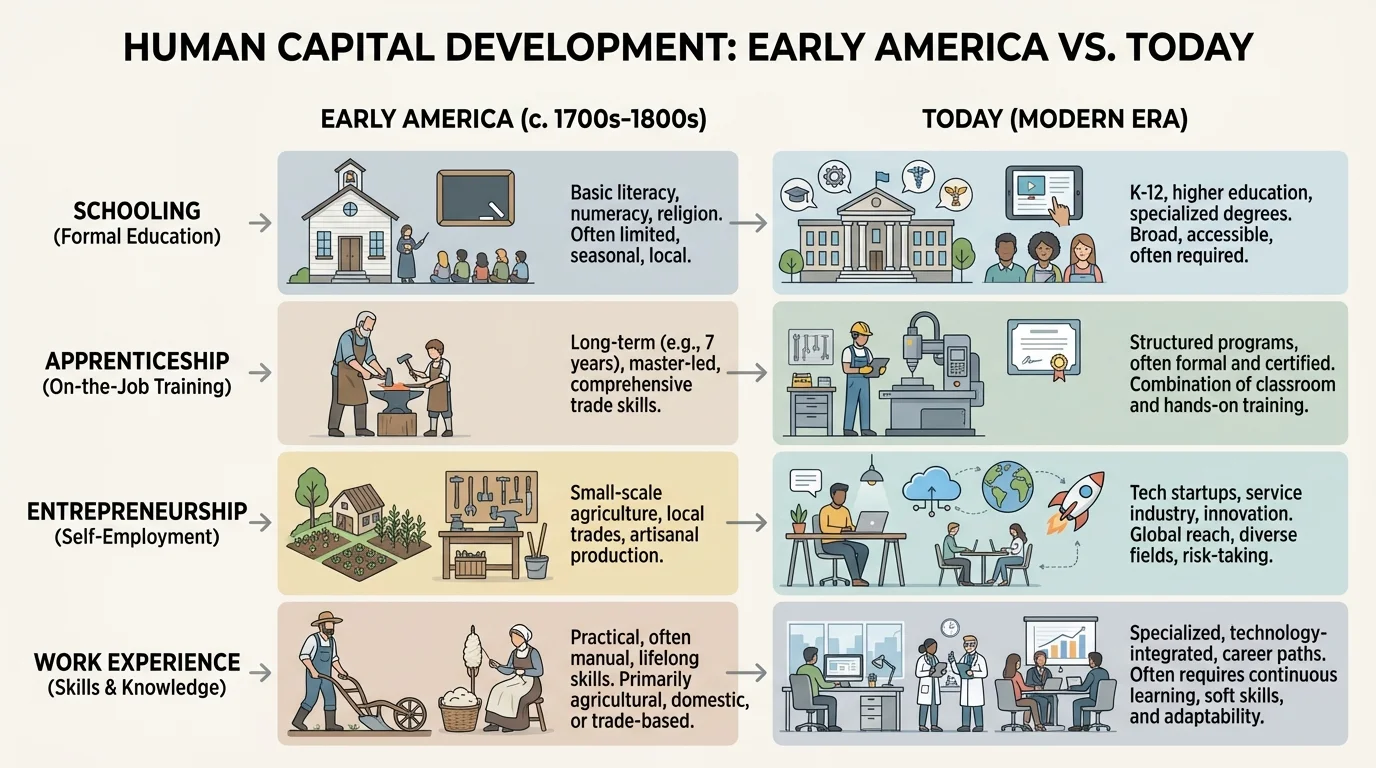
As [Figure 4] shows, in early America, many skills were learned locally and practically. Today, learning can happen in classrooms, workplaces, online spaces, and training programs across the country or even the world. Yet one idea has not changed: people build human capital by combining knowledge with practice.
| Pathway | Early American History | Today |
|---|---|---|
| Education | Often limited, local, and basic; focused on literacy, religion, and practical needs | Wider access to public schools, colleges, technical programs, and online learning |
| Apprenticeship | Major method for learning trades from masters | Still used in trades, internships, certifications, and career training |
| Entrepreneurship | Small shops, trade, farming, printing, and crafts shaped by local demand and taxes | Includes small businesses, startups, digital platforms, and global markets |
| Work experience | Learned through family labor, farming, and local business tasks | Includes on-the-job training, career ladders, technology updates, and management skills |
Table 1. Comparison of major ways people developed human capital in early American history and today.
One important change is specialization. Early Americans often needed a wide set of practical skills for daily survival. Today, many jobs require deeper specialized knowledge. Another major change is access. While access is still unequal, modern societies generally provide more routes for people to gain training and credentials.
At the same time, older forms of learning have not disappeared. Families still teach children practical skills. Workers still learn from mentors. Businesses still train employees by having them practice real tasks. Human capital develops through a mix of old and new methods.
Human capital connects directly to personal financial literacy. A person with stronger financial knowledge can earn, save, spend, and plan more effectively. In market economies, workers earn wages or profits, consumers decide what to buy, and governments collect taxes. All of these involve decisions that depend on knowledge.
Consider an early American merchant. To succeed, the merchant needed arithmetic, record-keeping, bargaining skill, and an understanding of taxes and trade rules. If imported tea became more expensive because of a tax, consumers might buy less of it. The merchant might switch products, lower costs elsewhere, or search for new suppliers. This is human capital in action: using knowledge to respond to market signals.
The same idea works today. A restaurant owner studies food costs, wages, customer reviews, and sales patterns. A worker decides whether extra training might lead to a better-paying job. A consumer compares quality and price before making a purchase. In each case, economic success depends partly on what people know and how well they apply that knowledge.
Real-world example: A business decision shaped by taxes and consumers
A candle maker in the early republic sells imported wax and local wax products.
Step 1: A tax raises the cost of imported wax.
The candle maker notices that imported materials now cost more.
Step 2: Consumers react to higher prices.
Some buyers look for cheaper local candles instead of imported ones.
Step 3: The business adapts.
The candle maker learns to improve local production, market quality, and track customer preferences.
The owner's human capital grows because changing conditions require new knowledge and better decisions.
When people invest in human capital, they often increase their ability to deal with taxes, prices, wages, and competition. That is why human capital is not only about careers. It is also about making informed choices in everyday economic life.
Although human capital can grow, not everyone begins with the same opportunities. Poverty, discrimination, poor schools, limited transportation, unsafe conditions, and lack of internet access can all make learning harder. In early American history, these barriers were even stronger for many groups.
That is why societies often invest in schools, libraries, roads, public health, and training programs. These investments do not guarantee equal outcomes, but they can widen access to learning. Public support for education is one way a society builds its future workforce and strengthens its economy.
Individuals also play a role. Curiosity, persistence, and effort matter. Human capital grows over time, often slowly. A single class, job, or project may seem small, but many small gains can add up. Reading more widely, practicing a skill, asking questions, and learning from mistakes are all part of that process.
As we saw earlier in [Figure 1], early Americans often learned by working beside others. That pattern still matters today, even in a world of digital learning. And the long expansion shown in [Figure 2] reminds us that societies can create more pathways for people to grow. The entrepreneurial cycle in [Figure 3] also shows that learning does not end when a person leaves school. Human capital keeps developing whenever people solve problems, adapt to change, and respond to consumers and taxes in a market economy.
