One small item helped start a revolution: tea. A tax on a product people used every day became so unpopular that it pushed colonists to protest, boycott, and eventually rebel. That makes taxes much more than numbers on paper. Taxes affect what people buy, how governments operate, and how citizens respond when they think a law is unfair.
Throughout the history of the United States, taxes have had a powerful impact on ordinary people. Sometimes taxes helped pay for roads, schools, armies, and public safety. At other times, taxes caused anger because people felt overburdened or left out of important decisions. To understand American history, it is important to see taxes not just as money collected by the government, but as a force that shapes daily life, political conflict, and the economy.
A tax is money collected by a government from people or businesses to pay for public needs. Governments use tax money to provide services such as roads, schools, police protection, courts, parks, and national defense. Without taxes, governments would have a much harder time paying for these shared services.
One important idea is revenue, which means income collected by the government. Taxes are one of the main ways governments raise revenue. Another key term is a tariff, which is a tax on imported goods. A tariff can make foreign products cost more, which may encourage people to buy goods made in the United States instead.
Direct taxes are paid more directly to the government, such as income taxes or property taxes. Indirect taxes are built into purchases, such as sales taxes or tariffs, so people may pay them when they buy goods. Both kinds affect consumer choices and the economy.
Taxes can be helpful and controversial at the same time. People may support taxes when they see the benefits, such as better schools or safer roads. But they may oppose taxes when they believe the amount is too high, the system is unfair, or the government is using the money poorly. That tension has existed throughout American history.
In the colonies, taxes became a major source of conflict with Britain because colonists believed British leaders were making decisions without colonial consent. Tax laws changed what people bought, how merchants sold goods, and how families spent money, as [Figure 1] illustrates through taxed goods and boycott activity in a colonial town. This was the context in which the famous idea of "no taxation without representation" became so important.
After the French and Indian War, Britain had large debts and decided that the colonies should help pay for imperial costs. Parliament passed laws such as the Sugar Act, the Stamp Act, and the Townshend Acts. These measures taxed items like sugar, paper, legal documents, glass, paint, and tea. For many colonists, the problem was not only the money. It was also the principle: they had no elected representatives in Parliament.
Taxes affected consumers directly. If paper, printed materials, or tea cost more because of taxes, families had to decide whether to pay the higher price, use less, or avoid the taxed goods. Merchants had to choose whether to import taxed products, raise prices, or risk losing customers. Some colonists responded with boycotts, refusing to buy British goods. Others turned to smuggling to avoid paying taxes.
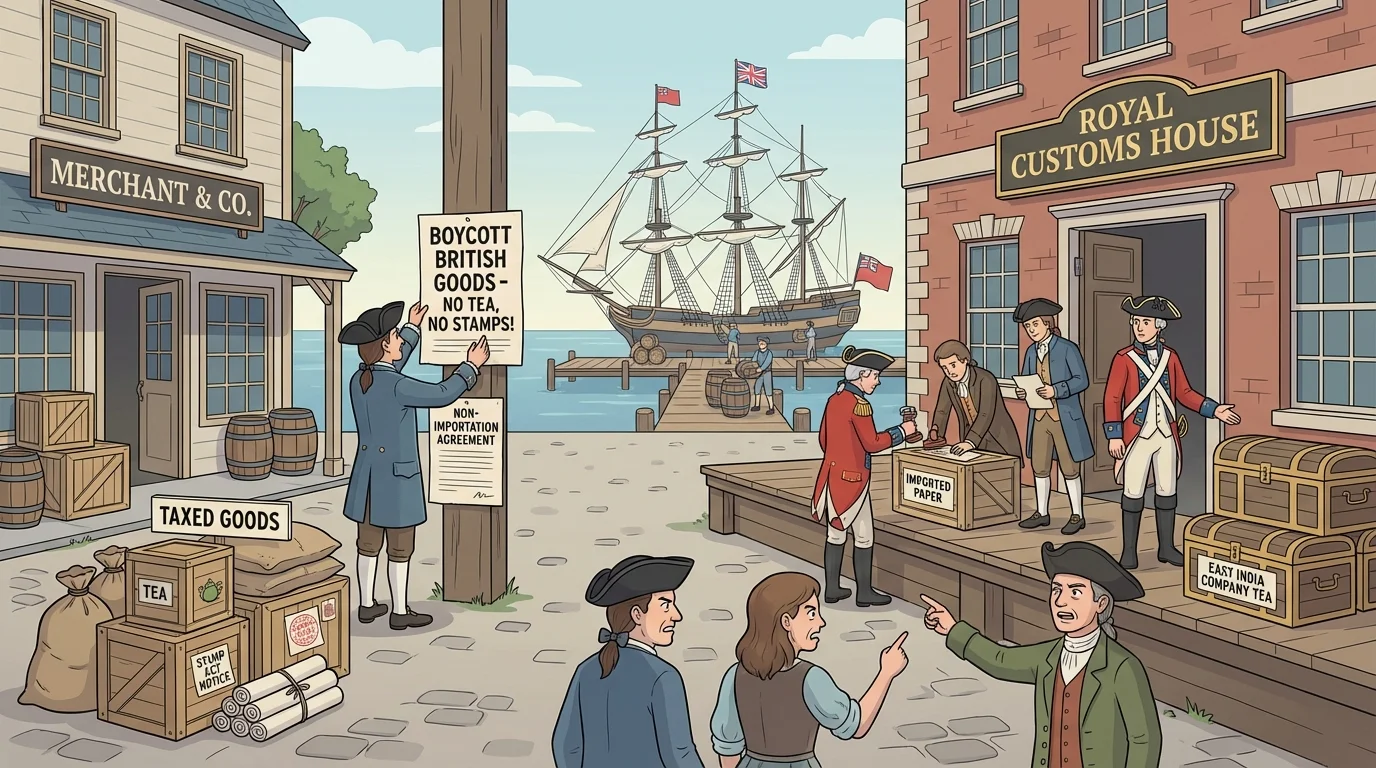
The Boston Tea Party in 1773 became one of the clearest examples of how taxes could spark protest. Colonists, angry over the Tea Act and British control, dumped tea into Boston Harbor. Britain answered with harsh punishments called the Coercive Acts. Instead of calming the conflict, these actions united many colonists against British rule.
The impact of taxes in this period was not the same for everyone. Wealthier merchants worried about trade restrictions and profits. Shopkeepers worried about customers. Farmers and laborers worried about the prices of everyday goods. Women also played an important role by making household decisions to avoid British imports. Consumer choices became political actions. As seen earlier in [Figure 1], even ordinary shopping decisions could turn into protest.
"No taxation without representation."
— Popular colonial protest slogan
In this way, taxes helped push the colonies toward independence. They were not the only cause of the American Revolution, but they became a powerful symbol of unfair government power.
After independence, the new United States faced a difficult question: how would it raise money? Under the Articles of Confederation, the national government was weak and could not effectively collect taxes from the states. This made it hard to pay debts, support the military, or run the country. The problem showed that taxes were not just something to resist; they were also necessary for a working government.
[Figure 2] The Constitution gave the federal government stronger power to tax. Leaders such as Alexander Hamilton believed that stable excise taxes and tariffs were needed to build national credit and strengthen the country. A tariff raised money from imported goods, while an excise tax charged money on certain products made or sold within the country.
A famous early test came with the tax on whiskey in the 1790s. Farmers on the western frontier often turned grain into whiskey because it was easier to transport and sell than bulky crops. The federal excise tax hit these farmers especially hard, and resistance grew quickly through the tension between frontier communities and federal authority. Many saw the tax as unfair because it affected small producers more heavily than larger businesses.
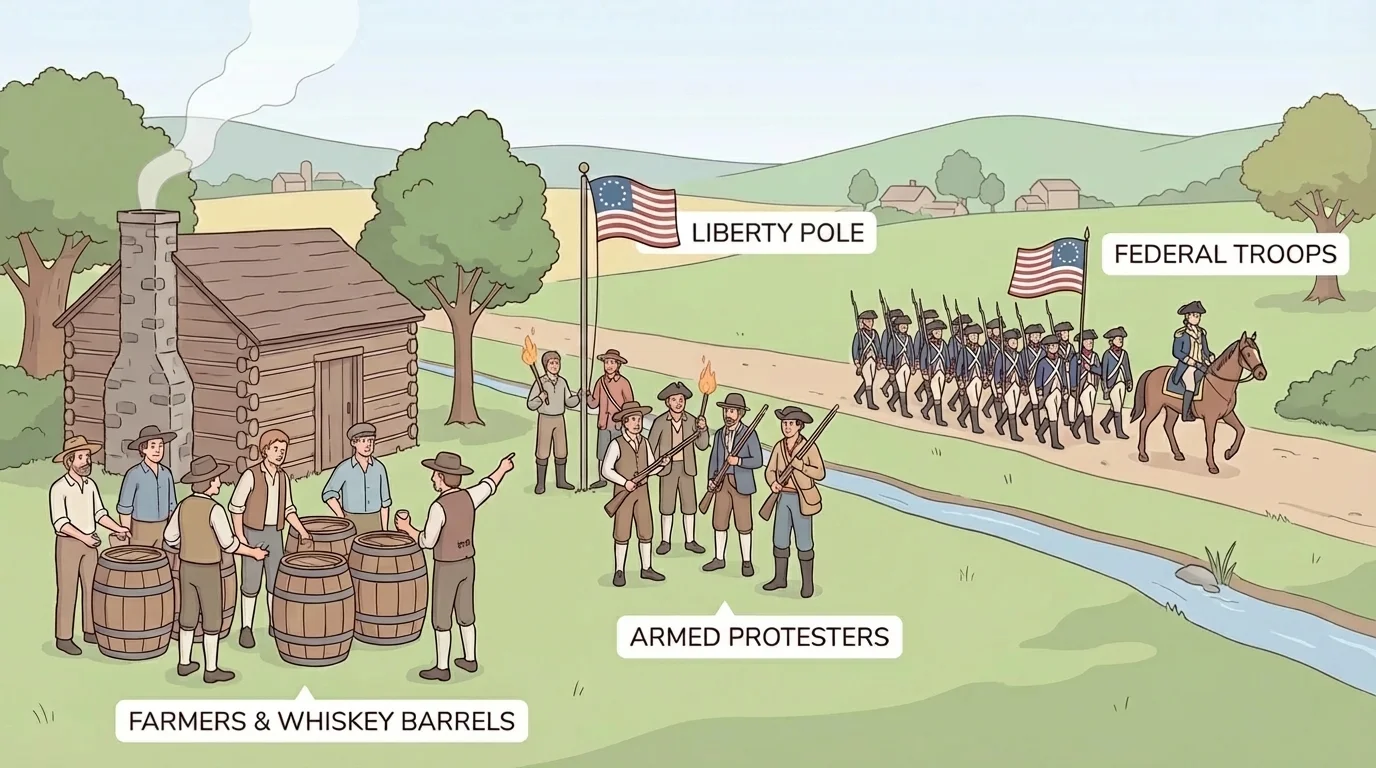
This conflict became the Whiskey Rebellion. Protesters threatened tax collectors and resisted federal law. President George Washington responded by sending militia forces to enforce the law. The rebellion was important because it showed that the new federal government had both the power to tax and the power to make its laws matter.
For Americans, the lesson was complicated. Taxes could support national stability, but they could also create resentment when people believed the burden was uneven. The Whiskey Rebellion, like colonial protests before it, showed that tax policy could shape public opinion and trust in government.
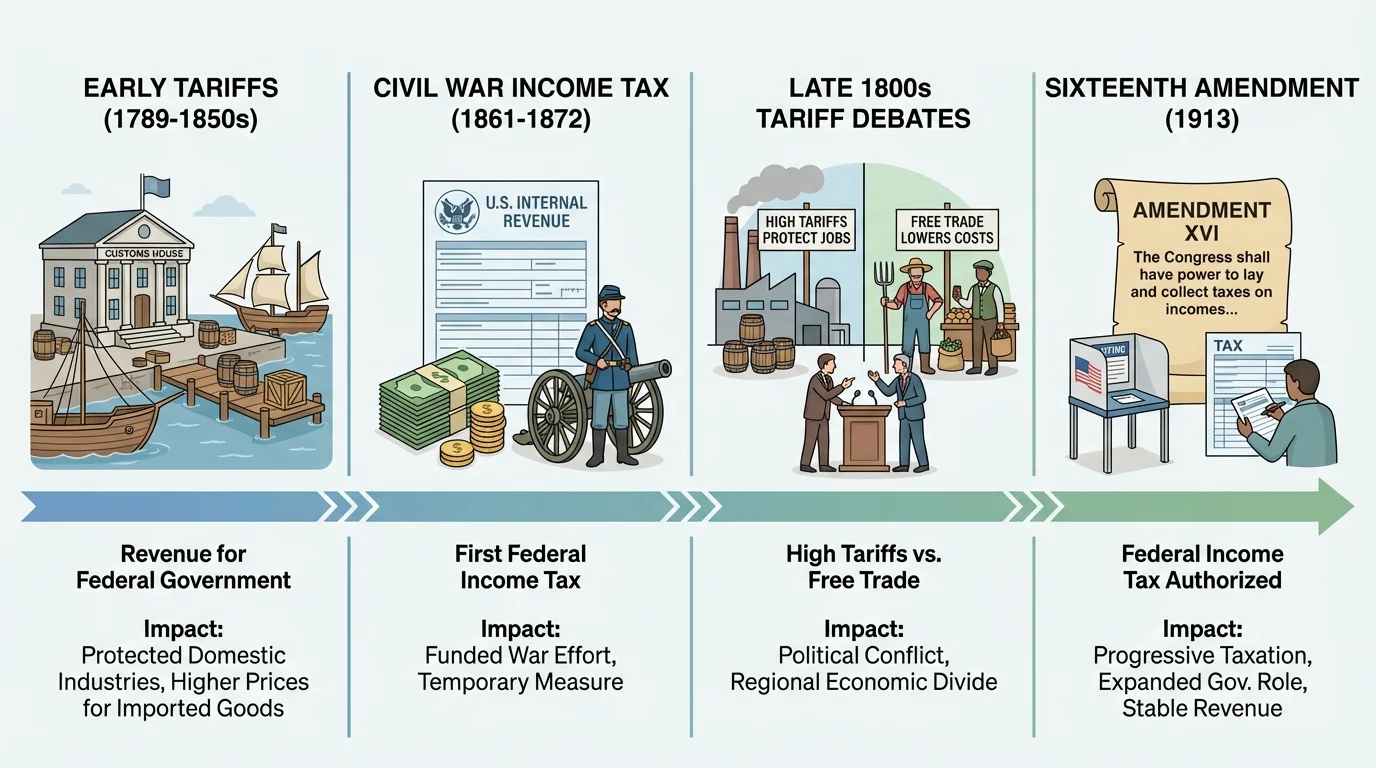
As the United States expanded, tax policy kept changing. In the early 1800s, the federal government relied heavily on tariffs rather than taxes on personal income. This meant the government raised much of its money from trade. Tariffs could help domestic industries by making imported products more expensive, but they could also raise prices for consumers.
As the nation industrialized, tax policy shifted along with the economy, and [Figure 3] traces some of the major turning points from trade taxes to income taxes. Different regions often had different opinions. Northern manufacturers often supported protective tariffs because they wanted help competing against foreign goods. Many Southerners opposed high tariffs because they bought imported goods and exported crops.
During the Civil War, the federal government needed enormous amounts of money to fund the war effort. It created a temporary income tax, a tax based on a person's earnings. This was a major change because it asked people to contribute according to how much money they made. After the war, that income tax ended, but the idea did not disappear.
By the late 1800s and early 1900s, many Americans argued that the tax system should be fairer. Industrialization had created great wealth for some people and difficult working conditions for many others. Reformers believed wealthy citizens should contribute more to support the nation. In 1913, the Sixteenth Amendment gave Congress clear authority to levy a federal income tax.
The new income tax changed the relationship between citizens and the federal government. Over time, it became one of the government's largest sources of revenue. This allowed the federal government to expand its role in national life. It could fund larger military efforts, infrastructure, and later programs that affected millions of Americans.
The federal income tax did not become a permanent, clearly established part of national law until the early 1900s. For much of early U.S. history, tariffs were far more important to federal finances.
The impact on people was significant. Workers began to see taxes as connected to wages and earnings, not just to prices in stores. Wealthier Americans often paid more in total, while debates grew about what counted as fair taxation.
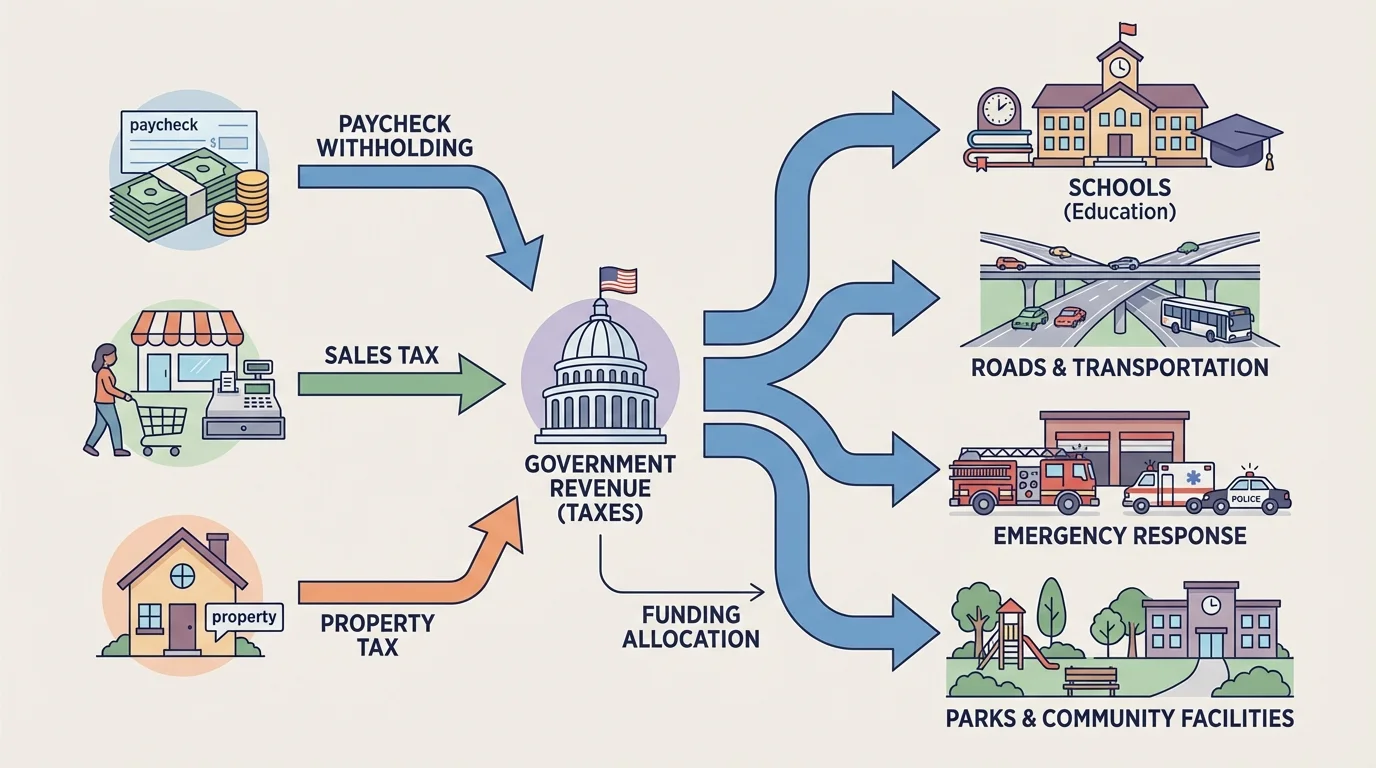
Today, taxes are built into many parts of everyday life, as [Figure 4] shows through the flow from paychecks and purchases to public services. A worker may pay federal and state income taxes. A shopper may pay sales tax on a purchase. A homeowner may pay property taxes. Employees and employers also pay payroll taxes that help fund programs such as Social Security and Medicare.
These taxes support services that people use every day, even when they do not notice them right away. Schools educate students. Roads and bridges allow travel and trade. Fire departments and police departments protect communities. Public health systems, libraries, and parks also depend on government funding.
At the same time, taxes affect family budgets. If a person earns less after taxes are taken from a paycheck, that may reduce how much they can spend or save. If sales taxes make goods cost more, shoppers may buy fewer items or choose cheaper brands. If property taxes rise, housing can become harder to afford.
Consider a simple example. If a student's family buys a pair of shoes priced at $50 and the sales tax rate is \(6\%\), the tax is \(50 \times 0.06 = 3\). The final cost becomes \(50 + 3 = 53\), so the family pays $53. That extra amount may seem small once, but over many purchases it can have a noticeable effect on spending.
Real-world tax example
A worker earns $800 in a week, and 15% of that amount is withheld for certain taxes.
Step 1: Convert the percent to a decimal.
\(15\% = 0.15\)
Step 2: Find the tax amount.
\(800 \times 0.15 = 120\)
Step 3: Find the remaining pay.
\(800 - 120 = 680\)
The worker takes home $680 before any other deductions.
The chart below compares common modern taxes and their everyday effects.
| Type of tax | What it is based on | Common effect on people | Examples of what it may fund |
|---|---|---|---|
| Income tax | Money earned from work | Reduces take-home pay | National programs, defense, services |
| Sales tax | Money spent on purchases | Raises the final price of goods | State and local services |
| Property tax | Value of homes or land | Affects housing costs | Schools, local government, roads |
| Payroll tax | Wages paid by workers and employers | Lowers paycheck amount | Social Security, Medicare |
| Tariff | Imported goods | Can raise prices or protect industries | Federal revenue, trade policy goals |
Table 1. Comparison of common taxes and how they affect daily life in the United States.
Later, when people debate school funding, road repair, or health programs, the flow shown in [Figure 4] remains important: tax money collected from individuals and businesses returns to the public through services and programs.
Not all taxes affect people in the same way. A tax system may be described as progressive if higher-income people pay a larger share of their income. It may be called regressive if lower-income people end up paying a larger share of what they have. Sales taxes are often considered more regressive because all shoppers pay the same rate, but that cost takes up more of a low-income family's budget.
These differences matter because fairness is one of the biggest questions in tax policy. Some people argue that those who earn more should pay more because they have a greater ability to contribute. Others argue that lower taxes encourage work, investment, and business growth. Both sides are trying to answer the same question: what is the fairest and most effective way to raise money for the public good?
Why tax debates continue
Taxes are never only about money. They are also about values. When citizens debate taxes, they are really debating what government should do, who should help pay for it, and how the burdens and benefits should be shared across society.
Over time, different groups have felt tax burdens differently. Farmers, factory workers, merchants, wealthy business owners, homeowners, and consumers have all viewed taxes through the lens of their own economic situation. That is why the same tax policy can be praised by one group and criticized by another.
Taxes influence markets because they change prices and incentives. If a tariff raises the cost of imported clothing, some consumers may switch to domestically made clothing. If a sales tax increases the price of a nonessential item, buyers may delay the purchase. If tax rates change for businesses, those businesses may change wages, prices, or investment plans.
This connection between taxes and consumer behavior has existed since colonial times. Colonists boycotted British goods. Frontier farmers resisted taxes on whiskey. Modern shoppers compare prices after sales tax. In each case, taxes affected decisions in the marketplace.
Taxes can also be used to encourage or discourage behavior. For example, some governments place higher taxes on cigarettes because they want to reduce smoking and raise revenue at the same time. In other cases, governments may offer tax benefits for certain activities, such as buying a home or investing in renewable energy. This shows that taxes are not only a way to collect money; they are also a policy tool.
Markets involve buyers, sellers, prices, and choices. Taxes matter in markets because they can change the price a buyer pays, the amount a seller receives, and the choices each side makes.
When students learn about taxes, they are also learning how governments and markets interact. Consumer decisions help show whether a tax is easily accepted, strongly resisted, or powerful enough to change behavior.
Looking across time helps reveal how much taxes have shaped American history. They helped trigger protests in the colonial period, tested the power of the early federal government, changed during war and industrial growth, and became part of everyday life in the modern United States.
| Period | Major tax development | Impact on people |
|---|---|---|
| 1760s–1770s | British taxes on colonies | Higher costs, protests, boycotts, anger over representation |
| 1780s | Weak national taxing power under Articles of Confederation | Government struggled to pay debts and operate effectively |
| 1790s | Federal tariffs and whiskey excise tax | Revenue for new government, but resistance from farmers |
| 1860s | Civil War income tax | Helped fund war; connected taxation more directly to earnings |
| 1913 | Sixteenth Amendment | Made federal income tax a permanent part of U.S. finance |
| 1900s–today | Growth of income, payroll, sales, and property taxes | Taxes became a regular part of work, shopping, and community services |
Table 2. Major turning points showing how tax policy changed over time and affected Americans.
The sequence highlighted earlier in [Figure 3] connects these turning points by showing that tax systems change when the country's economy, politics, and needs change.
In a democracy, taxes are tied to citizenship. People argue about tax rates, fairness, and government spending because taxes affect both private lives and public life. A person may dislike paying taxes, but that same person may value good schools, safe roads, emergency services, or national defense.
That creates a lasting challenge in U.S. history: balancing individual costs with shared benefits. When taxes feel unfair, they can produce anger and protest. When they are used effectively, they can support stability, growth, and opportunity. Americans have debated that balance since colonial times, and the debate continues today.
Understanding the impact of taxes over time helps explain major events in the nation's history and also helps explain ordinary experiences, from shopping at a store to receiving a paycheck. Taxes are part of the story of rebellion, nation-building, economic change, and everyday citizenship.
