One of the biggest forces shaping human history is movement. A city block, a playlist, a restaurant menu, a religious tradition, even the words people use every day often exist because someone moved, traded, shared, adapted, or blended ideas from somewhere else. Culture is not fixed. It changes when people travel, migrate, conquer, seek safety, study abroad, open businesses, carry memories, and build new lives. Those connections can make societies more creative and dynamic, but they can also bring disagreement, fear, and conflict.
Geographers study how places are linked. The modern world is deeply interconnected, as [Figure 1] shows through overlapping routes of migration, trade, and cultural exchange. People move for many reasons: work, war, education, climate pressures, family, religious freedom, or political persecution. At the same time, goods move through shipping lanes, highways, rail lines, and air cargo networks, while ideas move through schools, religions, books, media, and digital communication.
Migration is the movement of people from one place to another, either within a country or across borders. Some migration is voluntary, such as moving for a job. Some is forced, such as fleeing violence or environmental disaster. The movement of goods and ideas can happen with or without large-scale migration, but often they are connected. Traders, migrants, soldiers, missionaries, tourists, and students all help carry culture across space.
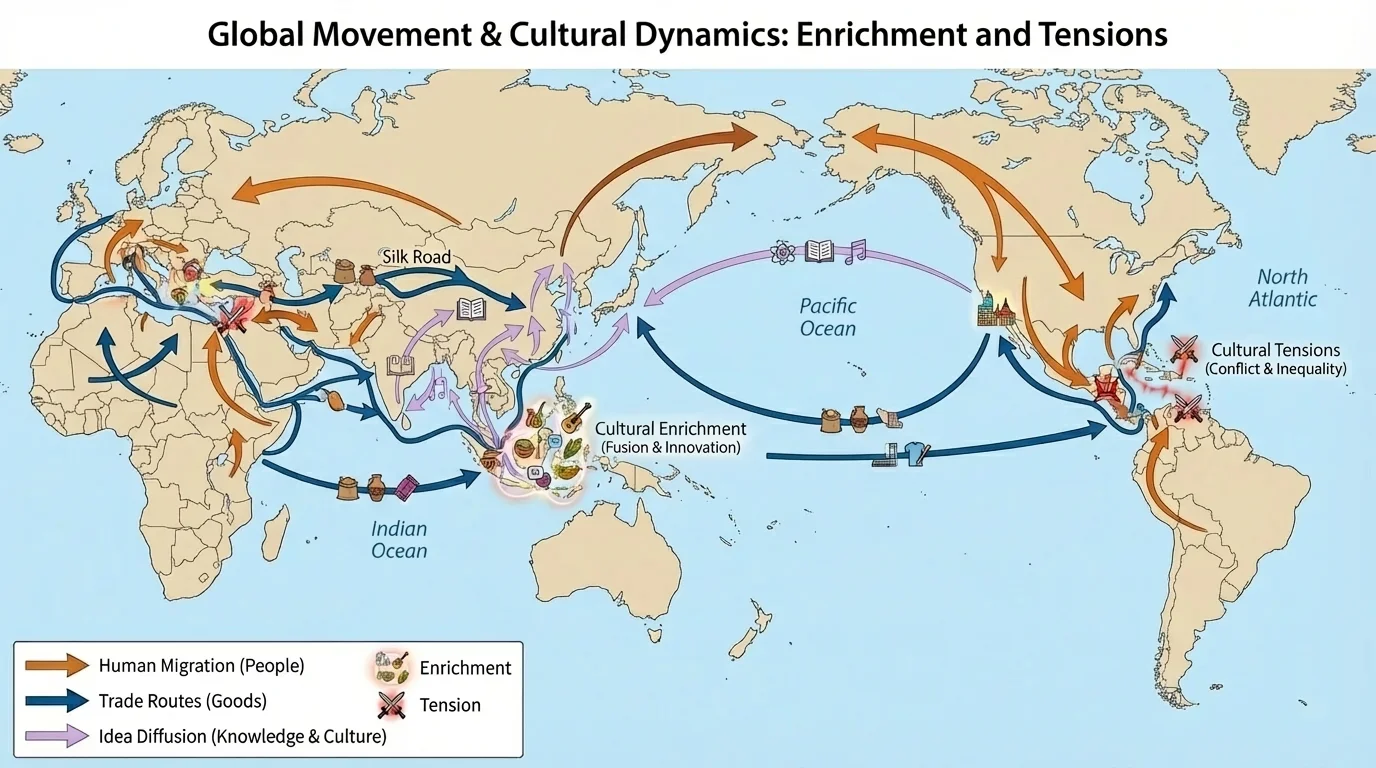
When cultures meet, the result is often cultural diffusion, the spread of cultural traits from one society to another. These traits may include clothing styles, foods, technologies, languages, music, architecture, political ideas, or religious beliefs. Diffusion does not mean one culture simply replaces another. More often, exchange creates new cultural forms through adaptation and blending.
Migration is the movement of people from one place to another, temporarily or permanently.
Cultural diffusion is the spread of ideas, customs, technologies, or products from one group or place to another.
Globalization is the increasing connection of the world's economies, cultures, and populations through trade, communication, transportation, and migration.
Because movement happens across space, geography matters. Oceans can connect continents through shipping. Mountains can slow migration. Rivers can become transportation corridors. Borderlands can become places of exchange, tension, or both. Major cities often grow where routes meet, making them powerful centers of diversity and interaction.
Migration can reshape culture in visible and invisible ways. One of the most obvious examples is language. Migrants bring words, accents, and ways of speaking that influence the language of the receiving society. English, for example, contains vocabulary from Germanic, French, Latin, Arabic, Hindi, and many other sources because of centuries of conquest, trade, colonization, and migration.
Food is another powerful example. Many dishes students may think of as "local" are actually products of exchange. Tomatoes, originally from the Americas, transformed Italian cuisine. Chilies from the Americas became central to cuisines in India, Thailand, China, and Korea. In the United States, foods such as tacos, pizza, sushi, and pho became common not because cultures stayed separate, but because people moved and shared traditions.
Migration also enriches music, art, literature, and fashion. Jazz developed from African musical traditions, European instruments, and American historical conditions. Hip-hop, born in the Bronx, spread globally and was adapted by artists in France, Senegal, South Korea, and Brazil, each adding local language and social concerns. Migrant communities often preserve traditions while also creating new hybrid identities.
Cultural blending and hybrid identities happen when people keep parts of their original culture while also adapting to a new environment. This can create bilingual communities, fusion cuisines, mixed artistic forms, and multiple layers of identity. A person may feel attached to a family homeland, a current nation, a city neighborhood, and a broader global culture at the same time.
Migration can also enrich economies and knowledge systems. Migrants may bring specialized skills, entrepreneurial energy, and professional expertise. Doctors, engineers, farmworkers, teachers, software developers, and small-business owners all shape the places where they settle. Universities and research centers often benefit from international students and scholars whose ideas contribute to scientific and cultural innovation.
Religion and belief systems travel with people as well. Islam spread not only through conquest but also through merchants and scholars across North Africa, the Middle East, Central Asia, and the Indian Ocean world. Buddhism moved from India into East and Southeast Asia through trade and missionary networks. Christianity spread through missionaries, empires, and migrant communities. In many places, religious exchange led to new practices, sacred architecture, and cultural traditions.
People do not have to migrate permanently for cultures to change. Goods move through trade, and ideas move through contact. A product can change daily life in places very far from where it was first produced. Paper, first developed in China, spread westward and transformed communication, administration, and education. The compass and gunpowder also moved across regions, changing navigation and warfare.
Trade networks connect producers, merchants, consumers, and governments across long distances. Historical examples include the Silk Roads, the trans-Saharan trade routes, and the Indian Ocean trade system. Modern examples include container shipping, global supply chains, and online commerce. These networks transport not only raw materials and manufactured goods but also stories, techniques, artistic styles, and social values.
Ideas can move especially fast in the digital age. Social media, films, music streaming, gaming communities, and online education allow trends and beliefs to cross borders almost instantly. This can create a shared global culture, but it can also spread misinformation, stereotypes, and political tension. Technology speeds up diffusion, but it does not erase differences in power, wealth, or access.
Some of the most influential cultural exchanges in history followed trade routes rather than political borders. A merchant carrying spices or textiles could also carry stories, mathematical knowledge, religious texts, artistic designs, and new technologies.
Goods themselves can carry cultural meaning. Clothing styles may reflect identity and values. Architecture may borrow design elements from distant regions. Sports spread too: soccer became global through empire, migration, and media; basketball spread through schools, military presence, and international broadcasting. A popular sport may seem universal, yet its local version often reflects regional history and culture.
Movement does not happen evenly across the map. Geography channels it, as [Figure 2] illustrates through gateways such as ports, rivers, and border crossings. Coastal cities often become cultural crossroads because ships bring people and goods from many regions. River valleys support settlement and transportation. Mountain ranges, deserts, and dense forests can limit movement or force it through narrow corridors.
Location matters. A port city like Singapore became a major hub because it sits along important sea routes linking the Indian Ocean and Pacific world. Istanbul has long been significant because it connects Europe and Asia. Cities near borders, such as El Paso and Ciudad Juarez, often develop shared economic and cultural spaces while also reflecting political tensions between states.
Transportation technology changes geography's effects. Railroads, canals, highways, and airports can reduce isolation and connect inland areas to global markets. Yet geography still matters because infrastructure is expensive and unevenly distributed. A region with strong transportation links will usually experience more exchange than one cut off by conflict, terrain, or weak investment.
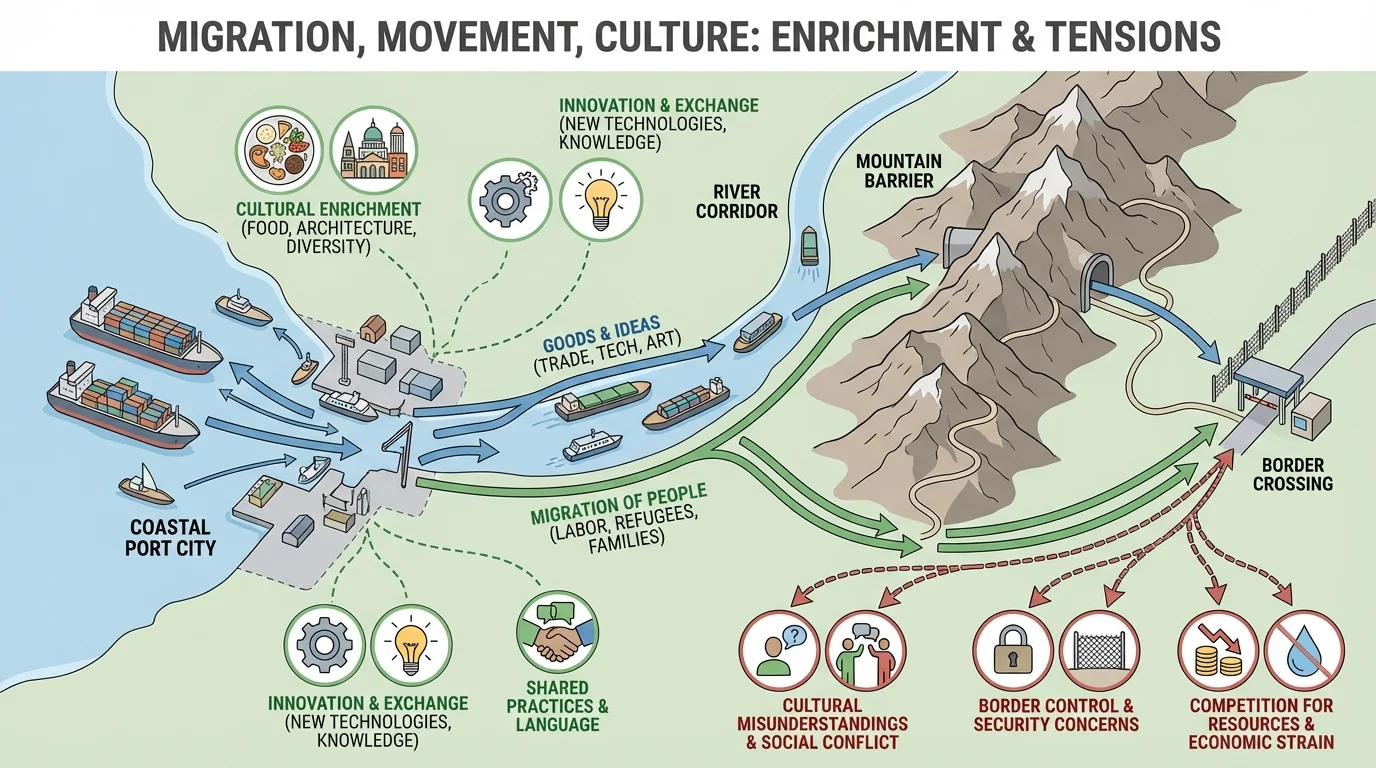
Geography also shapes where tensions arise. Places receiving many newcomers in a short time may feel pressure on housing, schools, transportation, or jobs. Border regions may face disputes over legal status, security, and resource use. Refugee camps often appear in transitional landscapes near conflict zones, where humanitarian need and political uncertainty overlap.
| Geographic feature | How it affects movement | Possible cultural impact |
|---|---|---|
| Coastline and ports | Encourage long-distance trade and migration | High diversity, new goods, cosmopolitan cities |
| Rivers | Provide transportation corridors and fertile land | Dense settlement and exchange along routes |
| Mountains and deserts | Slow movement or funnel it into passes | Isolation in some areas, concentrated exchange in others |
| Border zones | Can either restrict or channel movement | Mixed cultures, conflict over control, bilingual spaces |
| Transportation hubs | Increase connectivity and mobility | Rapid diffusion of ideas and products |
Table 1. Geographic features and their effects on the movement of people, goods, and ideas.
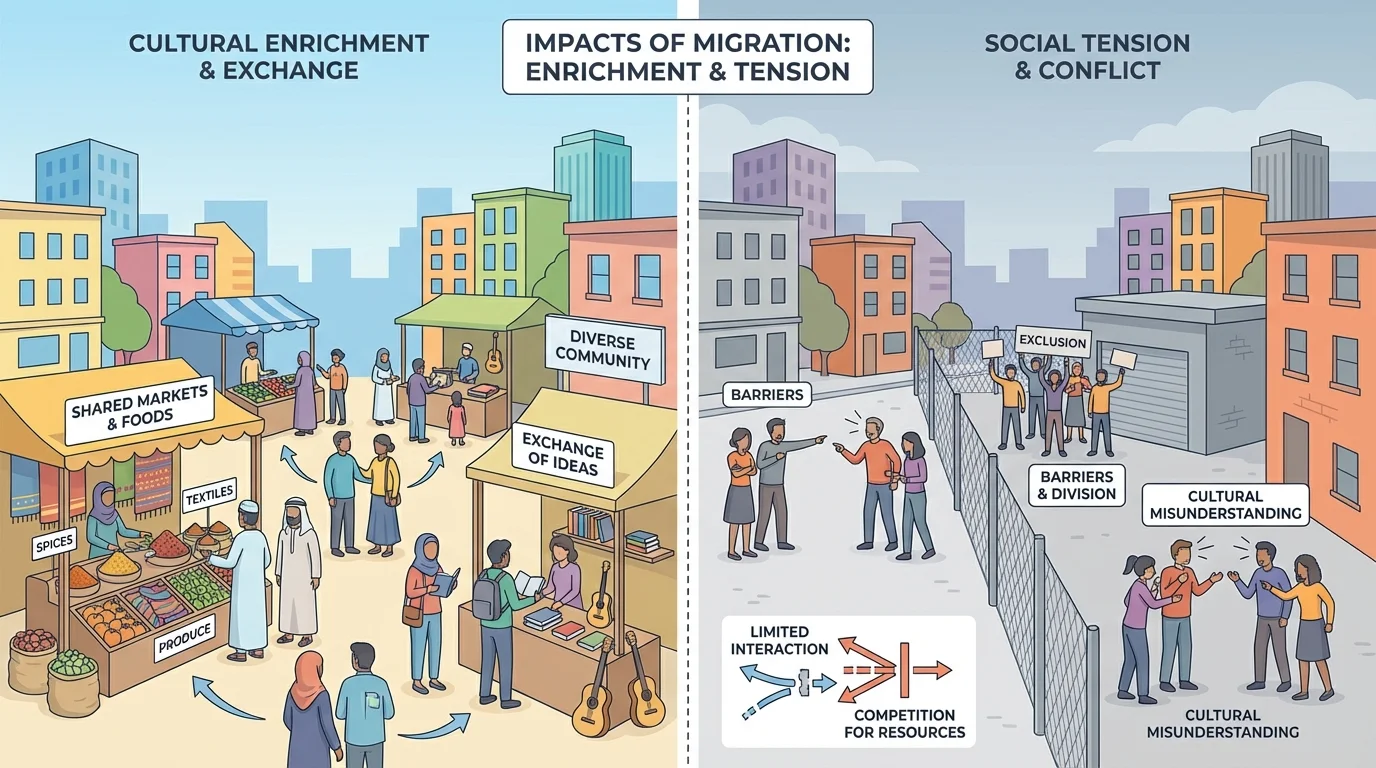
The same contact that produces exchange can also produce conflict, as [Figure 3] illustrates through the contrast between cooperation and exclusion. Tensions often begin when groups believe resources, status, or identity are under threat. These tensions are not automatic, but they are common enough that they must be studied carefully.
One source of tension is economic competition. If jobs are scarce or wages are low, some residents may blame migrants for their difficulties, even when the real causes include automation, corporate decisions, inflation, or unequal policy. Housing shortages can create similar resentment. Migrants themselves may face exploitation, dangerous labor conditions, or discrimination.
Another source is xenophobia, the fear or hostility toward foreigners or outsiders. Xenophobia often grows during periods of uncertainty, such as economic crisis, war, or rapid social change. Political leaders and media outlets sometimes intensify these fears by using stereotypes or presenting migrants as threats rather than as people.
Tension can also arise over culture and identity. Some societies expect assimilation, meaning newcomers should give up most of their original customs and adopt the dominant culture. Others support pluralism or multiculturalism, where multiple cultural traditions exist together. Debates over language use, religious symbols, school curriculum, and public holidays often reflect this deeper question: who gets to define national identity?
Power matters too. Cultural exchange is not always equal. Colonization spread ideas and goods, but it also involved conquest, forced labor, displacement, and cultural suppression. Enslaved Africans brought agricultural knowledge, music, religion, and resistance traditions to the Americas, profoundly shaping culture, but this happened under extreme violence and coercion. To understand exchange honestly, students must recognize both creativity and injustice.
Case example: tension in a rapidly changing city
A city receives many new residents over a short period because factories and service industries are hiring workers from other regions and countries.
Step 1: Identify positive changes.
New restaurants open, schools add language programs, businesses gain workers, and neighborhoods become more culturally diverse.
Step 2: Identify pressures.
Rents rise, public transit becomes crowded, and some long-time residents feel that the city is changing too fast.
Step 3: Explain why conflict may develop.
If leaders do not expand services or counter false stereotypes, frustration may be directed at newcomers instead of at underlying policy problems.
This example shows that tensions often come from how change is managed, not simply from diversity itself.
Religious and ethnic differences can become flashpoints when governments favor one group over another or when historical grievances remain unresolved. In some cases, migrants are welcomed in times of labor shortage but rejected when politics shift. This shows that public attitudes are shaped by power, policy, and economic conditions as much as by culture.
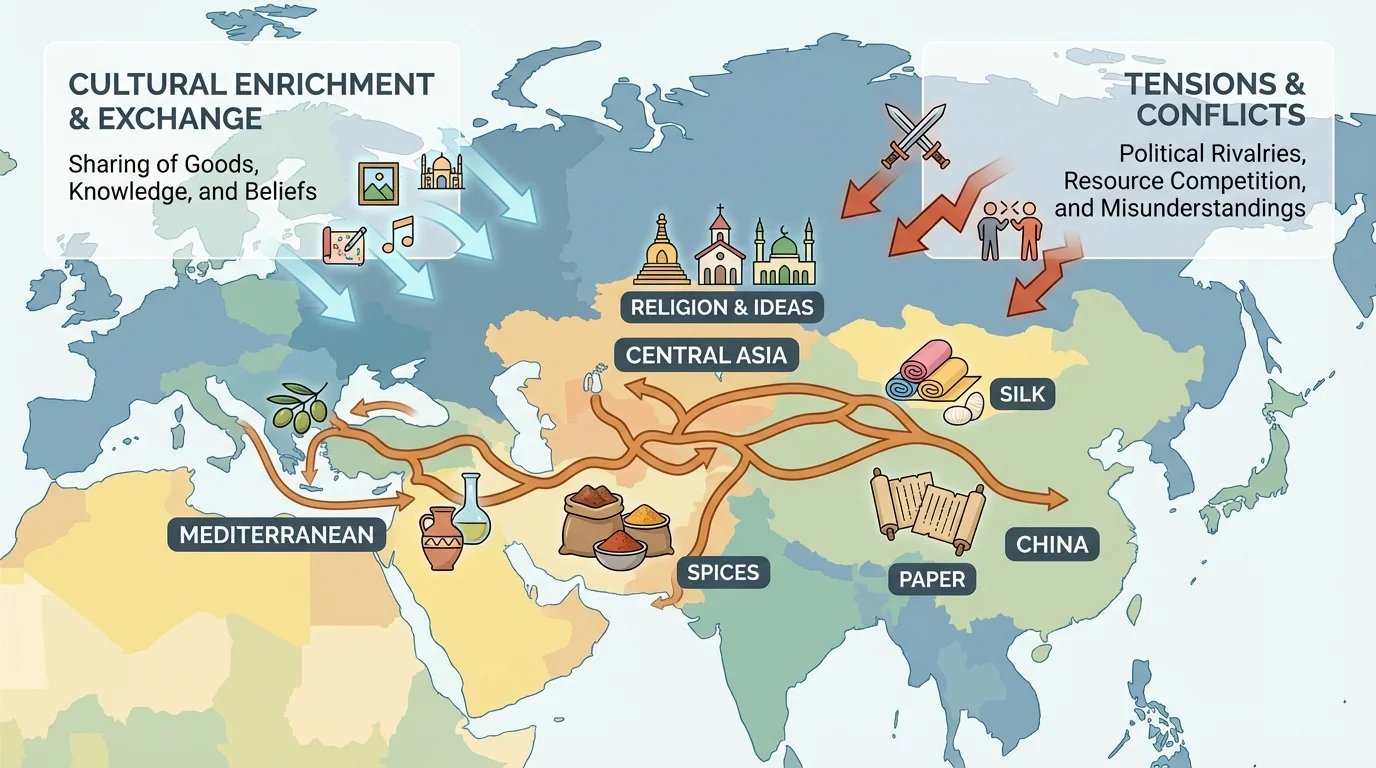
The [Figure 4] Silk Roads carried far more than luxury goods across Eurasia. Merchants transported silk, spices, horses, and precious metals, but they also spread religions such as Buddhism, artistic motifs, technologies such as papermaking, and even disease. This network linked China, Central Asia, the Middle East, and the Mediterranean, proving that exchange can be transformative and risky at the same time.
The Indian Ocean trade system connected East Africa, the Arabian Peninsula, South Asia, and Southeast Asia through monsoon wind patterns. Port cities such as Kilwa, Calicut, and Malacca became multicultural centers where merchants speaking different languages interacted. Swahili culture along the East African coast developed through this blending of African, Arab, Persian, and later other influences.
In the Americas, immigration shaped national cultures in powerful ways. The United States received migrants from Europe, Latin America, Asia, and Africa at different times and under different laws. These groups transformed industry, labor, politics, cuisine, religion, and the arts. At the same time, immigration sparked fierce debate over citizenship, borders, language, and belonging. Those debates continue today.
The movement of refugees from Syria after the civil war offers a modern example of both humanitarian responsibility and political tension. Neighboring countries such as Turkey, Lebanon, and Jordan received millions of displaced people, and many Syrians later sought asylum in Europe. Their arrival enriched host societies with skills, education, entrepreneurship, and culture, but it also created pressure on housing, schools, and public opinion, especially where governments were unprepared.
Globalization has also changed culture through consumer goods and media. Korean pop music, Japanese anime, Hollywood films, West African fashion, and Latin American food traditions circulate internationally. This creates exciting new cultural connections, but some critics worry that powerful media industries may overwhelm smaller local traditions. Others note that local communities often adapt global influences rather than simply copying them. As with the Silk Roads in [Figure 4], cultural exchange usually involves both transmission and transformation.
How societies respond to migration and exchange matters greatly. Inclusive policies can reduce conflict. These may include language access in schools and hospitals, fair labor protections, anti-discrimination laws, housing investment, and paths to legal status or citizenship. Such policies do not erase all tensions, but they make it more likely that diversity becomes a strength rather than a source of instability.
Education is especially important. Students who learn accurate history are less likely to believe that cultural purity ever truly existed. Most cultures are already products of centuries of contact. Understanding geography helps people see why movement happens and why borderlines on maps do not stop culture from flowing. The gateway patterns shown earlier in [Figure 2] help explain why some places become especially diverse and contested.
"Culture is a story of movement, meeting, and change."
Civic institutions also shape outcomes. Local governments, community organizations, religious groups, and schools can create spaces where people meet across differences. Shared public life matters. When groups interact only through rumors or headlines, fear grows easily. When they interact as classmates, coworkers, teammates, and neighbors, it becomes easier to see common interests.
Still, positive outcomes are not guaranteed. If inequality remains severe, if political leaders exploit divisions, or if one group is denied rights, tensions can deepen. That is why geographers and social scientists study patterns, not just isolated events. They ask where movement happens, who benefits, who is excluded, and how places are transformed over time.
Human geography focuses on how people, places, and environments are connected. Migration, trade, and communication are not random events; they follow patterns shaped by location, resources, politics, and infrastructure.
Understanding migration and the movement of goods and ideas requires holding two truths at once. Cultural contact can generate innovation, beauty, and opportunity. It can also create fear, inequality, and struggle. A serious study of geography does not choose one side of that story and ignore the other. It examines how connections across the world enrich human life while also producing real tensions that societies must address.
