A single diary entry, speech, photograph, or government order can change the way we understand an entire period of history. This is true only if we ask the right questions. Historians do not just collect old documents and accept them at face value. They test them, compare them, and use them to build inquiries about power, conflict, change, and human experience. Learning how to move from a source to a strong question is one of the most important parts of thinking like a historian.
History is not just a list of facts. It is an investigation into what happened, why it happened, how people understood it at the time, and why interpretations still differ. That means historical study begins with questions. Some questions are broad and central, such as why a revolution began or how a war changed citizenship. Other questions are smaller and more focused, such as what a political cartoon suggests about public opinion or how a soldier described daily life.
Good historical questions matter because they guide what evidence we seek and how we interpret it. If you ask, "Was the American Revolution justified?" you will look for evidence about taxation, representation, political ideas, and colonial resistance. If you ask, "How did ordinary colonists experience the Revolution differently from elite leaders?" you will look for different sources, including letters, petitions, or local records. The question shapes the investigation.
Primary source means evidence created during the time being studied or by someone directly involved in it, such as letters, photographs, speeches, laws, diaries, newspapers, interviews, and artifacts.
Secondary source means an account created later by someone analyzing or interpreting the past, such as a textbook, article, documentary, or biography.
Compelling question is a broad, arguable historical question that matters beyond one document and can support sustained investigation.
Supporting question is a narrower question that helps answer the compelling question by focusing on specific evidence, details, or subtopics.
When historians ask questions, they are not only trying to collect information. They are trying to make sense of human choices. That is why the same event can produce debate for generations. A battle, protest, law, or speech may be remembered one way by those in power and another way by those who suffered its effects. Historical inquiry begins when we notice those differences and refuse to treat the first source we read as the whole story.
Before a historian forms a strong question, the source itself must be evaluated. A point of view matters because every source is shaped by who created it, what they wanted, and what they could or could not see. Historians examine the creator, audience, purpose, time, and place of a source before deciding what it can reveal. A president's speech, a protest poster, and a private diary may describe the same event in very different ways because each comes from a different position.
Historical context means the political, social, economic, and cultural conditions surrounding a source. As [Figure 1] shows, a newspaper editorial written in the middle of a war must be read differently from a memoir written decades later. Context includes what people at the time knew, feared, believed, and debated. Without context, a source can be misunderstood. A phrase that seems simple now may have carried strong political meaning in its original moment.
Point of view is not the same as dishonesty. A source can be biased and still be useful. In fact, historians often learn a great deal from a source's bias. If a politician exaggerates a threat, that tells us something about the message they wanted the public to accept. If a letter omits certain details, that silence may reveal social pressure, censorship, or personal fear. Evaluating sources means asking what the source says, what it does not say, and why.
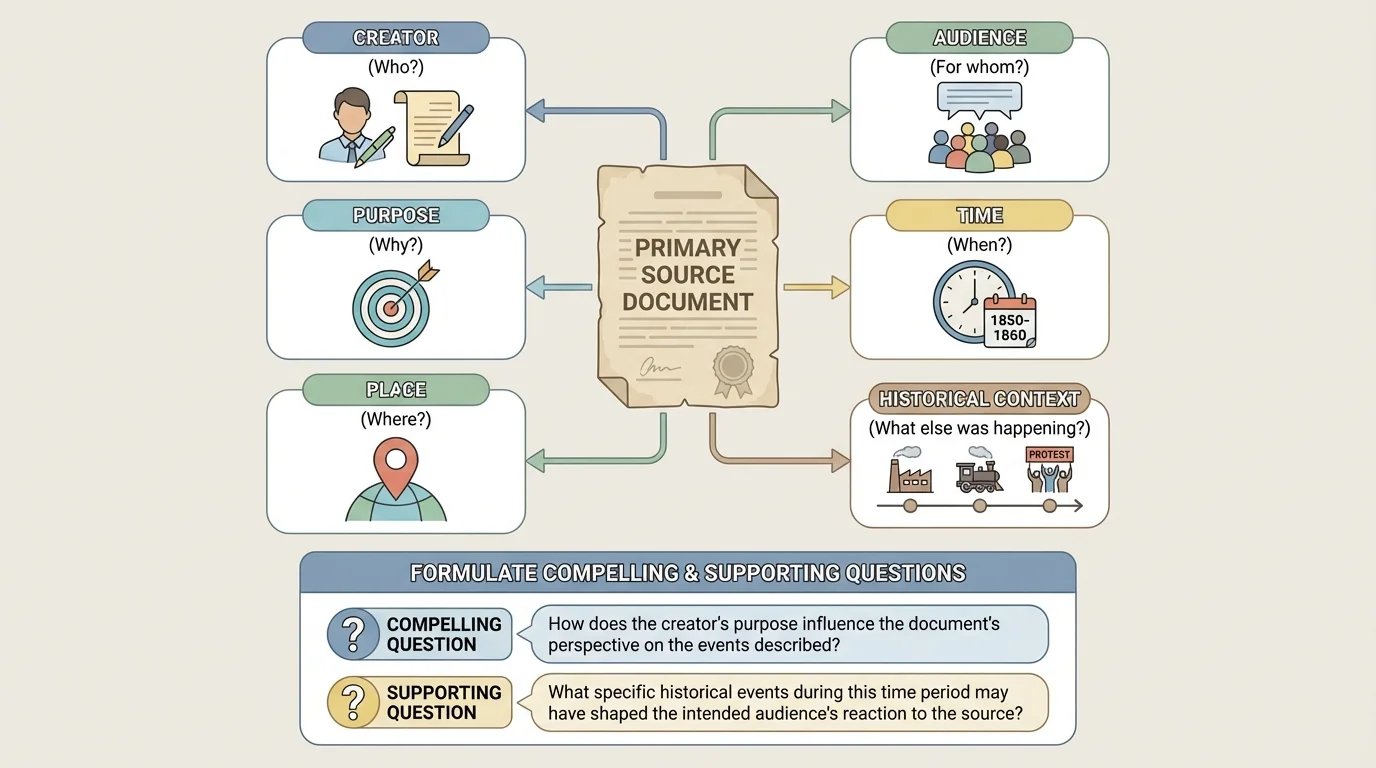
Consider a wartime propaganda poster urging citizens to conserve food. The poster is a primary source. Its point of view likely reflects government priorities, and its purpose is persuasive rather than neutral. Its historical context may include shortages, rationing, or attempts to unify the public. From this evaluation, a historian may begin to ask not only what the poster says, but what fears or goals made that message necessary.
Some of the most revealing sources in history were never meant for a wide audience at all. Private letters, marginal notes in books, and diary entries can expose emotions and doubts that public speeches carefully hide.
Another key idea is audience. A person writing to a friend may speak differently than the same person addressing a court, newspaper, or legislature. A source designed for the public often tries to persuade. A private source may be more candid, but it may also be limited by the writer's incomplete knowledge. Neither kind of source is automatically better. Historians compare them to build a fuller picture.
Historians often follow a set of habits when examining evidence. First, they identify the source: who created it, when, where, and in what form. Next, they read or observe closely for claims, word choice, imagery, tone, and omissions. Then they place it in context by asking what was happening at the time. Finally, they compare it with other sources to see where accounts agree or conflict.
This process is often called corroboration when multiple sources are compared. Corroboration does not mean every source must say exactly the same thing. It means historians test evidence by checking whether claims are confirmed, challenged, or complicated by other evidence. A source becomes more meaningful when placed beside another source that offers a different perspective.
These habits lead directly to better questions. If a source has a narrow perspective, one good question might ask whose voices are missing. If a source seems designed to persuade, a good question might ask what the creator hoped to achieve. If two sources conflict, a good question might ask why their accounts differ and what that difference reveals about the event.
From source evaluation to inquiry
Evaluating a source is not a separate task from asking questions. It is the foundation of inquiry. Once a historian identifies the creator, purpose, audience, and context of a source, patterns begin to appear. Those patterns lead naturally to questions about motive, power, reliability, and historical significance.
For example, if a plantation owner's record book lists productivity but says nothing about enslaved people's suffering, that silence itself becomes historically important. A historian may ask: What does this source reveal about the owner's priorities? What experiences are hidden by this kind of record? What other primary sources can help recover those missing perspectives? A strong historical question often begins with what is absent as much as what is present.
A compelling question is a big, meaningful question that cannot be answered with a simple fact or a yes-or-no response. Compelling questions sit at the top of an inquiry and organize many smaller investigations underneath them. They are arguable, important, and connected to larger themes such as freedom, power, identity, justice, conflict, or change.
Strong compelling questions usually have several features. As [Figure 2] illustrates, they are open-ended. They invite interpretation rather than one correct answer. They matter beyond a single source. They can be investigated with evidence. And they often connect the past to broader human issues that still matter today.
Compare these two questions: "What year did the Civil War begin?" and "How did the Civil War redefine freedom in the United States?" The first is factual and useful, but it is not compelling because it has one short answer. The second is compelling because it invites debate, requires evidence from multiple sources, and leads to deeper analysis about law, citizenship, slavery, and memory.
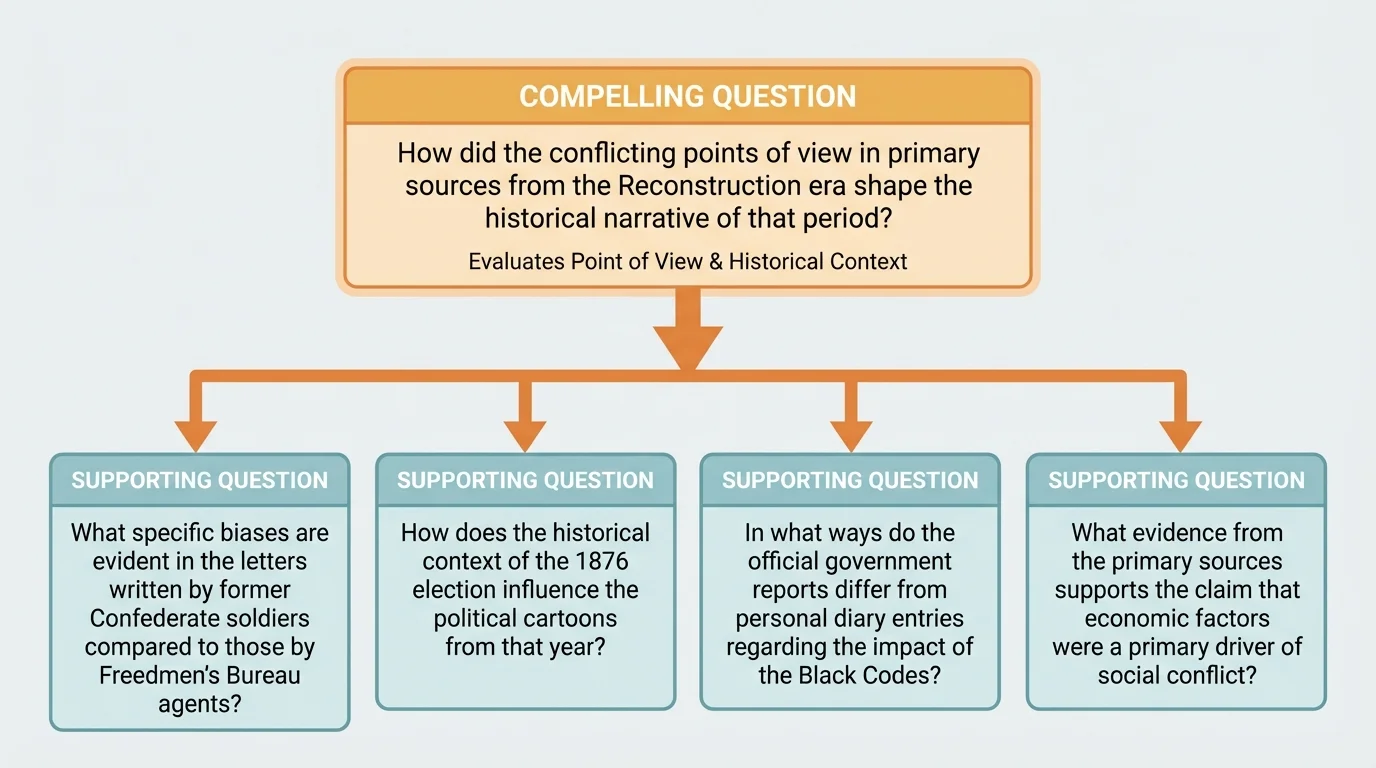
A compelling question should also be precise enough to investigate. "Why is history important?" is too broad for serious inquiry. "How did industrialization change the lives of workers in the late nineteenth century?" is much stronger because it names a process, a group, and a time period. Historians need questions that are broad enough to matter but narrow enough to explore.
"The most important thing is not to stop questioning."
— Albert Einstein
In history, though, the challenge is not just to question. It is to question responsibly. A compelling question must grow from evidence and historical understanding rather than from assumptions alone. If you read a source about a protest, for example, you should not jump immediately to a modern judgment. Instead, ask what the protest meant to people at the time, how different groups understood it, and what conditions produced it.
A supporting question helps answer the compelling question. It is narrower, more specific, and usually tied to particular sources or categories of evidence. If the compelling question asks, "How did industrialization change workers' lives?" then supporting questions might include: "How did factory schedules affect family life?" "What do workers' letters reveal about wages and safety?" and "How did labor unions respond to factory conditions?"
Supporting questions are essential because major historical questions cannot be answered all at once. They must be broken into parts. Historians move back and forth between the large inquiry and the smaller ones, using supporting questions to gather evidence and test interpretations. Good supporting questions are not random. Each one should contribute directly to answering the compelling question.
One way to think about the difference is this: compelling questions ask what larger historical issue is at stake, while supporting questions ask what evidence we need in order to understand that issue. The relationship between them is like the relationship between a documentary's central thesis and the individual scenes, interviews, and records that build it.
| Type of Question | Purpose | Example |
|---|---|---|
| Compelling | Drives the overall historical inquiry | How did World War I transform political life in Europe? |
| Supporting | Investigates one part of the larger issue | How did wartime propaganda affect civilian attitudes? |
| Supporting | Investigates evidence from a specific source type | What do soldiers' letters reveal about morale on the front? |
| Supporting | Checks perspective and context | How did political leaders describe the war differently from civilians? |
Table 1. Comparison of compelling and supporting questions in historical inquiry.
As with the hierarchy in [Figure 2], the strongest supporting questions are connected, not isolated. If a supporting question does not help answer the larger compelling question, it may be interesting but not useful for the inquiry you are conducting.
Once you have evaluated a source, you can turn observations into questions. If the source uses emotional language, ask why. If it leaves out a group, ask whose perspective is missing. If it was created during a crisis, ask how fear or urgency shaped its message. If it conflicts with another source, ask what explains the difference.
A useful pattern is to move from observation to inference to question. For example: Observation: a speech calls striking workers "dangerous radicals." Inference: the speaker may be trying to create fear or defend business interests. Question: How did business leaders use language to shape public opinion about labor unrest? This kind of questioning grows directly from evidence.
Example: Moving from a source to questions
Suppose you are studying women's suffrage and you examine a political cartoon opposing women's voting rights.
Step 1: Identify what the source shows.
The cartoon portrays women voters as neglecting home and family responsibilities.
Step 2: Evaluate point of view and purpose.
The creator likely opposes suffrage and wants the audience to fear social change.
Step 3: Form a compelling question.
How did arguments about gender roles shape the debate over women's suffrage?
Step 4: Form supporting questions.
What stereotypes about women appear in anti-suffrage cartoons? How did suffrage activists respond to those arguments? How did class and race affect the suffrage movement's public messaging?
The strongest questions usually emerge after close reading rather than before it. That is why historians often revise their questions as they learn more. Inquiry is not a straight line. A first question may be too broad, too vague, or based on an assumption that later evidence challenges. Revising a question is a sign of stronger thinking, not a failure.
The Boston Massacre is a classic example of why point of view matters. As [Figure 3] makes clear, the same event can appear either as cold-blooded murder or as a chaotic confrontation depending on the source. On March 5, 1770, British soldiers fired into a crowd in Boston, killing five colonists. But how should the event be understood: as a deliberate killing by British troops, an incident fueled by mob pressure, or something more complicated?
One famous primary source is Paul Revere's engraving, which portrays the British soldiers in a neat line firing deliberately into an unthreatening crowd. The image is powerful, dramatic, and politically useful. It helps spread outrage against British authority. Another source, such as courtroom testimony from the soldiers' trial, may describe a confused and threatening scene in which soldiers felt surrounded and endangered. These sources do not simply disagree on details. They reflect different purposes and audiences.
Revere's image was propaganda as well as evidence. That does not make it worthless. It reveals how patriot leaders wanted colonists to interpret the event. Witness testimony is also not perfectly neutral. Witnesses had limited viewpoints, emotional involvement, and possible political loyalties. A historian must read all of these sources critically.
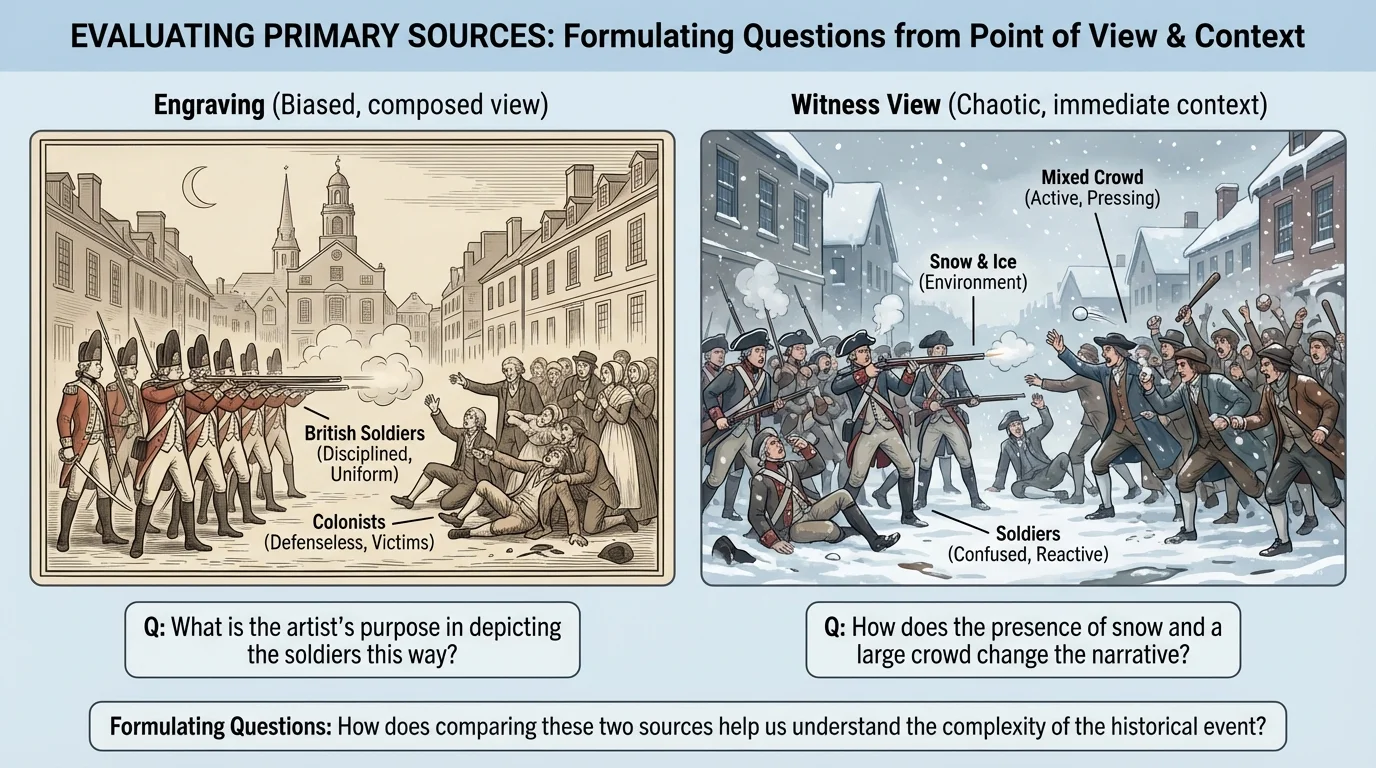
From these sources, a compelling question might be: "How was the Boston Massacre used to build support for resistance to British rule?" Supporting questions could include: "How does Revere's engraving shape the viewer's emotions?" "How do witness testimonies differ in their description of the crowd?" and "Why would patriot leaders want to publicize this event in a particular way?"
This case also shows why historians avoid treating primary sources as transparent windows into the past. A source may reveal not only what happened, but how people tried to persuade others about what happened. That difference is crucial when forming questions.
Earlier study of the American Revolution likely introduced the idea that events can become symbols. Symbolic events are historically powerful because they shape public memory, political identity, and later action, even when the event itself was more complex than popular retellings suggest.
Key figures in this episode include Paul Revere, Crispus Attucks, John Adams, and the British soldiers involved in the trial. The timeline matters: tensions had been rising in Boston through the late 1760s because of British taxation and military presence, and the incident occurred years before the Declaration of Independence. Historical questions become stronger when they place events in this sequence rather than isolating them.
Another powerful example comes from the incarceration of Japanese Americans during World War II. The context begins with the attack on Pearl Harbor in 1941, followed by wartime fear, racial prejudice, and Executive Order 9066 in 1942. Official government documents justified removal as a military necessity, while letters, photographs, and oral histories from Japanese Americans reveal loss, disruption, and injustice.
A government memo may use calm bureaucratic language to describe "relocation," while a family letter may describe fear, humiliation, or uncertainty. Both are primary sources. Their point of view differs sharply because one reflects state authority and policy, and the other reflects lived experience. Evaluating them requires asking who produced each source, for what audience, and under what pressures.
Historical context is especially important here. As [Figure 4] shows, without understanding wartime panic, anti-Asian racism, and the expansion of federal power during war, a student might read the official justification too narrowly. Context does not excuse the policy, but it helps explain how such a policy became possible. Historians use context to understand decisions, not to avoid moral judgment.
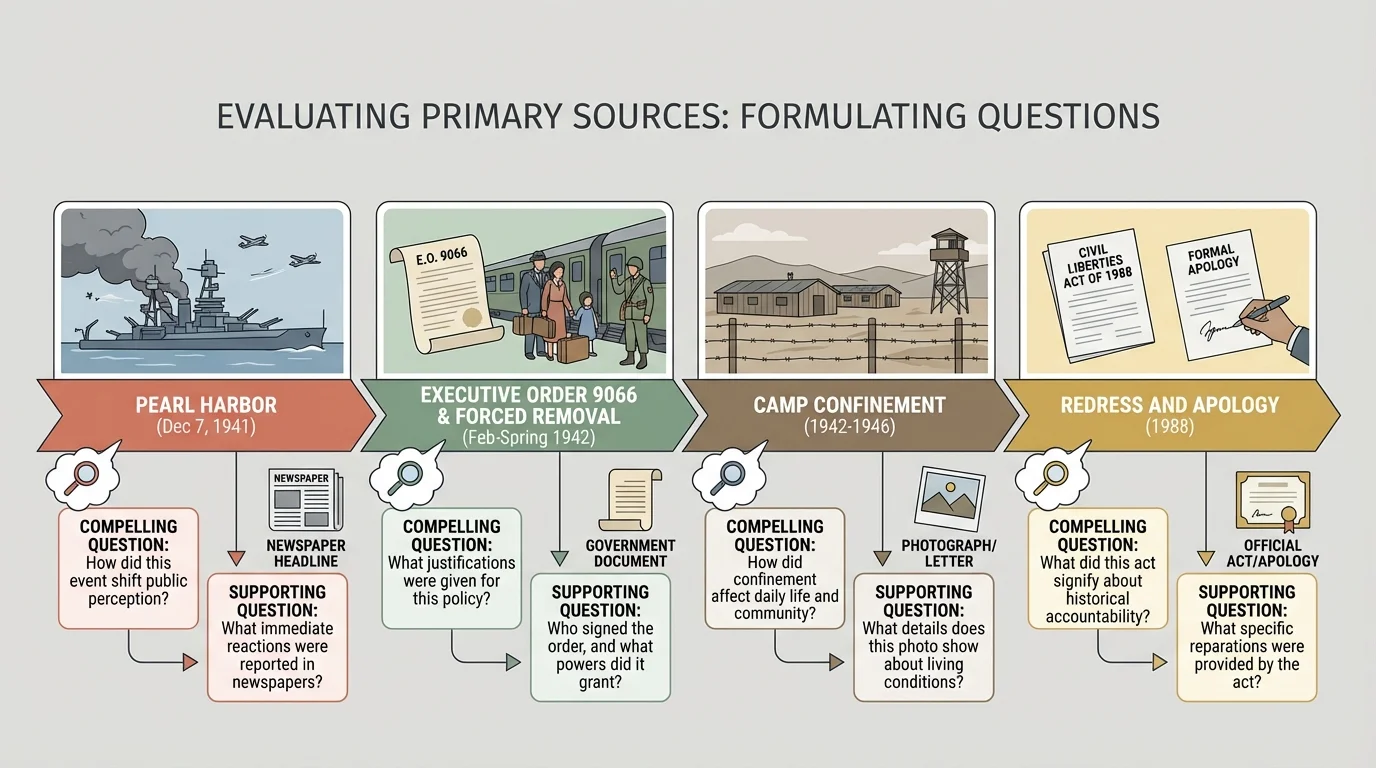
A compelling question might be: "How did wartime fear and racism shape the incarceration of Japanese Americans?" Supporting questions might include: "How did government officials justify the policy?" "What do camp photographs conceal or reveal?" "How did incarcerated people describe daily life?" and "How did later generations challenge the original narrative?"
The timeline also reminds us that historical inquiry does not end with the original event. Later apology, legal challenges, and redress become part of the historical story. A strong question can therefore connect immediate actions with long-term consequences and memory.
Example: Evaluating conflicting perspectives
Consider two sources from the same period: a government announcement about relocation and a diary entry from an incarcerated teenager.
Step 1: Identify point of view.
The announcement reflects official policy; the diary reflects personal experience.
Step 2: Identify purpose and audience.
The announcement seeks public acceptance; the diary may be private reflection rather than public persuasion.
Step 3: Place both in context.
Wartime fear and racism shape what the government presents as security and what families experience as forced displacement.
Step 4: Write questions from the evidence.
How did official language hide the human cost of incarceration? What experiences become visible only in personal sources?
These questions move beyond simple description. They ask how language, power, and perspective shape the historical record. That is exactly what strong inquiry should do.
One common mistake is asking questions that can be answered with a single fact. "When was the order signed?" may be useful, but by itself it does not drive investigation. Another mistake is asking a question so broad that it cannot be answered well, such as "Why do governments do bad things?" Historians need questions that are focused, evidence-based, and tied to a particular time and place.
Another danger is presentism, which means judging the past only by present-day values and assumptions without first understanding historical context. Moral judgment has a place in history, especially when dealing with injustice, but it must be informed by evidence and context. If we skip that step, our questions become shallow and less accurate.
Students also sometimes form questions that already assume the answer. For example, "Why was the government obviously lying?" is weaker than "How did government officials justify the policy, and how does that justification compare with personal accounts?" The second question leaves room for investigation. It does not pretend to know everything before the evidence is examined.
Strong historical questions are disciplined
They are not random curiosities. They emerge from careful reading of sources, attention to context, awareness of perspective, and willingness to revise. Historians ask questions that evidence can address, even when the final interpretation remains debated.
Vague wording is another problem. Words such as "good," "bad," or "important" need sharpening. Instead of asking, "Was Reconstruction good?" ask, "To what extent did Reconstruction expand political rights for formerly enslaved people?" This version is clearer, arguable, and connected to evidence.
Compelling and supporting questions do not exist just to fill a worksheet. They are the bridge between sources and interpretation. Once historians ask strong questions, they gather evidence from primary and secondary sources, compare perspectives, and make claims supported by that evidence. The final historical argument should answer the compelling question while showing how the supporting questions helped build the answer.
This means inquiry, analysis, and argument are connected. A historian might begin with a source, notice its point of view, ask why it frames events in a certain way, compare it with other evidence, and then argue that a public memory of the event was deliberately shaped for political reasons. The argument grows from questioning, not from guessing.
When done well, this process reveals that history is both evidence-based and interpretive. Facts matter. Dates, places, documents, and testimony matter. But interpretation matters too, because historians must decide what evidence means and how different pieces fit together. Strong questions help make that interpretation responsible and defensible.
The goal is not merely to ask more questions. It is to ask better ones: questions rooted in source evaluation, alive to point of view, informed by historical context, and capable of leading to thoughtful, evidence-based conclusions.
