Two students can read the same set of documents about a revolution, a war, or a reform movement and still reach different conclusions. That is not a failure of history. It is one reason history matters. The past does not speak for itself; historians have to ask questions, gather evidence, weigh interpretations, and argue for the explanation that best fits the record. Learning to construct and defend a historical argument means learning to think like a historian rather than simply repeat what happened.
In history, an argument is not a loud disagreement. It is a reasoned interpretation of the past, supported by evidence from sources. A strong historical argument does more than list facts. It explains why events happened, how people understood them, and what interpretation best matches the available evidence. This skill matters not only in history classes but also in citizenship, because public debates often depend on how people interpret the past.
History is built from evidence, but evidence alone is not enough. A letter, law, speech, photograph, map, newspaper article, census table, or diary entry does not automatically reveal a complete truth. Each source gives only part of the story. Historians must place sources in context, compare them, and decide how much weight each one deserves.
This is why historical interpretation can change over time. New evidence may be discovered. Older evidence may be reexamined from a different perspective. Historians may ask new questions, such as how women, workers, immigrants, Indigenous peoples, or enslaved people experienced events that older histories described mainly through political leaders. Historical knowledge grows not because facts are meaningless, but because evidence can be interpreted in more than one way.
Historical argument is a claim about the past that is supported by evidence and reasoning.
Interpretation is an explanation of what historical evidence means.
Evidence is information from sources that historians use to support or challenge a claim.
A successful argument must therefore do three things at once: make a clear claim, support that claim with relevant evidence, and explain how the evidence leads to the conclusion. If one of those parts is missing, the argument weakens.
A strong argument usually begins with a thesis, a focused statement that answers a historical question. A thesis is not just a topic. "The Civil War" is a topic. "Sectional conflict over slavery was the central cause of the Civil War, even though disputes over federal power and economic differences intensified the crisis" is a thesis because it makes a claim that can be defended.
The thesis should be specific, arguable, and historically defensible. If a statement is too obvious, too broad, or impossible to prove, it will not work well. "The Industrial Revolution changed society" is true, but too vague. A stronger version would identify how and for whom it changed society.
Historical arguments also require reasoning. Evidence does not support itself. If you quote a speech by Frederick Douglass, you still have to explain what that speech reveals about abolition, citizenship, or the limits of freedom in the United States. Historians connect pieces of evidence to larger claims through logic, context, and comparison.
Claim, evidence, and reasoning form the core of historical writing. The claim states the interpretation. The evidence provides support from sources. The reasoning shows why that evidence matters and how it proves the claim. Strong history writing makes all three visible.
Arguments can also include qualification. Historians often avoid absolute language because the past is complex. Instead of saying an event had only one cause, a historian may argue that one cause was most important while recognizing other contributing factors. That kind of precision strengthens credibility.
Good arguments begin with good questions. A weak question leads to a weak paper. "What happened during the Great Depression?" may produce a list of facts. A more compelling question asks for explanation, comparison, or evaluation: "To what extent did government action change the lives of Americans during the Great Depression?" That question invites interpretation.
Compelling historical questions often begin with phrases such as "Why did...," "How did...," "To what extent...," "How significant was...," or "Which factor best explains...?" These forms push students beyond description into analysis.
Historians also narrow their questions. Instead of asking why empires fall in general, they might ask why the Roman Empire weakened in the West, or why one colony rebelled while another did not. Narrowing a question helps match the claim to available evidence.
Earlier historical study often focuses on chronology, cause and effect, and point of view. Those ideas still matter here. A persuasive argument depends on knowing what happened first, what conditions shaped choices, and whose perspective a source represents.
A compelling question should be answerable with evidence. If a question cannot be investigated through sources, it may lead to speculation rather than history. Historians can infer motives and beliefs, but they do so by grounding conclusions in what people wrote, said, produced, or experienced.
To build an argument, historians rely on primary sources and secondary sources. Source evaluation is essential because not all evidence serves the same purpose, and not all sources answer the same question equally well. Historians compare when a source was created, who created it, who its audience was, and what strengths or limits it has.
[Figure 1] A primary source comes from the time being studied or from someone directly connected to it. Examples include letters from soldiers in World War I, photographs from the civil rights movement, court records, speeches, laws, posters, and diaries. A secondary source is created later and interprets the past, such as a historian's article or textbook chapter. Secondary sources can be extremely valuable because they place events in broader context and often bring together many primary sources.
When evaluating any source, historians ask several key questions. Who created it? When? For what audience? For what purpose? What perspective or bias might shape it? What does it reveal, and what does it leave out? A newspaper editorial and a private diary may describe the same event very differently because they were written for different reasons.
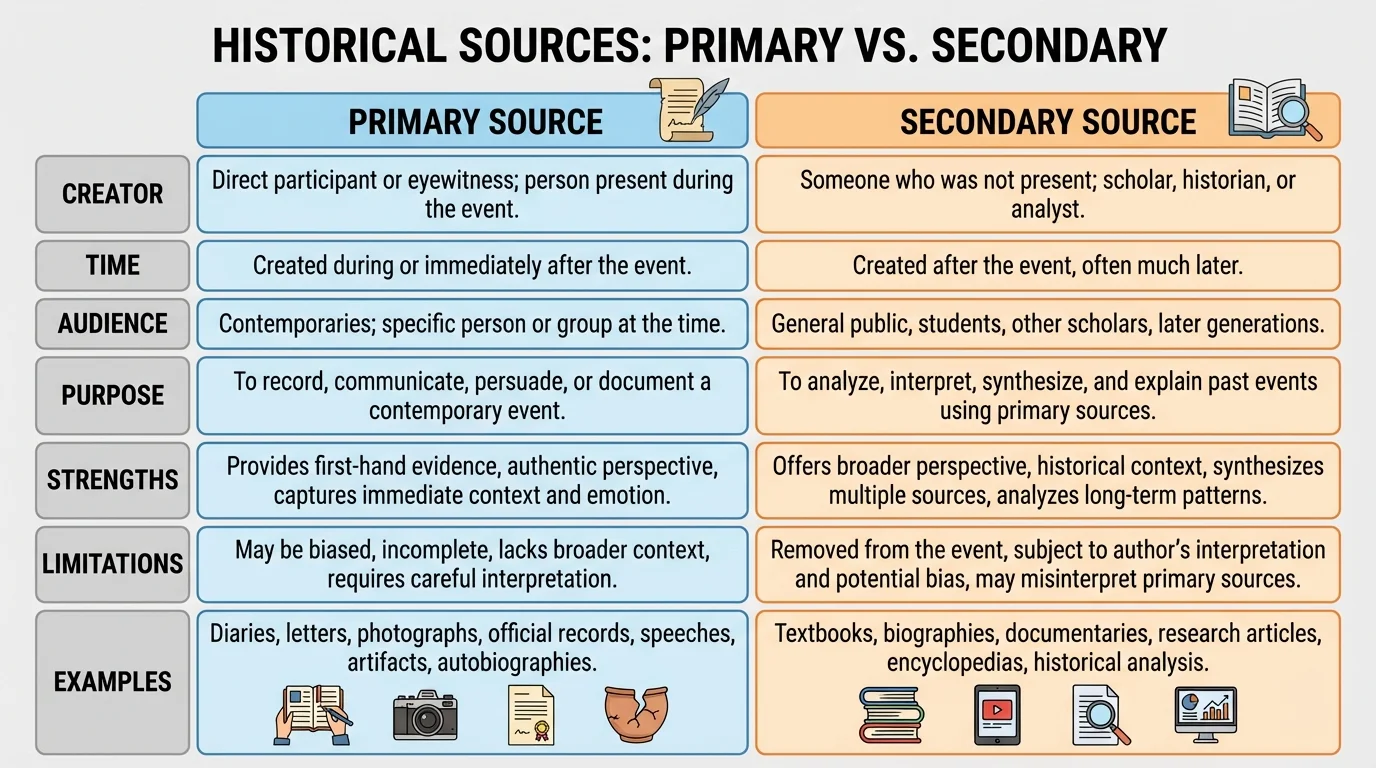
Bias does not automatically make a source useless. In fact, bias can itself be evidence. A plantation owner's account of slavery may be deeply self-serving, but that very self-interest tells historians something about power, ideology, and social attitudes. The key is not to treat any source as neutral simply because it exists.
Reliability is also specific to the question being asked. A political cartoon may not be reliable for exact numbers or detailed chronology, but it can be excellent evidence of public opinion, propaganda, or popular fears. A speech may not tell us what all citizens believed, but it can reveal what a leader wanted people to believe.
| Source Type | Useful For | Possible Limitation |
|---|---|---|
| Diary | Personal experiences and emotions | Limited viewpoint |
| Law or decree | Official policy and government goals | Does not show how fully the law was enforced |
| Newspaper article | Public reporting and contemporary reactions | May reflect political bias or incomplete information |
| Scholarly article | Interpretation and synthesis of many sources | Depends on the historian's methods and perspective |
Table 1. Common historical source types, what they help reveal, and their limitations.
Reading carefully means noticing word choice, tone, silence, and assumptions. If a speech repeatedly uses words like "order," "danger," or "liberty," that language may reveal the speaker's priorities. If a source never mentions certain groups, that silence can also be historically meaningful.
Historians do not just examine raw sources. They also evaluate one another's interpretations. One historian may argue that Reconstruction failed mainly because of violent white resistance in the South. Another may emphasize northern political fatigue, Supreme Court decisions, or economic priorities. These interpretations may conflict, overlap, or differ in emphasis.
To critique an interpretation, ask what evidence the historian uses, what evidence is missing, and what assumptions guide the argument. Does the historian rely mostly on political speeches while ignoring economic data or personal testimony? Does the interpretation explain both short-term and long-term causes? Does it account for regional differences?
This kind of evaluation is sometimes called historiography, the study of how history has been written and interpreted over time. Historiography matters because it shows that history is an ongoing conversation built from evidence, methods, and changing questions.
Some major historical debates last for decades because the disagreement is not about whether evidence exists, but about which evidence deserves the greatest weight. Historians may agree on the facts of an event yet still disagree about its meaning.
A careful student does not reject an interpretation simply because another one exists. Instead, the student compares them and decides which explanation better fits the available evidence.
Historical evidence rarely arrives in neat order. A historian may have speeches, census data, newspaper reports, photographs, maps, and later scholarly analysis all pointing in somewhat different directions. The challenge is to move from scattered material to a coherent interpretation through sourcing, contextualization, and corroboration that lead toward a defensible thesis.
[Figure 2] Contextualization means placing a source in the larger conditions of its time. A speech demanding stronger labor laws means more when you know it followed industrial accidents, urban poverty, and political corruption. Without context, evidence can be misunderstood.
Corroboration means comparing sources to see where they agree, disagree, or fill gaps in one another. If factory records show falling wages, workers' letters describe hardship, and reformers' reports criticize unsafe conditions, those sources reinforce each other. If they conflict, the historian must explain why.
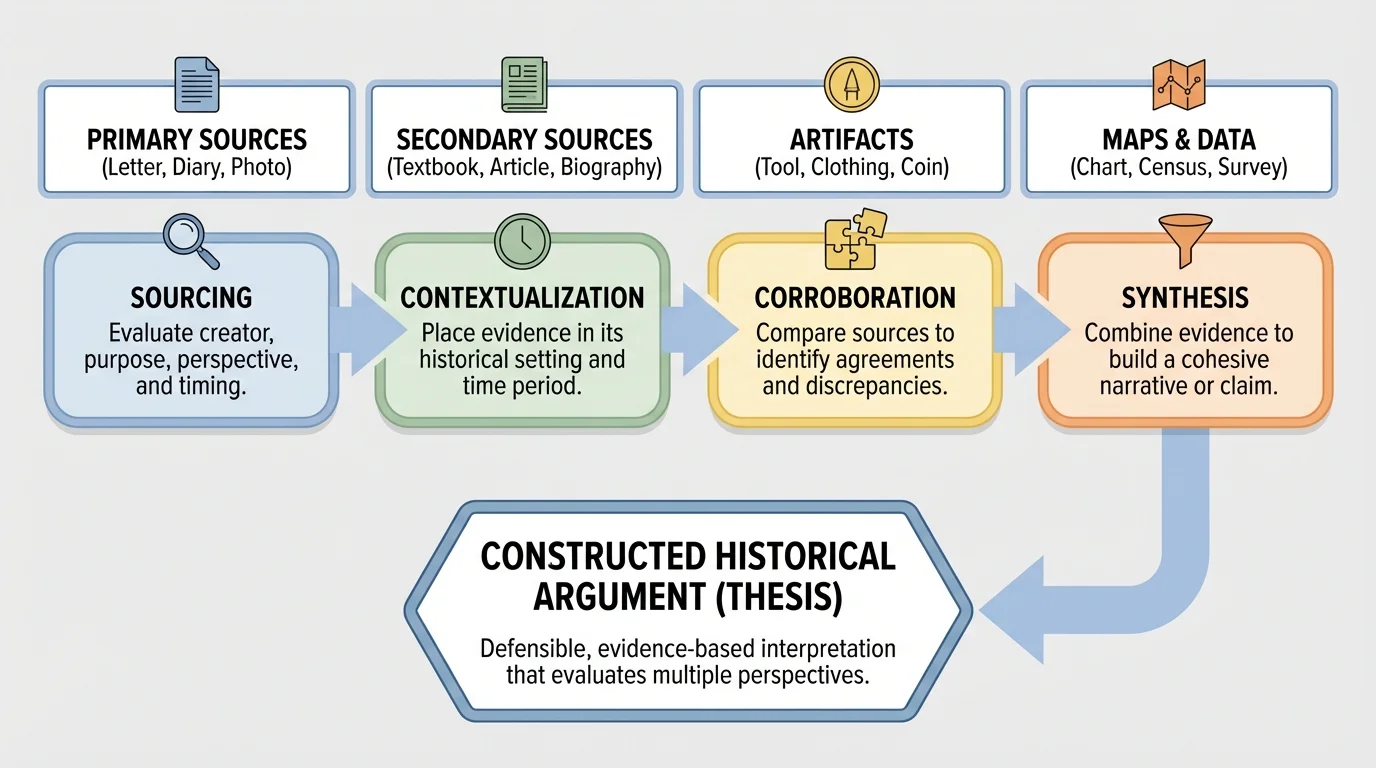
Synthesis goes a step further. It means combining evidence from a wide range of sources into a larger interpretation. Instead of treating each source separately, the historian builds a broader explanation that accounts for political, social, economic, and cultural factors together.
For example, if you were studying the causes of westward migration in the nineteenth-century United States, you might synthesize government land policy, economic opportunity, railroad expansion, personal letters, Indigenous displacement, and environmental conditions. A strong interpretation would not isolate only one of those forces if the evidence shows several working together.
This process also requires judgment. Not all evidence carries equal weight. A firsthand account from the moment may be powerful, but it could also be narrow or mistaken. A later scholarly study may be more comprehensive, but it still reflects interpretation. Historians weigh both immediacy and breadth.
Later in an argument, the same visual logic from [Figure 2] still applies: each new source should be tested for context, compared with others, and then woven into the larger claim rather than dropped in as an isolated quote.
Once evidence has been gathered and evaluated, the historian begins building the argument. A useful approach is to group evidence by categories rather than by source order. For example, an essay on imperialism might organize evidence into economic motives, nationalist ideology, military strategy, and effects on colonized peoples.
Each paragraph should include a clear subclaim, evidence from sources, and explanation. Quoting a document is not enough. After introducing a source, the writer should explain what it shows and how it supports the larger thesis. The reader should never have to guess why a piece of evidence is there.
Model structure for a strong body paragraph
Step 1: Make a focused subclaim.
Example: Economic pressures were a major cause of unrest in France before the Revolution.
Step 2: Introduce specific evidence.
Use tax records, bread price data, and complaints from the cahiers de doléances.
Step 3: Explain the significance.
Show how rising prices and unequal taxation increased resentment toward the monarchy and privileged estates.
Step 4: Connect back to the thesis.
Explain whether economic crisis was the main cause or one of several linked causes.
Notice that this structure does not simply report facts. It turns facts into an argument by explaining relationships among events, ideas, and conditions.
Strong historical writing acknowledges that other interpretations exist. This does not weaken the argument. It usually strengthens it. If you argue that slavery was the central cause of the Civil War, you should address why some people emphasize states' rights, economic differences, or political breakdown. Then you should show why your interpretation better explains the evidence.
A counterargument should be presented fairly, not as a weak straw man. After stating the alternative view, the historian responds with evidence, reasoning, or qualification. Sometimes the best answer is not "this view is completely wrong," but "this factor mattered, yet the evidence shows it was secondary to a larger cause."
This is also where avoiding presentism becomes important. Presentism means judging the past entirely by present-day values or assumptions. Historians can make ethical judgments, but they must still understand people in their own historical context. Otherwise, interpretation becomes oversimplified and inaccurate.
"The most effective arguments are not the loudest ones, but the ones that explain the most evidence with the greatest accuracy."
Complexity does not mean confusion. It means recognizing that historical events usually involve multiple causes, competing experiences, and unintended consequences.
[Figure 3] The American Revolution is a useful example because historians have offered several interpretations. Some emphasize taxation and representation. Others stress British attempts to tighten imperial control after 1763. Still others focus on colonial political culture, Enlightenment ideas, or social conflict within the colonies. Chronology matters here and helps lay out the escalation from postwar imperial policy to independence.
A strong historical argument about the Revolution might claim that the conflict grew not from taxation alone, but from a widening struggle over political authority after the Seven Years' War. To defend that claim, a student could use the Proclamation of 1763, the Stamp Act, colonial pamphlets, records of protest, British parliamentary debates, and the Declaration of Independence.
Primary sources might include Patrick Henry's resolutions, Thomas Paine's Common Sense, or colonial petitions to the king. Secondary sources might compare whether elite leaders or ordinary colonists drove resistance. The best interpretation would evaluate both and explain how ideology, economics, and imperial policy interacted.
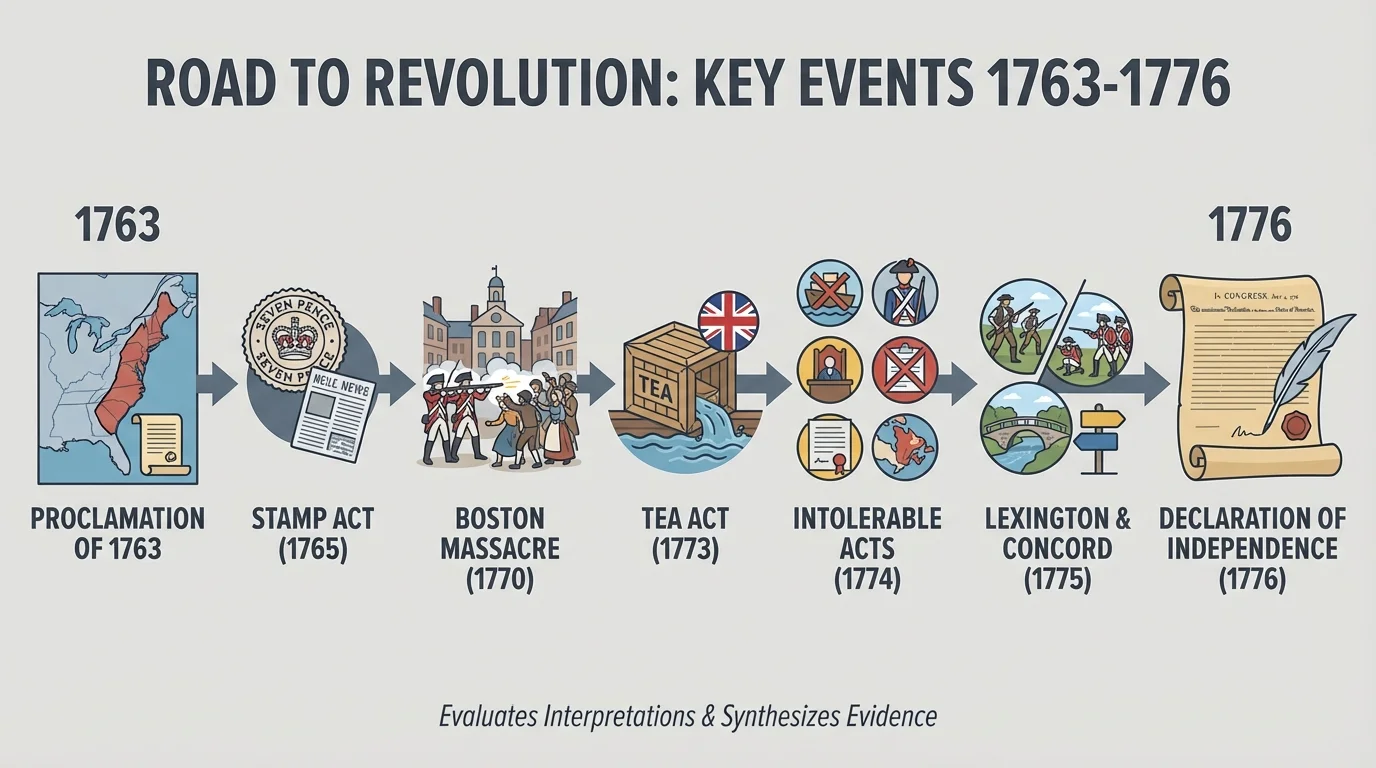
For example, if one historian claims the Revolution was mainly a constitutional dispute over rights, but another emphasizes material interests such as trade restrictions, a student should not choose randomly. The student should ask which interpretation explains more of the evidence across the full timeline. The sequence in [Figure 3] helps reveal that tensions intensified through repeated clashes over both power and principle.
A nuanced thesis might say that colonial resistance began with opposition to imperial taxation and regulation, but developed into a revolutionary movement because many colonists came to believe British authority itself threatened their political liberties. That argument includes change over time, multiple causes, and clear reasoning.
The New Deal provides another excellent test of historical argument because interpretations differ sharply. Some historians argue that it transformed the role of the federal government and offered meaningful relief and reform. Others argue that it did not go far enough, especially for African Americans, women, agricultural laborers, and the unemployed. Still others emphasize that economic recovery remained incomplete until World War II.
To evaluate these interpretations, a student might use Franklin D. Roosevelt's speeches, unemployment data, photographs from the Farm Security Administration, Supreme Court decisions, letters from citizens, and later scholarly analysis. The question "Was the New Deal successful?" is too broad unless success is defined. Successful in providing relief? In ending the Depression? In changing government responsibility? Different evidence may lead to different answers.
Comparing interpretations of the New Deal
Step 1: Define the standard of judgment.
Decide whether the argument evaluates relief, recovery, reform, or long-term political change.
Step 2: Match evidence to the question.
Use unemployment trends for recovery, Social Security legislation for reform, and firsthand letters for public response.
Step 3: Weigh conflicting evidence.
Programs helped millions, but some groups remained excluded or underserved.
Step 4: Reach a qualified interpretation.
A strong conclusion may argue that the New Deal reshaped government responsibility even if it did not fully end the Depression on its own.
This kind of argument is stronger than a simple positive or negative judgment because it explains what the evidence actually shows.
One common mistake is cherry-picking, selecting only the evidence that supports a preferred conclusion while ignoring contradictory sources. Strong historians do the opposite: they test their claims against difficult evidence.
Another mistake is confusing evidence with explanation. A paper may contain many quotations and still fail if it never explains how those quotations support the thesis. Historical writing is not a pile of documents. It is an interpretation built from them.
Students also weaken arguments when they make claims that are too broad, too moralizing, or too certain. Statements like "everyone wanted freedom" or "the policy was obviously evil" often hide important differences among groups and motives. Precision matters.
Finally, avoid treating secondary sources as if they are unquestionable truth. Historians are interpreters too. Their work should be evaluated for evidence, method, and argument just as primary sources should be evaluated for perspective and purpose.
A finished historical argument should open with a clear thesis, organize evidence logically, and explain the reasoning that connects evidence to interpretation. It should reference both primary and secondary sources where appropriate, address competing views, and maintain historical context throughout.
Defending an argument also means being able to explain your choices. Why did you trust one source more than another? Why did you consider one cause central and another secondary? Why does your interpretation explain the evidence better than the alternatives? These are the questions historians ask in classrooms, books, museums, and public debates.
History is not only about what happened. It is about how we know, how we interpret, and how we justify what we claim to know. When students can analyze sources, critique interpretations, synthesize evidence, and defend a reasoned conclusion, they are doing real historical work.
