The United States has often been described as a nation devoted to freedom, equality, and democracy. Yet some of the most important moments in its history reveal a striking paradox: rights expanded at the same time they were denied, liberty was praised while security measures restricted freedom, and the country sometimes avoided foreign entanglements even as it built global power. To study U.S. history well, historians ask two linked questions: What changed? and What stayed the same? Those questions help explain why the nation can look dramatically different across time and still carry long-running conflicts from one generation to the next.
From Reconstruction after the Civil War to the present, the United States experienced enormous shifts in politics, economics, technology, and culture. Formerly enslaved people gained constitutional protections. Women won the right to vote. The federal government grew in size and influence. The U.S. became a world power. Social movements challenged discrimination based on race, gender, disability, and sexual orientation. At the same time, older patterns continued: racial inequality persisted, debates over federal authority never disappeared, and Americans repeatedly argued over how much freedom should be sacrificed for safety. Understanding these patterns requires attention to cause and effect, complexity, and the relationship between unity and diversity.
Continuity means features of history that remain over time. Change means developments that alter institutions, ideas, laws, or daily life. Historians rarely see one without the other. For example, the legal end of slavery was a major change, but racism and unequal power remained major continuities. The expansion of voting rights was real, but so were efforts to suppress votes. In other words, history is not a simple story of constant progress.
Continuity is something that remains relatively consistent over time. Change is something that develops, shifts, or transforms. Cause and effect explains why events happen and what results they produce. Complexity reminds us that historical events often have multiple causes and mixed consequences.
One useful way to think about this is to compare history to a river. The surface keeps moving, but the riverbed below can shape its path for a long time. In U.S. history, ideas such as liberty, individualism, economic opportunity, and democracy have remained powerful. But who counted as fully included in those ideals changed over time, often because people organized, protested, voted, and went to court to force the nation to live up to its own principles.
[Figure 1] After the Civil War, the United States entered Reconstruction, a period of rebuilding and redefining the nation. This era shows clearly how legal change and social continuity can exist together. The 13th Amendment ended slavery, the 14th Amendment established birthright citizenship and equal protection of the laws, and the 15th Amendment prohibited denying the right to vote based on race. On paper, these amendments transformed the Constitution and expanded rights dramatically.
But change met fierce resistance. Southern states passed Black Codes to control African Americans' labor and movement. White supremacist groups, including the Ku Klux Klan, used terror to block Black political participation. By the late 19th century, Jim Crow laws enforced racial segregation, and poll taxes, literacy tests, and violence stripped many Black citizens of voting rights. The Supreme Court's decision in Plessy v. Ferguson in 1896 accepted "separate but equal," giving legal support to segregation.
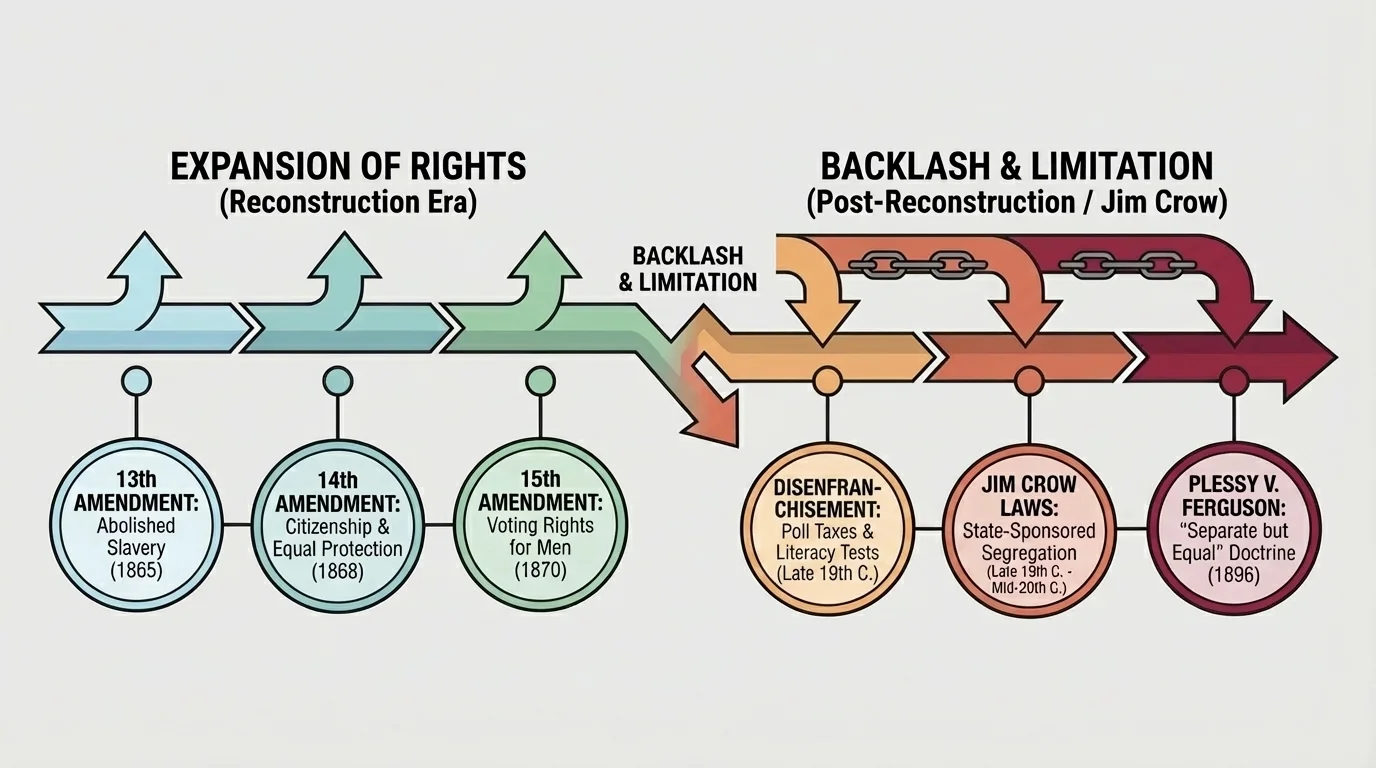
This period reveals an essential pattern in U.S. history: rights can expand in law without being fully protected in practice. That pattern appears again and again. Reconstruction changed the Constitution permanently, but it did not end the struggle over race, citizenship, and power. The continuity of white supremacy limited the impact of legal reform for decades.
Key figures from this era include Frederick Douglass, who pressed the nation to honor Black citizenship; Hiram Revels and Blanche K. Bruce, Black senators during Reconstruction; and later Ida B. Wells, who fought lynching and exposed racial violence. Their work reminds us that change usually requires organized effort, not just new laws.
From the 1890s through the 1920s, the United States experienced industrial growth, urbanization, and reform. The Progressive Era brought efforts to regulate big business, improve working conditions, and reduce political corruption. Reformers such as Jane Addams, Theodore Roosevelt, and Upton Sinclair helped push for change. The federal government began playing a larger role in economic life, especially through antitrust actions and consumer protection laws.
Yet reform had limits. Some Progressives supported democracy and fairness, but others backed segregation, nativism, or forced assimilation of Native Americans. The same society that moved toward women's suffrage also restricted immigration. The 19th Amendment, ratified in 1920, expanded political rights for women, but women of color still faced barriers to voting, especially in the South.
The early 20th century also saw the Great Migration, when millions of African Americans moved from the rural South to northern and western cities. They sought jobs and greater safety, but they often found housing discrimination, job inequality, and racial tensions in new locations. This movement changed music, politics, literature, and urban life. It also showed how change in geography did not automatically produce equality.
The Great Migration helped reshape American culture in ways students still encounter today. The Harlem Renaissance influenced literature, jazz, visual art, and ideas about Black identity that still shape U.S. culture.
Another continuity appeared in wartime fear. During and after World War I, the government limited dissent through the Espionage and Sedition Acts. The first Red Scare led to arrests and deportations of suspected radicals. Americans had long valued freedom of speech, but in moments of crisis, that liberty often came under pressure.
[Figure 2] The balance between freedom and protection has shifted repeatedly in U.S. history, especially during war and national emergencies. This debate asks a difficult question: how much liberty should a democratic society surrender to defend itself? There has never been a final answer. Instead, each generation has argued over it again.
During World War I, critics of the war were prosecuted. During World War II, after the attack on Pearl Harbor, the government forcibly relocated and interned Japanese Americans. In Korematsu v. United States, the Supreme Court upheld that policy at the time. Today, historians widely view internment as a major violation of civil liberties based on racism and wartime fear rather than proven military necessity.
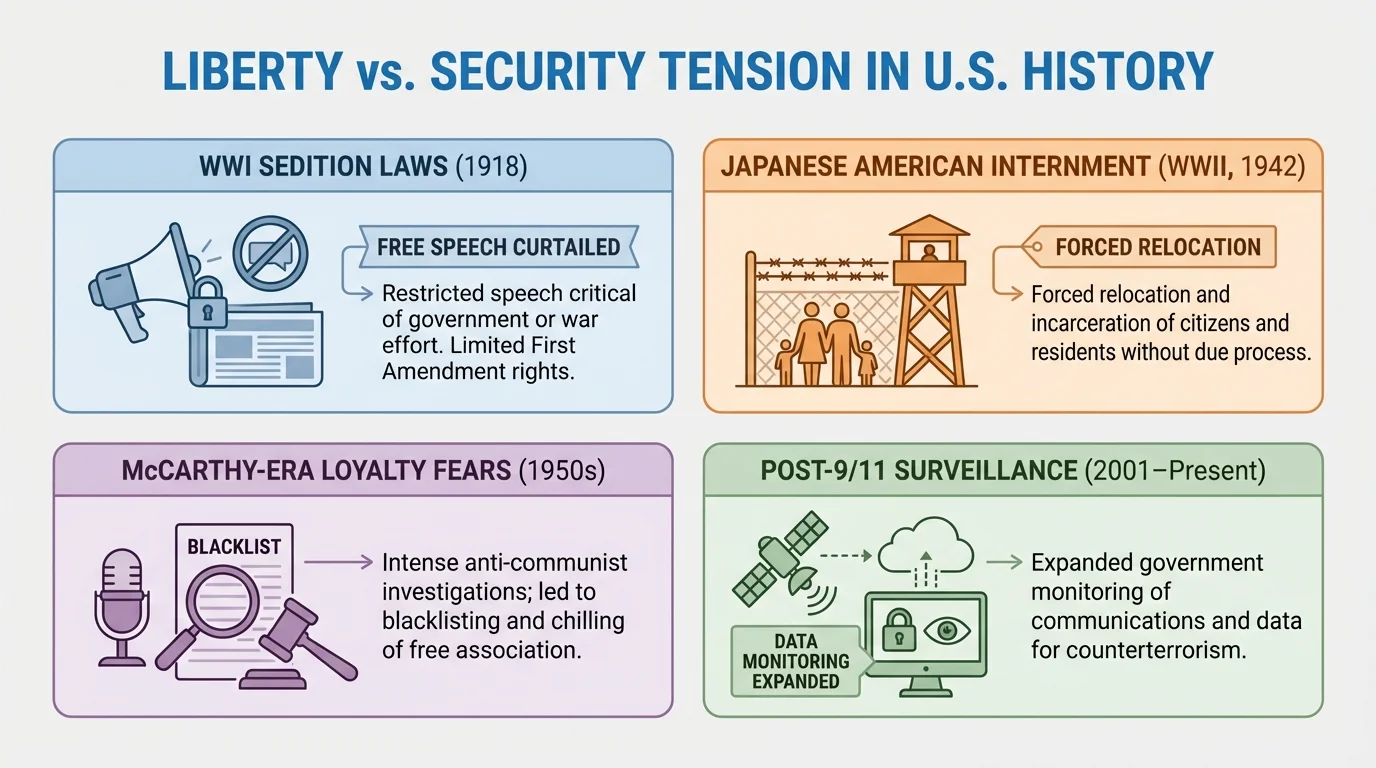
In the early Cold War, fear of communism led to loyalty investigations, blacklists, and the rise of McCarthyism. Senator Joseph McCarthy became a symbol of how accusations and fear could damage rights and reputations. Once again, security concerns narrowed civil liberties.
After the attacks of September 11, 2001, the U.S. government expanded surveillance powers and passed the USA PATRIOT Act. Supporters argued these steps were necessary to prevent terrorism. Critics warned that surveillance and detention powers could threaten privacy, due process, and constitutional freedoms. The pattern echoes earlier periods: danger leads many people to accept stronger government action, but later generations often question whether the limits on liberty went too far.
This issue remains complex because governments do have a duty to protect the public. The hard part is deciding where protection becomes overreach. As with the examples in [Figure 2], the same country can sincerely value liberty and still restrict it under pressure.
Another long-running debate concerns the proper role of government. Since Reconstruction, Americans have argued over whether the federal government should do more to solve social and economic problems or do less to preserve individual freedom and local control. This argument is one of the most consistent continuities in modern U.S. history, even though the government itself changed greatly.
The Great Depression marked a major turning point. President Franklin D. Roosevelt introduced the New Deal, creating programs to provide jobs, regulate banks, and support the elderly and unemployed. Agencies and reforms such as Social Security expanded the federal government's role in daily life. Many Americans welcomed this response to crisis. Others argued it gave Washington too much power and weakened free-market principles.
The debate over government is not simply "big" versus "small." Often the real question is what kind of government action people support. Some oppose welfare programs but support military spending. Others favor environmental regulation but want fewer restrictions in different areas. The argument is about priorities, values, and who should make decisions.
In the 1960s, President Lyndon B. Johnson launched the Great Society, including Medicare, Medicaid, civil rights legislation, and anti-poverty programs. These efforts reflected the belief that government should actively reduce inequality and protect rights. At the same time, critics claimed the federal government was becoming too powerful, expensive, or intrusive.
From the 1980s onward, leaders such as Ronald Reagan emphasized lower taxes, deregulation, and a smaller federal role in some areas. Yet even during conservative periods, the government remained central in defense, law enforcement, disaster response, and major economic crises. This is a good example of continuity and change together: public arguments about government stayed constant, while the specific policies and responsibilities kept evolving.
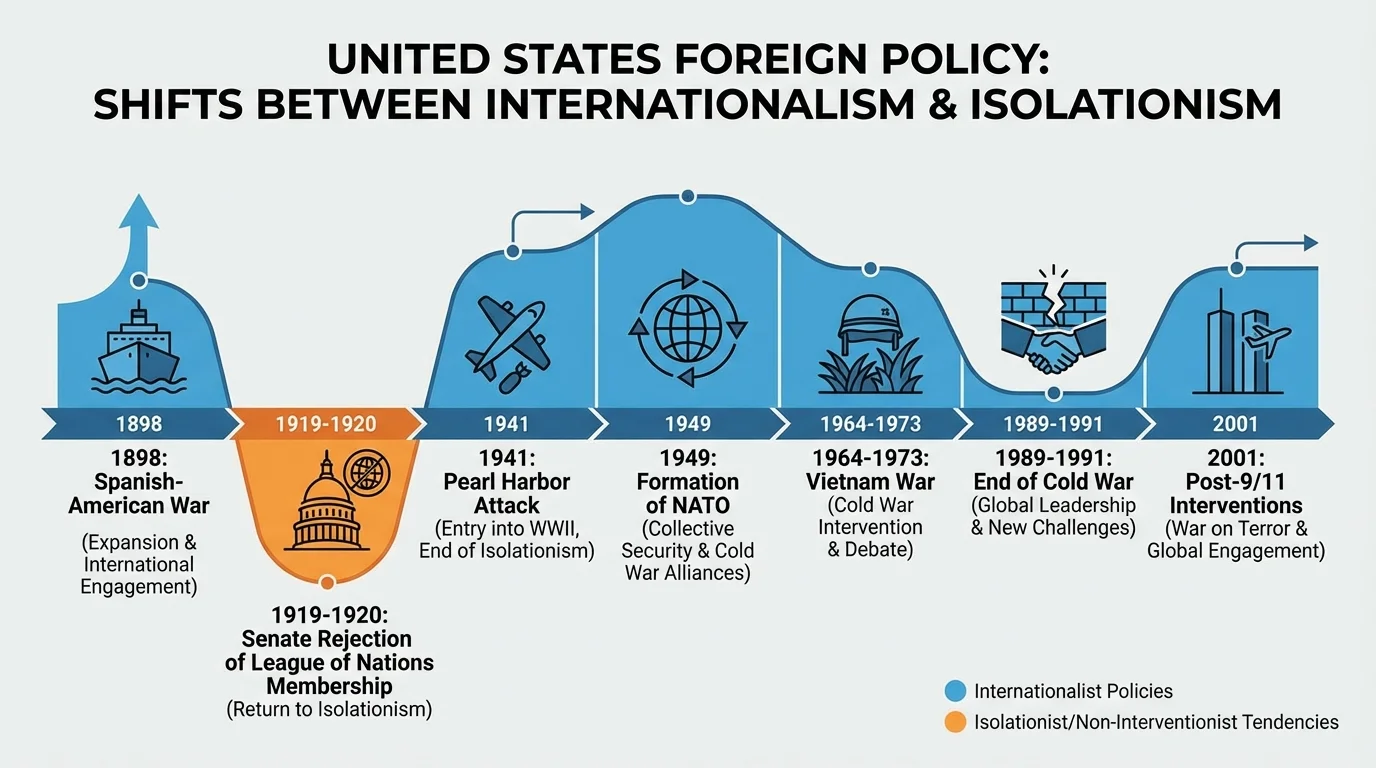
[Figure 3] U.S. history after Reconstruction also includes major expansionism. These policies involved territory, military power, markets, and political influence. Foreign policy did not move in a straight line; instead, it shifted between stronger international involvement and periods of withdrawal.
In 1898, the Spanish-American War marked a major step in overseas expansion. The United States gained control of Puerto Rico, Guam, and the Philippines, and it increased influence over Cuba. Supporters claimed expansion would spread civilization, democracy, and economic opportunity. Critics, including members of the Anti-Imperialist League such as Mark Twain and Andrew Carnegie, argued that ruling other peoples betrayed American ideals of self-government.
The Philippine-American War exposed the human cost of empire. Filipinos who sought independence fought U.S. control, and the conflict was brutal. This is one of the clearest examples of how expansion can increase power while creating violence, resistance, and moral contradiction. Expansionist policies often produced benefits for U.S. influence but serious harms for people living in annexed or occupied places.
After World War I, many Americans embraced a more isolationist approach. The Senate rejected membership in the League of Nations, reflecting skepticism about permanent foreign commitments. But after Pearl Harbor in 1941, the U.S. fully entered World War II and never returned to its earlier level of detachment.
The Cold War strengthened internationalism. The United States helped create the United Nations, formed NATO, provided aid through the Marshall Plan, and intervened in conflicts from Korea to Vietnam. After the Cold War, the U.S. remained deeply involved globally through trade, diplomacy, military alliances, and later the wars in Afghanistan and Iraq. The pattern in [Figure 3] makes clear that American foreign policy repeatedly swings, but global power has remained a major feature of the modern United States.
[Figure 4] The story of U.S. history since Reconstruction is also a story of repeated movements to widen citizenship and equality. Rights have expanded in waves rather than all at once. This is one of the clearest examples of change over time, but it also reveals continuity because each advance met resistance.
The modern Civil Rights Movement challenged segregation and disenfranchisement through court cases, protests, boycotts, and federal legislation. Brown v. Board of Education in 1954 declared school segregation unconstitutional. Activists such as Martin Luther King Jr., Rosa Parks, Ella Baker, John Lewis, and many local organizers helped push the nation toward the Civil Rights Act of 1964 and the Voting Rights Act of 1965.
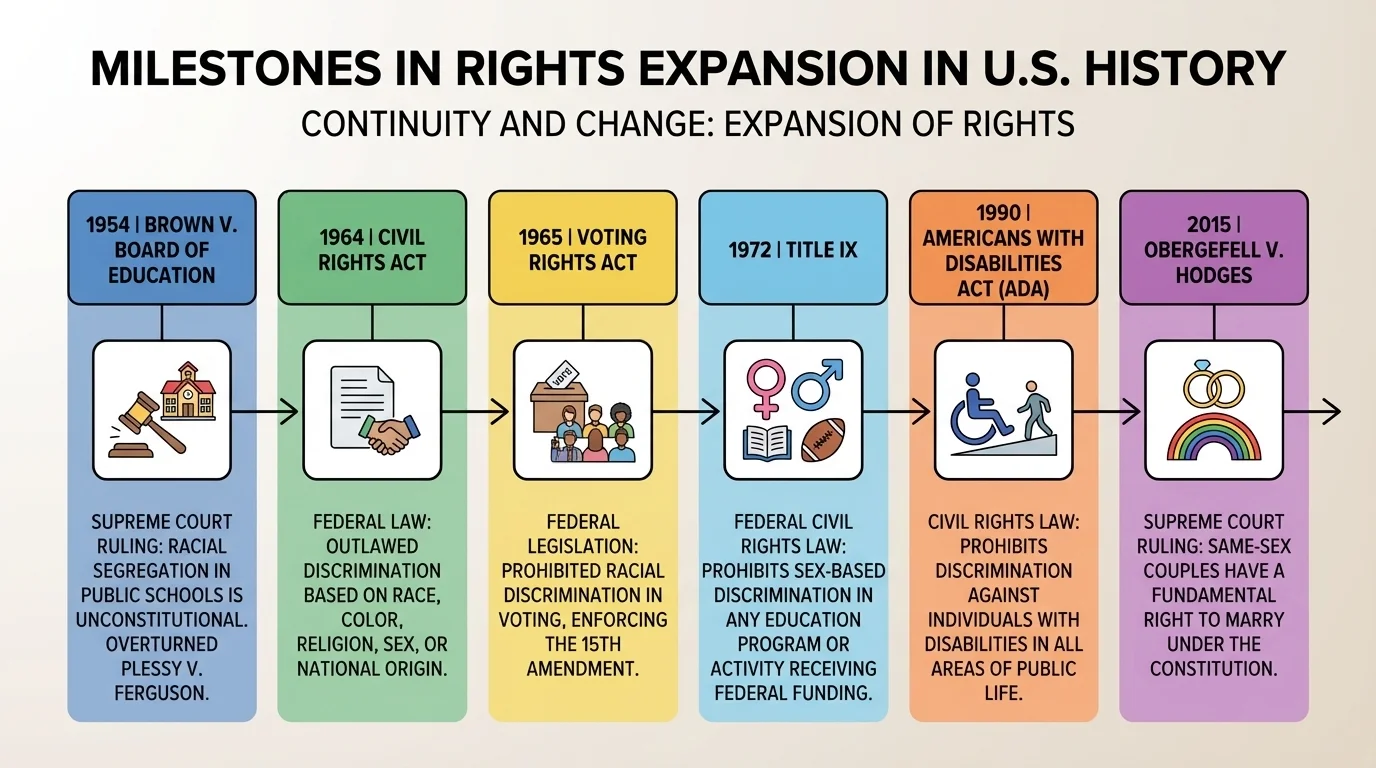
Other groups also organized for recognition and protection. Native American activists demanded tribal sovereignty and treaty rights. Latino activists such as Cesar Chavez and Dolores Huerta fought for farmworkers. The women's movement pushed for workplace equality, reproductive rights, and educational access, including through Title IX. The disability rights movement led to the Americans with Disabilities Act. LGBTQ+ activists fought discrimination and eventually won marriage equality in Obergefell v. Hodges in 2015.
Still, rights expansion never ended debate. School integration faced backlash. Voting rights protections have been contested. Wage gaps, discrimination, and unequal treatment remain. The legal victories shown in [Figure 4] are important, but they do not erase ongoing arguments over how equality should be defined and enforced.
"The arc of the moral universe is long, but it bends toward justice."
— Martin Luther King Jr.
This famous line captures hope, but history shows that the arc does not bend on its own. People bend it through activism, legal strategy, journalism, organizing, and voting. That is why cause and effect matter so much in history: rights expand because people force institutions to change.
United States history also involves the tension between national unity and social diversity. Americans often unite around constitutional ideals, patriotic symbols, and shared political traditions. At the same time, the country has always been diverse in race, ethnicity, religion, region, class, and political belief. That diversity is a source of creativity and strength, but it can also produce conflict over who belongs, whose values matter most, and what equality requires.
Complexity means rejecting simple labels. For example, the federal government has both protected rights and violated them. Expansion has created economic power and international influence, but also war, displacement, and domination. Calls for liberty have supported both reform movements and resistance to government action. A historian must hold these truths together rather than choosing only one side.
Primary sources help reveal this complexity. Constitutional amendments, Supreme Court opinions, speeches, protest signs, newspaper editorials, photographs, oral histories, and letters all show how Americans understood their own times. Secondary sources, written later by historians, interpret those materials and place them in broader context. Using both kinds of sources helps explain not only what happened, but why people disagreed so strongly about its meaning.
Case study: One issue, two historical patterns
Consider voting rights from Reconstruction to the present.
Step 1: Identify the major change.
The 15th Amendment and later the Voting Rights Act expanded formal access to voting for African Americans.
Step 2: Identify the continuity.
States and local officials repeatedly created barriers such as literacy tests, poll taxes, intimidation, racial gerrymandering, and other restrictive practices.
Step 3: Explain the complexity.
American democracy grew more inclusive over time, but that growth was uneven and contested. Progress and backlash happened together.
This same method can be used to analyze civil liberties, foreign policy, or debates over government power.
A timeline can help reveal both dramatic turning points and long continuities. Notice how often new rights, new powers, or new policies are followed by conflict over their meaning.
| Period/Event | Major Change | Important Continuity or Limitation |
|---|---|---|
| Reconstruction, 1865–1877 | 13th, 14th, 15th Amendments expand legal rights | Racial violence and white supremacy continue |
| Late 1800s–early 1900s | Industrial growth and Progressive reforms | Labor inequality, segregation, and nativism remain |
| World War I and Red Scare | U.S. increases global role | Civil liberties restricted during crisis |
| New Deal, 1930s | Federal government expands economic role | Debate over government power intensifies |
| World War II and Cold War | U.S. becomes global superpower | Security fears limit freedom at home and abroad |
| Civil Rights era, 1950s–1970s | Major gains in legal equality | Social and economic inequality persist |
| Late 20th century to present | New rights movements and global influence continue | Debates over inclusion, surveillance, and federal power remain |
Table 1. Major turning points in U.S. history from Reconstruction to the present, showing change alongside continuity.
Looking across these eras, one major lesson stands out: the United States is shaped not only by what it claims to value, but by how citizens struggle over those values in practice. Freedom, equality, security, democracy, and power are not fixed ideas with one permanent meaning. They are constantly debated. That is why continuity and change are such powerful tools for understanding the American past.
