A factory assembly line, a mushroom cloud, a moon landing, and a smartphone notification may seem like completely different moments in history. Yet they are connected by one powerful idea: when science and technology change, societies change with them. From the late 1800s to the present, the United States has been shaped by inventions that transformed how people worked, traveled, fought wars, received information, and understood their place in the world.
These changes did not happen in a simple straight line. Some innovations improved life dramatically while also creating new problems. Machines increased production but often made labor more repetitive. Nuclear science helped end a world war but introduced the threat of global destruction. The Internet opened extraordinary access to information while also spreading misinformation. To study these developments well, historians look for continuity and change, cause and effect, complexity, unity and diversity, and the power of significant ideas.
The Industrial Age refers to the period when machine-powered production, large factories, new energy sources, and improved transportation changed economies and daily life. In the United States, industrialization accelerated after Reconstruction. Railroads expanded, cities grew, corporations became larger, and scientific research became more closely tied to business and government.
The Space Age emerged after World War II, especially during the Cold War, when rocket science, satellites, and human spaceflight became symbols of national power and scientific achievement. The Digital Age developed as computers, microchips, and global networks transformed communication, commerce, education, entertainment, and politics. Together, these ages reveal how innovation can reshape nearly every part of society.
Innovation is the introduction of a new idea, method, or device that changes how people solve problems or meet needs. Technology is the practical application of scientific knowledge. Mass media refers to communication systems, such as radio, television, newspapers, and the Internet, that reach large audiences.
One major pattern across all three ages is that new inventions rarely affect only one area of life. A machine designed for factory efficiency can also change family routines, immigration patterns, consumer habits, and political debates. A communication tool can influence elections, business, and culture at the same time. That is why historians describe technological change as complex rather than simple.
In the late 19th century, scientific knowledge and engineering skill began driving economic growth on a massive scale. The Bessemer process made steel cheaper and more widely available, allowing the construction of skyscrapers, bridges, railroads, and heavy machinery. Electrification changed cities and factories. The work of inventors such as Thomas Edison and Nikola Tesla helped expand the use of electric light and electric power. Suddenly, production no longer depended as heavily on daylight or local water power.
Transportation and communication also advanced rapidly. Railroads linked distant regions of the country, while the telegraph and later the telephone allowed information to travel much faster than before. These innovations made the national economy more unified. A company could coordinate production, shipping, and sales across long distances. At the same time, this unity also exposed divisions: wealth became concentrated, labor conditions were often harsh, and industrial growth intensified conflicts between workers and owners.
Scientific innovation during the Industrial Age was not limited to machines. Advances in medicine, sanitation, and chemistry improved public health and agriculture. Germ theory, developed through the work of scientists such as Louis Pasteur and Robert Koch, changed how people understood disease. Better sanitation systems reduced infection in growing cities. New fertilizers and agricultural methods increased crop production, reshaping rural as well as urban life.
Electric streetlights did more than brighten cities. They extended business hours, changed nightlife, and altered how safe people felt moving through urban spaces after dark.
The Industrial Age shows clear cause and effect. As production increased, consumer goods became cheaper and more available. As railroads and factories expanded, immigration and urbanization grew. As corporations gained power, reform movements also grew in response. Progress and protest developed side by side.
One of the most influential industrial innovations was mass production, the system of making large numbers of standardized goods efficiently. The use of interchangeable parts had been established earlier, but in the early 20th century, manufacturers refined production into a much faster process. In an assembly line, as [Figure 1] shows, a product moves through a sequence of specialized stages, and each worker performs a repeated task. This method reduced production time and lowered costs.
Henry Ford did not invent every part of this system, but he became its most famous promoter in automobile manufacturing. At Ford's Highland Park plant, the moving assembly line dramatically increased the speed of production for the Model T. What once took many hours could be done much more quickly. As cars became cheaper, more middle-class Americans could buy them. This changed transportation, suburban growth, road construction, and even dating and leisure culture.
The assembly line also had serious social effects. Repetitive labor could be exhausting and dehumanizing. Workers became easier to replace because each job required a narrower set of skills. To reduce turnover, Ford famously raised wages, but higher pay did not erase all labor tensions. Unions continued fighting for safer conditions, reasonable hours, and worker rights.
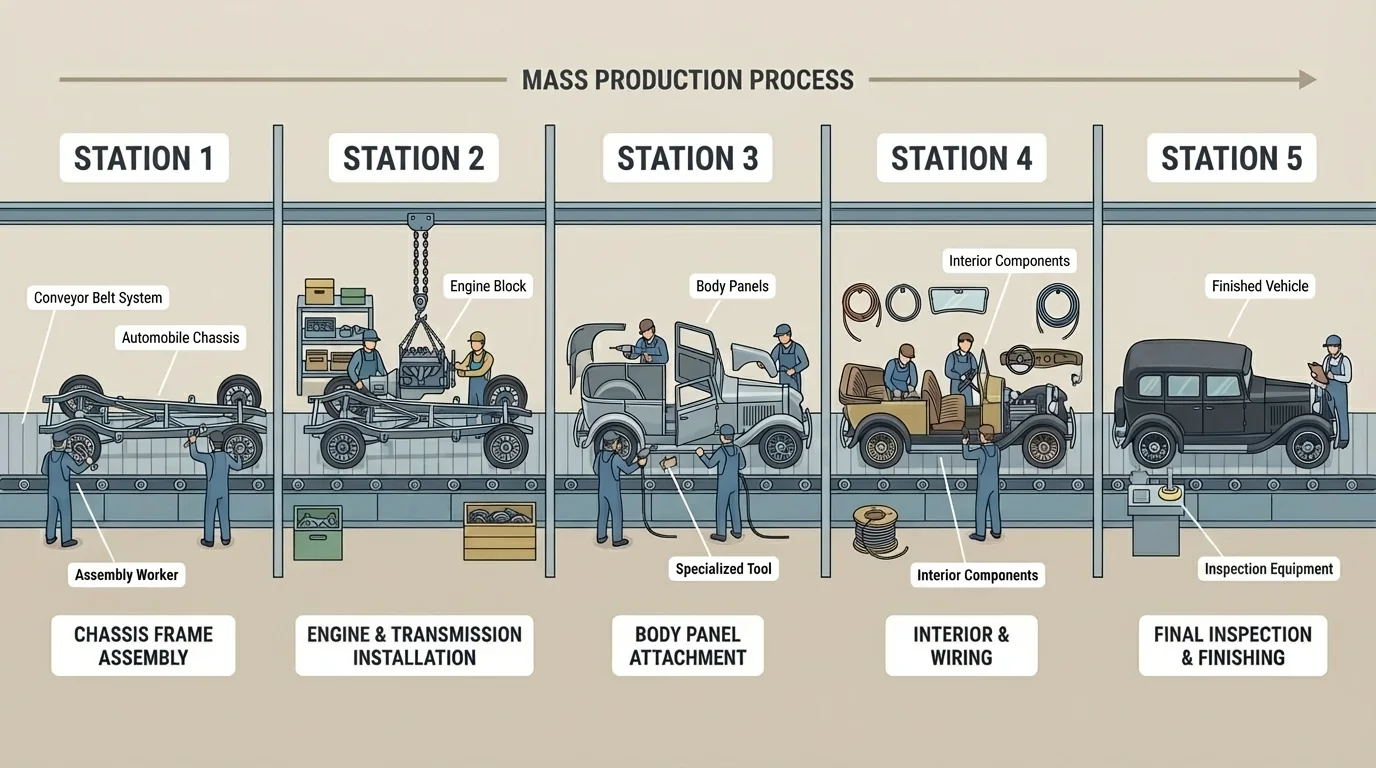
The effects of mass production went far beyond cars. Appliances, clothing, packaged foods, and household goods became increasingly standardized. Advertising encouraged people to see buying as part of modern life. This strengthened a national consumer culture. Yet it also raised questions that still matter today: When production becomes faster and cheaper, who benefits most? Consumers, business owners, and workers may all gain something, but not equally.
Why the assembly line mattered
The assembly line was more than a factory technique. It reorganized time, labor, and consumption. Workers followed the pace of the machine, businesses planned for large markets, and consumers came to expect affordable mass-produced goods. This is a strong example of how one technological change can reshape social habits and economic structures at the same time.
Later debates about automation, robotics, and artificial intelligence echo these earlier industrial changes. As with the system in [Figure 1], the central issue is not only what machines can do, but how their use changes workers' lives and the distribution of wealth and opportunity.
Scientific and technological progress has never been the work of one group alone. It came from individuals with different backgrounds, talents, and opportunities, though not all received equal recognition. patent systems, universities, corporations, and government agencies all shaped who could develop and profit from innovation.
Lewis Latimer, an African American inventor and draftsman, improved the production of electric lighting by helping develop better carbon filaments for bulbs. Granville Woods, also African American, created inventions related to railway communication and safety. George Washington Carver advanced agricultural science through research on soil improvement and crop rotation, helping farmers in the South restore worn-out land. Madam C. J. Walker built a business empire around hair-care products and manufacturing, showing that innovation also includes entrepreneurship and systems of distribution.
Women made major contributions as well, even when institutions limited their access. Marie Curie's work on radioactivity transformed modern science and medicine. During World War II and after, women mathematicians, engineers, and programmers played important roles in calculation, codebreaking, and early computing. In the space program, Katherine Johnson, Dorothy Vaughan, and Mary Jackson helped make complex aerospace achievements possible.
This diversity matters historically because it challenges the false idea that innovation comes only from a few famous names. It also reveals continuity in inequality. Many inventors from marginalized groups faced discrimination in education, hiring, funding, and public recognition. Studying their work helps historians understand both national unity and persistent barriers within that unity.
Case study: George Washington Carver and agricultural science
Carver is often remembered for peanuts, but his deeper contribution was scientific problem-solving in response to soil depletion.
Step 1: Identify the problem
Repeated cotton planting had drained nutrients from Southern soil.
Step 2: Apply scientific knowledge
Carver promoted crop rotation and alternative crops such as peanuts and sweet potatoes to restore soil health.
Step 3: Observe the broader impact
His work helped farmers diversify production, improve long-term yields, and reduce dependence on a single crop economy.
This example shows how innovation can be practical, local, and deeply connected to economic and social change.
Primary sources such as patent records, business advertisements, research notes, speeches, and photographs help historians study these innovators. Secondary sources, including biographies and historical analyses, help place their work in wider context.
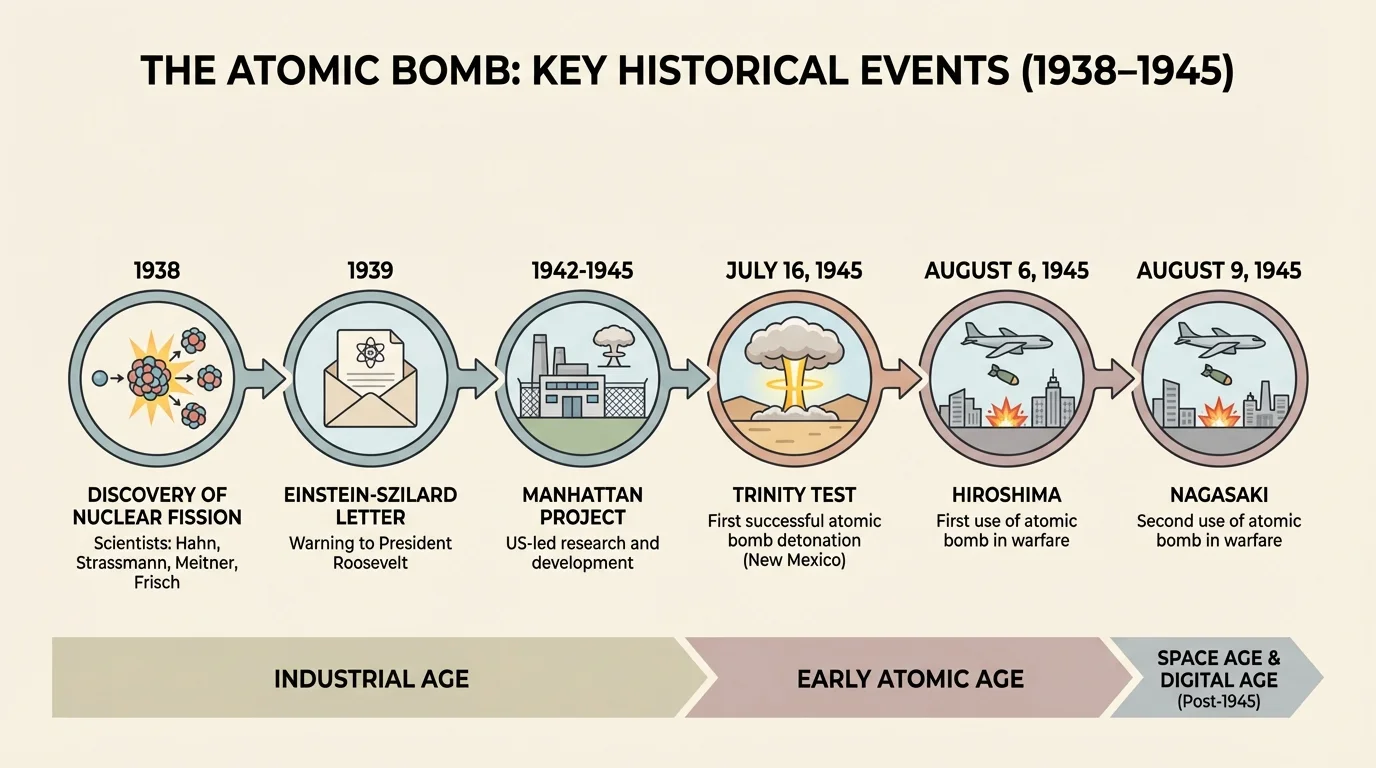
The 20th century revealed a darker side of scientific progress. Rapid advances in physics led to the discovery of nuclear fission, the process in which the nucleus of an atom splits and releases enormous energy. The path from scientific discovery to military use moved with extraordinary speed during World War II. Fears that Nazi Germany might build such a weapon first helped drive the United States into the Manhattan Project, a secret research and development program.
The Manhattan Project brought together scientists, engineers, military leaders, and industrial workers at sites including Los Alamos, Oak Ridge, and Hanford. It represented a new level of cooperation between government, universities, and industry. This was a turning point in modern history: science had become tightly linked to national security and state power.
On July 16, 1945, the first successful atomic test, called Trinity, took place in New Mexico. Weeks later, the United States dropped atomic bombs on Hiroshima and Nagasaki in Japan. The bombings contributed to Japan's surrender and the end of World War II, but they also killed vast numbers of civilians and introduced the world to the possibility of nuclear annihilation.
The creation of the atomic bomb raises major ethical and historical questions. Was it necessary to end the war quickly? Could another path have avoided such destruction? Historians continue to debate these questions using primary sources such as military documents, presidential statements, scientists' petitions, eyewitness accounts, and photographs.
The long-term effects were enormous. Nuclear weapons shaped the Cold War through deterrence, arms races, and public fear of global destruction. At the same time, nuclear science also led to peaceful uses, including nuclear power and medical treatments. This is a powerful example of complexity: the same scientific knowledge can produce both destructive and beneficial outcomes.
"Now I am become Death, the destroyer of worlds."
— J. Robert Oppenheimer, recalling a line from the Bhagavad Gita after the Trinity test
The sequence shown in [Figure 2] also demonstrates cause and effect in wartime decision-making. Scientific breakthroughs did not remain abstract. They moved into laboratories, factories, military plans, and finally global politics.
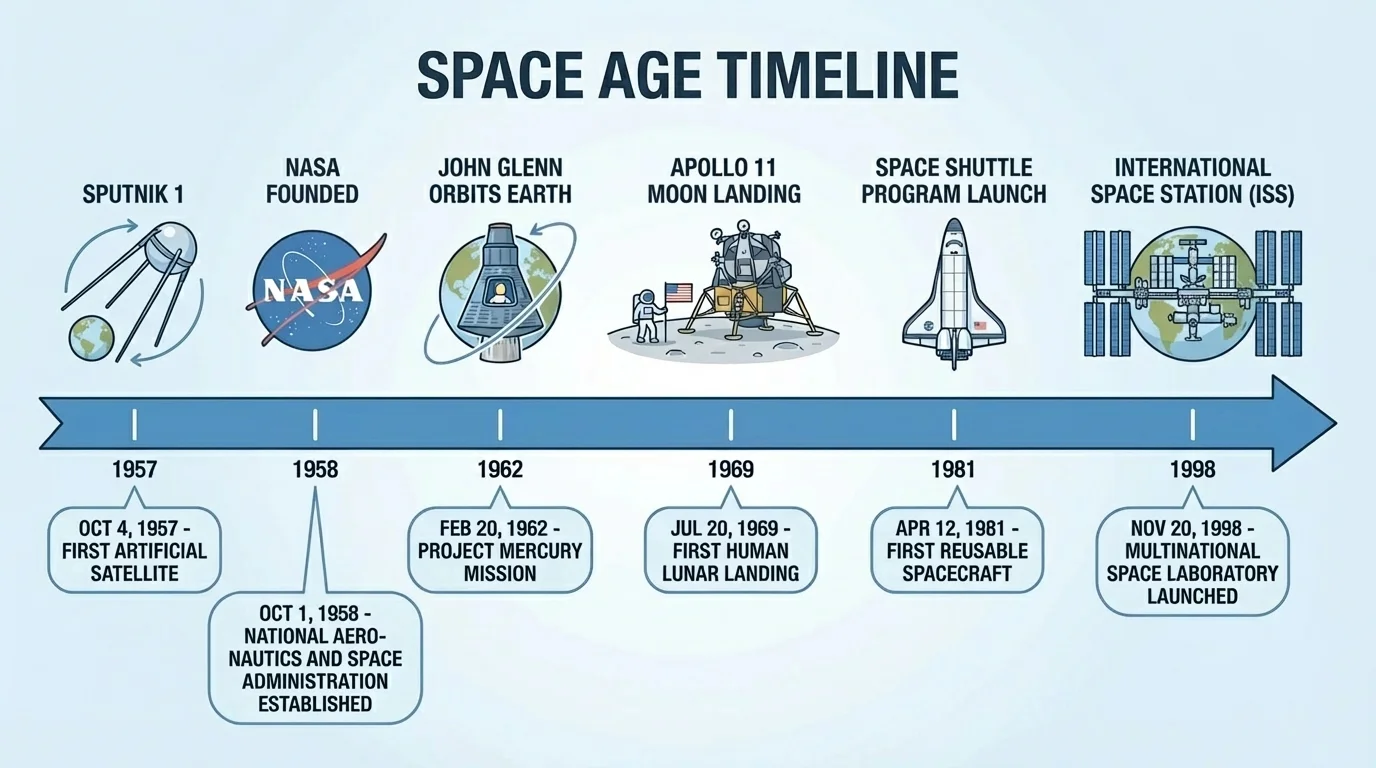
The Cold War competition between the United States and the Soviet Union pushed science and technology into a new arena: outer space. The Space Age developed through a rapid chain of milestone events beginning with the Soviet launch of Sputnik in 1957. This first artificial satellite shocked many Americans, who feared the United States was falling behind in science, education, and missile technology.
In response, the United States increased investment in research and science education and created NASA, the National Aeronautics and Space Administration, in 1958. Early missions in Project Mercury and Project Gemini tested whether humans could survive and work in space. In 1961, President John F. Kennedy challenged the nation to land a man on the moon before the decade ended.
That goal was achieved in 1969 when Apollo 11 astronauts Neil Armstrong and Buzz Aldrin walked on the moon while Michael Collins orbited above. The moon landing became one of the most famous moments in modern history. It demonstrated engineering skill, national determination, and the role of government-funded science in achieving ambitious goals.
NASA's influence extended far beyond astronaut missions. Space research helped improve satellite communication, weather forecasting, navigation systems, materials science, and Earth observation. Today, services people use regularly, including GPS and satellite-based forecasting, depend on space-age technologies. The space program also inspired careers in engineering, mathematics, and science.
Still, the Space Age involved political competition as much as exploration. Space achievements served as propaganda in the Cold War. They signaled technological power, military potential, and ideological prestige. This reveals another historical pattern: scientific achievements often carry symbolic meaning as well as practical value.
Objects first developed or refined for space missions helped improve products on Earth, including insulation materials, water purification systems, and lightweight engineering designs.
The milestones in [Figure 3] also show continuity and change. The basic human drive to explore remained constant, but the tools, institutions, and geopolitical stakes changed dramatically in the mid-20th century.
While rockets reached space, communication technology was changing life on Earth. Radio became a major force in the early 20th century, allowing political leaders, advertisers, musicians, and news organizations to reach millions of people at once. During the Great Depression, President Franklin D. Roosevelt used radio fireside chats to speak directly to the public. This helped reshape the relationship between citizens and government.
Film and later television expanded the reach of mass media. By the mid-20th century, television brought politics, sports, war coverage, and entertainment into homes across the country. Images from the civil rights movement, the Vietnam War, and the moon landing affected public opinion powerfully. People no longer depended only on newspapers or local conversations to understand national events.
Mass media created unity by giving millions of Americans shared experiences, but it also highlighted diversity and conflict. Different groups fought over representation, stereotypes, and access to public voices. Media could inform, persuade, entertain, and manipulate. Advertising shaped consumer desire; political messaging shaped public debate. The rise of mass media therefore changed not just what people knew, but how they formed opinions and identities.
| Medium | Period of major growth | Main impact |
|---|---|---|
| Radio | 1920s-1940s | Instant national broadcasting of news, music, and political speeches |
| Film | 1910s-1950s | Mass entertainment and cultural influence |
| Television | 1950s-1990s | Visual news, advertising, and shared national events |
| Internet | 1990s-present | Interactive, global, rapid communication and information exchange |
Table 1. Major forms of mass communication and their historical impact.
Primary sources for this topic include radio transcripts, TV broadcasts, advertisements, campaign commercials, and newspaper archives. These sources help historians trace how media shaped public thought and national culture.
The late 20th century and early 21st century brought another transformation just as profound as industrialization. Early computers had existed for decades, but the invention of the microchip and later improvements in computing power made digital devices smaller, faster, and cheaper. Businesses, schools, governments, and households increasingly relied on computers for storing and processing information.
The Internet is a network of networks that allows digital information to move between devices and servers across the world. Its roots reach back to ARPANET, a U.S. government-funded research network developed during the Cold War. Over time, networking technologies expanded, and by the 1990s the World Wide Web made online information easier for the public to access.
Personal computers, email, search engines, smartphones, and social media platforms changed communication habits dramatically. Information that once took days or weeks to spread can now move globally in seconds. Students can access libraries, videos, primary sources, and expert commentary from nearly anywhere. Businesses can sell products instantly across long distances. Families can stay connected across continents.
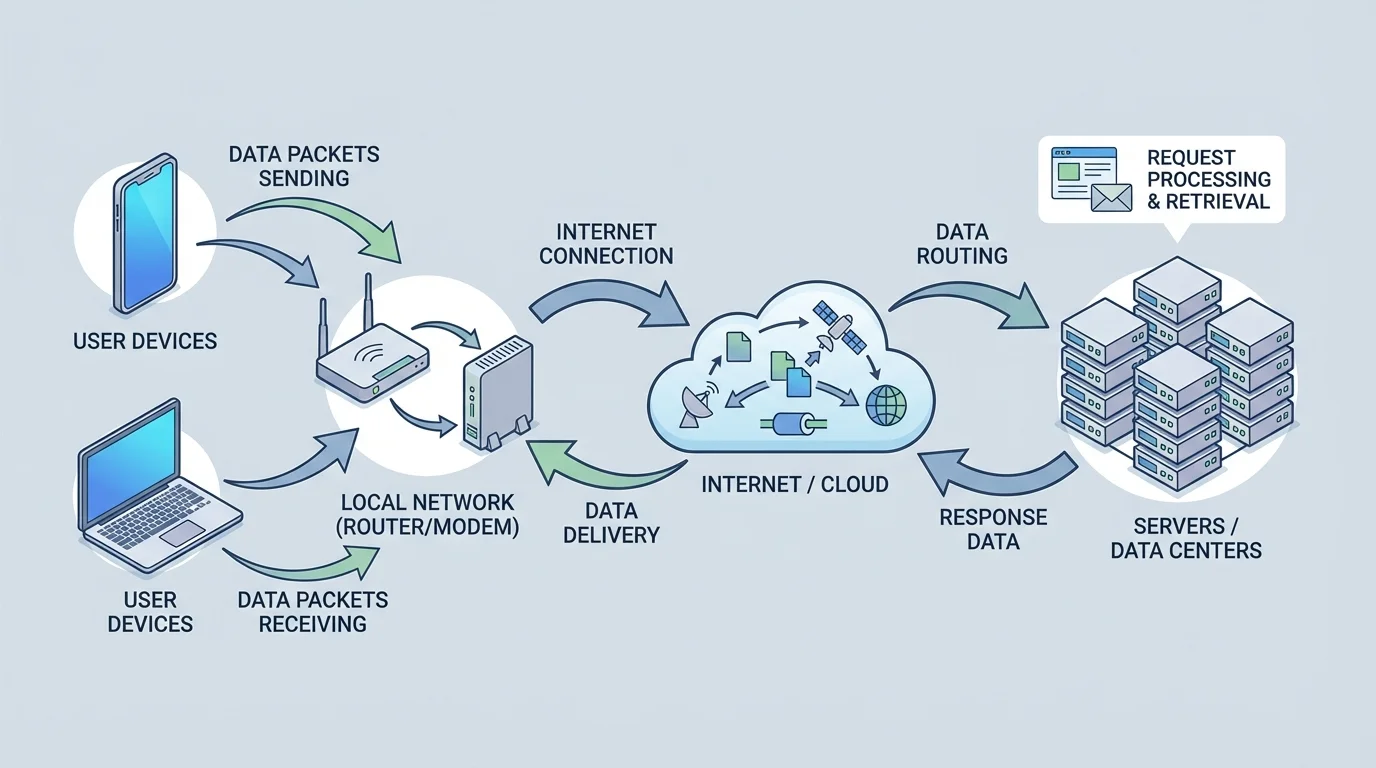
But the Digital Age also brought serious problems. Privacy concerns grew as companies and governments collected data. Cybercrime emerged as a major threat. Social media could build communities, but it could also intensify bullying, polarization, and the spread of false information. Jobs changed as automation replaced some tasks and created new ones. Once again, innovation produced both opportunity and disruption.
The basic process in [Figure 4] helps explain why digital systems are so powerful: information can be copied, stored, searched, and transmitted at high speed and low cost. That technical ability has transformed journalism, finance, medicine, education, entertainment, and politics.
Case study: How the Internet changed news
The movement from print and broadcast news to digital platforms changed both access and reliability.
Step 1: Faster distribution
Online news can be published and updated immediately instead of waiting for a print cycle or scheduled broadcast.
Step 2: Broader participation
People can respond, share, and even create content themselves through blogs, video platforms, and social media.
Step 3: New challenges
Because publication is easier, false claims and manipulated content can spread rapidly alongside accurate reporting.
This example shows that greater access to information does not automatically guarantee better understanding.
The Digital Age also deepened existing inequalities. Not everyone has equal access to high-speed Internet, updated devices, or advanced digital skills. This digital divide affects education, employment, healthcare access, and civic participation. In this way, the newest technologies still reflect older social divisions.
Across the Industrial Age, Space Age, and Digital Age, some themes stayed consistent. New technologies repeatedly increased productivity, expanded communication, and strengthened the connection between science and national power. At the same time, every major innovation created debates about fairness, ethics, and control. Who gets access? Who profits? Who takes the risks? Those questions have remained constant even as the technologies themselves changed.
There is also continuity in the role of institutions. Private companies, government agencies, universities, the military, and the media all shaped which innovations developed and how they were used. Yet there was also major change in scale and speed. Industrial machinery changed life over decades; digital networks can alter public behavior almost overnight.
The history of innovation in the United States is therefore not just a story of inventions. It is a story of people, power, labor, culture, war, and ideas. Scientific and technological advances helped build modern American life, but they also forced Americans to confront difficult choices about democracy, justice, and human responsibility.
When historians study innovation, they do more than list inventions. They ask how a development began, who influenced it, who benefited, who was harmed, and how it changed society over time.
That approach helps explain why a factory machine, a nuclear weapon, a television broadcast, and a smartphone all belong in the same historical conversation. Each one changed what people could do. Just as importantly, each one changed what people expected from work, government, science, and one another.
